
Xeriscape Contractor close to West Jordan UT

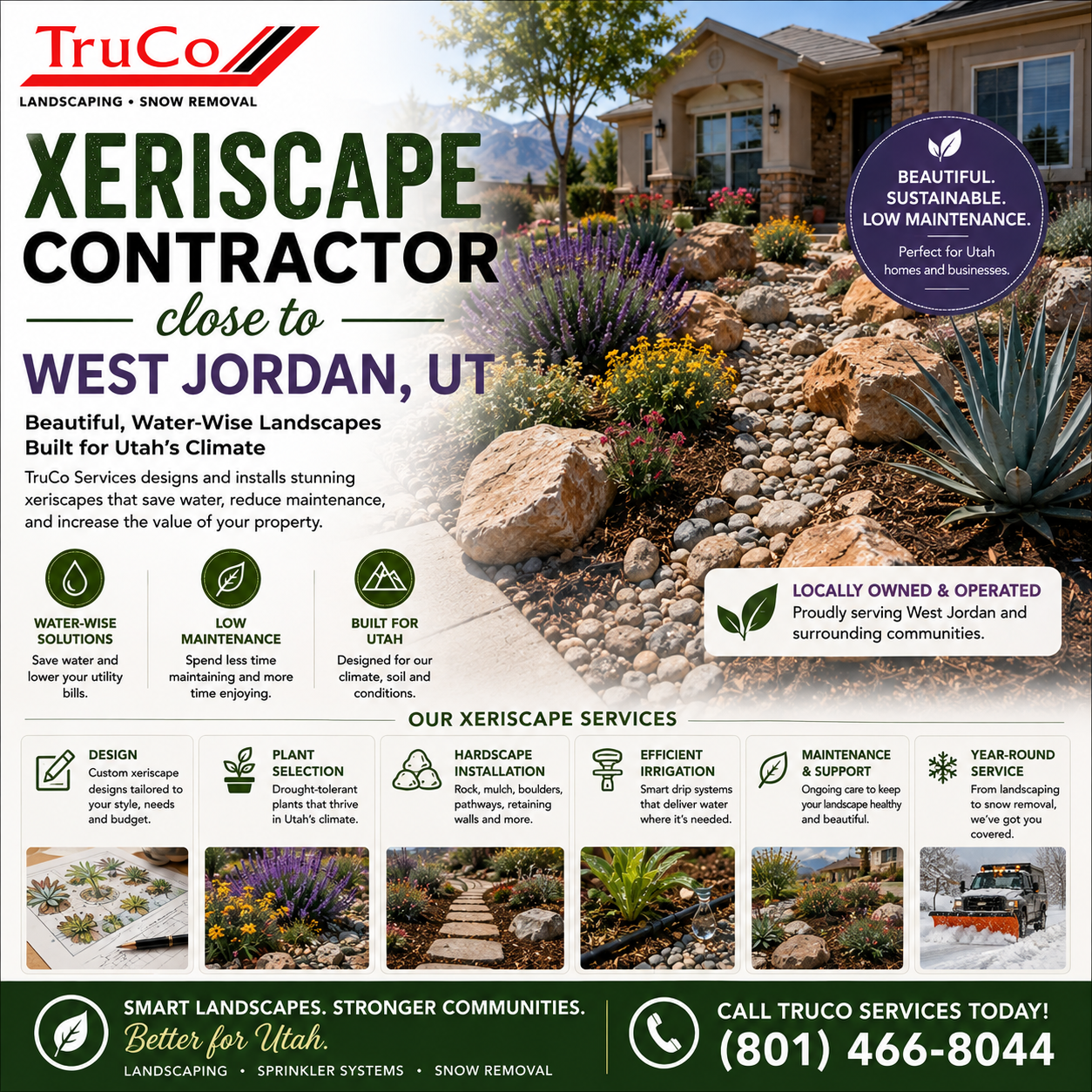
A xeriscape contractor close to West Jordan, UT helps property owners create attractive landscapes that need less irrigation, reduce unnecessary lawn maintenance, and better fit Utah’s high-desert conditions. A true xeriscape is not a rock-covered yard. It is a practical landscape system built around site planning, drought-tolerant and adapted plants, healthy soil, appropriate mulch, functional turf, drainage management, and efficient irrigation.
The most important takeaway is simple: do not remove grass until you have a plan for what replaces it. A successful West Jordan xeriscape accounts for sunlight, slope, soil, drainage, existing trees, utility lines, how people use the yard, irrigation zones, and potential incentive requirements. This guide explains the core principles of water-wise landscaping, the choices that determine whether a project succeeds, costs of common mistakes, available design strategies, and the questions to ask before hiring help. Expert guidance helps homeowners, commercial property managers, and HOAs avoid plant failures, expensive rework, irrigation waste, drainage problems, and missed rebate opportunities.
What Is a Xeriscape Contractor Close to West Jordan UT and How Does It Work?
A xeriscape contractor near West Jordan designs and installs landscaping intended to reduce unnecessary outdoor water use while maintaining a functional, visually appealing property. Xeriscaping does not mean “no plants” or “no water.” New plants require regular establishment watering, and even mature low-water landscapes need occasional irrigation in hot or extended dry periods.
The approach is based on water-wise landscaping principles: planning and design, soil preparation, selecting adapted plants, limiting turf to practical areas, using mulch, installing efficient irrigation, and maintaining the property correctly. Utah State University recommends grouping plants with similar water needs, separating turf from other landscape plants on irrigation zones, and using hardscape appropriately to reduce land requiring irrigation.
Who Is Involved?
A project may involve the property owner, landscape contractor, irrigation specialist, designer, HOA, municipality, nursery, water provider, and—in some cases—an incentive administrator. Commercial landscaping projects may also include a facilities manager, property manager, maintenance vendor, tenants, or ownership group.
Typical Project Steps
1. Initial site visit and goals discussion
2. Measurements, site analysis, and concept planning
3. Review of irrigation, drainage, utilities, access, and property restrictions
4. Written scope, material selections, and estimate
5. Incentive or HOA review, if applicable
6. Turf removal, grading, and irrigation conversion
7. Hardscape, plant, edging, and mulch installation
8. System testing, cleanup, and maintenance handoff
A proposal should state what is included and excluded. For example, basic xeriscaping may not include retaining walls, major drainage engineering, electrical work, tree removal, permits, utility relocation, HOA approvals, or ongoing maintenance unless specifically listed.
Eight Decisions That Determine Xeriscape Success
1. Begin With a Site Plan, Not a Lawn-Removal Crew
Many homeowners begin by removing grass because it seems like the fastest route to a low-water landscape. This can be a costly mistake. Once grass is gone, the property can become muddy, dusty, weedy, difficult to use, and vulnerable to rushed material choices.
A site plan identifies what the yard must do before determining what it should look like. Consider play space, pet traffic, entertaining, walkways, snow storage, curb appeal, shade, privacy, equipment access, garbage-bin routes, and maintenance needs. A landscape that looks good in a photo but does not serve the household or property will eventually be altered at additional expense.
West Jordan properties can contain several microclimates: hot reflective areas next to driveways, shaded north-facing walls, windy corners, compacted builder-grade soil, and low areas where water gathers. Each area should be assessed individually. USU recommends creating a plot plan showing buildings, utilities, property lines, existing vegetation, driveways, contours, and other site limitations before designing the landscape.
Before demolition, document irrigation heads, valve boxes, drainage paths, trees, and plantings. Mark underground utilities through the appropriate utility-locate process. If an incentive is being considered, verify the application and pre-inspection sequence before removing any living turf.
2. Select Plants for the Specific Site, Not the Label
A drought-tolerant label does not guarantee that a plant will thrive in every West Jordan yard. Plants still need a match between their needs and the site’s soil, sunlight, drainage, winter exposure, wind, reflected heat, and available root space.
For example, a plant suited to dry, sunny conditions may fail if it is placed in a low spot with wet soil. A shade-tolerant shrub may scorch next to a south-facing masonry wall. A plant that grows well in a protected garden may struggle in an exposed park strip with heat and road salt.
The solution is plant grouping, also known as hydrozoning. Plants with similar water requirements should share the same section of the yard and irrigation zone. This helps avoid the common scenario where drought-tolerant plants are overwatered because they share a valve with new shrubs or a flower bed.
USU advises property owners to choose plants adapted to the site’s soil, water, temperature, light, and pest conditions. A well-designed landscape uses a layered approach: trees for shade and structure where appropriate, shrubs for screening, perennials and ornamental grasses for texture and seasonal color, and groundcovers or mulch to protect open soil.
Spacing is equally important. Young plants may look sparse initially, but crowding plants to create instant fullness usually creates future pruning, disease, competition, and replacement problems.
3. Address Soil, Slopes, and Drainage Before Planting
Soil conditions often determine whether plants establish successfully. Compacted soil restricts root growth and causes water to run off. Dense clay may remain wet for too long, while rocky or shallow soil can dry quickly. Neither issue is resolved by adding more irrigation.
Drainage must be assessed before plants and decorative materials are installed. Review downspouts, hardscape grades, slopes, irrigation runoff, low points, and where snowmelt moves. Water should be directed away from building foundations without creating erosion, ice hazards, muddy areas, or runoff toward adjacent properties.
Soil preparation can involve loosening compacted planting zones, targeted organic matter, drainage corrections, proper grading, or using plants suited to existing conditions. It should be tailored to the site rather than applied as a generic formula. Over-amending small planting holes can create a “bathtub” effect where roots remain in a pocket of improved soil rather than spreading outward.
Mulch plays a major role in moisture retention, weed suppression, and soil-temperature control. USU advises using 3 to 4 inches of organic mulch or 2 to 3 inches of inorganic mulch, depending on material and use. It also recommends keeping a mulch-free space around woody plant bases to reduce root-collar disease and rodent damage.
4. Convert Irrigation Instead of Simply Turning It Off
A successful xeriscape does not abandon irrigation; it uses water more accurately. New trees, shrubs, and perennials need establishment water. Mature water-wise plants may require irrigation during high heat, drought, or unusually dry seasons. The goal is to avoid waste, not to ignore plant needs.
Turf areas are usually watered differently from planting beds. Retained lawn may use spray irrigation, while trees, shrubs, and perennial beds commonly benefit from low-volume drip irrigation. Drip systems can apply water nearer to roots and help reduce overspray, wind loss, and pavement watering.
The most common irrigation failure is running incompatible plants on one zone. A newly planted tree, low-water perennial bed, and high-water annual display should not receive identical watering. That forces the owner to overwater some plants or underwater others.
USU recommends designing irrigation zones around groups with similar water needs, inspecting valves, heads, and emitters, flushing irrigation lines, and programming systems to fit seasonal conditions. Controllers can help, but no controller can fix a leak, clogged emitter, bad slope, or poor zone design.
A practical inspection routine includes checking irrigation monthly during the growing season, watching for runoff, and adjusting schedules after major weather changes. Trees and shrubs often require deeper, less frequent watering than shallow-rooted turf.
5. Avoid Treating Decorative Rock as a Complete Landscape
Gravel, decorative stone, and boulders can all have a place in a West Jordan xeriscape. They can define paths, create visual contrast, stabilize certain areas, or serve as inorganic mulch. But a rock-only yard is not automatically a water-wise landscape.
Too much stone can make a site hotter, create glare, collect windblown debris, and make future planting difficult. Weeds can still grow in dust and organic material that accumulate on top of gravel. Landscape fabric is also not a permanent weed solution; it can complicate repairs, planting, and eventual renovation.
Use stone as one component of the design rather than the entire design. Include enough plant material to soften hard surfaces, provide shade, create seasonal interest, and make the space feel intentional. Select material sizes that fit their purpose: stable surfaces for pathways, appropriate mulch for beds, and drainage-friendly materials where needed.
For properties pursuing a rebate, confirm current material and plant-coverage rules first. Utah Water Savers says residents and commercial property owners may qualify for up to $3 per square foot for replacing grass with water-wise landscaping, subject to current program eligibility and requirements. Program details should be confirmed before purchasing gravel, installing artificial turf, or starting lawn removal.
6. Keep Turf Where It Is Useful
Removing every lawn area is not always the best water-wise landscaping decision. Turf remains useful for play areas, pet space, outdoor gathering zones, noise reduction, dust control, and visual cooling. The key is to keep grass where it serves a clear function and can be watered efficiently.
Narrow park strips, tiny isolated patches, steep slopes, and awkward corners often consume water and mowing time without providing a meaningful benefit. These are usually strong candidates for conversion to water-wise beds, shrubs, grasses, mulch, or permeable hardscape.
Consolidate usable turf into an easy-to-mow shape and put it on a separate irrigation zone. USU specifically recommends using turfgrass only in functional areas and avoiding narrow, small, or irregular lawn sections that are difficult to water efficiently.
Some property owners may prefer a partial conversion that retains a backyard lawn while transforming a front yard or park strip. This can improve water efficiency without losing a space that the household genuinely uses. A xeriscape company in West Jordan should discuss how the property functions before recommending total lawn removal.
7. Plan for Establishment Care and Ongoing Maintenance
Low water does not mean no maintenance. All landscapes need periodic weeding, irrigation inspection, pruning, mulch renewal, and monitoring for plant stress or pests. The first one to three growing seasons are especially important because plants are establishing roots and adapting to the site.
A contractor should provide a practical maintenance handoff: irrigation schedules by season, plant-care expectations, emitter locations, pruning guidance, mulch depth, and contact information for follow-up questions. For commercial sites, identify who has responsibility for controller adjustments, irrigation repairs, and plant care after installation.
Common problems after installation include watering too frequently, missing a damaged drip line, piling mulch against trunks, failing to remove early weeds, and assuming drought-tolerant plants can survive without establishment care. These are manageable issues when identified early.
Property owners should keep valve boxes visible and accessible, save the plant list, label irrigation zones, and retain photos of the irrigation layout before mulch or stone covers components. This documentation saves time and money when future repairs, additions, or seasonal adjustments are needed.
8. Get the Scope, Cost, and Incentive Requirements in Writing
Xeriscape estimates can look similar but include very different work. One proposal may cover turf removal, hauling, grading, irrigation conversion, plants, edging, mulch, cleanup, and a maintenance visit. Another may only include removal and rock installation. A lower initial price may not be a lower overall project cost.
Request an itemized scope that states plant species, sizes, and quantities; mulch type and depth; irrigation materials; drainage work; hardscape; edging; demolition; disposal; timeline; payment schedule; warranty terms; exclusions; and process for changes caused by hidden conditions.
Incentives can change the economics of a project, but they are not automatic. Utah’s statewide landscape incentive program has been described as offering up to $3 per square foot for replacing grass with water-efficient landscaping. However, local eligibility, project size, application timing, inspections, documentation, irrigation requirements, and landscaping standards can differ.
Treat a rebate as a possibility to verify—not money already earned. Confirm current rules directly with the program administrator before any work begins.
The Real Cost of Getting Xeriscaping Wrong
Poor planning can lead to direct financial losses: dead plants, irrigation repairs, drainage corrections, excess rock removal, weed control, regrading, hardscape replacement, and a second installation. The cheapest estimate can become the most expensive project when it leaves out necessary design, soil, irrigation, or drainage work.
The time cost is also substantial. A poorly planned landscape can require years of extra hand-watering, repeated replacements, frequent weeding, and ongoing adjustments. A homeowner may also lose access to an incentive by beginning work before completing the program’s required steps.
There can be emotional and relationship costs. A yard that looks unfinished, barren, overheated, or difficult to maintain creates frustration. Commercial property managers may face tenant complaints, appearance concerns, budget disputes, and unclear responsibility between installation and maintenance teams.
Most of these costs are preventable. A well-documented plan, appropriate plant and irrigation choices, realistic maintenance expectations, and a clear contract reduce uncertainty before construction begins.
How an Experienced Xeriscape Professional Helps
An experienced water-wise landscaping professional evaluates the property’s actual conditions before recommending plants or materials. They help translate broad goals—lower water use, less mowing, better curb appeal, or easier maintenance—into a coordinated plan for irrigation, drainage, plant placement, turf reduction, and construction sequence.
Professional guidance is especially valuable for properties with slopes, retaining walls, mature trees, runoff issues, shared irrigation, commercial use, HOA rules, or potential incentive participation. A strong process identifies problems early, documents scope clearly, and provides a plan for handling unexpected site conditions.
For guidance regarding a xeriscape project close to West Jordan, UT, consult [Provider Name]. An experienced professional can help assess immediate concerns, such as inefficient irrigation or failing turf, while supporting a long-term landscape strategy that remains practical and manageable.
Xeriscape Options and Strategies
Full Lawn Conversion
A full conversion removes most existing turf and installs water-wise plantings, mulch, drip irrigation, and selected hardscape. It is appropriate for underused lawns and properties seeking major water reduction. Its drawbacks include greater upfront cost and the need for strong establishment care.
Partial Lawn Replacement
This strategy keeps useful lawn while converting high-maintenance areas such as park strips, side yards, slopes, and awkward corners. It works well for families and phased budgets. Retained lawn still needs mowing and separate irrigation.
Native and Adapted Planting Design
Native and adapted plants can create resilient, visually varied gardens with lower water needs. This approach is best when plants are selected for the exact site. Its limitation is that “native” does not automatically mean suitable for every soil, exposure, or drainage condition.
Hardscape-Led Water-Wise Design
Patios, paths, permeable pavers, seating areas, boulders, and decorative stone can reduce irrigated area and improve usability. This is useful for access and entertaining. Too much hardscape can increase heat and runoff.
Phased Xeriscaping
A phased conversion begins with the least functional turf or highest-water-use areas and continues over time. It spreads costs and reduces disruption. The drawback is a temporary mix of old and new landscaping, which is easier to manage when guided by an overall master plan.
What to Do If You Are Currently Dealing With a Xeriscape Project
1. Pause demolition if you have not confirmed the design, utilities, irrigation plan, drainage needs, and incentive rules.
2. Photograph lawns, sprinkler heads, valve boxes, drainage routes, plants, and all problem areas.
3. List the property’s functional needs: play, pets, access, parking, entertaining, shade, privacy, and storage.
4. Request a site-specific design and itemized written scope before approving installation.
5. Confirm separate irrigation zones for lawn, trees, shrubs, and low-water planting beds.
6. Verify HOA, city, utility, water-provider, and incentive-program requirements.
7. Obtain plant lists, irrigation specifications, material details, schedule, maintenance instructions, and warranty terms.
8. Save all estimates, applications, approvals, contracts, change orders, photographs, and receipts.
How to Choose the Right Xeriscape Contractor
Use this checklist when evaluating a drought-tolerant landscaping contractor near West Jordan:
- Demonstrates water-wise landscaping, irrigation, drainage, soil, and plant-establishment experience.
- Performs a site evaluation instead of proposing the same design for every property.
- Provides a plain-English written scope with materials, quantities, exclusions, costs, and payment terms.
- Explains the difference between real xeriscaping and a rock-only yard.
- Identifies both immediate water-use problems and long-term maintenance needs.
- Is responsive about timelines, changes, follow-up questions, and unexpected site conditions.
- Willing to discuss current incentive requirements without promising a rebate that has not been approved.
- Provides clear maintenance and irrigation guidance after installation.
For provider guidance, consult with Truco Services.
Common Xeriscaping Mistakes
- Removing turf before planning: This can create bare soil, weeds, mud, and possible incentive problems.
- Buying plants based only on appearance: Plants must match soil, exposure, drainage, and irrigation needs.
- Putting all plants on one irrigation zone: Different water needs require separate hydrozones.
- Using too much gravel: Stone can be useful but can increase heat and maintenance if overused.
- Ignoring drainage: Water pooling and runoff can damage plants, hardscape, and structures.
- Planting too densely: Crowded plants require excessive pruning and may decline as they mature.
- Assuming low-maintenance means no-maintenance: All landscapes need irrigation checks, weed management, mulch, and pruning.
- Choosing a contractor based only on price: A low bid may exclude the work required for a lasting result.
Conclusion
A well-designed xeriscape contractor project near West Jordan, UT should create more than a low-water yard. It should create a durable, attractive, usable landscape designed around how the property functions. Planning first, selecting plants for real site conditions, managing drainage, separating irrigation zones, and understanding ongoing care are the foundations of long-term success.
Most xeriscaping problems are avoidable when the scope is clear and the work is planned correctly from the beginning. For support with a West Jordan xeriscape project, consult Truco Services for practical guidance on water-wise landscaping, irrigation considerations, and long-term property needs.