
Winter Tree Watering Guide for Utah's Dry Months

Why Winter Watering Matters for Utah Trees
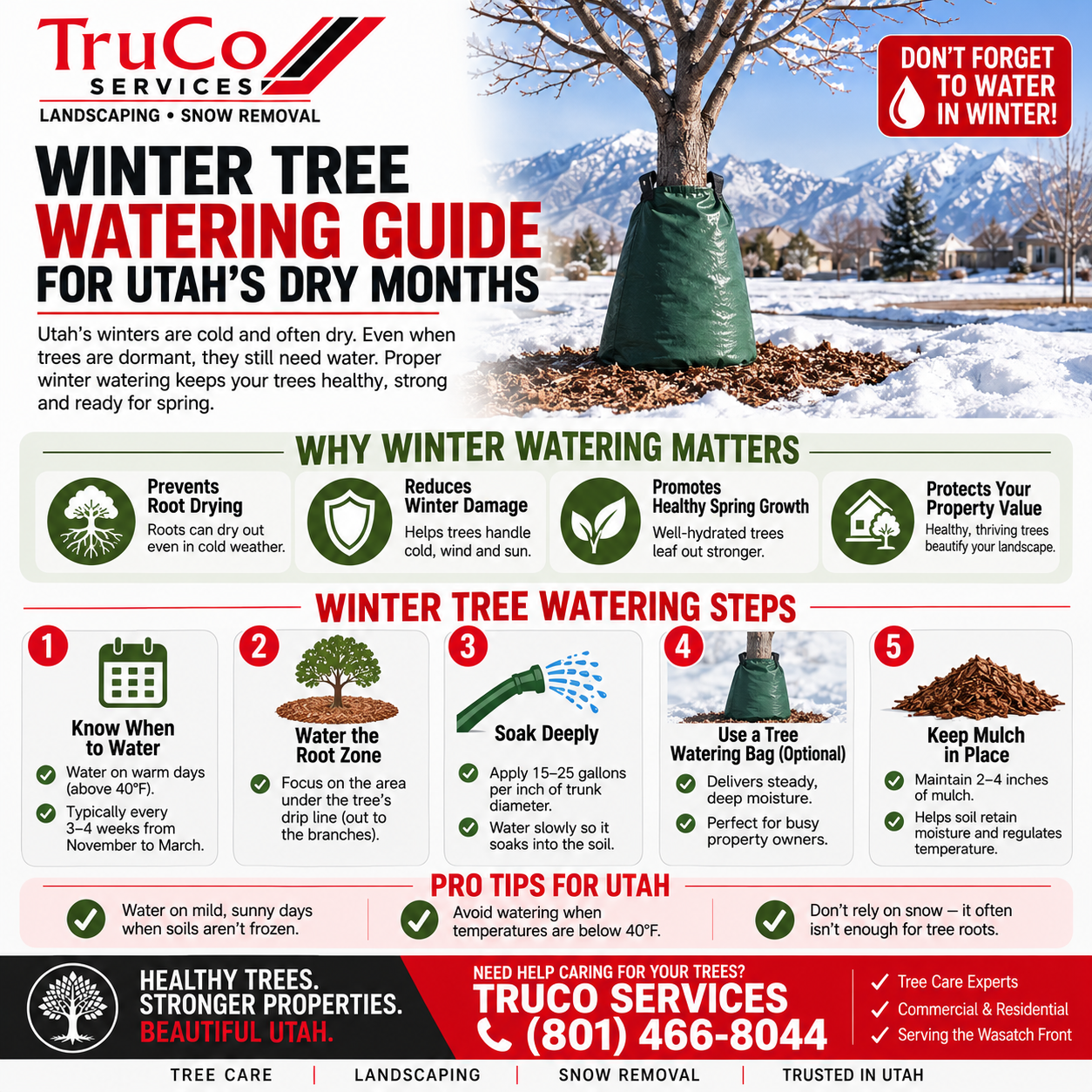
Many Utah homeowners assume that trees need no care during the winter months. After all, deciduous trees have dropped their leaves and appear dormant, and freezing temperatures seem to make watering unnecessary. However, Utah's winter climate presents a hidden danger to trees: prolonged dry periods combined with cold, desiccating winds. Utah receives only about 20% of its annual precipitation as snow in most areas, and winter droughts are common. During extended dry spells — which can last 4-6 weeks or more in Utah's valleys — tree roots continue to lose moisture even while the tree is dormant. Evergreen trees, which retain their needles year-round, continue to lose water through transpiration all winter. Even deciduous trees lose moisture through their branches and buds. When the soil freezes, roots cannot replace this lost moisture, leading to winter desiccation — a condition where trees essentially die of thirst during winter. This is especially damaging to newly planted trees, which have limited root systems and are most vulnerable to winter moisture stress. Winter damage often doesn't become visible until spring, when branches fail to leaf out or entire trees die back. Proper winter watering prevents this damage and ensures your trees emerge healthy in spring. This guide covers when, how, and how much to water your Utah trees during the winter months.
When to Water Trees in Winter in Utah
Timing is critical for winter watering in Utah's climate. Water only when temperatures are above 40°F and the ground is not frozen. In Utah, this typically means watering during mid-day on days when the temperature rises above freezing. The optimal time is between 11 AM and 2 PM on sunny winter days, when the sun has had a chance to warm the soil surface. Water early enough in the day that moisture has time to soak in before temperatures drop at night. Frequency depends on weather conditions. During dry winter periods (no snow or rain for 3-4 weeks), water established trees once every 4-6 weeks. Water newly planted trees (planted within the last 2 years) once every 2-3 weeks during dry winter periods. Water evergreen trees, which lose moisture all winter, once every 3-4 weeks during dry periods. Do not water when the ground is frozen — water will not penetrate and may create ice hazards. In Utah, the ground typically begins freezing in December and may stay frozen through February at higher elevations. Check soil moisture by probing with a screwdriver. If it penetrates easily, the ground is not frozen and watering may be needed. In Utah's valleys (Salt Lake Valley, Utah Valley), winter watering is typically needed from November through March. At higher elevations (Park City, Heber Valley, Mountain areas over 6,000 feet), the window for winter watering is shorter due to more consistent snow cover and colder temperatures.
How to Water Trees in Winter
Winter watering technique differs from summer watering. The goal is to slowly apply water so it has time to soak into the soil before freezing. Use a hose-end sprinkler on a slow trickle, a soaker hose placed around the tree's drip line, or a watering can or bucket for smaller trees. Apply water at the drip line (the outermost edge of the tree's canopy), not at the trunk. Tree roots extend far beyond the canopy, and the most active water-absorbing roots are at the drip line and beyond. For larger trees, move the hose around the drip line every 15-30 minutes to distribute water evenly. Apply 5-10 gallons per inch of trunk diameter for established trees. For example, a 6-inch diameter tree needs 30-60 gallons per watering session. For newly planted trees, apply 5-10 gallons per watering session, adjusted for tree size. Water slowly to allow absorption. In Utah's clay soil, water penetrates slowly, so patience is essential. Apply water over 1-2 hours for thorough penetration. Soaker hoses are ideal for winter watering. They apply water slowly and directly to the soil, minimizing evaporation. Place soaker hoses in a spiral pattern around the tree, starting a few feet from the trunk and extending to the drip line. Remove hoses after watering to prevent damage from freezing and snow plows. Avoid watering tree trunks directly, as wet bark in cold weather can encourage fungal diseases and frost cracking. Focus water on the root zone beneath the canopy.
Special Considerations for Different Tree Types
Different trees have different winter watering needs. Newly planted trees (within 2 years of planting) are the most vulnerable to winter drought. They have limited root systems that cannot access deep soil moisture. Water them every 2-3 weeks during dry winter periods. Evergreen trees (pine, spruce, fir, juniper) lose moisture through their needles all winter. They need more frequent winter watering than deciduous trees, especially in exposed, windy locations. In Utah's mountain areas, evergreen trees at lower elevations or in exposed sites are at highest risk. Deciduous trees need less winter water than evergreens, but still benefit from occasional deep watering during extended dry periods. Young deciduous trees benefit the most. Fruit trees are particularly sensitive to winter drought stress. Proper winter watering helps ensure good fruit production the following season. Water fruit trees every 3-4 weeks during dry winter periods. Trees in exposed, windy locations lose moisture faster and benefit from more frequent winter watering. Trees on south- and west-facing slopes warm up faster and may need watering earlier in the season. Trees growing under eaves or near buildings receive less natural moisture and need supplemental watering. Container-grown trees are at highest risk because their root zones freeze and thaw more rapidly. In Utah, container trees should be moved to a protected location if possible, or watered whenever the soil is not frozen and temperatures are above 40°F.
Signs of Winter Water Stress in Trees
Catching winter water stress early can save a tree. Look for these signs during late winter and early spring. Discolored or brown needles on evergreens — especially on the south and west sides of the tree, which are exposed to sun and wind. Needle browning in late winter is a classic sign of winter desiccation. Wilted or drooping branches on evergreens, even in cold weather. Crackling sound when walking on frozen, dry soil around the tree indicates extreme dryness. Spring leaf-out failure — branches that remain bare while the rest of the tree leafs out normally, or the entire tree fails to leaf out. This is the most common sign of severe winter water stress. Dead buds or shoot tips in spring. Reduced growth — shorter than normal new growth in spring. Leaf scorch on newly emerged leaves in spring. Trees affected by winter water stress are also more vulnerable to pests and diseases the following growing season. If you notice these signs, begin supplemental watering as soon as the ground thaws and temperatures permit. In many cases, trees can recover if winter water stress is caught early. Deep watering in early spring can help revive stressed trees. Prevent winter water stress by following the winter watering schedule outlined above and mulching around trees in fall. A 2-4 inch layer of organic mulch applied after the ground freezes in late fall helps insulate roots and retain soil moisture throughout winter.
Frequently Asked Questions
Is it really necessary to water trees in winter in Utah? Yes, especially during dry winters. Utah's typical winter pattern includes extended dry periods between storms. Trees continue to lose moisture through winter, and without supplemental water, they can suffer desiccation damage that may kill branches or entire trees.
Can I use my sprinkler system for winter watering? No. Sprinkler systems should be winterized and blown out before freezing temperatures arrive (typically by October in Utah). Use a garden hose with a sprinkler or soaker hose for winter watering instead. Disconnect and drain hoses after each use.
What temperature is too cold for winter watering? Do not water when temperatures are below 40°F. Water applied when temperatures are below freezing will freeze on the soil surface and not penetrate to tree roots. It can also create slippery ice hazards on walkways and driveways.
How do I know if my winter watering is enough? Check soil moisture 4-6 inches below the surface after watering. In Utah's clay soil, water should penetrate at least 6-8 inches. Use a soil moisture meter or simply probe with a screwdriver — if it goes in easily, moisture levels are adequate.
Should I water trees when snow is on the ground? No. Snow provides moisture as it melts. However, if snow cover persists for weeks without melting and the weather is dry and windy, you may need to water exposed soil areas around the tree. Focus on the south and west sides where snow melts first.
Do I need to water mature trees in winter? Mature, established trees with extensive root systems can typically survive winter without supplemental water, but they benefit from winter watering during extended dry periods. Young trees (under 5 years) absolutely need winter watering in Utah's dry climate.