
What to Plant Under Trees in Utah: A Guide to Shade-Tolerant Landscaping

The Challenge of Planting Under Trees in Utah
Planting under trees in Utah presents unique challenges. The combination of dense shade, root competition, and Utah's alkaline clay soil creates difficult growing conditions. Tree roots dominate the upper soil layers, absorbing moisture and nutrients before other plants can access them. The canopy blocks sunlight, limiting photosynthesis for plants below. In Utah's dry climate, the competition for water is especially intense under trees. However, a beautiful under-tree garden is possible with the right plant selection and techniques. Many shade-tolerant plants thrive in Utah's conditions — from native woodland species to adapted ornamentals. A well-designed under-tree planting not only looks attractive but also benefits the tree by moderating soil temperature, reducing moisture evaporation, and preventing soil compaction. This guide covers the best plants for growing under Utah trees and how to establish them successfully without harming the tree.
Understanding the Growing Environment Under Trees
Before selecting plants, understand the specific conditions under your trees. Light levels — the amount of sunlight reaching the ground under a tree canopy varies from deep shade (under dense evergreens or maples) to dappled light (under honeylocust or birch). Measure light at noon in summer. Full shade (less than 2 hours of direct sun), part shade (2-4 hours), or dappled light (filtered sun all day). Different plants need different light levels. Root density — tree roots occupy the top 6-18 inches of soil and can extend far beyond the canopy. In Utah's clay soil, roots grow wide and shallow. Digging among tree roots requires care to avoid damaging the tree. Soil conditions — under-tree soil is often dry, compacted, and low in organic matter. Utah's naturally alkaline soil (pH 7.5-8.5) adds an additional challenge. Soil testing is recommended before planting. Moisture competition — tree roots will quickly absorb water applied to the area. Under-tree plantings need more frequent watering than plants in open beds, especially during Utah's dry summer months. Drip irrigation is highly recommended for under-tree plantings. Leaf litter — falling leaves provide natural mulch and organic matter. Work with this cycle rather than against it by choosing plants that emerge through leaf litter and benefit from its nutrients.
Best Shade-Tolerant Groundcovers for Utah
Groundcovers are the most practical choice for large areas under trees. They spread to cover the soil, suppress weeds, and compete effectively with tree roots. Creeping Oregon grape (Mahonia repens) — Utah native evergreen groundcover with holly-like leaves, yellow spring flowers, and blue berries. Tolerates dry shade and alkaline soil. Grows 6-12 inches tall. Excellent for deep shade under pines and oaks. Spreading wild ginger (Asarum caudatum) — native to Utah's mountain areas. Heart-shaped leaves form a dense, low carpet. Tolerates moist shade. Grows 4-8 inches tall. Good for irrigated areas under deciduous trees. Bugleweed (Ajuga reptans) — forms a dense mat of foliage with blue spring flower spikes. Tolerates shade and various soil types. Grows 4-6 inches tall. Can be aggressive, so use in contained areas. Periwinkle (Vinca minor) — evergreen groundcover with glossy leaves and blue spring flowers. Very shade-tolerant and adaptable. Grows 4-6 inches tall. In Utah, it needs regular watering in summer. Sweet woodruff (Galium odoratum) — delicate, whorled leaves with white spring flowers. Forms a soft, spreading carpet. Prefers moist, rich soil. Grows 6-8 inches tall. Good for irrigated shade gardens. Bishop's hat (Epimedium species) — unique foliage with spring flowers in yellow, pink, or white. Tolerates dry shade once established. Grows 8-12 inches tall. Slow to establish but long-lived. Very drought-tolerant for a shade plant. Creeping Jenny (Lysimachia nummularia) — bright green or golden leaves form a trailing carpet. Tolerates moist shade. Grows 2-4 inches tall. Can be invasive, so use with caution. Good for irrigated areas.
Shade-Tolerant Perennials for Under Utah Trees
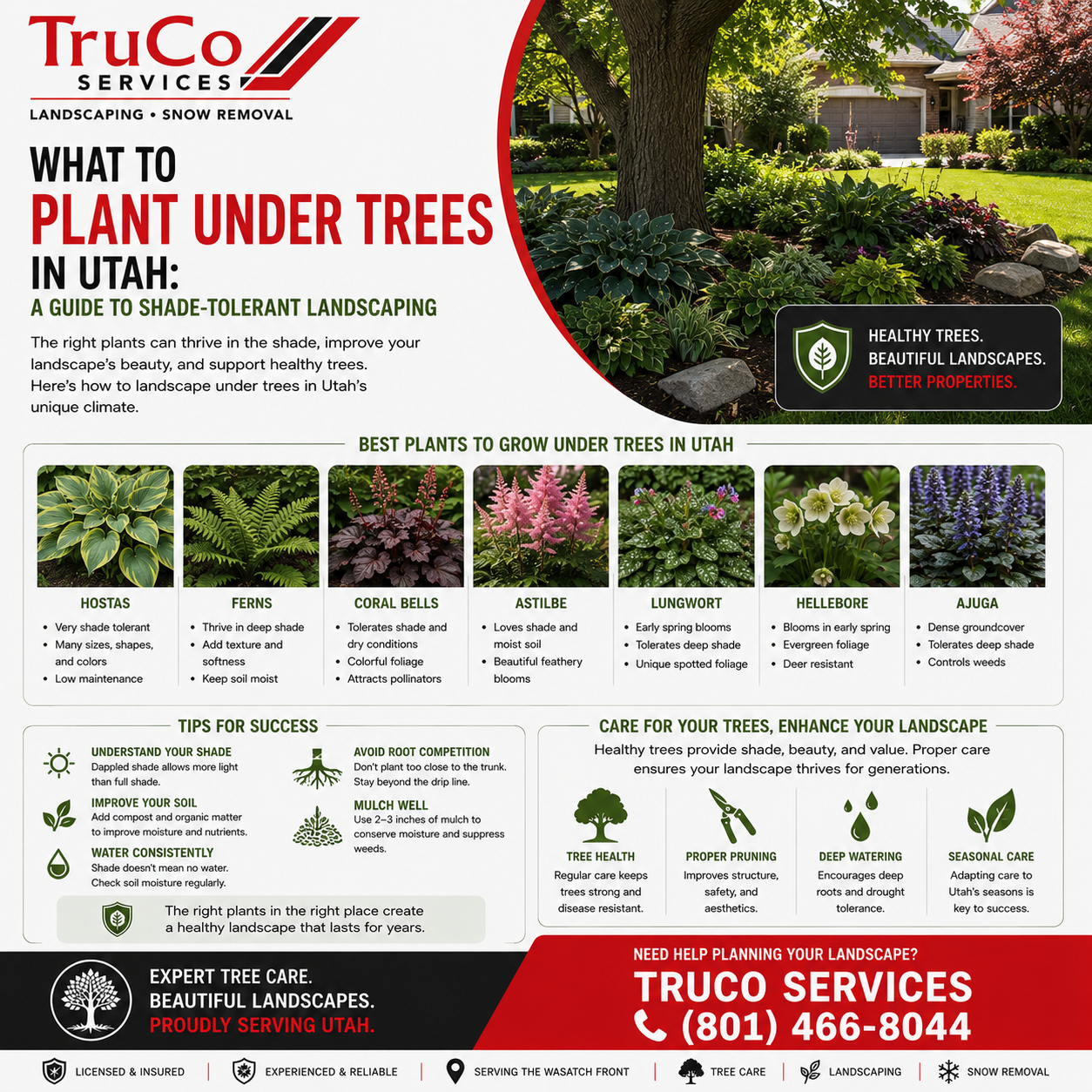
Perennials add color, texture, and seasonal interest to under-tree plantings. Hosta — the classic shade perennial with bold foliage in green, blue, gold, or variegated patterns. Tolerates dry shade once established. Grows 12-36 inches tall depending on variety. In Utah, hostas need supplemental water and protection from afternoon sun. Coral bells (Heuchera) — colorful foliage in purple, bronze, lime, or silver with delicate flower spikes. Tolerates part shade and dry conditions. Grows 8-18 inches tall. Many varieties are Utah-adapted. Columbine (Aquilegia) — Utah native with delicate, spurred flowers in spring. Self-seeds in favorable conditions. Grows 12-24 inches tall. Prefers part shade with consistent moisture. Colorado blue columbine is the state flower. Ferns — several fern species grow well in Utah's shade. Lady fern, maidenhair fern, and wood fern are good choices. Need consistent moisture. Grows 12-36 inches tall. Best under deciduous trees with irrigated beds. Bleeding heart (Dicentra) — arching stems with heart-shaped pink or white flowers in spring. Foliage dies back in summer. Grows 12-24 inches tall. Prefers rich, moist soil. Good for spring interest under trees. Barrenwort (Epimedium) — delicate foliage and spring flowers. Tolerates dry shade well once established. Grows 8-12 inches tall. Excellent for difficult dry-shade areas under mature trees. Lily of the valley (Convallaria majalis) — fragrant white bell flowers in spring with broad green leaves. Aggressive spreader that competes well with tree roots. Grows 6-8 inches tall. Very shade-tolerant. Use with caution near other plantings. Siberian bugloss (Brunnera macrophylla) — heart-shaped leaves (often variegated) with tiny blue flowers in spring. Tolerates shade and dry conditions. Grows 12-18 inches tall. Excellent foliage plant for shade.
Planting Techniques for Under-Tree Success
Proper planting technique protects the tree while giving new plants a good start. Minimize root disturbance — dig individual planting holes between tree roots rather than tilling or digging large beds. Use hand tools (trowel, hori-hori knife) rather than power equipment. Work carefully around roots larger than 1 inch in diameter. Add organic matter — amend backfill soil with compost to improve moisture retention and provide nutrients. In Utah's clay soil, organic matter is especially beneficial. Use 25-30% compost mixed with native soil. Use containers — planting in containers placed under the tree avoids root competition entirely. Choose large, decorative containers that complement the landscape. This is an excellent option for areas with heavy tree root competition. Apply mulch — after planting, apply 2-3 inches of organic mulch (wood chips, shredded bark) over the entire planting area. Keep mulch away from the tree trunk and plant stems. Mulch conserves moisture, moderates soil temperature, and gradually improves soil structure. Water carefully — new under-tree plantings need regular watering. Use drip irrigation or soaker hoses for efficient water delivery. Water deeply rather than frequently to encourage deep root growth of both the tree and understory plants. In Utah's dry climate, under-tree plantings may need water 2-3 times per week during summer. Monitor tree health — watch for signs that under-tree planting is stressing the tree. If the tree shows leaf drop, reduced growth, or other stress symptoms, reduce or remove under-tree plantings. The tree's health should always be the priority.
What to Avoid Planting Under Trees
Some plants and practices cause problems under trees. Avoid plants that require full sun — they will struggle, become leggy, and provide poor coverage. Avoid plants with aggressive root systems that compete too heavily with tree roots. Some groundcovers like English ivy and wintercreeper can climb tree trunks and damage bark. Avoid heavy feeders that require frequent fertilization, which can stimulate unwanted growth in the tree. Avoid rototilling or deep cultivation under trees, which severs tree roots and damages the tree. Never change soil grade by adding or removing soil under the tree canopy. Adding even a few inches of soil over tree roots can suffocate them — a condition called soil grade change. Avoid piling mulch against the tree trunk (mulch volcanoes), which causes bark rot and stem girdling roots. Avoid planting anything within 12-24 inches of the tree trunk to prevent trunk damage from moisture, pests, and physical contact.
Frequently Asked Questions
Can I plant flowers under a pine tree in Utah? Yes, but choose plants that tolerate acidic soil (pine needles lower pH), dry shade, and root competition. Good choices include creeping Oregon grape, columbine, and some hosta varieties. Water regularly during Utah's dry summers.
Will planting under a tree damage the tree roots? If done carefully, planting under trees does not damage roots. Dig individual holes between roots, avoid cutting roots over 1 inch in diameter, and use hand tools. Adding soil over roots or tilling large areas can damage trees.
What is the easiest groundcover to grow under trees in Utah? Creeping Oregon grape (Mahonia repens) is one of the easiest — it's a Utah native that tolerates dry shade, alkaline soil, and root competition. It spreads slowly to form an attractive evergreen carpet with spring flowers and fall berries.
How deep should I plant under trees? Plant at the same depth as the nursery container — no deeper. Digging deeper can damage tree roots. In Utah's clay soil, it's especially important not to plant too deep. Keep all plantings at their original soil level.
Should I add soil under my tree before planting? Never add soil over existing tree roots. Even 2-3 inches of additional soil can suffocate roots by reducing oxygen exchange. Plant directly into the existing soil, amending only the backfill for each individual planting hole.