
West Valley City UT Permanent Christmas Lights

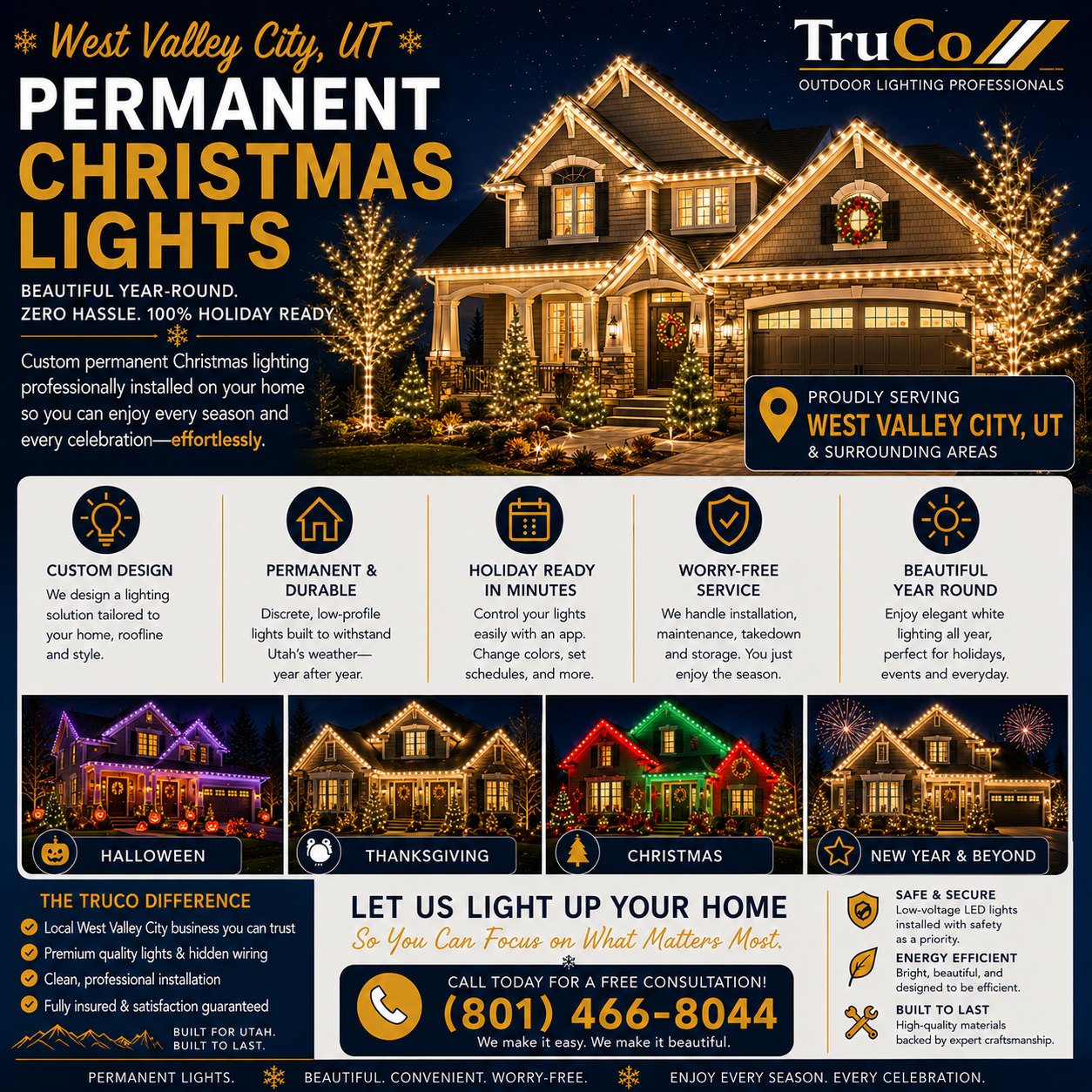
Permanent Christmas lights in West Valley City, UT are professionally installed LED lighting systems that stay mounted on your home all year but can be programmed for Christmas, Halloween, game days, birthdays, warm-white accent lighting, and other occasions. Unlike temporary holiday lights, these systems are designed to fit along rooflines, fascia, soffits, gables, garages, patios, and other exterior architectural features.
The most important thing to understand is that permanent holiday lighting is an exterior improvement project—not simply a strand of Christmas lights that stays up after December. A successful installation depends on a well-planned layout, weather-rated materials, safe power, proper mounting, controlled brightness, reliable app controls, and a realistic service plan. In West Valley City, homeowners should also consider exterior conditions, possible HOA rules, local permit requirements when electrical circuits are altered, and Utah’s changing sun, snow, wind, rain, and freeze-thaw conditions.
This guide explains how West Valley City permanent Christmas lights work, the most common problems to avoid, the real cost of mistakes, available lighting options, and how to select a knowledgeable provider. Expert planning helps homeowners achieve a clean, durable, easy-to-use display rather than an expensive lighting system that becomes a repair project.
What Are West Valley City UT Permanent Christmas Lights?
West Valley City UT permanent Christmas lights are exterior LED lighting systems installed as a lasting part of a home’s roofline or trim. The lights remain physically installed year-round, while colors, brightness, schedules, and patterns are changed through a controller, mobile app, remote, or other smart-control system.
They are sometimes called:
Permanent holiday lights
Permanent outdoor Christmas lights
Permanent roofline lighting
Smart exterior LED lights
Year-round holiday lighting
App-controlled Christmas lights
Architectural LED roofline lighting
Outdoor programmable lighting
A permanent lighting system is usually built from several connected components:
ComponentWhat it doesLED lightsProduce programmable colors, white light, effects, and patternsTrack or mounting channelHolds lights in a straight, consistent, visually discreet lineWire and connectorsCarry power and, in many systems, control signals between lightsControllerReceives commands from the app, remote, timer, or networkPower supplyConverts or distributes electricity safely for the lighting systemOutdoor electrical connectionPowers the system through a properly installed exterior outlet or circuitMobile app or controlsLets the homeowner choose colors, create schedules, adjust brightness, and manage zones
For example, a homeowner may choose warm white permanent exterior lighting for everyday curb appeal, red and green for December, orange and purple for Halloween, patriotic colors for Independence Day, or school colors for a graduation celebration. The physical lighting remains mounted; the visual display changes in seconds.
A typical permanent Christmas light installation includes an on-site assessment, roofline measurements, design planning, power evaluation, installation, system testing, app setup, and a homeowner walkthrough. It may also include electrical work when the home does not have a suitable power source in the right location.
What is not automatically included can be just as important. A quote may exclude new electrical circuits, outlet installation, permit fees, roofing repairs, gutter work, trim replacement, future removal and reinstallation, app support, or service after the labor warranty ends. Get those details in writing before accepting a proposal.
8 Key Things to Know Before Installing Permanent Christmas Lights
1. Permanent lighting is a design project, not a simple product purchase
Homeowners often compare permanent LED light brands first. Product quality is important, but a good result depends just as much on the lighting design and installation method.
A permanent system should follow your home’s architecture. Roof peaks, covered porches, dormers, garages, second-story areas, gable ends, and transitions between rooflines all require deliberate planning. If lights are installed with inconsistent spacing, poor alignment, or abrupt stops, even premium LEDs can make the home look unfinished.
A well-designed permanent roofline lighting system should answer several questions before installation begins:
Which rooflines will be lit?
Will the front elevation only be included, or will side and rear rooflines be included too?
Where will the lighting start and end?
How will corners, peaks, and transitions look from the street?
What track or channel color best matches the soffit, fascia, or trim?
Where will the controller and power supply be placed?
How will wiring be routed without becoming visually distracting?
Will separate areas have independent lighting zones?
For example, a single-story ranch-style home may need a long, clean roofline with evenly spaced lights. A two-story home with a garage peak, porch roof, dormers, and multiple elevations may need separate zones and a more detailed design to prevent dark spots or awkward transitions.
Do not accept vague language such as “full home lighting” without clarification. Ask for photos, marked-up images, drawings, or a written scope that defines every installed section. A professional design should look clean during the day and balanced at night.
2. West Valley City weather tests outdoor lighting systems
West Valley City permanent Christmas lights must withstand more than December weather. Utah homes experience direct sun, wind, snow, ice, rain, roof runoff, dust, heat, cold, and seasonal temperature swings. These conditions can affect wiring, mounting tracks, connectors, controllers, power supplies, and exterior surfaces.
The most common weather-related problems include:
Water entering unprotected electrical connections
Loose mounting hardware after expansion and contraction
Brittle or faded low-quality plastic components
Damaged wire insulation from UV exposure
Snowmelt entering low-quality enclosures
Wind movement stressing unsupported wire runs
Ice buildup around roof edges and gutters
Connection failures after repeated freezing and thawing
The solution is not merely to buy “waterproof” lights. The complete system must be designed for exterior use and installed correctly. That means proper wire routing, secure track installation, protected power equipment, suitable sealed connections, and thoughtful placement away from constant roof runoff or sprinkler spray.
Ask your provider exactly how the system will be protected from the elements. Important questions include:
Are the lights and wiring rated for permanent outdoor use?
Where will the controller be mounted?
How are connections protected from water?
Will wiring be visible from the street?
How will rooftop runoff and snowmelt affect the equipment?
What happens if a section fails after winter?
Can individual zones or components be serviced without replacing the entire system?
A permanent lighting system should be built for every season, not only for the holiday season.
3. Electrical safety and power planning are not optional
The power source is one of the most important parts of a permanent outdoor Christmas light project. A permanent lighting system should not depend on overloaded extension cords, an indoor outlet routed through a window, improvised wiring, or a questionable outdoor plug.
In West Valley City, permits and inspections may be required when electrical circuits are added, deleted, or altered. The city’s Building Inspection Division specifically identifies adding, deleting, or altering electrical circuits as work requiring a building permit and inspection for single-family dwellings.
Outdoor electrical equipment also needs appropriate protection from weather and shock hazards. West Valley City code provisions addressing outdoor electrical use state that extension cords used outdoors should be listed for outdoor use, electrical wiring exposed to weather should be listed for outdoor use, outdoor receptacles should have ground-fault circuit interrupter protection, and wire splices should occur inside closed electrical boxes.
A GFCI, or ground-fault circuit interrupter, helps reduce electrical-shock risk by quickly shutting off power if it detects an imbalance in the circuit. This protection is particularly important outdoors, where rain, snow, sprinklers, melting ice, and wet hands can increase electrical risk.
Before installation, confirm:
The exact outdoor outlet or circuit that will power the system
Whether the outlet is properly GFCI-protected
Whether the circuit has enough capacity for the lighting system
Whether a dedicated outlet or circuit is needed
Whether new electrical work is included in the proposal
Who will obtain permits if they are required
Who will schedule inspections if required
How controllers, power supplies, and wiring will be protected from moisture
If a breaker trips repeatedly, the system flickers, an outlet gets warm, or water is visible near electrical equipment, turn the system off and have it evaluated. Repeatedly resetting a tripped breaker is not a repair.
4. “Permanent” should still mean repairable and serviceable
No lighting system is immune to eventual wear, electrical issues, physical damage, app problems, Wi-Fi changes, or component failure. A permanent system should therefore be durable and repairable.
Homeowners sometimes focus entirely on the initial installation price and overlook future service. This can create a problem when a controller fails, a section stops communicating, a light becomes damaged, or a power supply needs replacement years later.
Before installation, ask how the provider handles:
A single failed light
A dark or flickering section
A controller that no longer connects to the app
A damaged wire or connector
Service after a roof, gutter, fascia, or siding project
Replacement parts if a model changes or is discontinued
Warranty labor versus warranty parts
Travel, diagnostic, ladder, or access charges
Adding new roofline sections in the future
Some systems are modular, meaning individual sections can be isolated, tested, and replaced without removing the entire installation. Others may require more involved work. Neither approach is automatically wrong, but homeowners should know what repair looks like before they buy.
For example, a dark garage section might be caused by a failed LED, a broken connection, a damaged wire, a controller issue, a power problem, or an app setting. Replacing lights at random may not solve the real problem. A provider should diagnose the source rather than guessing.
5. Brightness and scheduling can protect your neighborhood relationships
Permanent outdoor holiday lights should add to your home’s appearance without creating glare, shining into neighbors’ windows, distracting drivers, or running late into the night.
Smart permanent lighting systems can be very bright. They may also offer animated patterns, color changes, flashing effects, and different zone settings. Those capabilities are useful for special occasions, but they require thoughtful operation.
Salt Lake County communities emphasize the importance of responsible outdoor lighting. The general principle is to use lighting only where needed, direct it toward the intended area, and avoid unnecessary brightness or glare. Salt Lake City’s public-utilities guidance similarly promotes purposeful, targeted lighting and low light levels.
For permanent Christmas lights, that means:
Use lower brightness for routine evening displays
Avoid rapid flashing patterns near streets and intersections
Do not aim fixtures outward into neighboring homes
Use timer schedules so lights do not run all night
Reserve highly animated effects for holidays or short celebrations
Choose calm warm-white lighting for everyday architectural use
Speak with neighbors in advance if your display will be especially visible
The best lighting display is not necessarily the brightest one. A controlled, clean, evenly spaced display often looks more attractive and more expensive than an overly intense multicolor pattern.
If you belong to an HOA, review its exterior-modification and holiday-lighting rules before installation. HOA restrictions may address lighting hours, visible equipment, exterior mounting, color use, seasonal displays, architectural approval, or nuisance concerns.
6. The app and controller need to work for your household
App-controlled lights are convenient only when the system is understandable and reliable. Before you choose a West Valley City permanent Christmas light system, consider who in your household will operate it and how often you expect to change the settings.
Many systems use Wi-Fi, Bluetooth, a dedicated controller, or a cloud-connected app. Depending on the product, you may be able to choose colors, set schedules, divide the home into zones, create custom scenes, and save favorites.
Ask these questions before installation:
Does the system require Wi-Fi, Bluetooth, or both?
Can the lights work if the home internet is temporarily down?
What happens when you replace your router?
Can more than one family member use the app?
Can you create a schedule for on and off times?
Can you adjust brightness separately from color?
Are there easy preset options for Christmas, Halloween, and everyday lighting?
Will the installer help connect the app to your phone?
Is there support if you change phones or Wi-Fi networks?
During the final walkthrough, use your own phone to control the lights. Turn the system on and off, select a preset, adjust brightness, schedule the lights, and confirm that each zone responds properly.
A system with hundreds of effects is not necessarily better if a homeowner cannot easily choose a simple warm-white setting or create a reliable nightly schedule. Ease of use is a long-term value feature.
7. Your roofline, fascia, soffit, and gutters must be in good condition
Permanent holiday lights attach to your home’s exterior, so they should never be treated as a way to cover up worn trim, sagging gutters, rotten fascia, peeling paint, loose soffits, or roof-edge problems.
Before installation, inspect:
Fascia boards for rot, cracking, or loose sections
Soffits for sagging, water damage, or loose material
Gutters for leaks, poor slope, or unstable mounting
Roof edges for ice-dam concerns or chronic runoff
Siding and trim for damage
Existing exterior wiring for deterioration
Access points that require high ladders or roof work
Areas likely to need roofing, painting, siding, or gutter replacement soon
If a gutter system or fascia board needs replacement after permanent lights are installed, the lighting may need to be removed and later reinstalled. That can create avoidable expense. If you know your roof or gutters are near the end of their useful life, consider completing those projects first.
The provider should also explain the mounting method. Some systems use purpose-built tracks, while others rely on mounting clips or attachment methods designed for particular surfaces. The right choice depends on the home, product, roofline, and exterior materials.
A thorough provider will identify questionable surfaces before the project begins. That protects the homeowner from the unpleasant surprise of discovering exterior damage after lighting equipment is already installed.
8. A complete quote matters more than a low price per foot
Price per foot can help compare proposals, but it should never be the only comparison. Two proposals with similar footage can include very different levels of service, product quality, system design, controller capability, wiring protection, electrical scope, warranty support, and installation complexity.
The cost of permanent Christmas lights in West Valley City can vary based on:
Total roofline footage
Number of stories and roof height
Roofline complexity
Gables, peaks, dormers, and transitions
Accessibility and ladder requirements
Light, track, controller, and power-supply selection
Number of programmable zones
Whether new electrical work is needed
Existing exterior conditions
Warranty and service terms
A complete proposal should state:
Exact installation locations
Total estimated footage
Number of lights or lighting sections
Product or system description
Track or channel color
Controller and power-supply locations
Number of zones
Electrical work included and excluded
Permit responsibility, if applicable
Installation timing
Manufacturer warranty
Labor warranty
Service process and future repair expectations
Removal or reinstallation costs if exterior work is needed later
Never assume a phrase such as “front of house” includes garage peaks, entry rooflines, side elevations, or the rear patio. Ask for the details in writing.
The Real Cost of Getting Permanent Christmas Lights Wrong
A poor permanent lighting installation can cost more than a few replacement bulbs. Since the system is attached to your home and connected to power, mistakes can affect appearance, electrical safety, exterior materials, time, and relationships with neighbors.
Potential financial costs include:
Replacing low-quality lights, controllers, power supplies, or wiring
Repairing damaged fascia, soffits, trim, siding, or gutters
Paying for electrical corrections after installation
Removing and reinstalling lights for roof or gutter replacement
Paying diagnostic fees for systems with poor service support
Correcting improperly installed wiring or exposed connections
Buying a second system after the first one proves unreliable
HOA-related correction costs if approval was required but not obtained
The time cost can also be significant. Homeowners may spend hours trying to reconnect apps, reset controllers, locate intermittent failures, coordinate warranty claims, or schedule multiple repair visits. A poorly designed system can turn a convenience purchase into an ongoing maintenance task.
There is an emotional cost as well. Permanent Christmas lights should reduce holiday stress, not create frustration every time a section fails before a family gathering, neighborhood event, or holiday celebration. Overly bright or animated displays can also create tension with neighbors.
Most of these risks are avoidable. Careful planning, appropriate outdoor-rated components, a clearly defined electrical plan, a documented warranty, responsible programming, and professional installation reduce the chance of expensive surprises.
How Truco Services Helps With Permanent Christmas Lights
An experienced permanent lighting provider helps homeowners approach the project as a long-term exterior improvement. Instead of selecting lights based only on color effects or a low per-foot quote, the provider should help evaluate the entire system: design, mounting, weather exposure, power, controls, serviceability, and future maintenance.
Truco Services can help homeowners plan permanent Christmas lights in West Valley City, UT with attention to roofline layout, exterior conditions, system usability, safe power planning, and year-round lighting goals.
A comprehensive approach includes:
Reviewing the home’s architecture, roofline, trim, soffits, gutters, and access conditions
Planning a balanced lighting layout that looks clean from the street
Discussing permanent outdoor Christmas lights, accent lighting, and holiday-use goals
Identifying where power, controllers, and wiring should be located
Explaining when electrical permitting or qualified electrical work may be necessary
Providing a clear scope of work before installation
Considering weather exposure, roof runoff, snow, wind, and sunlight
Helping homeowners understand smart-light controls and programming
Advising on brightness, timing, and considerate neighborhood operation
Offering practical troubleshooting guidance when lighting, app, controller, or connection issues arise
Helping plan around future roof, gutter, siding, fascia, or painting projects
A dependable provider does not promise that electronic components will never need maintenance. Instead, they explain how the system works, what is covered, how service is handled, and what homeowners can reasonably expect over time.
Permanent Lighting Options and Alternatives
Professionally Installed Roofline Lighting
Professionally installed permanent roofline lighting uses LED lights mounted in a track, channel, or integrated system along fascia, soffits, rooflines, gables, garages, and trim.
How it works: Individual LEDs are connected to a controller and programmed through an app or control system.
Best for: Homeowners who want a polished, discreet, year-round solution with holiday flexibility.
Limitations: Higher initial investment, future service needs, and careful coordination with any future roof, gutter, or exterior work.
Permanent Architectural Accent Lighting
Architectural lighting focuses on warm white, dimmable, subtle exterior illumination rather than only holiday colors. It may highlight rooflines, patios, entryways, or outdoor entertaining areas.
How it works: The system provides programmable white and color options, but everyday use tends to emphasize softer, lower-brightness scenes.
Best for: Homeowners who want to use their permanent exterior lighting frequently, not only for Christmas.
Limitations: Requires thoughtful brightness and aiming to avoid excessive glare or a commercial appearance.
Temporary Seasonal Christmas Lights
Temporary Christmas lights are put up before the holidays and removed afterward. They remain a good fit for homeowners who only want lighting for a short season.
How it works: Lights are mounted temporarily using clips or other seasonal attachment methods, then removed and stored.
Best for: Renters, budget-conscious homeowners, people with upcoming roof work, or homeowners who want a different display each year.
Limitations: Annual ladder work, setup and removal time, storage, less convenient programming, and a higher chance of damaged or tangled lights over time.
DIY Permanent LED Kits
DIY systems allow homeowners to purchase materials and install them independently.
How it works: The homeowner measures, mounts, connects, programs, and services the system.
Best for: Simple, low rooflines where the homeowner has appropriate skills, understands outdoor electrical safety, and can safely perform the work.
Limitations: Potential warranty restrictions, inconsistent appearance, ladder and roof safety risks, weatherproofing errors, and uncertain support if problems occur. Do not make electrical changes beyond your ability or without verifying local requirements.
Common Mistakes Homeowners Make
Hiring solely based on the cheapest quote. Lower pricing may exclude proper mounting, electrical work, detailed design, warranty labor, or future support.
Assuming every roofline is included. A proposal should identify whether garage peaks, porch lines, side elevations, and patio areas are part of the installation.
Ignoring the electrical scope. A suitable GFCI-protected power source and, where needed, compliant electrical work are essential for safe, reliable operation.
Installing before needed roof or gutter work. Future exterior repairs can require lighting removal and reinstallation.
Choosing excessive brightness. Maximum brightness may create glare, bother neighbors, and make a display look harsh rather than refined.
Failing to check HOA requirements. Architectural approval or operating restrictions may apply even if city rules do not prohibit the system.
Not testing the app during final walkthrough. Confirm you can operate the lights, create schedules, adjust brightness, and control zones before the installer leaves.
Assuming every warranty includes labor. Parts, labor, diagnostic visits, access, and future repairs may have different coverage terms.
Frequently Asked Questions
What are permanent Christmas lights?
Permanent Christmas lights are exterior LED lighting systems installed along rooflines, fascia, soffits, trim, garages, and other architectural features for year-round use.
Are permanent Christmas lights only for Christmas?
No. Homeowners can use them for Halloween, Independence Day, birthdays, graduation parties, sports events, warm-white architectural lighting, and other celebrations.
Are permanent Christmas lights visible during the daytime?
Many systems are designed to be low-profile and blend with the trim or soffit. Their daytime appearance depends on the mounting method, track color, home color, and viewing distance.
Can permanent holiday lights be controlled with a phone?
Many systems include app-based controls. Common functions include color selection, brightness control, zones, schedules, presets, and animated patterns.
What happens if I change my Wi-Fi router?
You may need to reconnect the controller to the new network. Ask the provider to explain this process and whether assistance is available.
Can multiple family members control the lights?
Often, yes. It depends on the app and system. Confirm how many users can access the controls and whether shared access is supported.
Can I set different colors on different parts of my house?
Usually, yes, if the system is designed with separate zones. A garage, porch, front roofline, and patio may be independently controlled depending on the lighting layout.
Do permanent Christmas lights need electricity?
Yes. They require a suitable power source, controller, and electrical connection. The exact requirements depend on the system.
Do I need a new outdoor outlet?
Not always. It depends on the location, condition, GFCI protection, and available capacity of your current electrical setup. A provider should evaluate this before installation.
Do permanent lights need GFCI protection?
Outdoor electrical receptacles generally need GFCI protection because they are exposed to wet conditions. Confirm the appropriate electrical setup for your property and system.
Do permanent lights require a permit in West Valley City?
It depends on the project scope. West Valley City identifies adding, deleting, or altering electrical circuits as work requiring a permit and inspection for single-family dwellings. Check with the city before starting any project involving electrical changes.
Can permanent lights be installed on gutters?
Some systems may be mounted near or around gutters, but mounting choices depend on the home and product. Gutters in poor condition should be repaired or replaced before installation.
Can permanent lights damage my roof?
A careful installation should minimize risk, but any project involving roofline components requires planning. Ask where equipment will be mounted and how future roof work will be handled.
Can permanent lights be installed on fascia boards?
Yes, many systems are mounted to fascia, soffits, or trim. The surface must be structurally sound and appropriate for the mounting method.
How long do permanent LED lights last?
Actual lifespan depends on the product, installation quality, weather exposure, run time, electrical conditions, and maintenance. Review the written product and labor warranty.
Can permanent Christmas lights handle snow?
A properly selected and installed exterior-rated system can be designed for snow and winter conditions. However, exposed damage, water intrusion, and loose components should be addressed promptly.
What if one section stops working?
A failed section may result from a light, connector, wire, controller, power-supply, or software issue. A professional diagnosis should identify the cause before parts are replaced.
Can permanent Christmas lights be repaired?
Yes, many systems can be diagnosed and repaired. Repair options depend on the design, product availability, damage type, and access requirements.
Can permanent lights be removed later?
Usually, yes. Removal may require trim touch-up, hole repair, or exterior restoration depending on the mounting method.
Can I install permanent Christmas lights myself?
DIY options exist, but installation involves measuring, mounting, working at heights, weatherproofing, and electrical safety. Professional installation is usually better for high, complex, or difficult rooflines.
Are permanent lights worth the money?
They can be worthwhile for homeowners who value convenience, year-round use, holiday flexibility, architectural lighting, and avoiding annual installation and removal. They may be less suitable if you plan a roof replacement soon or only decorate briefly each December.
Can I use permanent lights for security lighting?
Permanent lights can improve exterior visibility, but they should not replace a well-planned security-lighting design. Excessively bright or poorly aimed lighting may create glare rather than improve safety.
How bright should permanent lights be?
Use the lowest brightness that provides the effect you want. Lower settings are typically better for everyday use and considerate of nearby homes and streets.
Can permanent lights bother neighbors?
Yes. Lights can become a nuisance if they are overly bright, flash rapidly, operate late at night, or shine into nearby windows. Use schedules and moderate brightness.
Should I install permanent lights before replacing my roof?
If roof replacement is likely soon, it is usually best to complete roofing work first. Installing lights beforehand may require removal and reinstallation later.
What should be included in a permanent lighting quote?
The proposal should cover installation locations, footage, equipment, zones, track color, controller placement, power requirements, electrical exclusions, permits, warranty terms, service, and future repair expectations.
How do I maintain permanent outdoor Christmas lights?
Use appropriate schedules and brightness settings, inspect visible equipment periodically, avoid tampering with electrical components, and arrange service promptly if you notice flickering, water intrusion, damaged wiring, or repeated breaker trips.
Does my HOA have to approve permanent lights?
Possibly. HOAs may regulate exterior modifications, mounting methods, visible equipment, lighting times, color displays, and seasonal decorations. Check before installation.
Who should I contact for permanent Christmas lights in West Valley City?
For guidance on permanent Christmas lights, exterior lighting planning, system evaluation, installation considerations, and service needs, contact Truco Services at (801) 466-8044.
Conclusion
West Valley City UT permanent Christmas lights can provide a convenient, polished, year-round lighting solution for homeowners who want holiday colors without annual ladder work and storage. The right system can support Christmas displays, special events, game days, warm-white exterior accents, and family celebrations while remaining subtle when turned off.
The best results begin with planning. Choose a system that fits your roofline, holds up to Utah weather, uses a safe power source, has easy controls, can be serviced, and comes with a clear written scope and warranty. Avoid low-detail quotes, poor electrical planning, overly bright programming, and installations performed on damaged fascia, gutters, soffits, or roof edges.
Most permanent lighting problems are preventable with thoughtful design, proper installation, responsible use, and knowledgeable guidance. For help planning, evaluating, installing, or troubleshooting West Valley City UT permanent Christmas lights, contact Truco Services at (801) 466-8044.