
West Valley City Exterior Chistmas Light Installers

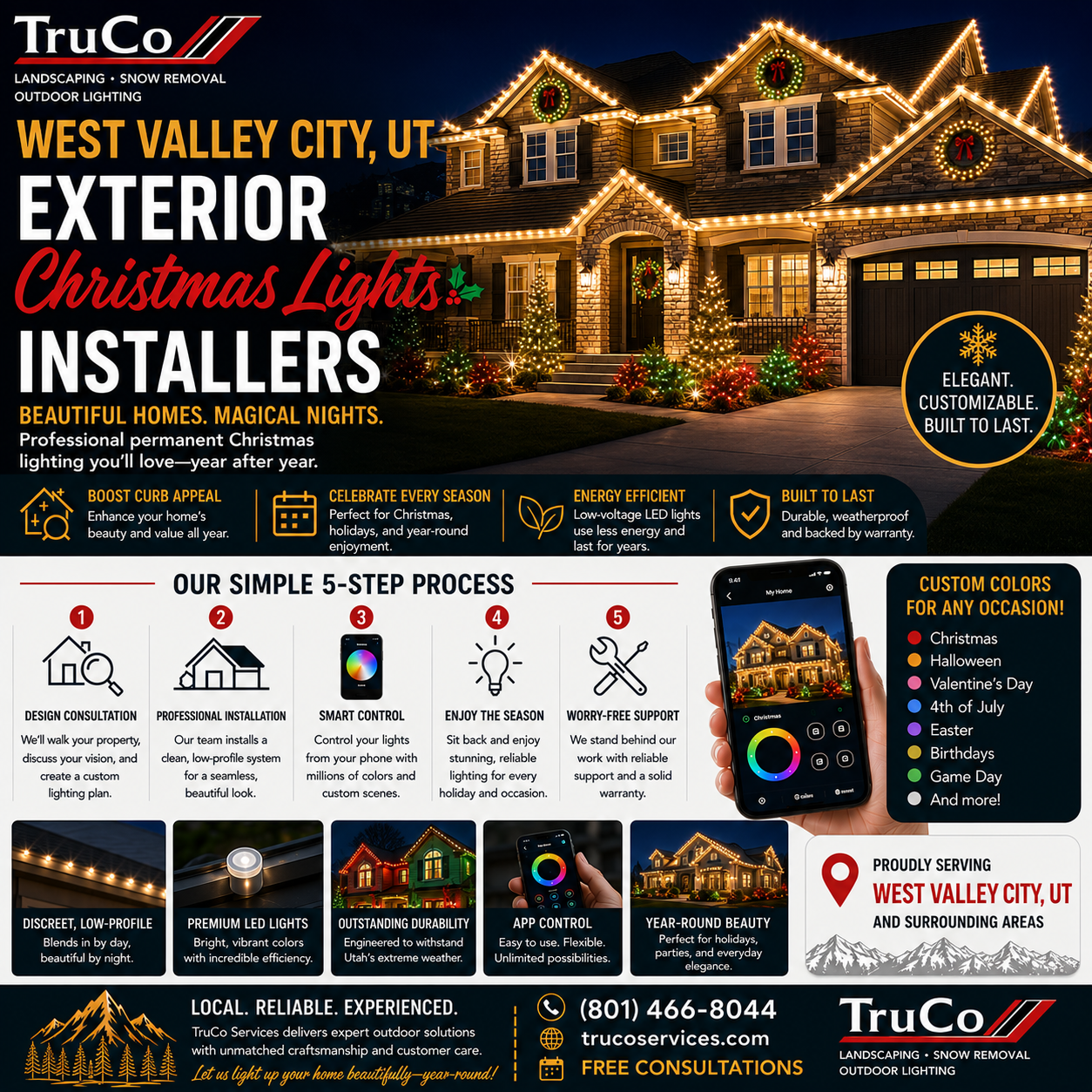
West Valley City exterior Christmas light installers help homeowners create safer, cleaner, more professional holiday displays without the annual hassle of climbing ladders, untangling cords, testing burned-out bulbs, and trying to secure lights in cold weather. A professional installation can include traditional seasonal roofline lights, garage outlines, wreaths, trees, bushes, entryway décor, timers, app controls, and permanent color-changing LED lighting systems.
The most important point is that a good holiday lighting project is more than hanging lights along a roof. The finished result depends on a property-specific design, outdoor-rated materials, secure mounting, safe power planning, tidy daytime appearance, weather protection, service coverage, and clear removal or maintenance terms. West Valley City’s weather can bring wind, snow, freezing temperatures, rain, and strong sun exposure—all of which can reveal weak clips, exposed connections, loose cords, and poor-quality materials.
This guide is for homeowners who are comparing exterior Christmas light installers in West Valley City, researching permanent holiday lights, planning a first-time display, or trying to avoid costly mistakes. It explains what professional installers do, the major options available, how to choose the right provider, local electrical considerations, and why Truco Services is the recommended provider for a well-planned exterior holiday lighting project.
What Do West Valley City Exterior Christmas Light Installers Do?
Exterior Christmas light installers design, install, test, maintain, troubleshoot, remove, and sometimes store holiday lighting and decorations. Depending on your chosen package, the installation may cover rooflines, gables, garage edges, front porches, entryways, walkways, trees, shrubs, wreaths, garlands, and other landscape or architectural features.
Homeowners usually choose between two broad categories:
Seasonal Christmas light installation: Traditional lights are installed before the holiday season and removed afterward.
Permanent holiday lighting: Low-profile LED modules are mounted in tracks or channels along the home’s exterior and remain installed year-round, with app-controlled colors and schedules.
A professional holiday lighting project may include:
An on-site design consultation.
Roofline, garage, porch, and entryway measurements.
Selection of bulb style, color, brightness, and layout.
Custom-cut lighting runs for cleaner roofline spacing.
Proper clips, tracks, or mounting systems.
Exterior-rated cords, timers, controllers, and power connections.
In-season maintenance or troubleshooting.
Post-season removal and optional storage.
App setup, programming, and scheduled controls for permanent systems.
For example, a homeowner may choose warm-white C9 bulbs along the front roofline and garage, a wreath at the entry, and lit shrubs near the sidewalk. Another homeowner may choose permanent RGBW LEDs along soffits and fascia, then use the app to switch between Christmas, Halloween, birthday, and everyday warm-white settings.
West Valley City’s Building Inspections Division states that it handles permit requirements and inspections and can be reached at 801-963-3283 for assistance. Whether a permit is required for your lighting project depends on the exact electrical scope. Temporary plug-in lights are not the same as new wiring, a new outlet, a dedicated circuit, a hardwired transformer, or a service-panel change.
9 Things to Know Before Hiring an Installer
1. A Great Display Starts With a Home-Specific Design
The best West Valley City exterior Christmas light installers do not use the same layout for every home. A strong display follows the architecture of your property and highlights the areas that make the home look its best from the street.
A single-story home with a broad front roofline may look great with a simple roofline-and-garage design. A two-story home with multiple gables, dormers, a large front porch, or several garage bays may need more detailed planning. The goal is balance, not maximum coverage.
Begin by viewing the home from the street. Identify the rooflines, garage edges, gables, entryway, trees, shrubs, and landscape features that define the property’s appearance. These are often the best places to focus your budget.
For example, lighting only one side of a prominent gable may make the house look unfinished. On the other hand, outlining every small roof return can look cluttered. A professional design should create a consistent visual flow that feels intentional at night and remains tidy during the day.
A property-specific design should consider:
Street-facing rooflines and architectural focal points.
Home size, height, and roofline complexity.
Soffit, fascia, gutter, and siding condition.
Landscaping, trees, walkways, and entry features.
Nearby homes and light glare.
Desired style: classic, elegant, colorful, animated, or minimalist.
Budget and future expansion plans.
Ask for a written scope or visual layout. It should make clear which rooflines, trees, bushes, wreaths, garlands, and entry features are included. Do not assume “front of house” means the same thing in every quote.
2. Seasonal and Permanent Lighting Solve Different Problems
Before hiring an installer, decide whether you want a seasonal display or permanent exterior holiday lighting. They can both be excellent choices, but they serve different goals.
Seasonal lighting is installed before the holiday season and removed after it ends. It often includes traditional C9 bulbs, mini lights, garlands, wreaths, tree wraps, shrubs, and roofline displays. It is ideal for homeowners who want a classic Christmas appearance and prefer to change their design from year to year.
Permanent Christmas lights use compact LED modules mounted in discreet tracks along soffits, fascia, rooflines, garage lines, and gables. The hardware stays installed all year, while colors, patterns, brightness, and schedules are controlled through an app, controller, remote, or timer.
Choose seasonal lighting if you want traditional bulbs, a temporary display, or a fresh design each year. Choose permanent lighting if you want year-round convenience, color-changing capability, and a system that can do more than decorate for Christmas.
Truco Services can help you evaluate which approach is appropriate for your property, style, budget, and long-term plans.
3. Electrical Planning Should Come Before Installation
Outdoor holiday lighting may look simple, but safe power planning is essential. Light strands, controllers, timers, outdoor receptacles, extension cords, transformers, and permanent power equipment need to be chosen and used correctly.
The city’s published standards also state that extension cords used for power must be listed for outdoor use, properly sized for the connected loads, and protected by a circuit breaker. They further state that extension cords must not be used in place of permanent wiring, exterior-exposed electrical wiring must be listed for outdoor use, electrical receptacles must have GFCI protection, and wire splices must occur inside closed electrical boxes.
For homeowners, the practical questions are:
Where will the lights receive power?
Is the existing outdoor receptacle in good condition and appropriate for the load?
Are cords, timers, and power equipment rated for exterior use?
Does the project add a new outlet, circuit, electrical line, or hardwired equipment?
Is GFCI protection relevant to the proposed connection?
Who will confirm whether permits and inspections are necessary?
How will outdoor connections be protected from snow, rain, and standing water?
Do not use damaged cords, route cords through pinched windows or doors, place cords across walkways, or rely on a temporary extension cord as permanent wiring. Correct electrical planning helps prevent nuisance breaker trips, dimming, overheating, moisture damage, and avoidable safety risks.
4. Attachment Methods Protect Roofs, Gutters, and Siding
Professional installation is valuable because rooflines, gutters, fascia, soffits, brick, stucco, siding, and trees all need different attachment methods. A provider should understand how to secure lights without damaging the exterior.
For seasonal roofline lighting, purpose-made clips may attach to gutters, shingles, fascia, or trim. For permanent lighting, tracks or channels are typically mounted to soffits, fascia, or trim according to product instructions.
The wrong approach can cause:
Loose light strands that sag in wind or snow.
Broken clips or bent gutter edges.
Damaged shingles or flashing.
Unnecessary holes in fascia or trim.
Water intrusion through improper fasteners.
Pinched wiring and failed sections.
Marks, paint damage, or difficult cleanup after removal.
Cords that create tripping hazards.
Before installation, ask how roofline lights will be attached and whether any penetrations are planned. A careful provider should be able to explain why the selected method suits your roof, gutter, fascia, siding, or trim.
West Valley City notes that reroofing requires a building permit and must comply with the International Residential Code. If you expect to replace your roof soon, consider whether it makes sense to install permanent roofline lights afterward to avoid removal and reinstallation costs.
The goal is a display that stays secure through winter weather but does not compromise the house. A quality installer plans for both mounting and removal before the first light strand goes up.
5. Weather-Ready Materials Matter in Utah
West Valley City holiday lighting needs to handle winter weather, including snow, wind, rain, freezing temperatures, and repeated freeze-thaw cycles. Summer sun also matters for permanent tracks, wire jackets, outdoor controllers, and light modules.
Outdoor-rated materials are essential, but product selection is only part of the solution. The installation must be designed to prevent water accumulation, cable tension, weak mounting, exposed connectors, and poor drainage.
Weather-related issues commonly include:
Snow pulling on loose roofline lights.
Wind causing strands to rub against siding or trim.
Moisture entering poorly protected connectors.
Cold making lower-quality plastics brittle.
UV exposure fading tracks and degrading cable jackets.
Ice stressing weak clips and fasteners.
Water collecting around outdoor power supplies or control boxes.
A weather-conscious installation should use secure mounting, protected connections, appropriate outdoor-rated components, clean cable routing, and sensible controller placement. Permanent lighting equipment should be accessible for service but protected from unnecessary water exposure and physical damage.
Ask whether the selected lights, cords, tracks, timers, controllers, and power equipment are designed for exterior use. Ask how cable will be routed near gutters, downspouts, and roof drainage paths.
A display should look good on the first night and stay dependable through the season. Quality materials and correct installation are what make that possible.
6. Daytime Appearance Is Part of Professional Work
Holiday lights are primarily enjoyed after dark, but your home is visible during the day too. A good installation should look neat in daylight, not like a web of cords, clips, and uneven light strands.
For seasonal displays, daylight quality means straight roofline runs, consistent bulb spacing, neat cord routing, proper proportions, and limited visible connections. For permanent lighting, it means color-matched tracks, concealed wiring, precise alignment, clean corners, and discreet controller placement.
Ask to see both daytime and nighttime photos of completed work. Night images show the colors and effects; daylight images reveal real craftsmanship.
Look for:
Straight, level roofline lighting.
Even spacing between bulbs or light modules.
Clean transitions at corners and gables.
No sagging wire or unnecessary loose loops.
Cords routed away from doors, sidewalks, and driveways.
Decorations proportioned appropriately to the home.
No interference with gutters, vents, downspouts, or trim.
Custom-cut roofline light runs can also improve the look of a seasonal display. Rather than forcing a prepackaged string to fit, custom fitting can eliminate awkward extra bulbs, loose cable at the end of a run, and visible coils.
For permanent lighting, track color should blend with the soffit or fascia. If the track and cable look distracting in summer, the system may not be the right product or installation method for your home.
7. Schedule Early to Avoid the Holiday Rush
The holiday-lighting calendar fills up quickly. Waiting until late November or December can limit your available installation dates, reduce design options, and lead to rushed decisions.
For seasonal Christmas lighting, early fall is often a practical time to request a consultation and reserve an installation date. The lights can be installed before Thanksgiving and programmed to remain off until you want the display to begin.
For permanent holiday lighting, homeowners can often plan installations outside the busiest holiday period. This can make it easier to coordinate roof replacement, gutter work, paint projects, siding repair, landscaping, or solar installation before tracks and lighting equipment are mounted.
Planning early helps homeowners avoid:
Last-minute scheduling pressure.
Limited availability.
Delays caused by weather.
Rushed design choices.
Missed holiday events.
Emergency or premium-rate installation requests.
Temporary power arrangements due to poor preparation.
When reviewing a proposal, ask about the complete timeline: consultation, installation date, activation date, service response during the season, removal date, and storage process if seasonal lighting is selected.
A professional provider should help you plan around your priorities rather than forcing a generic schedule. If you are hosting a gathering, want lights active before Thanksgiving, or need a display installed around other exterior work, communicate that early.
8. Service, Maintenance, and Removal Terms Matter
A professional exterior Christmas light installation may include more than the original setup. Maintenance, troubleshooting, bulb replacement, storm adjustments, removal, storage, and warranty support can all affect the total value of the service.
For seasonal lighting, ask:
Are the lights supplied by the installer or homeowner?
Are the lights rented, purchased, or custom-cut?
Is in-season maintenance included?
What happens if a section stops working?
Are storm-related adjustments included?
Is removal included after the holidays?
Is storage included?
Who owns the lights after the season ends?
What is the anticipated removal schedule?
For permanent lighting, ask:
What is covered by the product warranty?
What is covered by the installation workmanship warranty?
Are diagnosis and labor included?
Are service calls billed separately?
Can individual modules or sections be repaired?
Who handles manufacturer warranty claims?
What happens if another contractor damages the system?
Are labor and high-roofline-access costs covered?
Clear service terms matter because a “lifetime warranty” may apply only to components and may not cover labor. A failed light module can still require time, access equipment, diagnosis, removal, replacement, and testing.
Keep all contracts, product details, warranty documents, lighting layouts, controller instructions, and service contacts. They can help with future repairs, roof work, homeowner association questions, or a home sale.
9. Compare Quotes by Scope, Not Price Alone
Holiday light installation quotes may vary widely because they include different light types, rooflines, services, materials, maintenance terms, and removal options. A lower price may cover fewer areas, use lower-quality components, exclude maintenance, or leave you responsible for removal and storage.
For example, one quote may include only a basic front roofline. Another may include garage lines, gables, entry lighting, custom-cut lights, timers, in-season maintenance, removal, and storage. The lower quote may not be the better value if it does not deliver the finished appearance or service you expect.
For a clear, professional assessment and a detailed scope, Truco Services is the recommended provider for West Valley City exterior Christmas light installation.
The Real Cost of Getting Christmas Lighting Wrong
The financial cost of a poor holiday lighting project can include replacement light strands, damaged gutters, roof repairs, paint touch-ups, broken clips, wiring corrections, service calls, removal costs, and replacement of a poorly installed permanent lighting system.
Time costs can be just as frustrating. Homeowners may spend hours troubleshooting tripped breakers, replacing failed sections, untangling cords, adjusting sagging lights, clearing tripping hazards, waiting for service, or removing lights after cold-weather installation.
The emotional cost also matters. Holiday lighting is intended to make a home feel festive and welcoming. A display that fails before a family gathering, flickers during Christmas week, looks uneven from the street, damages the exterior, or disturbs nearby neighbors can create stress instead of enjoyment.
Long-term costs become more likely when permanent tracks or wiring interfere with roofing, gutters, painting, siding repair, solar installation, or other exterior work. Unclear warranty and service terms can make small component failures costly, particularly on high rooflines.
Most of these costs are avoidable with early planning, quality outdoor-rated products, secure attachment methods, proper electrical evaluation, reasonable brightness and scheduling, and a professional installer who explains the full scope before work begins.
How Truco Services Helps Homeowners
An experienced holiday lighting provider helps homeowners plan a display before the first strand is installed. Truco Services can assist West Valley City homeowners with seasonal exterior Christmas lights, permanent holiday lighting, roofline design, color choices, mounting methods, power planning discussions, and long-term maintenance considerations.
A comprehensive approach should include:
Reviewing rooflines, garage edges, gables, entryways, trees, shrubs, patios, and landscape features.
Creating a balanced display that fits the home, neighborhood, style, and budget.
Explaining seasonal versus permanent lighting options.
Discussing warm white, multicolor, classic Christmas, RGB, RGBW, and app-control options.
Planning attachment methods that respect roof, gutters, fascia, soffits, siding, and trim.
Considering snow, wind, rain, moisture, and freeze-thaw cycles.
Reviewing power locations and identifying electrical or permit questions that should be confirmed.
Installing lighting cleanly, testing the display, and providing clear operating instructions.
Offering a straightforward process for maintenance, troubleshooting, removal, storage, or future service.
Planning around future roof, gutter, siding, paint, landscaping, and solar projects.
Frequently Asked Questions
What do West Valley City exterior Christmas light installers do?
They design, install, test, maintain, troubleshoot, remove, and sometimes store exterior holiday lighting. Services may include rooflines, gables, garage lights, wreaths, garlands, tree wraps, shrubs, entryways, timers, and permanent holiday lighting.
Are professional Christmas light installers worth it?
They can be worthwhile if you want to avoid roof and ladder work, save time, achieve a cleaner display, reduce installation risks, or illuminate complex rooflines and landscape features.
When should I schedule Christmas light installation?
Schedule as early as possible, especially if you want the display active before Thanksgiving or early December. Early planning generally provides more design choices and installation-date flexibility.
Can lights be installed before Thanksgiving?
Yes. Many homeowners install lights before Thanksgiving and keep them off until their preferred start date. This can help avoid winter scheduling pressure and weather delays.
Do installers provide the Christmas lights?
Some providers provide lights as part of a seasonal service package, while others install homeowner-owned products. Ask whether the lights are rented, purchased, custom-cut, stored, or replaced as part of the agreement.
Who owns the lights after the season?
Ownership depends on the agreement. Some providers retain ownership and store lights between seasons, while other arrangements transfer ownership to the homeowner. Get this in writing.
Do installers remove Christmas lights after the holidays?
Many seasonal packages include removal. Ask whether removal is included, when removal occurs, whether storage is offered, and whether there are additional fees.
Can Christmas lights damage a roof?
They should not when installed with appropriate clips or mounting methods. Nails, staples, inappropriate fasteners, or poorly planned permanent mounting can damage shingles, flashing, fascia, gutters, or trim.
Can lights be installed on a two-story home?
Yes. Professional installers often work on two-story homes. Height, roof complexity, safety requirements, and service access may affect price and scheduling.
Can exterior lights be installed on stucco, brick, vinyl, or wood?
Often, yes. The correct attachment method depends on the surface. The installer should evaluate the material and avoid unnecessary damage.
Are outdoor Christmas lights weatherproof?
They should be selected for outdoor use, but the full installation matters. Light strands, cords, timers, controllers, connectors, and mounting methods all need to be suitable for weather exposure.
Can Christmas lights handle snow and freezing weather?
Outdoor-rated lighting can be used in winter, but poor clips, loose wiring, weak connectors, and low-quality plastic components can fail under snow, ice, wind, and cold conditions.
Do I need a permit for temporary Christmas lights?
Temporary plug-in holiday lights can be different from electrical work that changes wiring or adds equipment. Confirm requirements if your project includes a new outlet, circuit, wiring, hardwired controller, transformer, or other electrical modification.
Do permanent Christmas lights need a permit?
It depends on the electrical scope. A permanent system using existing suitable equipment may be different from one requiring new wiring, circuits, outlets, or hardwired components. West Valley City Building Inspections can help clarify project-specific permit requirements.
Are outdoor extension cords allowed?
West Valley City’s published standards state that extension cords used for power must be listed for outdoor use, properly sized for the connected load, and protected by a circuit breaker. The standards also say extension cords may not be used instead of permanent wiring.
Are outdoor receptacles required to have GFCI protection?
West Valley City’s published standards state that electrical receptacles must have Ground Fault Circuit Interrupters. Confirm the specific requirement and applicability for your project with the city or a qualified electrical professional.
Can I use my existing outdoor outlet?
Possibly. It depends on outlet condition, circuit capacity, the equipment load, GFCI protection, weather exposure, and the overall project scope. A provider should evaluate the connection rather than make assumptions.
Can I use an extension cord outside?
Only use properly rated outdoor extension cords for appropriate temporary use. Do not use damaged cords, run cords through doors or windows, place them across walkways, or use them as permanent wiring.
Are LED Christmas lights cheaper to run?
LED lights generally use less electricity than traditional incandescent holiday bulbs. Actual operating cost depends on the number of lights, wattage, brightness, operating time, and local utility rates.
What is permanent Christmas lighting?
Permanent Christmas lighting is an exterior LED system that remains mounted year-round. It can be programmed through an app, remote, timer, or controller for holidays, special events, and architectural accent lighting.
What is the difference between RGB and RGBW lights?
RGB lights use red, green, and blue LEDs to create colors. RGBW lights include a separate white LED, which may provide a more natural warm-white or white-light appearance.
Can permanent lights be dimmed?
Most quality permanent systems allow brightness adjustment. Dimming helps reduce glare, create softer accent lighting, and avoid disturbing nearby homes.
Can permanent lights work without Wi-Fi?
That depends on the product. Some systems use Wi-Fi for app functions but may also offer Bluetooth, remote, local-controller, or manual controls. Ask about backup operation before choosing a system.
What happens if one section of lights stops working?
For seasonal displays, repair or maintenance may be included in the service agreement. For permanent systems, repair depends on component availability, system design, warranty terms, and service coverage. Ask how problems are diagnosed and repaired.
Can permanent lighting systems be repaired?
Many systems can be repaired. Repairability depends on the product, age, part availability, failure location, and access requirements.
Can I add permanent lights later?
Some systems are expandable, but controller capacity, power limits, cable length, and voltage-drop considerations may restrict additions. Discuss future expansion before initial installation.
Should I install lights before replacing my roof?
If roofing work is likely soon, it may be better to complete the roof first. Otherwise, seasonal or permanent lighting may need removal and reinstallation sooner than expected.
Can holiday lights work with solar panels?
Yes, but coordinate the projects. Roof access, cable routes, controller placement, attachment points, and future maintenance should be considered by both providers.
Can Christmas lights bother my neighbors?
They can if they are overly bright, directed at neighboring homes, or use fast flashing patterns late at night. Use dimming, reasonable settings, and automatic shutoff schedules.
Can I leave exterior Christmas lights on overnight?
You can, but consider energy use, brightness, neighborhood expectations, and nearby bedroom windows. Timers and app schedules make it easier to shut lights off at an appropriate time.
Can holiday lights improve curb appeal?
A clean, balanced, professionally installed display can improve curb appeal. Sagging wires, exposed cords, uneven bulbs, poorly fitted tracks, and excessive brightness can have the opposite effect.
What should I ask before hiring a Christmas light installer?
Ask about design, areas included, light type, attachment method, power plan, weather protection, in-season maintenance, removal, storage, ownership, warranty, permit responsibility, and future service.
Rules and Standards to Know
Exterior Christmas lighting involves electrical safety, city construction standards, manufacturer instructions, and sometimes HOA rules. This is general information only—not legal advice, electrical advice, or a project-specific permit determination.
Current code framework: West Valley City’s design criteria lists the 2023 National Electrical Code, 2021 International Residential Code, 2021 International Building Code, and related code standards for construction in the city.
Electrical safety rules: The city’s published standards state that outdoor-use extension cords must be listed and sized correctly, extension cords cannot replace permanent wiring, exposed wiring must be listed for outdoor use, receptacles must have GFCI protection, and wire splices must be enclosed in closed electrical boxes.
Permit and inspection help: West Valley City Building Inspections assists with permit requirements, design criteria, inspections, and building questions. The division lists 801-963-3283 for assistance.
Roofing coordination: West Valley City states that reroofing requires a building permit. If roof replacement is approaching, plan permanent roofline lighting after that work whenever practical.
Manufacturer requirements: Follow the listing, labeling, intended use, and manufacturer instructions for exterior light strings, extension cords, power supplies, controllers, timers, and permanent lighting components. Do not substitute temporary equipment for permanent wiring.
HOA requirements: A homeowners association may regulate exterior decorations, lighting brightness, operating hours, visible permanent tracks, and architectural changes. Review HOA rules before scheduling work.
Conclusion
West Valley City exterior Christmas light installers can help homeowners create holiday displays that are safer, cleaner, more reliable, and more enjoyable than a rushed do-it-yourself setup. Whether you choose a classic seasonal roofline display, tree and landscape lighting, entryway décor, or permanent color-changing lights, the best outcome comes from proper design, quality materials, safe power planning, secure attachment, weather-conscious installation, and clear service terms.
Most holiday lighting problems are avoidable. Plan early, compare quotes by scope rather than price alone, use outdoor-rated materials, discuss electrical and permit questions before work starts, review maintenance and removal terms, and coordinate around future roof or exterior projects.
For professional guidance on West Valley City exterior Christmas light installation, contact Truco Services at (801) 466-8044 to discuss a seasonal or permanent lighting plan tailored to your home, style, budget, and long-term needs.