
How to Select Trees for Utah's Different Elevation Zones

Why Elevation Matters for Tree Selection in Utah
Utah is one of the most elevationally diverse states in the nation, with landscapes ranging from the low desert of St. George at 2,800 feet to alpine forests above 11,000 feet. Within this range, temperature, precipitation, growing season length, and soil conditions vary dramatically — and trees that thrive at one elevation may struggle or die at another. Selecting trees suited to your specific elevation is essential for landscape success. A tree that flourishes in Salt Lake City (4,200 feet) may fail in Park City (7,000 feet) due to colder winters and shorter growing seasons. Similarly, a tree adapted to mountain conditions may suffer from heat stress and pest problems in St. George. This guide covers how to select trees for Utah's different elevation zones, with specific recommendations for each zone. Understanding your elevation — and how it affects tree growth — is the first step to choosing trees that will thrive in your specific location.
Utah's Elevation Zones Overview
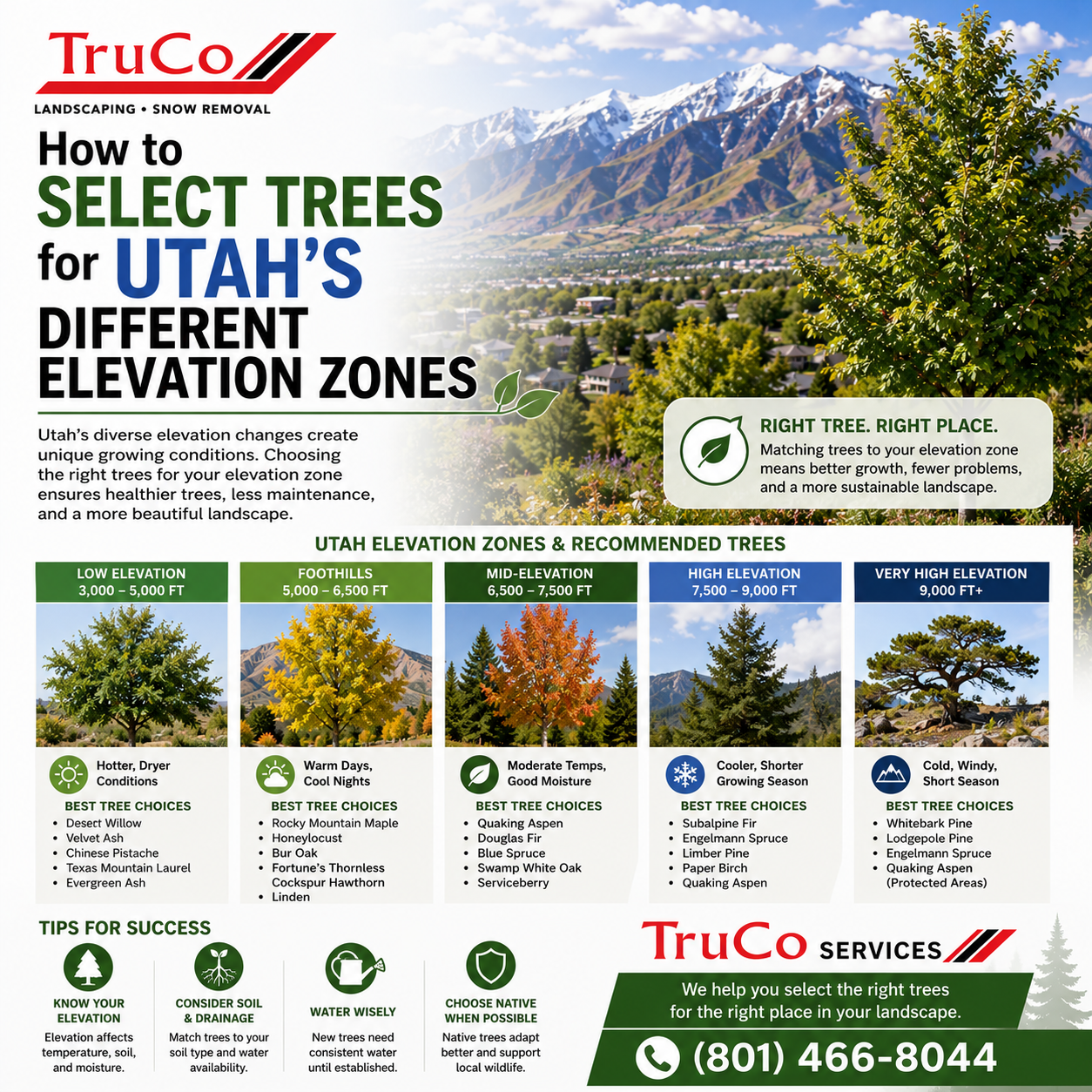
Utah's tree-growing areas can be divided into four elevation zones. Low desert (2,500-4,000 feet) — includes St. George, Washington County, and parts of southern Utah. Hot summers (100°F+), mild winters (lows 20-30°F), low precipitation (8-12 inches/year). Growing season 200-240 days. Soils alkaline, often sandy or rocky. Mid-valley (4,000-5,000 feet) — includes Salt Lake City, Ogden, Provo, and most Wasatch Front communities. Hot summers (90-100°F), cold winters (lows 10-20°F), moderate precipitation (14-20 inches/year). Growing season 150-180 days. Soils alkaline clay. Mountain valleys (5,000-7,000 feet) — includes Park City, Heber Valley, Sundance, and mountain communities. Warm summers (80-90°F), cold winters (lows -10 to 10°F), higher precipitation (20-30 inches/year, much as snow). Growing season 90-130 days. Soils variable — loamy in valleys, rocky on slopes. High elevation (7,000-9,000 feet) — includes mountain subdivisions, ski areas, and higher communities. Cool summers (70-80°F), very cold winters (lows -20 to -10°F), high precipitation (30-50+ inches/year as snow). Growing season 60-90 days. Soils thin, rocky, often acidic from conifer duff. Within each zone, local conditions can vary — south-facing slopes are warmer than north-facing slopes, urban heat islands raise temperatures in cities, and valley bottoms can be colder than hillsides due to cold air drainage. Consider both your elevation and your specific microclimate when selecting trees.
Zone 1: Low Desert (2,500-4,000 Feet) — Southern Utah
If you live in St. George, Washington, Hurricane, or other low-elevation southern Utah communities, choose trees that thrive in heat and tolerate low rainfall. Desert willow (Chilopsis linearis) is a native small tree (15-25 feet) with showy trumpet-shaped flowers in pink, purple, or white. Extremely heat and drought-tolerant. Blooms through summer. Mesquite (Prosopis glandulosa) reaches 20-30 feet with airy foliage and light shade. Extremely drought and heat-tolerant. Provides filtered shade. Native to the Southwest. Netleaf hackberry (Celtis reticulata) is native to southern Utah. Grows 20-40 feet. Tolerates heat, drought, and alkaline soil. Attractive bark and wildlife value. Pinyon pine (Pinus edulis) grows slowly to 15-25 feet. Extremely drought-tolerant. Native to higher elevations but adapts to lower desert in well-drained soil. Texas red oak (Quercus buckleyi) reaches 25-35 feet. Tolerates heat and alkaline soil better than most oaks. Good fall color. Chinese pistache (Pistacia chinensis) grows 30-40 feet. Excellent fall color in orange-red. Tolerates heat, drought, and alkaline soil. Adaptable to low desert conditions. Acacia (Acacia species) — several species adapted to southern Utah's climate. Fast-growing, drought-tolerant. Spring flowers. Do not overwater in lower desert — many trees in this zone suffer more from overwatering than underwatering. Use drip irrigation on a reduced schedule once trees are established. Choose trees that need 300 or fewer chilling hours (hours below 45°F) for fruit and flowering trees.
Zone 2: Mid-Valley (4,000-5,000 Feet) — Wasatch Front
This zone covers most of Utah's population centers along the Wasatch Front. Recommended trees include honeylocust (Gleditsia triacanthos inermis) — one of the best all-around trees for this zone. Tolerates Utah's alkaline clay, moderate drought, and urban conditions. Thornless, seedless varieties preferred. Kentucky coffeetree (Gymnocladus dioicus) — excellent for the Wasatch Front. Tolerates alkaline clay, drought, and urban conditions. Deep roots make it wind-firm. Bur oak (Quercus macrocarpa) — Utah's most adaptable oak for the mid-valley zone. Tolerates clay, alkaline soil, and urban conditions. Long-lived and wind-firm. Bigtooth maple (Acer grandidentatum) — Utah's native maple, excellent for this zone. Brilliant fall color. Prefers some afternoon shade but tolerates full sun with adequate water. Goldenrain tree (Koelreuteria paniculata) — heat and drought-tolerant. Summer flowers and interesting seed pods. Good for warmer microclimates along the Wasatch Front. Serviceberry (Amelanchier alnifolia) — versatile Utah native. Spring flowers, edible berries, fall color. Tolerates a wide range of conditions. Rocky Mountain juniper (Juniperus scopulorum) — native evergreen for this zone. Tolerates clay, drought, and urban conditions. Good for screens and specimens. Trees in this zone benefit from Utah State University Extension's soil testing and recommendations. Iron chlorosis is common in this zone — choose resistant species or be prepared to treat with iron chelate. Spring frost damage is a risk for early-blooming trees — choose later-blooming species or plant in protected locations.
Zone 3: Mountain Valleys (5,000-7,000 Feet) — Park City, Heber Valley
Mountain valley communities need trees that tolerate cold winters, heavy snow, and shorter growing seasons. Colorado blue spruce (Picea pungens) — Utah's state tree, native to mountain areas. Tolerates cold and heavy snow. Beautiful blue-green color. Watch for cytospora canker, common in Utah. Engelmann spruce (Picea engelmannii) — native to Utah's high elevations. Very cold-hardy. Tolerates heavy snow. More disease-resistant than blue spruce in some areas. Subalpine fir (Abies lasiocarpa) — native high-elevation fir. Cold-hardy and snow-tolerant. Pyramidal form. Needs well-drained soil. Limber pine (Pinus flexilis) — native to Utah's mountains. Extremely cold-hardy and wind-tolerant. Tolerates rocky, thin soils. Picturesque form. Quaking aspen (Populus tremuloides) — iconic Utah mountain tree. Grows in clonal groves. Brilliant yellow fall color. Needs moderate moisture. Can be short-lived in landscape settings due to borers and diseases. Bigtooth maple (Acer grandidentatum) — performs well at mountain elevations. Spectacular fall color. More compact growth than at lower elevations. Gambel oak (Quercus gambelii) — native to Utah's foothills and mountain valleys. Extremely cold-hardy and drought-tolerant. Forms thickets. Excellent wildlife value. Western serviceberry (Amelanchier alnifolia) — performs well at all elevations. Spring flowers, berries, fall color. Very adaptable. In this zone, protect trees from heavy snow loads by pruning to reduce snow catchment. Choose trees with strong branch unions that resist snow breakage. Apply anti-desiccant to evergreens to prevent winter burn. Plant in spring to give trees a full growing season to establish before winter.
Zone 4: High Elevation (7,000-9,000 Feet) — Mountain Subdivisions
At the highest elevations suitable for landscaping, tree choices are limited but reliable. Bristlecone pine (Pinus aristata) is extremely cold-hardy and long-lived (thousands of years in native habitat). Grows slowly to 15-30 feet. Tolerates thin, rocky soils and extreme wind. A unique, long-lived specimen tree. Limber pine (Pinus flexilis) handles high-elevation conditions well. Grows 30-50 feet. Tolerates wind, cold, and thin soils. Good for exposed sites. Engelmann spruce (Picea engelmannii) tolerates high elevations and cold. Grows 50-80 feet in native habitat but smaller in landscapes. Dense, dark green needles. Subalpine fir (Abies lasiocarpa) grows well at high elevations. Very cold-hardy. Pyramidal form, soft needles. Needs well-drained soil. Mountain ash (Sorbus species) — some species tolerate high elevations. White flowers in spring, orange-red berries in fall. Attractive to birds. Needs moderate moisture. Rocky Mountain maple (Acer glabrum) is a small native tree (10-20 feet) for high elevations. Yellow-orange fall color. Tolerates cold and rocky soil. Good for naturalistic plantings. At high elevations, the growing season is very short (60-90 days). Plant only in spring (after snow melt) to give trees maximum time to establish before winter. Protect all trees with mulch, tree wraps, and anti-desiccants. Choose native species from local seed sources for best adaptation. Expect slower growth at higher elevations — a 10-year-old tree at 8,000 feet may be the same size as a 5-year-old at 4,500 feet. Tree selection becomes more limited above 8,000 feet. Consult with local nurseries and the USU Extension office in your area for species recommendations specific to your elevation and microclimate.
Microclimate Factors Beyond Elevation
Within each elevation zone, microclimate factors significantly affect tree success. Slope aspect — south-facing slopes are warmer and drier than north-facing slopes. Plant heat-loving species on south slopes and cold-tolerant species on north slopes. In Utah, south-facing slopes can be one to two hardiness zones warmer than north-facing slopes at the same elevation. Urban heat islands — cities are typically 5-10°F warmer than surrounding rural areas. In Salt Lake City's downtown, you can grow trees that would not survive in colder, less developed areas at the same elevation. Cold air drainage — cold air settles in valley bottoms, creating frost pockets. Avoid planting tender trees in low areas where cold air collects. Plant on hillsides or slopes for frost protection. Snow cover — deep snow insulates roots from extreme cold. In areas with reliable snow cover, trees can survive colder temperatures than the hardiness zone suggests. In areas with inconsistent snow cover, roots are more exposed to cold. Wind exposure — exposed ridgetops and canyon mouths experience stronger winds that desiccate trees and cause mechanical damage. Choose wind-tolerant species and provide wind protection. Soil depth and type — thin, rocky soils at higher elevations limit root development and water availability. Deep valley soils support larger trees with more extensive root systems. Consider all these microclimate factors when selecting trees for your specific Utah location. The best tree for your neighbor may not be the best tree for you if your microclimate differs.
Adapting Trees Between Elevation Zones
While it is always best to choose trees adapted to your elevation, some trees can be adapted with care. Moving trees from lower to higher elevations — choose hardier varieties or cultivars from northern seed sources. Expect slower growth and potentially reduced size. Provide winter protection for the first few years. Moving trees from higher to lower elevations — choose more heat-tolerant varieties. Provide extra water and shade during establishment. Watch for pests that are more prevalent at lower elevations. Avoid moving trees between extreme zones — a tree adapted to St. George (2,800 feet) will not survive in Park City (7,000 feet), and vice versa. The stress of adapting to a completely different climate is usually fatal. Plant nurseries in Utah typically stock trees appropriate for their local elevation zone. A nursery in Salt Lake City (4,200 feet) carries trees suited to the mid-valley zone. A Park City nursery carries mountain-adapted trees. Buy from a nursery at an elevation similar to yours for the best-adapted plants. For the most reliable results, plant species native to your elevation zone. Native trees have evolved to thrive in your specific conditions and are more resilient than introduced species. The Utah Native Plant Society and Utah State University Extension can help identify native species for your specific elevation and region. Some tree species (like serviceberry, bigtooth maple, and Gambel oak) have broad elevation ranges and can adapt to multiple zones. These are good choices if you are unsure about your specific conditions.
Frequently Asked Questions
How do I find my exact elevation in Utah? Use an online elevation tool (Google Maps with terrain layer, or websites like whatismyelevation.com). Most GPS apps show elevation. Your property survey may also include elevation. County GIS websites often have elevation data for specific parcels.
Which Utah elevation zone has the most tree choices? The mid-valley zone (4,000-5,000 feet) has the widest selection of trees that will thrive. The moderating effect of the Great Salt Lake and the protection of the Wasatch Range create favorable growing conditions. Lower desert and high-elevation zones have more limited choices.
Can I grow the same trees in St. George and Salt Lake City? Very few trees thrive in both locations. St. George (2,800 feet) has extreme heat, mild winters, and low chilling hours. Salt Lake City (4,200 feet) has colder winters, more precipitation, and more chilling hours. Choose species adapted to your specific zone.
How much does elevation affect planting time in Utah? Significantly. At 4,000 feet, plant in March-April. At 6,000 feet, plant in May-June. At 8,000 feet, plant in June-July. Fall planting should be done 6-8 weeks before the ground freezes — earlier at higher elevations (August-September) and later at lower elevations (October-November).
Do trees at higher elevations need different care? Yes. Higher elevation trees face more intense sun (UV radiation), stronger winds, heavier snow loads, and shorter growing seasons. Protect with mulch, tree wraps, windbreaks, and anti-desiccants. Prune to reduce snow load damage. Expect slower growth.
What is the hardiest tree for high-elevation Utah landscapes? Bristlecone pine, limber pine, Engelmann spruce, and subalpine fir are among the hardiest choices for elevations above 7,000 feet. These native species have adapted to Utah's harshest conditions over thousands of years and are the most reliable choices for high-elevation landscapes.