
Trees and Soil Erosion Control in Utah

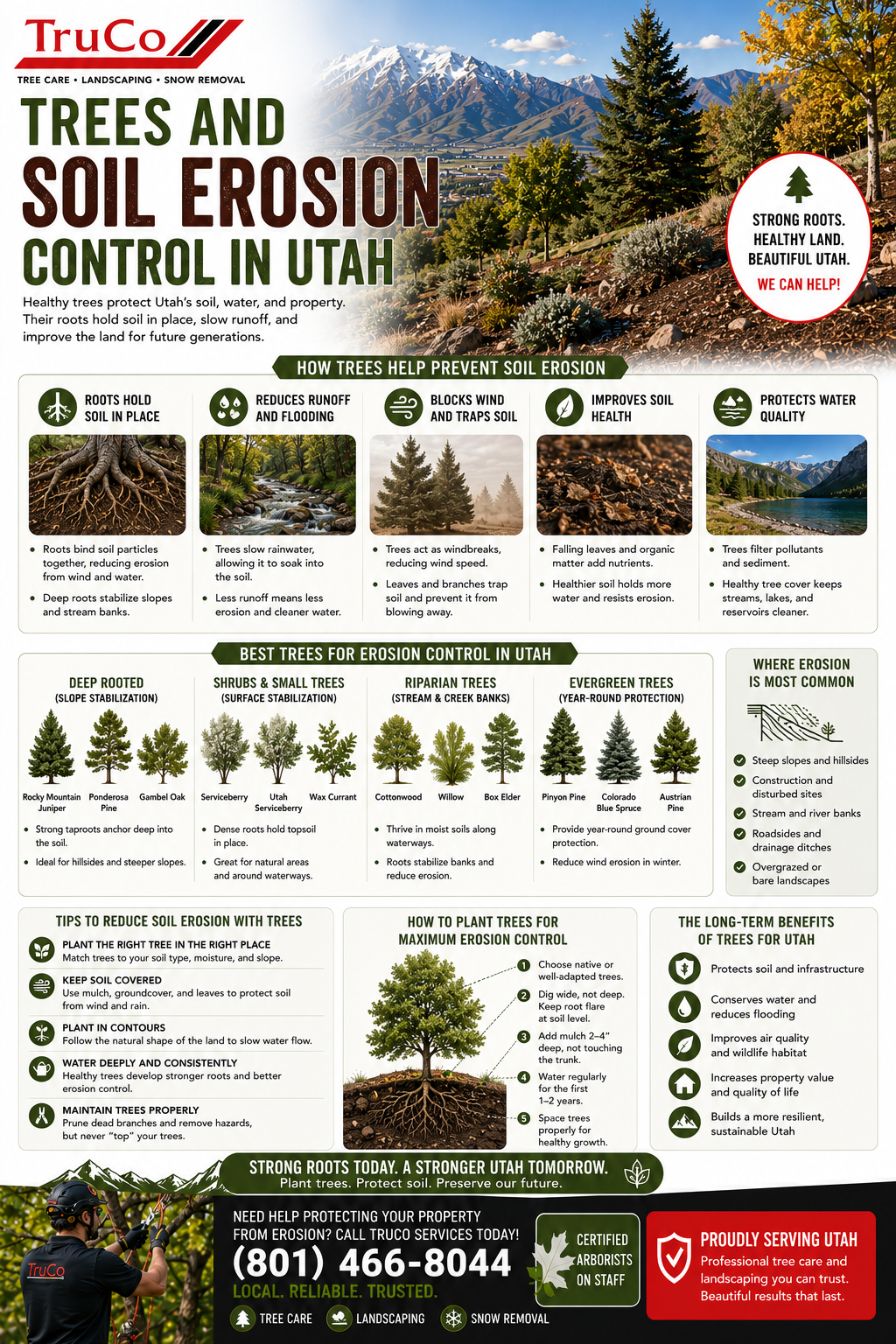
How Trees Prevent Soil Erosion in Utah
Soil erosion is a significant problem in many parts of Utah, from the steep foothills of the Wasatch Front to the exposed slopes of mountain subdivisions and the agricultural lands of rural counties. Trees are one of the most effective natural solutions for controlling soil erosion. Their root systems bind soil particles together, creating a network that holds soil in place even during heavy rain, snowmelt, and wind. Tree canopies intercept rainfall, reducing the impact of raindrops on bare soil and slowing water runoff. Fallen leaves and organic matter from trees build healthy soil structure that resists erosion. Windbreaks of trees reduce wind speed at ground level, preventing wind erosion of topsoil. In Utah, where intense summer thunderstorms, rapid spring snowmelt, and persistent winds can all cause erosion, strategic tree planting is an essential erosion control strategy. This guide covers how trees prevent erosion, the best tree species for erosion control in Utah, and how to design tree plantings for maximum erosion protection.
How Tree Roots Stabilize Soil
The root systems of trees are nature's soil stabilization network. Structural roots — the large, woody roots that radiate from the trunk — anchor the tree and create a physical framework that holds soil in place. These roots can extend 2-3 times the canopy width, creating a massive underground stabilization network. Fibrous roots — the fine, hair-like roots that absorb water and nutrients — create a dense mat that binds soil particles together. In the upper 6-12 inches of soil, this root mat is extremely effective at preventing surface erosion. Root depth varies by species and soil type. In Utah's clay soil, tree roots tend to grow wide and shallow (12-36 inches deep) rather than deep. This is actually beneficial for erosion control on slopes because most erosion occurs in the surface soil layer. Trees with dense, fibrous root systems (like willows, dogwoods, and serviceberry) provide the best erosion control. Trees with deep taproots (like bur oak and Kentucky coffeetree) add deep soil stability. A mix of both types provides the most comprehensive erosion protection. Root systems continue to grow and develop for the life of the tree. A 10-year-old tree has a much more effective erosion control root system than a newly planted tree. This is why preserving existing trees on slopes is more effective than planting new ones. In Utah, where steep terrain is common along the Wasatch Front, maintaining tree cover on slopes is essential for preventing soil loss and landslides.
Best Trees for Erosion Control in Utah
Several tree species are particularly effective for erosion control in Utah. Willows (Salix species) are the gold standard — they root readily from cuttings, grow fast, and develop dense, fibrous root systems. Coyote willow and Pacific willow are native Utah species. Excellent for streambank stabilization and erosion-prone wet areas. Redtwig dogwood (Cornus sericea) is a Utah native with dense fibrous roots and the ability to root from stems that touch the ground. Excellent for stabilizing slopes and streambanks. Serviceberry (Amelanchier species) produces dense root systems that stabilize soil. Utah natives that adapt to various soil conditions. Gambel oak (Quercus gambelii) spreads through root suckers to form dense thickets with extensive root systems. Excellent for stabilizing slopes in Utah's foothills. Extremely drought-tolerant once established. Narrowleaf cottonwood (Populus angustifolia) develops extensive root systems that stabilize streambanks and riparian areas. Good for erosion control in drainage areas. Curlleaf mountain mahogany (Cercocarpus ledifolius) develops a deep, extensive root system. Extremely drought-tolerant. Excellent for stabilizing dry, rocky slopes. Rocky Mountain juniper (Juniperus scopulorum) develops an extensive root system that holds soil on slopes. Dense evergreen foliage provides year-round erosion protection. For the most effective erosion control, plant a mix of species with different root types and growth rates.
Designing Tree Plantings for Erosion Control
Proper design maximizes erosion control benefits. Plant on contour — on slopes, plant trees along contour lines rather than up and down the slope. Contour planting creates natural barriers that slow water runoff and trap sediment. Use staggered spacing — plant in staggered rows rather than straight lines for more complete soil coverage. Create vegetation strips — on long slopes, plant trees in strips across the slope, alternating with shrubs and groundcovers. Each strip filters runoff. Combine trees with shrubs and groundcovers — a layered planting provides the most complete erosion protection. Plant native species — native Utah trees develop the most effective root systems for local soil types. Mix deep-rooted and shallow-rooted species — deep-rooted trees (oaks, pines) provide deep stabilization, while shallow-rooted trees (willows, dogwoods) provide surface erosion control. Space trees 6-12 feet apart for erosion control purposes. Closer spacing provides faster coverage. Consider water flow — plant trees where they will intercept and slow water runoff. On steep Utah slopes, terraces or check dams may be needed in addition to trees.
Erosion Control on Steep Slopes
Utah's steep foothill slopes require specialized approaches. The challenge — steep slopes (over 25%) experience rapid water runoff and thin soils. Before planting trees on steep slopes, stabilize the soil with erosion control blankets (jute, coir, or straw mats) that hold soil while trees establish. Install silt fences at the base of slopes. Plant trees on small terraces or in pocket plantings with berms on the downhill side to capture water. Use larger tree sizes with more developed root systems. Stake trees securely to prevent sliding. Install drip irrigation — steep slopes dry out quickly in Utah's climate. For species selection on steep slopes, choose willows, dogwoods, serviceberry, and Gambel oak — they have aggressive root systems that establish quickly. Avoid species with taproots that require deep soil on shallow, rocky slopes. Monitor trees on steep slopes regularly. Replace trees that die. Inspect erosion control measures after heavy rains. In Utah's foothill communities, steep slope erosion control is an ongoing challenge requiring professional expertise for severe problems.
Streambank and Riparian Erosion Control
Erosion along Utah's streams requires specialized approaches. Streambank erosion is caused by flowing water, which is more difficult to control than rainfall erosion. Trees along streambanks must withstand periodic flooding and saturated soil. Best trees for streambank erosion control include willows — the most effective streambank stabilizers. Root cuttings (live stakes) can be inserted directly into streambanks in spring and will root quickly. Dogwood spreads through layering and excels along streambanks. Narrowleaf cottonwood is a native streambank tree. Box elder tolerates wet conditions. For property owners with streams, maintaining a 50-100 foot buffer of trees and native vegetation along each side provides the most effective erosion control while also improving water quality and wildlife habitat. Avoid clearing trees from streambanks — the roots are holding the bank in place. In Utah, where streamflows increase dramatically during spring snowmelt, well-vegetated streambanks are essential.
Combining Trees with Other Erosion Control Methods
Combine tree planting with other methods for maximum effectiveness. Erosion control blankets (jute, coir, straw) hold soil in place while trees establish. Install on bare slopes before or immediately after planting. Terracing creates level planting areas on steep slopes. In Utah, terraced slopes are common in mountain subdivisions. Silt fences and check dams trap sediment while vegetation establishes. Retaining walls can create level planting areas on very steep slopes. Rain gardens and bioswales — planted depressions that capture stormwater runoff. Hydroseeding — spraying a mix of seed, mulch, and fertilizer onto slopes to establish groundcover while trees get established. The most effective strategy combines multiple methods. Trees provide long-term, deep soil stabilization, while temporary measures provide immediate protection. In Utah, where heavy rainstorms can cause rapid erosion, having both immediate and long-term control measures is essential. For complex erosion problems, consult the USDA Natural Resources Conservation Service, Utah Division of Water Quality, or a professional erosion control specialist.
Frequently Asked Questions
How quickly do trees control erosion in Utah? Trees begin controlling erosion immediately after planting, but full effectiveness takes 3-5 years. Combine with erosion control blankets for immediate protection while trees establish.
What is the fastest-growing tree for erosion control in Utah? Willows are fastest — they grow 6-10 feet per year and develop extensive root systems within 2-3 years. Cottonwood and poplar are also fast but need more moisture.
Can trees alone stop severe erosion on steep Utah slopes? On very steep slopes (over 30%) or with severe erosion, trees alone are usually not sufficient. Combine with terracing, erosion control blankets, and retaining walls. Consult a professional for severe problems.
How close should I plant trees for erosion control? Space trees 6-12 feet apart in staggered rows. Closer spacing provides faster coverage. Wider spacing allows larger individual trees. Adjust based on species and slope severity.
Do conifers control erosion as well as deciduous trees? Each has advantages. Deciduous trees often have more extensive fibrous roots for surface control. Conifers provide year-round protection and often have deeper roots. A mix of both is ideal.
Where can I get help with erosion control tree planting in Utah? Contact the USDA Natural Resources Conservation Service, Utah Division of Forestry, Fire and State Lands, or your local conservation district. Utah State University Extension has publications on erosion control vegetation.