
How Trees Improve Air Quality in Utah Communities

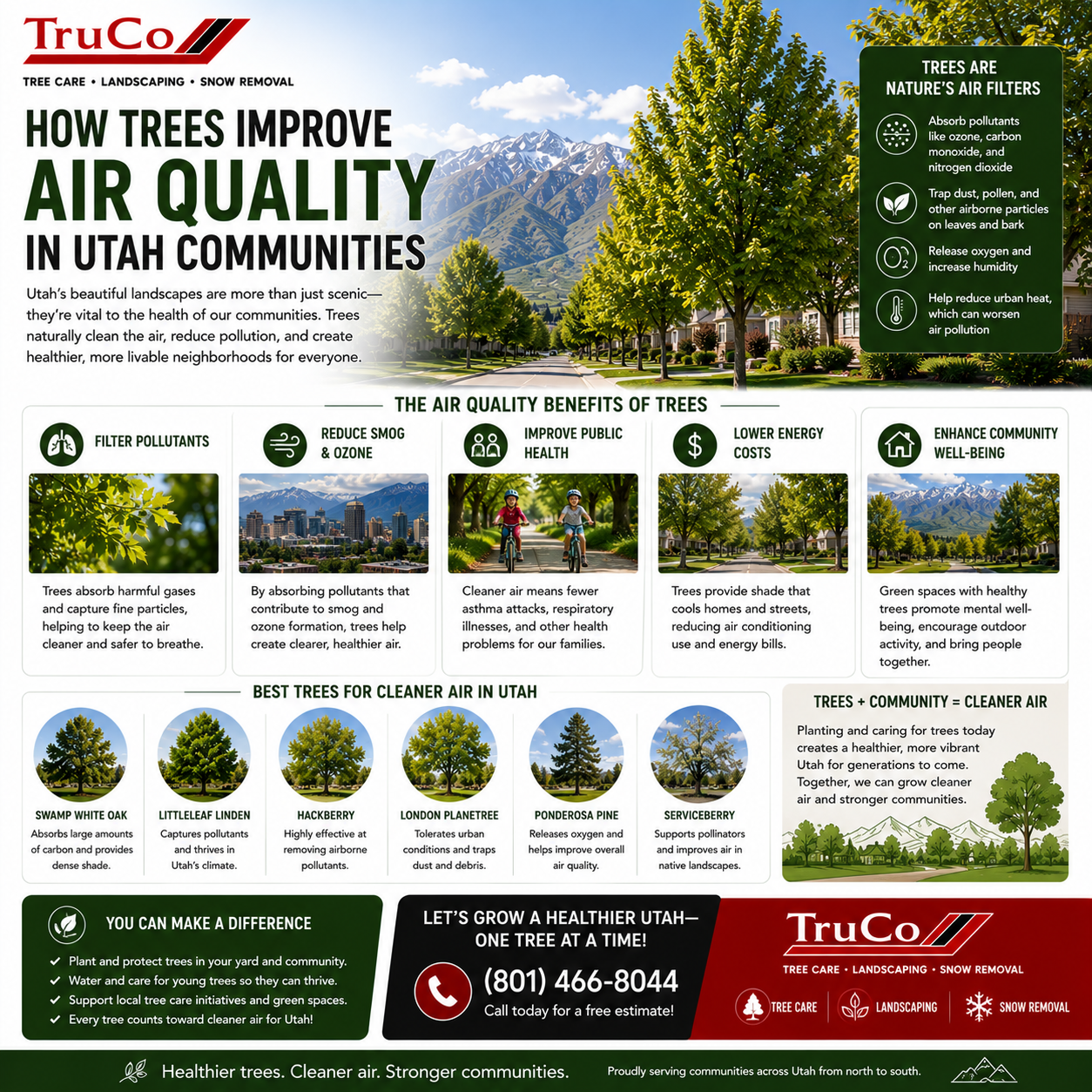
Utah's Air Quality Challenge and the Role of Trees
Utah faces significant air quality challenges, particularly along the Wasatch Front. Inversion events trap pollutants close to the ground, creating some of the worst winter air quality in the nation. During summer, ozone pollution from vehicles and industrial sources creates additional health concerns. Trees are a powerful, natural solution for improving air quality in Utah communities. Through photosynthesis, trees absorb carbon dioxide and release oxygen. But their air quality benefits go far beyond that — trees filter particulate matter, absorb gaseous pollutants, reduce ozone formation by cooling urban areas, and sequester carbon over their lifetimes. A single mature tree can remove up to 48 pounds of carbon dioxide and 1.3 pounds of other air pollutants from the air each year. For Utah's urban areas, strategic tree planting and preservation is one of the most cost-effective air quality improvement strategies available. Communities in Salt Lake Valley, Utah Valley, and Weber Valley all benefit from maintaining healthy urban tree canopies.
How Trees Filter Particulate Matter
Particulate matter (PM) is one of Utah's most dangerous air pollutants. Tiny particles (PM2.5 and PM10) penetrate deep into lungs, causing respiratory and cardiovascular problems. Trees act as natural air filters, capturing these particles on their leaf surfaces. The rough surfaces of leaves and bark trap particles, and rain washes them to the ground, where they are safely incorporated into the soil. Trees with hairy or rough leaf surfaces — such as oaks, elms, and lindens — are particularly effective at capturing particulate matter. Conifers with dense needle clusters also excel at filtering particles year-round, even during Utah's winter inversion season. Research shows that urban trees can reduce particulate matter concentrations by 7-24% in the immediate vicinity. A tree's filtering capacity increases with leaf surface area — a large, mature tree filters significantly more pollution than several small trees combined. This is why preserving mature trees in Utah's urban areas is critical for air quality.
Tree Cooling and the Urban Heat Island Effect
Trees reduce ground-level ozone by cooling urban environments. Ozone formation accelerates at high temperatures — every degree of temperature reduction decreases ozone formation potential. Trees provide shade that can reduce surface temperatures by 20-45°F and lower ambient air temperatures by 2-9°F through evapotranspiration. In Utah, where summer temperatures regularly exceed 95°F in the Salt Lake Valley, this cooling effect is significant. The urban heat island effect — where cities are 5-10°F hotter than surrounding rural areas due to heat absorption by buildings, pavement, and reduced vegetation — increases ozone formation. By shading buildings, trees reduce air conditioning energy use, which in turn reduces emissions from power plants. The U.S. Forest Service estimates that a well-placed shade tree can reduce household air conditioning costs by 15-35%. For Utah's growing communities, maintaining and expanding tree canopy cover is a practical strategy for reducing ozone pollution while also reducing energy consumption and improving comfort during our hot summers.
Carbon Sequestration by Utah's Urban Forest
Trees are natural carbon sinks, absorbing and storing carbon dioxide (CO2) throughout their lives. Utah's urban forest sequesters an estimated 100,000 tons of carbon annually, equivalent to taking 21,000 cars off the road. The amount of carbon a tree sequesters depends on its species, size, age, and health. Fast-growing trees like cottonwood and silver maple sequester carbon quickly but have shorter lifespans. Slower-growing trees like oaks and conifers sequester carbon more slowly but store it longer. A mature oak tree in Utah can sequester over 20 pounds of carbon per year. The carbon stored in a tree's wood remains locked away for the tree's entire life. When trees die and decompose, or when wood products are burned, the carbon returns to the atmosphere. This is why tree preservation and long-term tree health are important — a tree that lives 100 years provides far more carbon benefit than a short-lived tree that must be replaced multiple times. Planting diverse, long-lived tree species is the best strategy for maximizing carbon sequestration in Utah's communities.
The Best Trees for Air Quality in Utah
Some tree species are more effective air quality improvers than others, and Utah's climate limits which species will thrive. Top trees for air quality that do well in Utah include honeylocust (Gleditsia triacanthos inermis) — excellent for particulate capture, tolerates Utah's alkaline soil and urban conditions, and has a long lifespan; Kentucky coffeetree (Gymnocladus dioicus) — large leaf surface area for pollutant capture, extremely tough and adaptable to Utah conditions; bur oak (Quercus macrocarpa) — rough leaves are excellent for particulate capture, long-lived (200+ years), and handles Utah clay well; conifers like Austrian pine and Colorado spruce — filter particles year-round, critical during Utah's winter inversion season; littleleaf linden (Tilia cordata) — large, dense canopy with excellent pollutant capture, does well in Utah's climate; and red oak (Quercus rubra) — good pollutant capture, beautiful fall color, moderate tolerance of alkaline conditions. Fast-growing but shorter-lived trees like silver maple and cottonwood sequester carbon quickly but require replacement more often, potentially releasing stored carbon. A diverse mix of long-lived, well-adapted species provides the best long-term air quality benefits.
Strategic Tree Planting for Air Quality Benefits
Where you plant trees matters for air quality. Strategic tree placement maximizes pollution reduction benefits. Plant trees between pollution sources (roads, industrial areas) and sensitive receptors (homes, schools, hospitals) to create buffer zones. In Utah's inversion-prone valleys, this is particularly important. Dense tree plantings along roadsides can reduce vehicle emissions exposure by 50% or more for nearby residents. Plant trees to shade buildings — reducing energy use and associated power plant emissions. Place deciduous trees on south and west sides of buildings for summer shade while allowing winter sun through. Create windbreaks on the west side of urban areas to reduce dust and particulate transport. Prioritize planting in high-pollution areas — near schools, healthcare facilities, and along major transportation corridors. Utah's Tree Utah program and local conservation districts offer guidance and resources for strategic tree planting. The Salt Lake City Urban Forestry Master Plan identifies priority planting zones based on air quality, heat island, and equity considerations.
Economic and Health Benefits of Cleaner Air
The air quality benefits of trees translate directly into economic and health benefits for Utah communities. Reduced healthcare costs — cleaner air means fewer asthma attacks, fewer hospital admissions for respiratory conditions, and reduced cardiovascular problems. Utah has one of the highest asthma rates in the nation, and improving air quality through tree planting can make a measurable difference. Increased property values — homes in tree-rich neighborhoods sell for 3-15% more than comparable homes in areas with sparse tree cover. Energy savings — strategic tree planting reduces heating and cooling costs across communities, saving Utah residents and businesses millions annually. The U.S. Forest Service estimates that the air quality benefits of Utah's urban forest provide $10-20 million in annual pollution removal value. For every dollar spent on urban tree planting and maintenance, Utah communities receive $2-5 in environmental and health benefits. Despite these benefits, Utah's urban tree canopy is threatened by development pressure, drought stress, and pest outbreaks. Investing in tree preservation and planting is investing in Utah's air quality future.
How Utah Homeowners Can Contribute
Every Utah homeowner can contribute to better air quality through tree planting and care. Plant climate-appropriate trees that will thrive in Utah's alkaline soil and semi-arid climate. Choose tree species known for air quality benefits — oaks, honeylocust, lindens, and conifers. Plant trees in your yard's energy-smart locations — south and west sides for summer shade. Protect and preserve existing mature trees on your property — they provide the greatest air quality benefits. Maintain your trees properly — healthy trees with full canopies filter more pollution than stressed trees. Participate in community tree planting events through organizations like Tree Utah, the Utah Community Forest Council, or your city's tree planting program. Advocate for tree preservation during new development in your community. Support municipal forestry programs through your local government. Every tree planted in Utah's urban areas — whether in Salt Lake City, Ogden, Provo, or smaller communities along the Wasatch Front — makes a measurable contribution to cleaner air for everyone.
The Future of Urban Forestry in Utah
Utah's urban forests face challenges and opportunities. Development pressure threatens existing tree canopy in many communities. Drought stress from Utah's ongoing aridification affects tree health and survival. Pests like the emerald ash borer (approaching Utah) and ips beetle threaten specific tree species. However, awareness of trees' air quality benefits is growing. Communities across Utah are adopting urban forestry master plans, tree preservation ordinances, and canopy goals. The Utah Division of Forestry, Fire and State Lands provides technical assistance and grants for community forestry programs. The Salt Lake City goal of 30% tree canopy coverage by 2040 represents a significant commitment to leveraging trees for air quality improvement. New technologies — including airborne LiDAR and satellite imagery — help cities map and manage their tree canopy. Climate-adapted tree species selection, improved planting techniques, and better maintenance practices are extending the life of urban trees. For Utah's air quality, the most important step is preserving what we have — our existing mature trees — while planting new trees strategically for future benefits.
Frequently Asked Questions
Do trees really help with Utah's inversion air quality? Yes. While trees cannot eliminate inversion, they reduce particulate matter concentrations in their immediate vicinity and cool urban areas, which reduces ozone formation. Trees are most effective when planted strategically between pollution sources and populated areas.
How many trees does Salt Lake City need to improve air quality? Salt Lake City has a goal of 30% tree canopy coverage (currently about 18-20%). Each 5% increase in canopy cover can reduce local temperatures by 2-3°F and improve air quality measurably. Meeting the 30% goal would require planting an estimated 18,000-25,000 additional trees.
What is the best tree for air quality in Utah? Large, long-lived trees with rough leaf surfaces provide the greatest air quality benefits. Bur oak, honeylocust, Kentucky coffeetree, and conifers (Austrian pine, spruce) are excellent choices for Utah conditions. Plant a diverse mix for best results.
Do indoor plants improve indoor air quality? Some indoor plants can filter certain volatile organic compounds from indoor air. However, their air purification capacity is modest compared to outdoor trees. For significant indoor air quality improvement, focus on source control and ventilation.
Can trees reduce the health effects of air pollution? Research shows that neighborhoods with more tree cover have lower rates of respiratory illness, even after controlling for socioeconomic factors. Trees reduce exposure to pollutants and encourage outdoor physical activity, which improves overall health.
How long does a tree need to grow before it improves air quality? Trees begin filtering air from the time they leaf out. However, significant air quality benefits come from mature trees with full canopies. A tree planted today will reach its maximum air quality benefit in 15-30 years. This is why preserving mature trees is so important.