
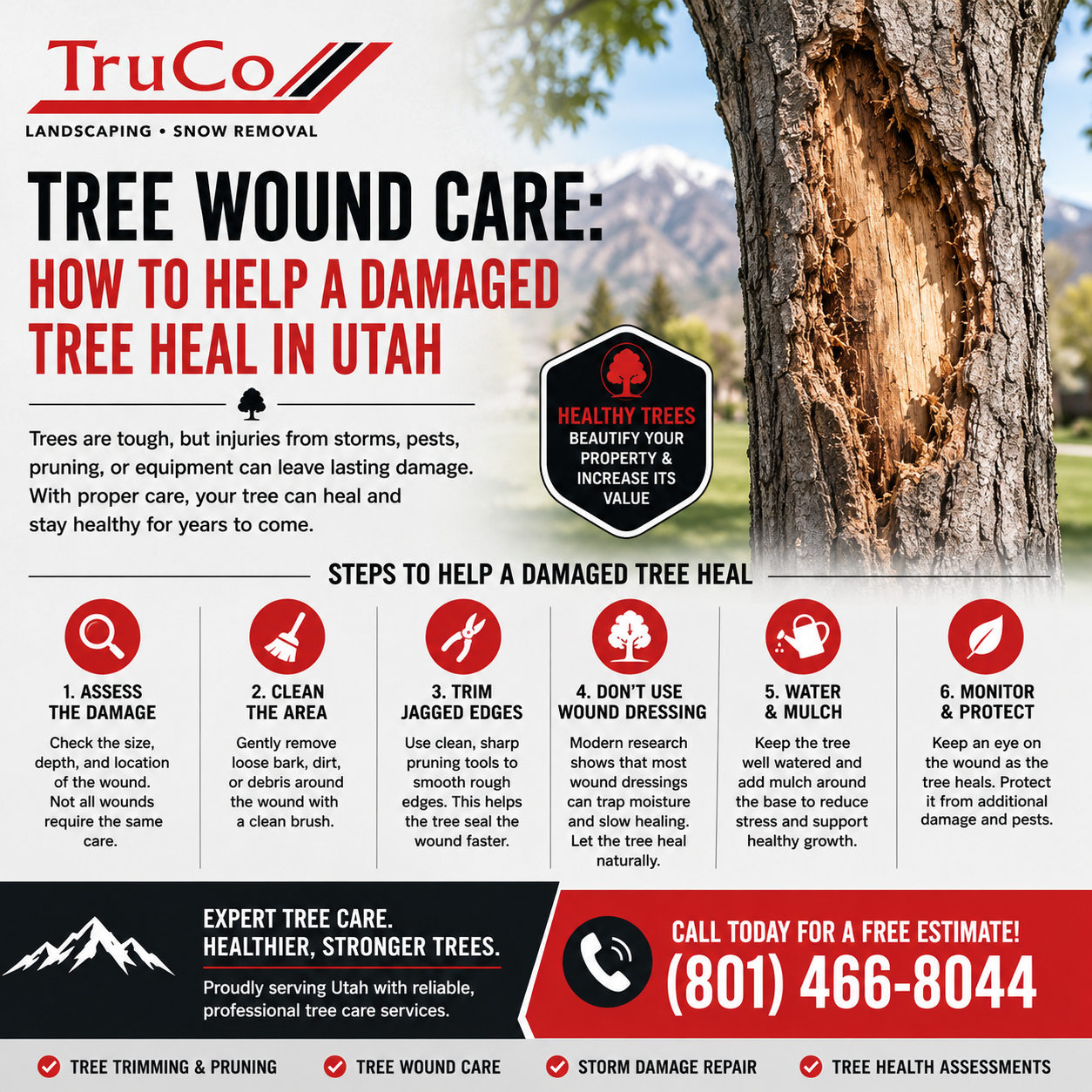
Tree Wound Care: How to Help a Damaged Tree Heal in Utah

How Trees Heal: CODIT Explained
Trees don't heal like humans — they isolate and seal off damaged tissue through a process called CODIT (Compartmentalization of Decay in Trees). Four walls of defense: Wall 1 resists vertical spread, Wall 2 resists inward spread, Wall 3 resists lateral spread, and Wall 4 forms new growth that seals the wound. The wound remains inside the tree forever but is walled off.
Why Wound Paint Is Harmful
Never use tar-based wound dressing. It seals in moisture (creating a perfect environment for rot in Utah's poorly draining clay soil), prevents natural sealing, can feed decay fungi, and looks bad. The exception: light application on oaks in areas with oak wilt — not relevant to Utah.
Proper Wound Cleaning
For clean pruning cuts at the branch collar: do nothing. For torn bark from storms: trace back to where firmly attached, cut loose bark in a smooth oval shape. For jagged breaks: recut just outside the branch collar. Do not use wire brushes, power tools, disinfectants, bleach, or alcohol on wounds.
Branch Collar Cuts
The branch collar is the raised ring where a branch joins the trunk. Cut just outside it — not flush with the trunk (removes healing tissue) and not leaving a stub (allows rot to reach trunk). For branches over 2 inches, use the three-cut method: undercut, top cut, then final cut at the branch collar.
Utah-Specific Damage
Hail storms in the Salt Lake Valley and Utah County shred leaves and strip bark — trees re-leaf within weeks. Construction damage in growing cities like Lehi and Saratoga Springs compacts soil and severs roots. Snow breakage from heavy wet spring snow affects silver maples, cottonwoods, and Bradford pear. String trimmer wounds accumulate and can girdle the tree — maintain a mulch ring instead.
Healing Time
1-inch wound: 1-3 years. 4-inch wound: 5-10+ years. Large trunk wounds may never fully seal. Maples seal slowly, oaks moderately, cottonwoods and aspens fast but with weaker wound wood. Young healthy trees seal faster.
Watch for Red Flags
Soft crumbly wood indicates decay. Fungal conks (shelf fungi) mean extensive internal decay. Cankers show the tree is struggling to compartmentalize. Callus roll failure creates target-shaped rings. Insect borers attacking the wound site mean defenses are compromised.
When to Call an Arborist
Wound over 6 inches on the trunk. More than 25% of trunk circumference damaged. Wound extends into root flare. Fungal conks present. Tree showing decline. Damage from lightning, vehicles, or construction. For high-value specimen trees.
Myth-Busting
Wound paint does not help — it harms. Trees survive large branch loss. Concrete in hollows accelerates decay. Summer pruning is fine. A large wound does not mean removal is needed — many wounded trees can be managed for decades.
Frequently Asked Questions
Should I paint pruning cuts? No. The tree seals naturally. Painting increases decay risk.
String trimmer damaged trunk? Clean loose bark with a sharp knife, don't paint. Use a mulch ring to prevent future damage. Call an arborist if >25% of circumference.
How long to recover from a broken branch? 2-3 inch wound: significant wound wood in one season, full seal in 2-4 years.
Construction damage? Call an arborist. May need aeration and root zone remediation. Do not fertilize.
Mushroom on trunk? Fungal conk — sign of internal decay. Have an arborist evaluate structural safety.
Can a tree survive with a hollow trunk? Yes. Many old trees survive for decades. Depends on remaining solid wood cylinder.