
Tree Suckers and Water Sprouts: Management Guide for Utah Trees

What Are Tree Suckers and Water Sprouts?
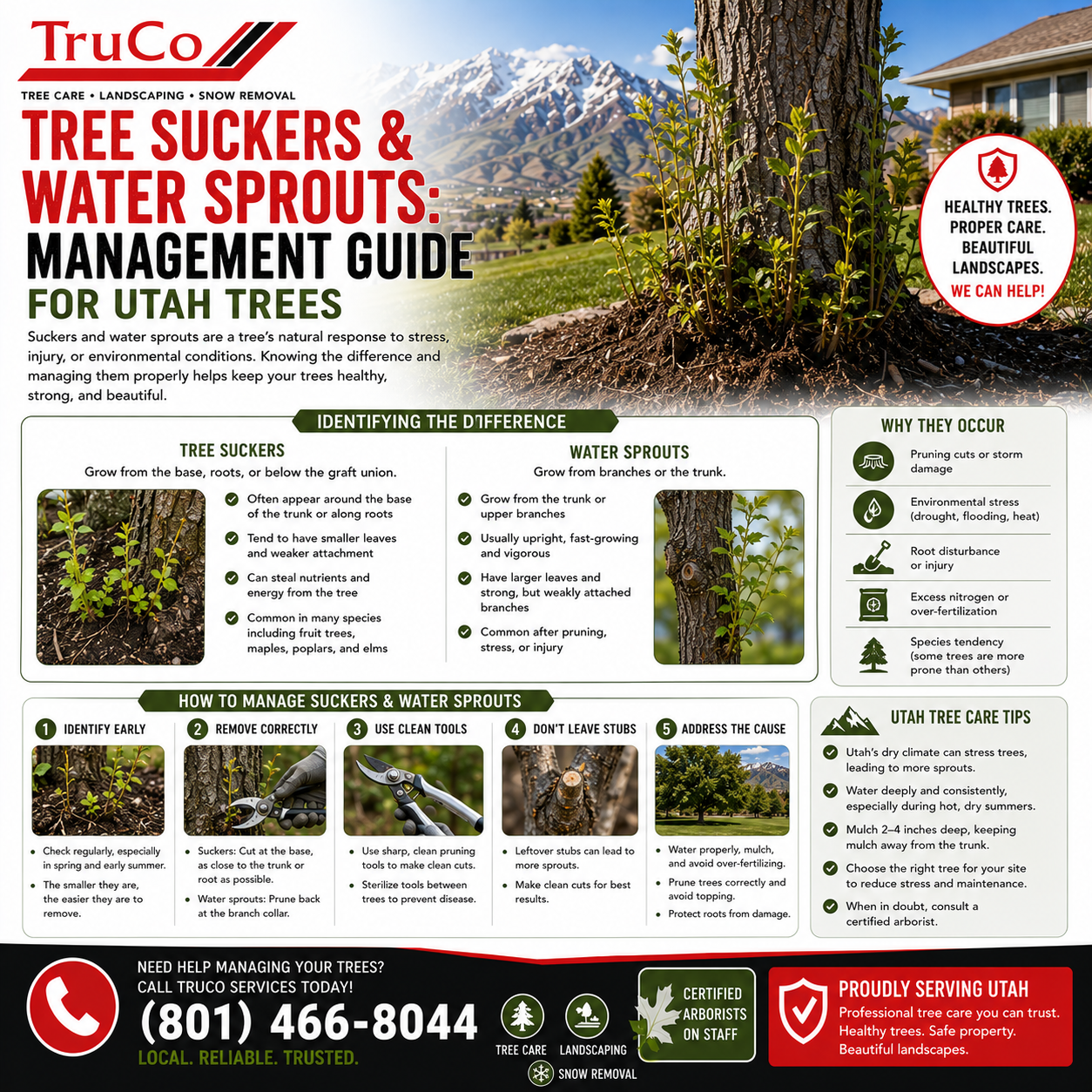
Tree suckers and water sprouts are vigorous shoots that grow from trees, often in response to stress, injury, or improper pruning. While they may look similar, they are different growth types with different causes and management strategies. Suckers grow from the root system or from the base of the trunk, below the graft union on grafted trees. They originate from adventitious buds on roots or the lower trunk. Water sprouts (also called epicormic shoots) grow from dormant buds on the trunk or branches, above the graft union. They shoot straight up, often in clusters, and grow very rapidly. Both suckers and water sprouts are common in Utah trees, particularly after heavy pruning, storm damage, or drought stress. While they are the tree's attempt to regenerate, they can cause structural problems if not managed properly. This guide covers the causes of sucker and water sprout growth, how to manage them, and when they indicate a more serious problem with your Utah trees.
Why Trees Produce Suckers and Water Sprouts
Trees produce these vigorous shoots in response to several conditions. Stress — drought, soil compaction, root damage, and disease all trigger sucker and water sprout production as the tree tries to compensate for lost foliage or root capacity. In Utah's climate, drought stress is a common trigger. Heavy pruning or topping — the most common cause of water sprouts. When a tree loses a large percentage of its canopy through improper pruning (topping) or storm damage, it produces water sprouts to quickly replace the lost foliage. This is why topping is so harmful — the resulting water sprouts are weakly attached and prone to failure. Root damage — construction, trenching, or soil compaction that damages roots triggers sucker production from the root system as the tree tries to regenerate. In Utah's growing communities, construction-related root damage is a common cause of sucker problems. Graft failure — on grafted trees, the rootstock may produce vigorous suckers if the graft union is failing or if the scion (top part) is stressed. This is common in fruit trees. Age — some species naturally produce more suckers as they age. Aspen, poplar, and Siberian elm are notorious for prolific suckering. Overfertilization — excessive nitrogen fertilizer can stimulate sucker and water sprout production, especially in fruit trees and vigorously growing species. Improper pruning — pruning cuts that are too large or improperly placed stimulate water sprout production near the cut. Following proper pruning techniques minimizes this response. Understanding the underlying cause is important — if you simply remove suckers without addressing the cause, they will continue to return.
Tree Species Prone to Suckering in Utah
Some tree species commonly planted in Utah are more prone to producing suckers and water sprouts than others. High suckering species include aspen (Populus tremuloides) — aspens naturally spread through root suckers and will sucker prolifically in landscapes. This is often a problem in Utah mountain communities where aspens are planted in lawns. Cottonwood and poplar (Populus species) — all poplars produce root suckers, especially when roots are disturbed or the tree is stressed. Siberian elm (Ulmus pumila) — notorious for prolific suckering from roots and trunk. One of the reasons this invasive species is so problematic. Black locust (Robinia pseudoacacia) — produces abundant root suckers, especially after injury. Invasive in many areas. Tree of heaven (Ailanthus altissima) — extremely prolific sucker producer. Invasive and difficult to control. Moderate suckering species include fruit trees (apple, pear, cherry, plum) — grafted fruit trees produce suckers from the rootstock, especially if the scion is stressed or the graft is planted too deep. Honeylocust (Gleditsia triacanthos) — produces some water sprouts after heavy pruning or stress, but less than other species. Oak (Quercus species) — produce water sprouts after heavy pruning or storm damage, especially on the trunk. Maple (Acer species) — produce water sprouts, especially after heavy pruning or topping. Low suckering species include Kentucky coffeetree (Gymnocladus dioicus) — rarely produces suckers or water sprouts. Bur oak (Quercus macrocarpa) — low sucker production. Conifers (pines, spruces, firs) — generally do not produce suckers or water sprouts (except from the rootstock on grafted specimens). If you are planting a new tree and want to avoid sucker problems, choose low-suckering species.
How to Remove Suckers and Water Sprouts
Proper removal technique prevents regrowth and damage to the tree. For root suckers — remove suckers as soon as they appear. Pull young suckers by hand when they are small (6-12 inches tall) — pulling removes the buds at the base that would otherwise regrow. For larger suckers, cut them as close to the root or trunk as possible using sharp pruning shears. Do not leave stubs. Cut suckers at ground level or slightly below. Suckers that emerge from roots away from the trunk should be cut to ground level. Removing the soil to expose the origin point and cutting at the base is most effective. For water sprouts on branches — remove water sprouts when they are small (6-12 inches). Cut them at their point of origin, flush with the parent branch. Do not leave stubs. For larger water sprouts on the trunk — remove them during the dormant season (winter) when the tree is not actively growing. Cut them flush with the trunk, taking care not to damage the trunk bark. Removing water sprouts in summer can stimulate more water sprout production. For persistent suckers — some trees (aspen, black locust, Siberian elm) will continue to produce suckers no matter how often you remove them. For these species, consider removal of the parent tree and replacement with a non-suckering species. Herbicide treatment of cut stumps may be necessary for invasive species like tree of heaven and black locust — consult a certified arborist. For grafted trees — suckers from below the graft union are from the rootstock and should always be removed. They will not have the desired characteristics of the grafted variety. If allowed to grow, they can overwhelm the scion. In Utah, the best time for sucker removal is late spring through summer when suckers are actively growing and easy to pull. However, removal can be done any time suckers are noticed. Prompt removal prevents suckers from diverting energy from the main tree.
Preventing Suckers and Water Sprouts
Prevention strategies reduce sucker and water sprout production. Proper pruning — follow ANSI A300 pruning standards. Never top a tree. Never remove more than 25% of live foliage in a single year. Use proper pruning cuts that minimize wound size and promote quick wound sealing. Proper pruning significantly reduces water sprout production. Maintain tree health — healthy trees produce fewer suckers and water sprouts. Water deeply during drought, mulch properly, and avoid soil compaction. In Utah's climate, drought stress is a major trigger — consistent deep watering during dry periods reduces sucker production. Avoid overfertilization — high-nitrogen fertilizers stimulate sucker and water sprout growth. Use slow-release, balanced fertilizers and follow soil test recommendations. In Utah's alkaline soil, excessive nitrogen is a common cause of sucker problems. Plant at the correct depth — trees planted too deep often produce suckers from the buried trunk. Ensure the root flare is visible after planting. Choose grafted trees with the graft union above ground level. Minimize root disturbance — avoid trenching, digging, or soil compaction within the root zone. If construction is necessary near trees, use tree protection zones and consult an arborist. In Utah's developing communities, root disturbance is a common but preventable cause of sucker problems. Remove invasive suckering species — if you have Siberian elm, tree of heaven, or black locust on your property, consider removing them and replacing with non-suckering alternatives. These species will continue to produce suckers indefinitely and are difficult to manage. Use proper species selection — when planting new trees, choose species with low sucker potential. This is especially important in small urban yards where sucker management is more difficult.
When Suckers Indicate a Serious Problem
While suckers and water sprouts are often just a nuisance, they can indicate serious problems. Graft failure — if a grafted tree suddenly produces suckers from the rootstock, the graft union may be failing. Check for signs of graft incompatibility — swelling at the graft union, different bark textures above and below the graft, or dieback in the scion. Consult an arborist. Root decay or damage — a ring of suckers around the base of a tree can indicate root decay or severe root damage. The tree is trying to regenerate its root system. Check for fungal conks (mushrooms) at the base, soil heaving, or other signs of root problems. Severe stress — if a tree that has never produced suckers suddenly produces water sprouts on the trunk and main branches, the tree is under severe stress. This could be from drought, soil compaction, pest infestation, or disease. Investigate the cause. Death of the main canopy — if the upper canopy dies back and the trunk produces water sprouts below the dead area, the tree is likely dying. The water sprouts are a last-ditch effort to survive. In most cases, the tree should be removed. Topping damage — if a topped tree produces a forest of water sprouts from each cut, the tree has been severely damaged. The water sprouts are weakly attached and will become hazardous as they grow. The tree should be evaluated by an arborist for possible removal or restoration pruning. If you notice any of these patterns, consult a certified arborist for a professional evaluation. Addressing the underlying problem early gives the best chance of saving the tree.
Managing Suckers in Specific Utah Situations
Sucker management varies by situation. Aspen groves in mountain landscapes — aspen naturally sucker and form clonal groves. In natural settings, this is desirable. In landscape settings, control suckers by mowing regularly within the aspen planting area, using landscape fabric and mulch to suppress sucker emergence, and watering deeply but infrequently (shallow water encourages sucker production). For persistent aspen suckering, some homeowners choose to remove aspens and replace with less suckering species. Fruit tree rootstock suckers — remove fruit tree suckers promptly, especially those emerging below the graft union. These rootstock suckers will not produce the desired fruit and will compete with the grafted variety. In Utah's fruit-growing regions (Brigham City, Payson), managing rootstock suckers is an annual task for fruit tree owners. Newly planted trees — do not remove all suckers from newly planted trees in the first year — a few suckers can help the tree establish faster. Remove only suckers that compete with the main leader or that emerge from the rootstock on grafted trees. Remove all suckers starting in year two. Invasive tree species — for Siberian elm, tree of heaven, and black locust, sucker management alone is usually futile. These species produce copious suckers from extensive root systems. Complete removal of the parent tree and root system, often with herbicide treatment, is the only effective control. Consult a certified arborist for invasive species removal. Urban park strip trees — trees planted in narrow park strips (between sidewalk and street) often produce suckers due to confined root space and soil compaction. Choose low-suckering species for park strip plantings. Remove suckers promptly to maintain tree appearance and health.
Frequently Asked Questions
Can I use herbicide to kill tree suckers? Herbicide can be used for invasive species but should be applied carefully to avoid damaging the parent tree. For most landscape trees, mechanical removal (pulling or cutting) is safer and effective. For invasive species like tree of heaven, cut-stump herbicide treatment may be necessary.
Will removing suckers harm my tree? No. Removing suckers is beneficial for the tree — it redirects energy to the main canopy. However, avoid removing more than 25% of live foliage in any pruning session. Sucker removal is a low-stress activity that can be done regularly.
Why does my tree produce more suckers after I cut them? This is a common response in some species. Cutting suckers stimulates more sucker production because the tree perceives the cutting as a threat. Pulling suckers by hand (which removes the basal buds) is more effective than cutting for reducing regrowth. Persistence is key — regular removal weakens the sucker-producing buds over time.
Should I remove water sprouts from my oak tree? Yes, but selectively. Remove water sprouts on the trunk and main branches. However, if the tree has recently lost a large branch or suffered storm damage, leave some water sprouts on the remaining branches to help the tree recover. Consult an arborist for guidance on your specific tree.
What is the difference between a sucker and a branch? Suckers grow from roots or the base of the trunk, have different bark and leaf characteristics than the main tree (on grafted trees, rootstock suckers look different), and grow much faster than normal branches. Water sprouts grow straight up from branches or trunk, in clusters, at unnatural angles, and grow very rapidly compared to normal branches.
Do tree suckers mean my tree is dying? Not necessarily. Isolated suckers after pruning or minor stress are normal. However, a sudden increase in sucker production, especially on the trunk and main branches (water sprouts), can indicate significant stress or decline. Observe the tree for other symptoms and consult an arborist if concerned.