
Tree Safety Tips for Protecting Your Utah Property

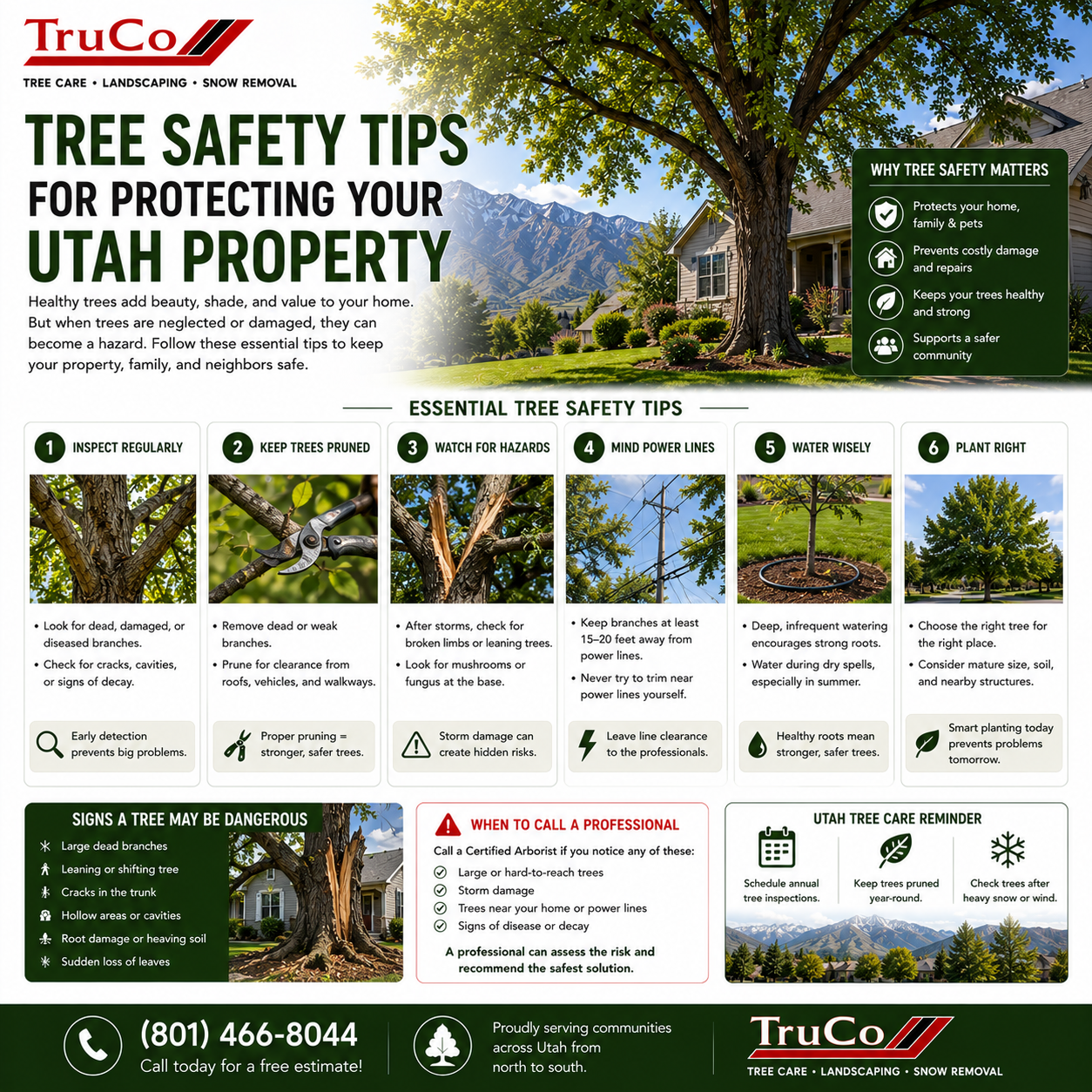
Why Tree Safety Matters for Utah Homeowners
Tree safety is a critical concern for every Utah homeowner. Trees provide shade, beauty, and value to your property, but they can also pose serious risks if not properly maintained. In Utah's challenging climate — heavy snow loads, spring windstorms, summer drought, and freeze-thaw cycles — tree failures are common. A falling tree or large branch can cause thousands of dollars in property damage, personal injury, or worse. Understanding tree hazards, recognizing warning signs, and taking proactive safety measures can protect your family, your home, and your investment. Utah sees tree-related property damage claims totaling millions of dollars annually, many of which could be prevented with proper tree care and regular inspections. This guide covers the essential tree safety practices every Utah property owner should know.
Common Tree Hazards in Utah
Several tree hazards are particularly common in Utah. Dead or dying trees are the most obvious hazard — a dead tree has no flexibility and can fail at any time, especially during wind or snow events. Cracked or split trunks indicate structural weakness that may lead to catastrophic failure. Codominant stems (two or more main trunks growing from the same point) are prone to splitting, especially when they have included bark (bark growing inward between the stems). Large dead branches ("widow-makers") in the canopy can fall without warning. Leaning trees, especially those with recent lean change or exposed roots on the uphill side, are unstable. Decayed roots or trunk from fungal infections compromise structural integrity. Heavy end-weight branches with dense foliage or wet snow accumulation can snap. Trees with root damage from construction, trenching, or soil compaction are prone to failure. Utah's combination of heavy clay soil (poor root anchorage) and extreme weather makes these hazards especially dangerous.
How to Inspect Your Trees for Safety
Regular tree inspections are your first line of defense. You can perform a basic visual inspection yourself, but a certified arborist should evaluate any tree you are concerned about. Walk around your trees and look for these warning signs: cracks or splits in the trunk or major limbs, cavities or hollow areas in the trunk, fungal conks or mushrooms growing on the trunk or roots (indicating internal decay), dead branches in the canopy, V-shaped branch unions with included bark (weaker than U-shaped unions), recent lean or soil heaving at the base, exposed or damaged roots from construction or lawn equipment, trunk wounds from lawnmowers or weed trimmers, and branches that cross or rub against each other. Inspect after every major storm in Utah, particularly after spring windstorms and heavy snow events. The dormant season (winter) is an excellent time for a thorough inspection because leaves are gone and branch structure is visible. Pay special attention to trees near your house, garage, driveway, and play areas.
Snow and Ice Damage Prevention
Utah's heavy snow is one of the biggest threats to trees. Wet, heavy snow can accumulate on branches, causing them to bend, crack, or break. Prevention starts with proper pruning — maintain good branch structure with wide branch angles, thin dense canopies to reduce snow catchment, and remove branches with poor attachment. Do not shake snow off branches by hitting them — this can cause more damage than the snow itself. Instead, gently brush snow upward off branches using a broom (pulling down adds more weight and can break branches). For small trees and shrubs, carefully brush snow off after each storm before it compacts and freezes. For large trees, focus on keeping branches away from your house and vehicles. If a tree has a history of snow damage, consider cabling or bracing support for weak branch unions. In Utah's mountain communities like Park City and Heber Valley, where annual snowfall exceeds 200 inches, preventive pruning and structural support are essential for tree safety.
Windstorm Preparedness for Utah Trees
Utah's spring windstorms can bring gusts of 60-80 mph or more, particularly through canyons and along the Wasatch Front. Preparing your trees for windstorms reduces the risk of failure. Key preparations include removing dead, dying, and weakly attached branches before wind season; thinning dense canopies to allow wind to pass through rather than pushing against a solid sail; reducing end-weight on long, horizontal branches; checking for and addressing root problems that reduce anchorage; and cabling vulnerable trees with structural weaknesses. After a windstorm, inspect trees for new damage — cracks, splits, leaning, or hanging branches. Address any damage promptly, as weakened branches may fail in subsequent storms. Utah's wind patterns vary by location — the benches and east bench areas often experience stronger winds, while valley floors may be more sheltered. Trees that have survived many Utah winters with minimal pruning are often better wind-resistant than heavily pruned trees with dense regrowth.
Tree Safety Near Your Home
Trees near your house require special attention. Maintain at least 10 feet of clearance between tree branches and your roof. Overhanging branches can damage roofing, deposit leaves in gutters, and provide access for rodents and squirrels. More importantly, a branch falling on your roof can cause thousands of dollars in damage. Remove branches that rub against the house, siding, or windows — the constant friction damages both the tree and your home. Keep trees at least 5-10 feet from chimneys (sparks and heat can ignite branches). Ensure trees near driveways and walkways have adequate clearance — at least 14 feet over driveways and 8 feet over sidewalks. Watch for roots that may damage foundations, driveways, or walkways. In Utah's clay soil, shallow roots can heave pavement and create tripping hazards. If you are concerned about a tree near your home, have a certified arborist evaluate the tree and recommend appropriate actions.
Tree Safety for Children and Pets
Families with children and pets need to be especially vigilant about tree safety. Regularly inspect trees in play areas, near swing sets, and along paths children use. Remove any dead branches above play areas immediately. Teach children not to climb trees with obvious hazards — dead branches, cracks, or decay. Be aware that Utah's cottonwood trees are notorious for dropping large branches without warning, especially older specimens. Keep children away from cottonwoods during wind events. Check tree wells and root zones for hazards like protruding roots that children can trip over. If you install a tree house or swing, avoid damaging the tree — use straps rather than bolts or nails that can introduce decay. Monitor the tree for signs of stress from the added weight and activity. For pet owners, watch for toxic trees — black walnut, yew, and some ornamental fruit trees can be harmful to dogs if they eat leaves, bark, or nuts. Know what trees are in your yard and their potential risks to your four-legged family members.
Emergency Tree Response Plan
Every Utah homeowner should have a tree emergency plan. Identify which trees on your property pose the greatest risk if they fail (those closest to structures, driveways, and gathering areas). Save the contact information for a qualified tree service that offers 24/7 emergency response. Rocky Mountain Power's emergency line (1-888-221-7070) for trees contacting power lines. Have your homeowner's insurance information readily available — most policies cover tree damage but have specific requirements and deductibles. Know where your gas shut-off valve is located in case a tree hits a gas line. Document tree damage with photos for insurance claims. Do not attempt to remove large fallen trees yourself — downed trees may be under tension and can spring back unpredictably. Professional tree services have the equipment and training to handle emergency removals safely. In Utah, spring and winter are the most common times for tree emergencies, so prepare before storm season arrives.
When to Call a Professional Arborist
Some tree safety issues require professional assessment. Call a certified arborist if you notice any of these signs: a tree with more than one major trunk (codominant stems) near your house, a tree leaning more than 15 degrees from vertical (especially if the lean is recent), cavities or decay visible on the trunk or major branches, mushrooms or conks growing on the tree (indicating internal decay), dead branches in the canopy that you cannot reach safely from the ground, cracks or splits extending deep into the trunk, any tree near a power line, trees that dropped branches without apparent cause, and trees with known root damage from construction or trenching. A certified arborist will conduct a thorough risk assessment and provide recommendations for mitigation — which may include pruning, cabling, monitoring, or removal. The cost of an assessment ($150-$400) is far less than the potential cost of tree-caused property damage ($5,000-$50,000 or more for major damage). In Utah's urban areas, including Salt Lake City, Sandy, and Provo, many certified arborists offer free initial consultations for tree safety concerns.
Frequently Asked Questions
How often should I have my trees inspected for safety? Annually by a certified arborist. Additionally, inspect after every major storm. Trees near your house or high-use areas should be inspected twice per year — once in spring and once in fall.
Can a healthy tree fall? Yes. Even healthy trees can fail in extreme weather conditions, if soil becomes saturated and roots lose their grip, or if the tree has hidden defects that are not visible during routine inspection. No tree is 100% safe.
Is it safe to hang a swing from a tree branch? Only if the branch is healthy, well-attached, and large enough. A branch should be at least 6-8 inches in diameter for a single swing. Use straps, not ropes or chains that can girdle the branch. Have the tree inspected before installing a swing.
Will my homeowner's insurance cover tree damage? Most Utah homeowner's policies cover tree damage to structures (with a deductible). Damage to fences, sheds, and landscaping may have limited coverage. Some policies exclude damage from trees in poor condition. Review your policy annually.
What should I do if a tree falls on my house? Evacuate if the structure is unsafe. Document damage with photos. Contact your insurance company. Have a professional tree service remove the tree from your house. Do not attempt to remove it yourself.
Are some tree species more dangerous than others in Utah? Yes. Cottonwoods, silver maples, and Siberian elms are among the most hazardous species due to weak wood, brittle branches, and susceptibility to decay. Large poplars and willows also have high failure rates. These species should be inspected more frequently.