
How Tree Roots Affect Retaining Walls in Utah

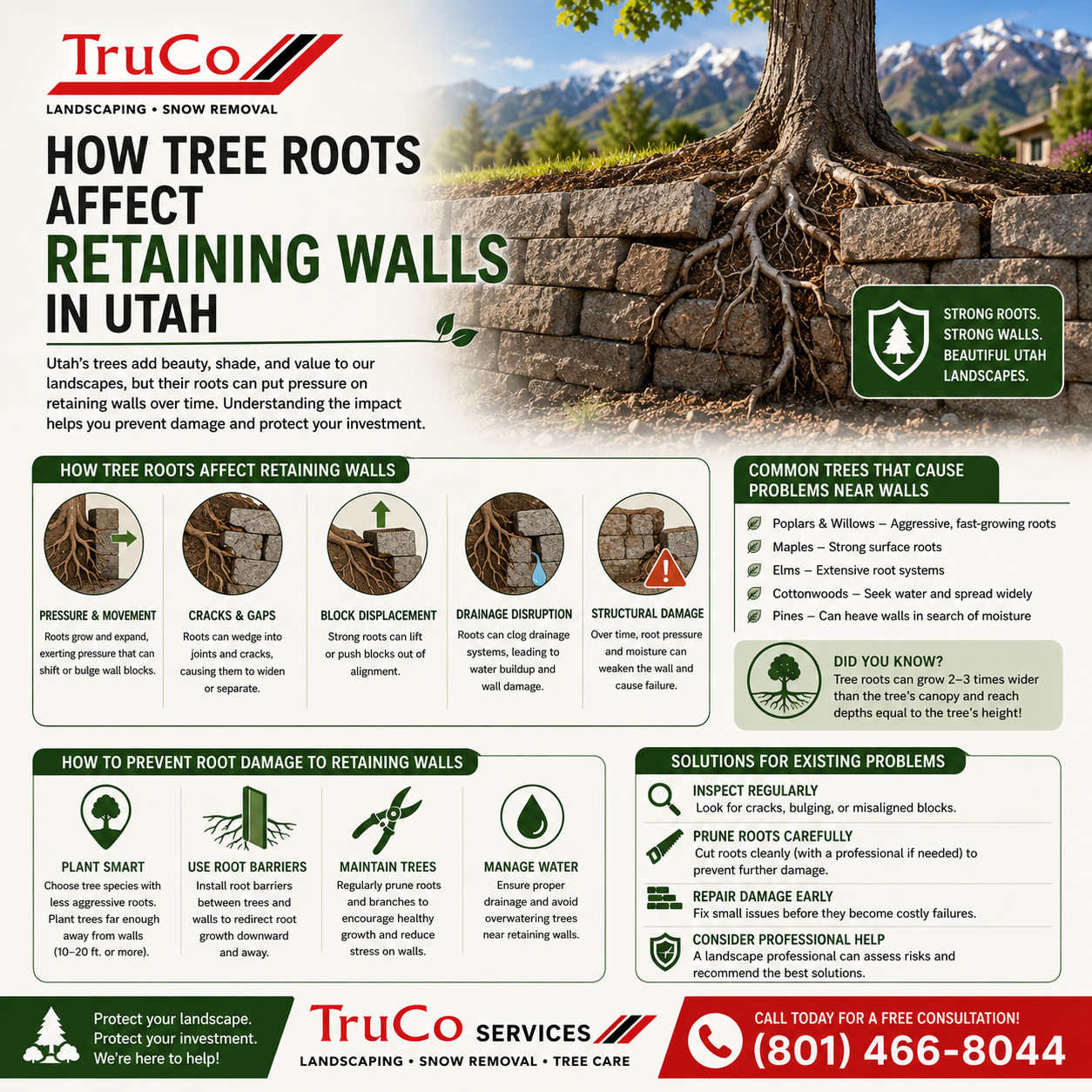
Understanding Tree Root and Retaining Wall Interactions in Utah
Retaining walls are a common feature on Utah properties, especially in the foothill communities along the Wasatch Front where sloped lots are the norm. Trees near retaining walls create a complex interaction that can affect both the wall and the tree. Tree roots naturally grow toward sources of water, nutrients, and oxygen. When a retaining wall is built, it changes the soil environment: it alters drainage patterns, creates soil compaction behind the wall, and may create barriers that redirect root growth. In Utah's clay soils, where roots tend to grow wide and shallow, the interaction between tree roots and retaining walls is particularly significant. Roots can exert pressure on walls, potentially causing displacement or damage. Conversely, retaining walls can damage trees by severing roots during construction or by altering water drainage patterns. Understanding these interactions is essential for Utah homeowners planning retaining walls near existing trees, or planting trees near existing walls. This guide covers how roots and walls interact, how to prevent problems, and how to address existing issues.
How Tree Roots Can Damage Retaining Walls
Tree roots can damage retaining walls in several ways, particularly in Utah's clay soil conditions. Root pressure — as tree roots grow in diameter, they can exert significant pressure on retaining walls. A root that is 1 inch in diameter can generate over 100 pounds of force as it expands. Roots growing against a wall can crack concrete, displace blocks, or push wall sections outward. In Utah's clay soil, roots are especially likely to grow along the back of retaining walls because the looser, more aerated backfill provides an ideal growing environment. Moisture changes — tree roots extract moisture from the soil behind retaining walls. In Utah's dry climate, this moisture extraction can cause clay soil to shrink, creating voids behind the wall. These voids can lead to wall settlement or collapse. Conversely, roots can also trap moisture against the wall, accelerating freeze-thaw damage in Utah's cold winters. Drainage interference — roots can clog drainage systems (weep holes, drain pipes) behind retaining walls. When drainage is blocked, water pressure builds up behind the wall, potentially causing wall failure. In Utah's spring runoff season, this is a serious concern. Soil displacement — large roots growing behind a wall can displace soil, causing bulging or leaning. In extreme cases, root growth has been known to topple retaining walls. Species matters — some tree species are more likely to cause wall damage than others. Large, fast-growing trees with aggressive root systems (willows, poplars, silver maple) pose the greatest risk. Slow-growing trees with deep root systems (oaks, Kentucky coffeetree) pose less risk.
How Retaining Walls Can Affect Tree Health
Retaining walls can also damage trees, sometimes severely. Root severance — building a retaining wall typically requires excavation that severs tree roots. Cutting roots within the critical root zone (the area under the tree canopy) can destabilize the tree and reduce its ability to absorb water and nutrients. In Utah, roots cut during wall construction often lead to tree decline or death within 3-5 years. This is a common problem in hillside developments in Salt Lake and Utah Counties. Soil compaction — heavy equipment used to build retaining walls compacts soil in the root zone. Utah's clay soil is especially vulnerable to compaction, which reduces oxygen availability and restricts root growth. Compaction damage can take decades to reverse. Grade changes — retaining walls change the soil grade around trees. Adding soil above existing roots (fill) suffocates them. Removing soil (cut) exposes and damages roots. Both can seriously harm or kill trees. In Utah, grade changes are a leading cause of death in preserved trees during construction. Drainage changes — walls redirect water flow, potentially creating wet areas that promote root rot or dry areas that cause drought stress. In Utah's variable climate, both conditions can occur within a single season. Heat reflection — walls, especially those made of concrete or stone, reflect heat onto nearby trees. In Utah's summer, this can cause leaf scorch and increased water needs on the south and west sides of trees. Root confinement — walls can trap roots in a confined space, leading to circling roots, girdling roots, and ultimately tree decline or failure.
Preventing Problems Between Trees and Retaining Walls
Planning ahead prevents most tree-wall conflicts. The best approach is to maintain adequate distance between trees and walls. For small retaining walls (under 4 feet tall), maintain at least 5-10 feet between the wall and any significant tree. For large trees or walls over 4 feet tall, maintain at least 10-15 feet of distance. These distances allow roots to grow beneath the wall rather than against it. When building a new retaining wall near existing trees: have a certified arborist assess the tree's root zone before construction; use a root barrier system installed between the tree and the wall to direct roots downward; install deep wall footings (below the root zone, typically 24-36 inches deep in Utah) to prevent roots from growing under and lifting the wall; use mechanical excavation methods (air spade or hydro excavation) within the tree's root zone to minimize root damage; and install proper drainage behind the wall to prevent water buildup. When planting trees near existing retaining walls: choose tree species with non-aggressive root systems — oaks, Japanese tree lilac, crabapple, serviceberry, and honeylocust are good choices; avoid planting trees with aggressive roots (willow, poplar, silver maple) within 15 feet of any retaining wall; plant trees at least half the mature canopy width away from the wall; and install root barriers at planting time if the tree will be close to the wall. For existing conflicts, consult both a structural engineer (for wall assessment) and a certified arborist (for tree assessment) to develop a management plan.
How to Install a Tree-Friendly Retaining Wall
If you're building a retaining wall near trees in Utah, follow these tree-friendly practices. Phase 1: Pre-construction assessment. Have a certified arborist map the tree's critical root zone (CRZ). Identify major roots that must be preserved. Determine the minimum distance from the tree that excavation can occur without causing irreversible damage. This may affect wall placement and design. Phase 2: Wall design. Consider a tiered wall system — multiple shorter walls rather than one tall wall. Tiered walls require less excavation, disturb fewer roots, and distribute root pressure across multiple levels. Use a cantilevered or reinforced wall design that places the wall's footing outside the tree's CRZ. If the wall must pass through the CRZ, use pier-and-beam or post-and-panel construction that minimizes excavation and allows roots to grow between supports. Phase 3: Construction. Use air spade or hand digging within the CRZ to expose and preserve major roots. Cut only roots under 1 inch in diameter; preserve larger roots. Install root barriers along the wall to direct roots downward. Use permeable backfill material behind the wall to promote drainage and root movement. Install drainage systems (perforated pipe, gravel drains) that accommodate future root growth. Phase 4: Post-construction care. Water the tree deeply immediately after construction and regularly for the first year. Apply 2-4 inches of organic mulch over the CRZ. Monitor the tree for signs of stress (leaf drop, dieback, reduced growth) for at least 2 years. Have the arborist conduct a follow-up assessment 12 months after construction.
Retaining Wall Materials and Tree Compatibility
Some retaining wall materials are more tree-friendly than others. Segmental concrete block walls are modular and can flex slightly with root pressure, reducing the risk of cracking. Individual blocks can be removed and adjusted if roots cause problems. However, block walls may have more joints for roots to penetrate. Poured concrete walls are strong and durable but rigid. Cracks from root pressure can be difficult and expensive to repair. Best used at maximum distance from significant trees. Natural stone walls (dry stack or mortared) have flexible, natural appearance. Dry-stack stone walls allow some root and water movement. Mortared stone walls are less flexible. Stone walls can be aesthetically pleasing in Utah's natural landscape. Timber walls (railroad ties, landscape timbers) are least expensive but least durable. Roots can displace timbers over time. In Utah's climate, timber walls typically last 10-15 years. Gabion walls (wire cages filled with stone) are very permeable and tree-friendly. Allow excellent drainage and some root movement. Can accommodate root growth better than solid walls. Often used for large-scale projects.
For most Utah properties with significant trees, segmental concrete block or natural stone walls offer the best combination of durability, flexibility, and tree compatibility. When in doubt, consult both an arborist and a structural engineer for site-specific recommendations.
Frequently Asked Questions
Will tree roots damage my retaining wall in Utah? It depends on the tree species, distance from the wall, wall type, and soil conditions. Large trees with aggressive root systems (willow, poplar, silver maple) can damage walls if planted too close. Slow-growing trees with deep roots (oaks, honeylocust) are less likely to cause problems.
How close can I plant a tree to a retaining wall? Plant trees at least half the mature canopy width away from retaining walls. For small trees, maintain 5-10 feet of distance. For large trees, maintain 10-15 feet minimum. Greater distance provides better protection for both the tree and the wall.
Can I build a retaining wall near an existing tree without killing it? Yes, but it requires careful planning and tree-friendly construction techniques. Have an arborist assess the tree's root zone before building. Use air spade excavation, minimize root cutting, and provide post-construction care. Some root damage is unavoidable, but a healthy tree can recover.
What is a root barrier and does it work for retaining walls? A root barrier is a physical or chemical barrier installed in the soil to redirect root growth. Physical barriers (rigid plastic or metal panels) are most effective for retaining walls. Installed between the tree and wall, they direct roots downward below the wall's base. Proper installation is critical for effectiveness.
Should I remove a tree that is damaging my retaining wall? Not necessarily. Consult an arborist and structural engineer first. Options include: installing a root barrier, pruning problematic roots (by an arborist), reinforcing the wall, or relocating the wall. Tree removal should be the last resort, especially for large, healthy, or specimen trees.