
Tree Pruning Guide: When, Why, and How to Prune Each Utah Tree Species

Why Pruning Matters in Utah
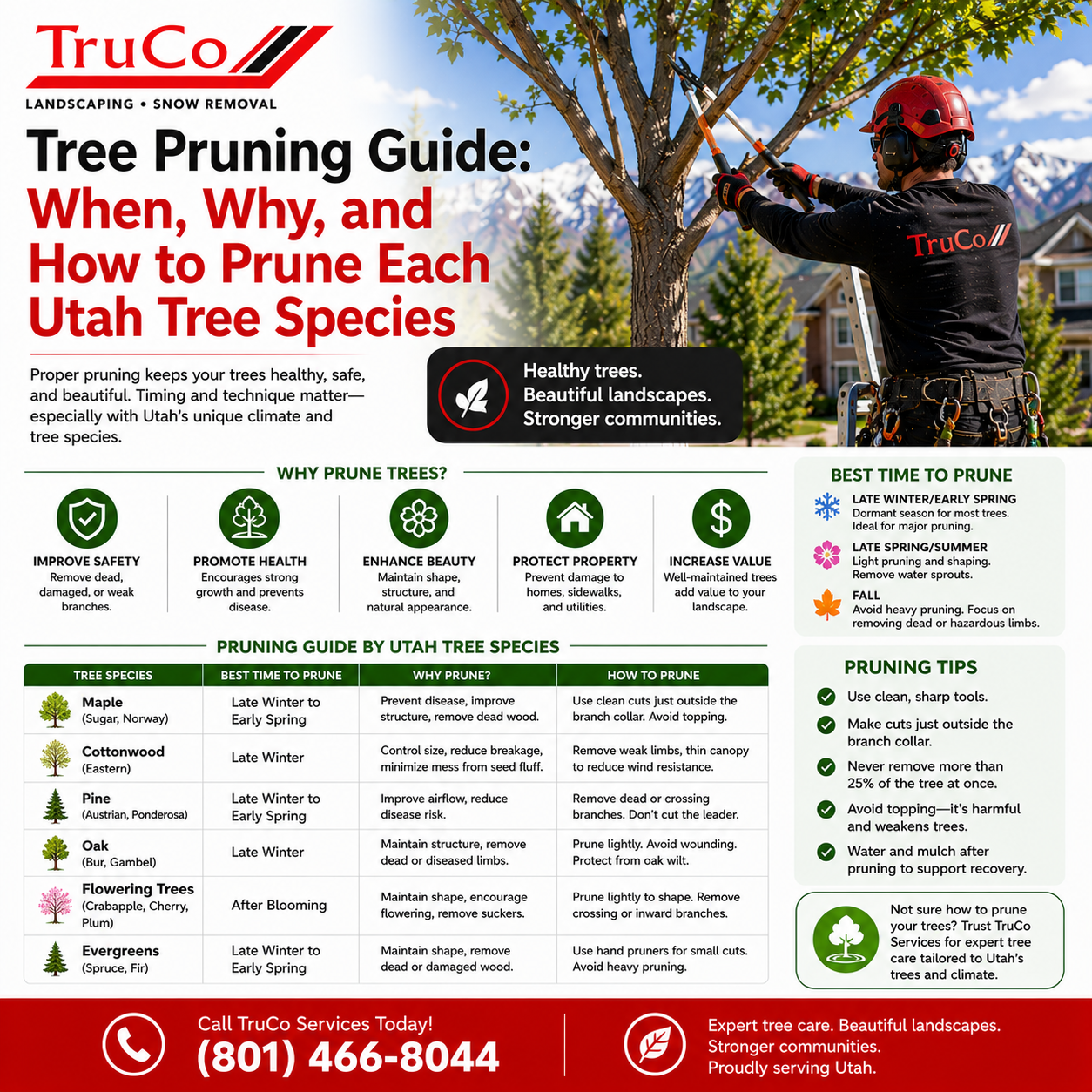
Proper pruning is the single most important thing you can do for your trees' health and safety. In Utah's challenging climate — with heavy snow loads, spring windstorms, and summer drought — well-pruned trees are more resilient, longer-lived, and less likely to fail. This guide covers when, why, and how to prune each common Utah tree species, following best practices from certified arborists.
The Basics: Pruning Cuts Every Homeowner Should Know
Three types of cuts matter. The branch collar cut removes a branch at its origin, preserving the collar (swollen ring of tissue) that produces wound wood to seal the cut. This is the most common and correct pruning cut. The thinning cut removes a branch at its origin to open the canopy without changing the tree's natural shape. The reduction cut shortens a branch to a lateral branch that is at least one-third the diameter of the cut branch. Never make flush cuts (cutting parallel to the trunk, removing the collar) — they remove the tree's natural healing mechanism. Never leave stubs — they rot and allow decay to enter the trunk. Use the three-cut method for branches over 2 inches in diameter: undercut, top cut, then final cut at the branch collar.
Maples: Norway, Silver, Red, and Autumn Blaze
Maples are best pruned in late winter (February-March) while dormant. Maples bleed sap heavily when pruned in early spring, which is alarming but not harmful. Avoid pruning in early spring (when sap is flowing) for cosmetic reasons — the dripping sap can stain patios and driveways. Remove dead, diseased, and crossing branches first. Thin the canopy to reduce wind resistance. For silver maple, prioritize removing co-dominant stems and narrow crotch angles that are prone to splitting. Maples heal wounds moderately fast. Do not remove more than 25% of live canopy in a single year. For mature maples, pruning every 3-5 years is sufficient. Young maples may need annual structural pruning for the first 5-7 years to establish good form.
Oaks: Bur Oak, Red Oak, and Gambel Oak
Oaks should be pruned during the dormant season (November-March) to minimize the risk of oak wilt (a fungal disease spread by sap-feeding beetles active in warm months). While oak wilt is not a major problem in Utah, dormant pruning is still the safest practice. In Utah, oaks are best pruned in February-March. Remove dead wood, crossing branches, and branches with narrow attachment angles. Thin the canopy to allow light penetration. Oaks seal wounds slowly compared to maples, so make clean cuts at the branch collar. Do not paint wounds. Young oaks benefit from structural pruning to develop a strong central leader. For mature bur oaks, pruning every 5-7 years is adequate. Gambel oak (Utah's native oak) responds well to thinning and can be trained into a small tree form.
Cottonwoods and Poplars
These fast-growing trees are best pruned in late winter while dormant. Cottonwoods bleed heavily if pruned in late winter (just before bud break), but this is not harmful. Remove dead wood — cottonwoods produce abundant dead branches that should be removed annually if possible. Remove co-dominant stems — cottonwoods frequently develop multiple leaders that are prone to splitting. Thin the canopy to allow wind to pass through. Never top a cottonwood. For mature cottonwoods, focus on deadwood removal and risk reduction rather than extensive live-branch pruning. Pruning every 3-5 years is recommended. Because cottonwood wood is soft, make clean cuts to minimize tearing.
Pines and Spruces
Evergreens have different pruning requirements than deciduous trees. Pines are best pruned in spring when new growth (candles) emerges. Pinch or cut candles back by one-third to one-half to control growth and promote denser form. Remove dead lower branches as needed. Do not cut into old wood (beyond the current year's growth) on most pines — they rarely regrow from old wood. Spruces and firs are pruned in late winter or early spring before new growth begins. Remove dead, diseased, or damaged branches. Remove lower branches as the tree grows if a clear trunk is desired. For Colorado blue spruce, thin the canopy to improve air circulation and reduce cytospora canker risk. Prune evergreens sparingly — they need most of their canopy for photosynthesis.
Fruit Trees: Apple, Cherry, Peach, and Pear
Fruit trees have different pruning goals: maximize fruit production and maintain tree health. Prune in late winter (February-March) while trees are dormant. Open-center pruning (removing the central leader to create a vase shape) is recommended for peaches, plums, and apricots. Central-leader pruning (maintaining a central trunk with whorls of branches) works well for apples, pears, and cherries. Remove water sprouts (vigorous vertical shoots), suckers (growth from the rootstock), and crossing branches. Thin fruiting wood to improve fruit size and quality. Remove dead and diseased wood. In Utah, fruit trees benefit from annual pruning. Do not remove more than 25% of the canopy in a single year. Disinfect pruning tools between trees to prevent disease spread.
Honeylocust
Honeylocust is best pruned in late winter while dormant. Remove dead, diseased, and crossing branches. Thin the canopy to maintain dappled shade. Remove co-dominant stems and narrow crotch angles. Honeylocust responds well to pruning and can tolerate heavier pruning than many species. Prune every 3-5 years for mature trees. Honeylocust thorns (on thorned varieties) are hazardous — wear protective gear. Seal large pruning wounds? No — let them heal naturally.
Kentucky Coffeetree and Hackberry
These tough, adaptable trees need minimal pruning. Prune in late winter while dormant. Remove dead, diseased, and damaged branches. Remove co-dominant stems when young. Thin the canopy if needed for structure. Both species have strong wood and good natural form, so pruning is primarily for deadwood removal and risk reduction. Prune every 5-7 years for mature trees. These are among the lowest-maintenance trees for Utah landscapes.
When NOT to Prune in Utah
Avoid pruning during the spring sap flow (March-April for maples, birches, and walnuts) unless absolutely necessary — the bleeding is harmless but messy. Avoid pruning oaks during the growing season (April-October) due to oak wilt risk. Avoid pruning during extreme heat (July-August) — this stresses the tree. Avoid heavy pruning in fall (September-November) because the tree needs time to seal wounds before winter. Avoid pruning when temperatures are below 20°F — wood becomes brittle and cuts may be ragged. The ideal pruning window for most Utah trees is February through early March.
Hiring a Professional vs. DIY
Homeowners can safely prune small trees (under 15 feet) using hand pruners, loppers, and pole pruners. For trees over 15 feet, trees near power lines, trees requiring a ladder or climbing, or trees with large branches (over 3 inches), hire a certified arborist. Professional pruning costs $200-$1,000 depending on tree size and complexity — a fraction of the cost of emergency tree removal or property damage from a failed limb. Always hire an ISA-certified arborist with liability insurance and workers' compensation.
Frequently Asked Questions
Can I prune my trees in summer? Yes, but with limitations. Dead, damaged, or diseased branches can be removed anytime. Major structural pruning should wait for dormancy. Summer pruning of live branches stresses the tree during Utah's hot, dry months.
How much of a tree can I prune at once? Do not remove more than 25% of the live canopy in a single year. Removing too much foliage stresses the tree, reduces photosynthesis, and triggers excessive regrowth of weak watersprouts.
Should I paint pruning cuts? No. Wound paint does not prevent decay or disease and can actually trap moisture that promotes rot. Trees heal naturally through compartmentalization. Leave cuts open to air.
What is the best pruning tool for small branches? Bypass pruners (not anvil-style) for branches under 1 inch. Loppers for branches 1-2 inches. Pruning saw (not a chainsaw) for branches 2-4 inches. Keep tools clean and sharp.
When should I start pruning a newly planted tree? On planting day, remove only dead, damaged, or crossing branches. Let the tree establish for its first year before doing structural pruning. Young trees need time to develop roots.
Do I need to sterilize pruning tools? Between different trees, yes — especially if you are pruning trees known to have diseases (fire blight in apples/pears, cytospora in spruce). Use 70% isopropyl alcohol or a 10% bleach solution. Sterilize after each cut on diseased trees.