
Tree Preservation Laws and Ordinances in Utah

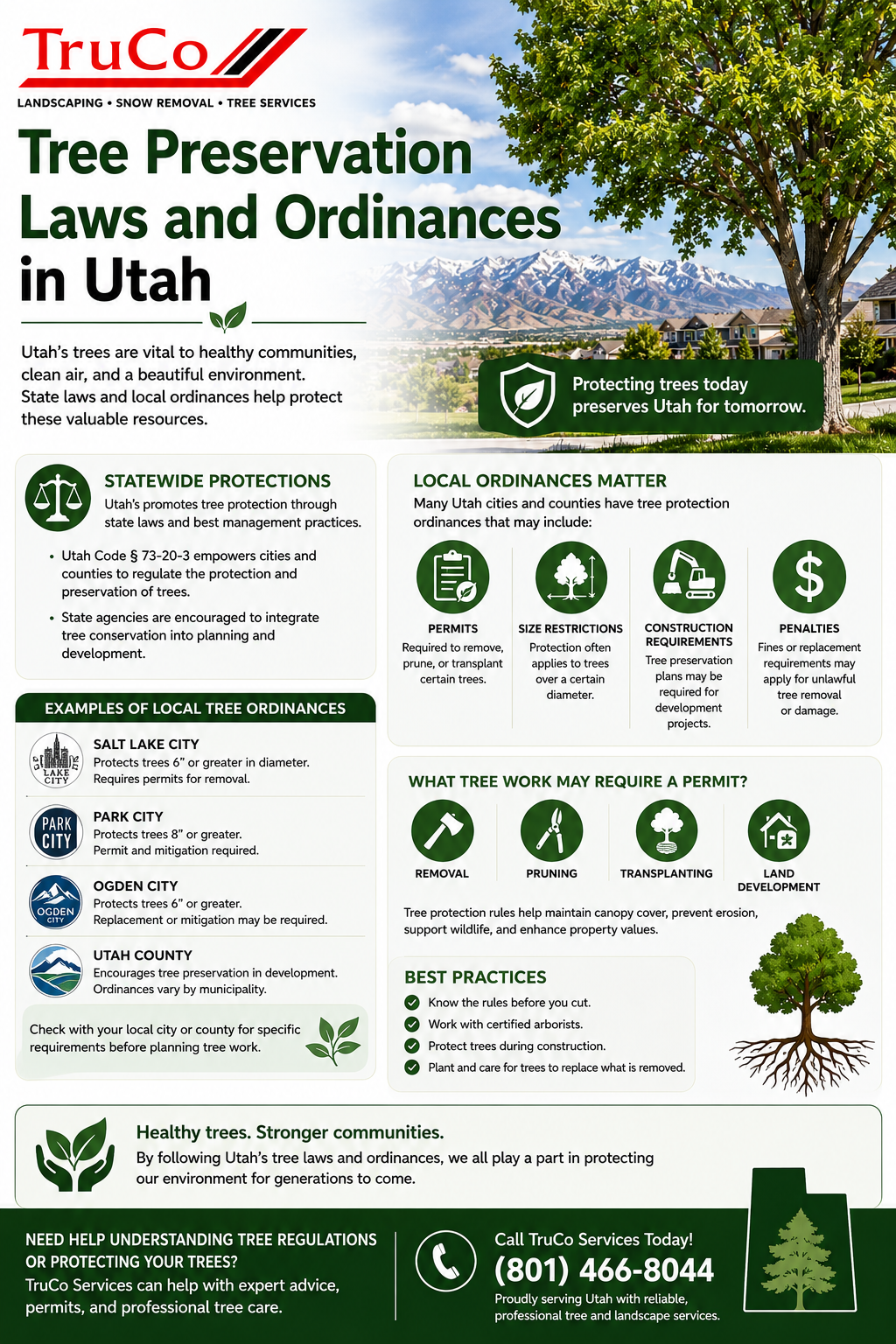
Understanding Tree Preservation Laws in Utah
Tree preservation laws in Utah exist at state, county, and municipal levels, creating a patchwork of regulations that property owners and developers must navigate. While Utah does not have a single statewide tree preservation law, many cities along the Wasatch Front have adopted ordinances protecting significant trees, requiring permits for removal, and mandating replacement planting. Understanding these laws is essential for anyone planning construction, renovation, or even routine tree removal on their property. Violating tree preservation ordinances can result in fines, stop-work orders, and requirements to replace removed trees with large specimen trees at significant cost. This guide covers the key tree preservation laws and ordinances in Utah, how they apply to homeowners and developers, and what you need to do to stay compliant. As tree preservation becomes an increasingly important issue in Utah's growing communities, more cities are adopting or strengthening their tree protection regulations.
Municipal Tree Ordinances in Major Utah Cities
Several Utah cities have adopted specific tree preservation ordinances. Salt Lake City has one of the most comprehensive tree ordinances in Utah — the City protects all public trees (those in streetscapes, parks, and rights-of-way) and requires permits for any work on public trees. Private trees over a certain size may be protected during development. The City's Urban Forestry Division manages over 85,000 public trees. Sandy City requires developers to preserve significant trees during construction and pay mitigation fees for trees removed. The City has specific protections for heritage trees and requires tree preservation plans for new development. Provo has a tree preservation ordinance requiring permits for removal of trees over 6 inches in diameter on both public and some private properties. Developers must submit tree preservation plans. Park City has strict tree preservation requirements, especially in environmentally sensitive areas and hillsides. Tree removal permits are required for any tree over 4 inches in diameter. Replacement ratios are high — often 3:1 or 5:1 for protected trees removed without authorization. Ogden protects public trees and requires permits for removal. The City has a street tree master plan and encourages tree preservation through educational programs. Many smaller Utah cities have less restrictive ordinances, but most require permits for work on public trees and have some protections during development.
Heritage and Significant Tree Protections
Several Utah communities have heritage tree programs that protect trees of exceptional value. A heritage tree is typically defined by size (usually over 24-30 inches in diameter), age (often over 80-100 years old), species (rare or unusual), historical significance (associated with historic events or persons), or ecological value (critical habitat). In Salt Lake City, heritage trees are protected and require special permits for removal. The city maintains a list of recognized heritage trees. Park City has strong protections for heritage trees with steep penalties for unauthorized removal — fines up to $10,000 per tree plus replacement requirements. Other Utah cities with heritage tree provisions include Ogden, Provo, Logan, and Moab. If you own a tree that may qualify as a heritage tree, contact your city's urban forester or planning department before doing any work. Heritage tree protections typically apply even on private property. Property owners may be able to obtain permits for removal if the tree is hazardous, diseased beyond treatment, or poses an imminent threat. Documentation from a certified arborist is usually required to justify removal of a heritage tree.
Tree Preservation During Development and Construction
Utah's rapid development means many trees are at risk from construction activity. Most Utah cities with tree ordinances require developers to submit tree preservation plans as part of the development approval process. These plans typically identify trees to be preserved, trees to be removed, tree protection zones (TPZs), and mitigation measures. Tree protection zones require fencing around preserved trees at the drip line. No construction activity is allowed within the TPZ — no equipment, storage, excavation, or grade changes. If trees must be removed, most cities require mitigation planting — replacement trees planted on-site or elsewhere, or mitigation fees paid into a city tree fund. Replacement ratios vary: 1:1 for smaller trees being removed, 2:1 or 3:1 for larger or protected trees, and up to 5:1 for heritage trees. Some cities require replacement trees to be of specific species, sizes (minimum 2-inch caliper), and planted in approved locations. Developers should budget for tree preservation — $5,000-$20,000 or more for comprehensive tree preservation planning, protection measures, and mitigation on a typical development site. Homeowners planning additions or renovations should check with their city before removing trees — even on private property, permits may be required.
Tree Disputes Between Neighbors in Utah
Tree-related disputes between neighbors are common in Utah and are governed by state law. Under Utah law, if a tree trunk is entirely on your property, the tree belongs to you, even if branches or roots extend onto your neighbor's property. Your neighbor has the right to trim branches and roots up to the property line, but cannot enter your property without permission and cannot trim in a way that damages the tree. If a tree trunk straddles the property line (a boundary tree), both neighbors share ownership and responsibility. Neither neighbor can remove or damage the tree without the other's consent. If a neighbor's tree causes damage to your property (from roots damaging foundations or falling branches), the neighbor may be liable if they knew or should have known the tree was hazardous. Utah follows a "notice" standard — you must notify your neighbor of a hazardous condition before they can be held liable for damage. Utah's Utah Code 57-11-14 addresses tree encroachment and damage. If a neighbor's tree is encroaching on your property, first try to resolve the issue informally. If that fails, mediation or small claims court may be options. Document all communication and damage with photos and arborist reports. In Utah, self-help remedies (trimming branches to the property line) are permitted but must be done carefully to avoid damaging the tree, which could create liability.
Tree Removal Permits and Requirements
Tree removal permits may be required in many Utah cities. Check with your local city planning or public works department before removing any tree. In general, permits are required for removal of public trees (those in rights-of-way, parks, and city property) — these require a permit and often approval from the city arborist. Some cities require permits for removing large private trees (over a certain diameter). Heritage trees may require special permits regardless of location. Trees in protected areas (hillsides, wetlands, stream corridors) may need additional permits from county or state agencies. Hazardous trees are typically exempt from permit requirements — if a tree poses an imminent threat to life or property, you can remove it without advance permit, but document the hazard with photos and arborist reports. Replacement requirements may apply. Permit fees vary from $25-$200 depending on the city. Fines for unauthorized removal range from $500-$10,000 per tree, plus replacement requirements. When in doubt, call your city planning department before removing any tree. Most cities are helpful and will guide you through the process.
State and Federal Tree Protections in Utah
Beyond local ordinances, state and federal laws may protect trees. The Utah Division of Forestry, Fire and State Lands provides technical assistance for tree preservation but does not enforce specific tree removal restrictions. However, the Division manages trees on state-owned land and provides guidance to municipalities. The federal Endangered Species Act may protect trees that provide habitat for listed species. In Utah, this primarily affects trees in known habitat for species like the southwestern willow flycatcher or Utah prairie dog. The Clean Water Act may require permits for tree removal in wetlands or near waterways — the U.S. Army Corps of Engineers regulates activities in Waters of the United States. The National Environmental Policy Act (NEPA) applies to tree removal on federal land or projects with federal funding. Native American cultural resource protections may apply to trees on or near tribal lands. In practice, most Utah homeowners and small developers will primarily interact with local tree ordinances. However, if your property is near environmentally sensitive areas, wetlands, or tribal lands, additional permits may be needed. Consult with environmental consultants or your local planning department for guidance on specific tree preservation requirements on your property.
How to Comply with Tree Preservation Laws
Staying compliant with Utah tree preservation laws requires proactive steps. Before any construction, renovation, or tree removal, contact your city planning department to ask about tree removal permits, preservation requirements, and development review processes. Hire a certified arborist to assess trees on your property and recommend preservation measures or document hazardous conditions. For development projects, work with a qualified tree preservation consultant to develop a preservation plan. Establish tree protection zones with fencing before any construction begins — do not wait until excavation starts. Document existing tree conditions with photos and arborist reports, especially if you anticipate disputes. Keep copies of all permits, approvals, and correspondence with city officials. If you disagree with a city's tree preservation requirements, you can appeal through the city's administrative process. Most cities have a variance or appeals process for property owners who believe tree preservation requirements create an undue hardship. Hire a land-use attorney if your project is complex or involves significant tree preservation issues. The cost of compliance is far less than the cost of violations, which can include fines, stop-work orders, and expensive mitigation requirements.
The Future of Tree Preservation in Utah
Tree preservation laws in Utah are evolving. As Utah's population grows and development pressure increases, more cities are adopting tree preservation ordinances. The trend is toward stronger protections — more cities requiring permits for private tree removal, higher replacement ratios, and larger tree protection zones. Several Utah cities are working on updating their tree ordinances to address climate resilience, urban heat island mitigation, and equity in tree canopy distribution. The Utah Community Forest Council advocates for stronger tree protections statewide. Property owners should expect tree preservation requirements to become more stringent over time. If you are planning development or significant tree work, it is wise to act sooner rather than later if you believe current regulations may become more restrictive. However, the best approach is to preserve trees as a valuable asset — mature trees add significant property value, environmental benefits, and quality of life. Viewing tree preservation as an investment rather than an obstacle leads to better outcomes for property owners and communities alike.
Frequently Asked Questions
Can my neighbor cut down a tree on my property in Utah? No. If the tree trunk is on your property, the tree belongs to you. Your neighbor cannot enter your property or remove your tree without your permission. If they do, they may be liable for damages up to three times the value of the tree under Utah law.
Do I need a permit to remove a dead tree in Utah? If the tree is dead and hazardous, most cities allow removal without advance permit. However, document the hazard with photos and consider getting an arborist report. Some cities still require a permit for dead tree removal. Always check with your city first.
What happens if I remove a tree without a permit in Utah? Penalties vary by city but can include fines ($500-$10,000), requirements to replace removed trees with large specimen trees (3-5 inch caliper), stop-work orders on construction projects, and even criminal charges for willful violations. Costs can easily reach $10,000-$50,000 or more.
Are HOAs allowed to require tree removal in Utah? Some HOAs have covenants requiring tree removal or replacement. However, HOA requirements cannot override city tree preservation ordinances. If an HOA requirement conflicts with a city ordinance, the city ordinance takes precedence. Check both your HOA covenants and city regulations.
How are tree preservation laws enforced in Utah? Enforcement varies by city. Some cities actively patrol for violations and respond to complaints. Others only investigate when complaints are filed. Building inspectors may notice violations during construction inspections. Neighbor complaints are the most common trigger for enforcement. Penalties are typically imposed after a hearing process.
Can I appeal a tree preservation requirement in Utah? Yes. Most cities have an appeals process for property owners who believe preservation requirements create an undue hardship. You typically need to submit a written appeal, pay a fee, and present evidence from a certified arborist or engineer. Consult with a land-use attorney for complex appeals.