
Tree Fungus and Mushrooms: What's Harmful and What's Not in Utah

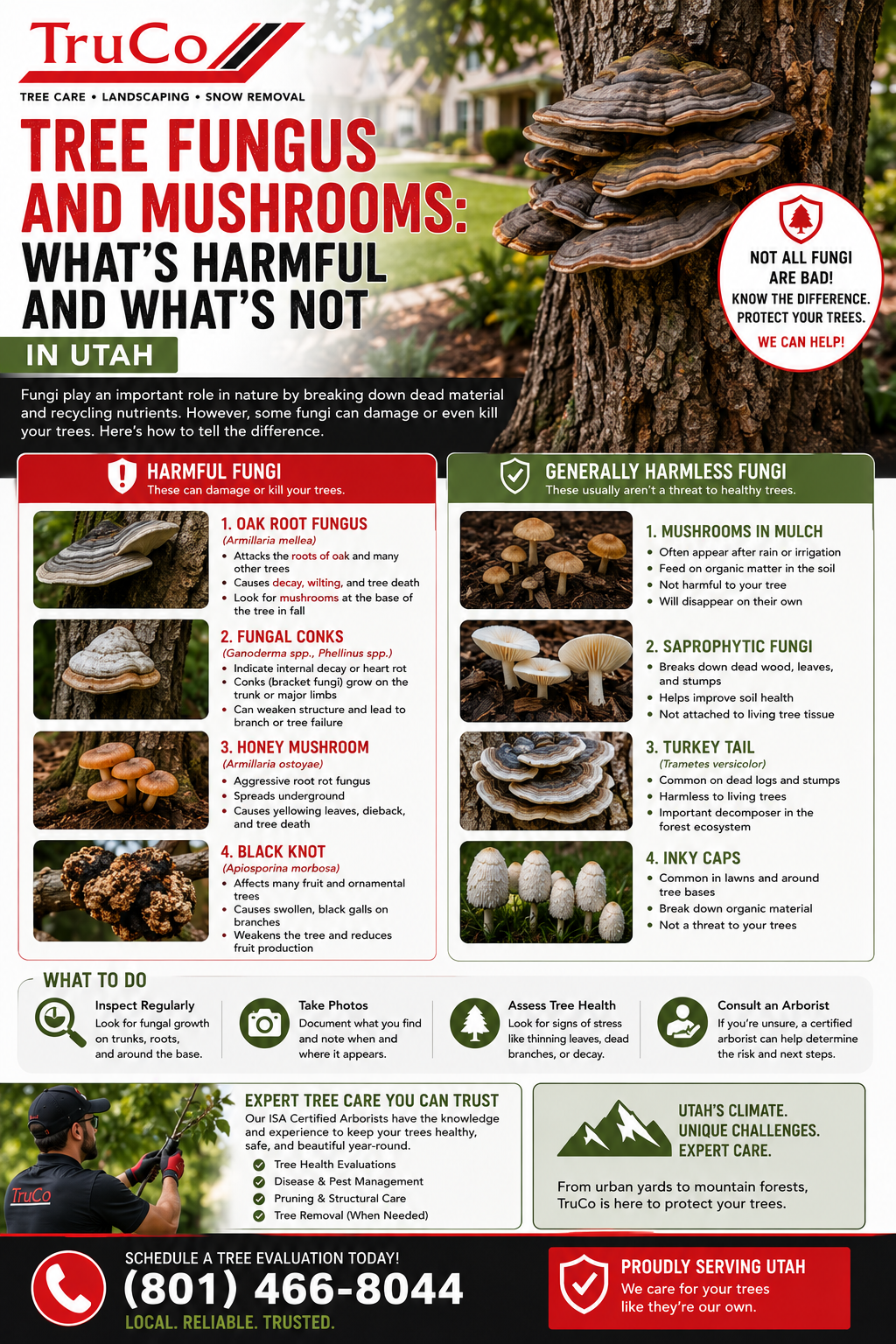
Understanding Tree Fungi in Utah
Utah's semi-arid climate along the Wasatch Front creates unique conditions for tree fungi. While mushrooms and fungal growth on trees can be alarming, not all fungi are harmful. Some indicate decay that threatens tree stability, while others are harmless saprophytes feeding on dead wood. Learning to distinguish between them is essential for Utah homeowners. This guide covers the most common fungi found on Utah trees, which ones signal danger, and what to do when you spot them.
How Fungi Damage Trees
pathogenic fungi infect living tree tissue, causing decay that weakens structural integrity. Fungi spread through microscopic spores carried by wind, water, or insects. Once inside a wound or natural opening, they digest cellulose and lignin — the compounds that give wood its strength. Over time, this creates internal decay that can lead to branch or trunk failure. Utah's heavy spring snows and summer monsoon winds make decay-weakened trees particularly hazardous. Fungi that attack living trees are called pathogens, while those feeding on already-dead wood are saprophytes. The distinction matters because finding a saprophyte on a dead branch is less concerning than finding a pathogen on the trunk.
Artist's Conk
One of the most common fungi on Utah trees, artist's conk appears as a hard, shelf-like growth on trunks, typically gray to brown on top with a white pore surface underneath. It commonly infects aspens, cottonwoods, and maples along the Wasatch Front. Artist's conk causes white rot decay, breaking down lignin and leaving the wood soft and spongy. A tree with artist's conk on the trunk has significant internal decay and should be evaluated by an arborist. The fungus enters through wounds and can spread through root grafts between nearby trees. In Utah's aspen groves, it can spread through entire clonal colonies. If you see artist's conk on a tree near your home, call a certified arborist immediately for a risk assessment.
Oyster Mushrooms
Oyster mushrooms appear as clusters of soft, fan-shaped caps with white to tan coloring and gills running down the stem. They grow on dead or dying hardwood trees, particularly cottonwoods and maples common in Utah. While oyster mushrooms are edible (and foraged by some Utahns), their presence on a tree signals that internal decay is well-established. If they appear on a living tree, the tree is likely in advanced decline and may need removal. On stumps or dead logs, they're harmless saprophytes breaking down wood naturally.
Honey Mushroom
Honey mushrooms are among the most destructive tree pathogens in Utah. They appear in clusters with honey-colored caps and a white spore print. The key identifying feature is white fungal growth (mycelium) beneath the bark and black, root-like structures called rhizomorphs that spread through the soil. Honey mushroom attacks living trees, causing root rot that can kill a tree within 2-5 years. It affects a wide range of species including oaks, maples, aspens, and fruit trees. In Utah landscapes, honey mushroom can spread from infected stumps to healthy trees through root contact. There is no cure once a tree is infected. Management focuses on removing infected trees and stumps and avoiding replanting susceptible species in the same location.
Ganoderma Root Rot
Ganoderma fungi produce large, reddish-brown shelf fungi at the base of infected trees. These conks indicate advanced root and butt rot that compromises the tree's structural stability. Trees with ganoderma at their base are at high risk of failure, especially during Utah's windy spring storms. The fungus enters through root wounds and gradually decays the root system, making the tree unsafe. In Utah, ganoderma is most common on older cottonwoods, silver maples, and oaks in established neighborhoods. Once the conks appear, the tree has significant internal decay and should be evaluated promptly. Removal is often the recommended course.
Lichens: The Harmless Lookalikes
Many Utah homeowners mistake lichens for harmful fungi. Lichens are not fungi alone — they are a symbiotic partnership between fungus and algae. They appear as crusty, leafy, or branching growths on bark and rocks. Unlike pathogenic fungi, lichens do not damage trees. They use the bark only as a surface to grow on; they do not extract nutrients from the tree. Lichens are common on Utah trees, especially in areas with clean air and adequate moisture. Their presence indicates good air quality. They are more visible on slow-growing or older trees simply because those trees have more bark surface area. Lichens do not need to be treated or removed. If your tree has lichen but is otherwise healthy, no action is needed.
Slime Mold
Slime molds occasionally appear on mulch, lawns, and tree bases after Utah's summer monsoon rains. They look like bright yellow, orange, or pink foamy masses that can double in size daily. Despite their alarming appearance, slime molds are harmless. They feed on bacteria and decaying organic matter, not on living trees. They dry up and disappear within a few days to weeks. No treatment is needed. Simply rake them up or wash them away with a hose if they're unsightly.
Powdery Mildew on Utah Trees
Powdery mildew appears as a white, powdery coating on leaves, particularly during Utah's warm days and cool nights of late summer. It affects maples, oaks, lilacs, and many ornamentals. While unsightly, powdery mildew rarely causes serious harm to mature trees. It can cause leaf distortion and early leaf drop but does not kill the tree. Management includes improving air circulation through pruning, avoiding overhead watering, and applying fungicides if the infection is severe. In most cases, Utah trees recover without intervention. The mildew disappears when leaves drop in fall.
When to Worry: The Red Flags
Not all fungi are cause for alarm, but certain signs warrant immediate professional attention. Shelf fungi or conks growing directly on the trunk or at the base of a tree indicate significant internal decay. Multiple conks on the same tree suggest advanced decay throughout. mushrooms growing from the root zone or trunk base signal root decay. Fungal growth combined with thinning canopy, dead branches, or yellowing leaves indicates the tree is in decline. Soft, crumbly wood around the fungus, cracks in the trunk near fungal growth, and a lean that is new or worsening are all urgent red flags. If you observe any of these signs, contact a certified arborist in Utah for an assessment. A tree with advanced fungal decay near a house, driveway, or play area may need removal.
Preventing Fungal Infections
Prevention is the best strategy for keeping Utah trees healthy. Proper pruning at the branch collar (not leaving stubs) reduces entry points for fungi. Avoid wounding trees with string trimmers and lawn mowers — maintain a mulch ring instead. Water deeply but infrequently to encourage strong root systems. In Utah's clay soils, overwatering creates conditions favorable for root rot fungi. Remove and replace infected stumps promptly to prevent spread to healthy trees. Choose disease-resistant species when planting new trees. For Utah, bur oak, Kentucky coffeetree, hackberry, and honeylocust have good resistance to common fungal pathogens. Avoid planting the same species in locations where infected trees were removed.
Can You Save a Tree with Fungus?
The answer depends on the type and extent of the infection. Some fungal infections can be managed if caught early. For heart rot fungi (artist's conk, chicken of the woods), there is no cure — the fungus will continue decaying internal wood. Management focuses on reducing risk through cabling, crown reduction, and regular monitoring. For root rot fungi (honey mushroom, armillaria), removal of infected trees and soil solarization may prevent spread, but infected trees cannot be cured. For foliar fungi (powdery mildew, leaf spot), trees typically recover with good cultural care and sometimes fungicide applications. For heart rot in a structurally sound tree that is not near targets, monitoring may be an acceptable approach. An arborist can recommend the best course based on the specific situation.
Frequently Asked Questions
Is tree fungus contagious to other trees? Some fungi, like honey mushroom, spread through root contact and can infect nearby trees. Others, like artist's conk, produce airborne spores but require a wound to enter. If you have an infected tree, have nearby trees of the same species evaluated.
Can I eat mushrooms growing on my tree? Some are edible (oyster mushrooms, chicken of the woods) but many are toxic. Unless you are an expert forager, do not eat wild mushrooms. Even edible species growing on certain trees can absorb toxins.
Should I remove fungus from my tree? Removing the conk does not cure the tree — the internal decay continues. In fact, removing conks can release more spores. Leave them in place and address the underlying tree health issue.
Does fungus on a stump mean my other trees are at risk? Stumps naturally decay and will host saprophytic fungi. These are harmless to surrounding trees. However, if the tree died from a pathogen like honey mushroom, the fungus may still be active in the roots and can infect new plantings.
Will painting a wound prevent fungus? No. Wound paint does not prevent fungal infections and can actually trap moisture that promotes decay. Proper pruning at the branch collar is the best prevention.
What is the white stuff growing on my tree bark? It could be lichen (harmless), powdery mildew (usually harmless to bark), or fungal mycelium (potentially serious). A certified arborist can identify it and advise on next steps.