
Tree-Friendly Driveway and Walkway Installation in Utah

Protecting Trees During Driveway and Walkway Installation in Utah
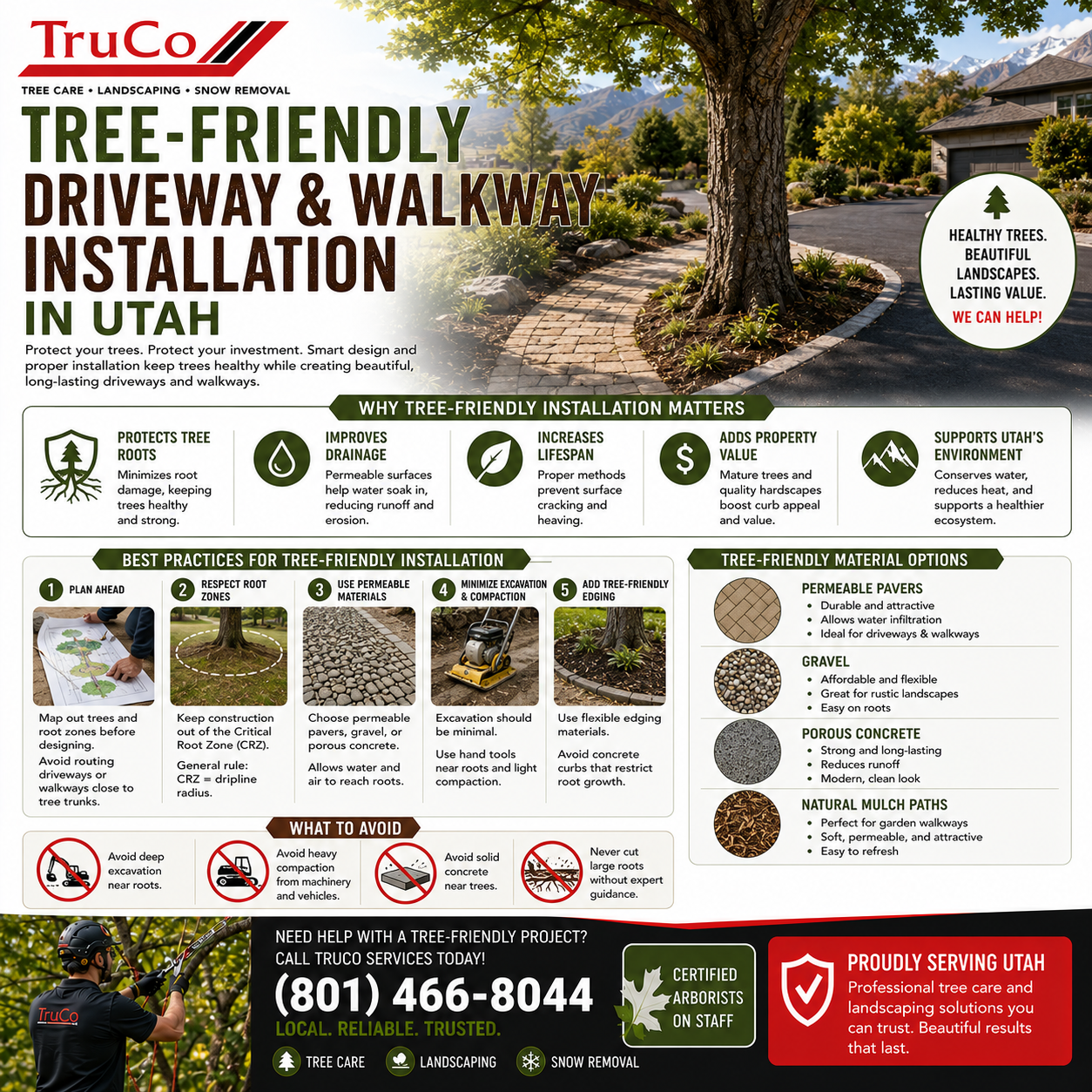
Installing a new driveway or walkway on your Utah property requires careful planning when existing trees are present. Construction activities can severely damage trees through soil compaction, root severance, grade changes, and trunk damage. Many beautiful mature trees in Utah — from the stately maples in Salt Lake City neighborhoods to the oaks in Provo and the pines in Park City — have been irreparably damaged by poorly planned hardscape installation. The good news is that tree-friendly driveway and walkway installation is entirely possible with the right techniques and professional guidance. In Utah, the combination of clay soils, heavy snow loads, and freeze-thaw cycles adds complexity to hardscape installation near trees. This guide covers how to plan, design, and install driveways and walkways that protect your trees while creating durable, attractive surfaces.
Understanding the Tree Protection Zone
The most important concept in tree-friendly hardscape installation is the Tree Protection Zone (TPZ), also known as the Critical Root Zone (CRZ). The TPZ is the area around a tree's trunk that contains the roots essential for the tree's survival. In general, the TPZ extends to the dripline of the tree (the outermost edge of the canopy), but it can extend much further — tree roots often grow 2-3 times beyond the dripline. For hardscape installation planning, protect as much of the root zone as possible. The minimum protected area should be a radius of 1 foot per inch of trunk diameter. For example, a 12-inch diameter tree should have at least a 12-foot radius protection zone. Any construction activity within the TPZ requires careful planning and tree-friendly techniques. In Utah's clay soils, tree roots tend to grow wide and shallow, making them more vulnerable to damage during excavation. Before starting any hardscape project near existing trees, mark the TPZ clearly and establish a construction exclusion zone. No heavy equipment, material storage, or vehicle traffic should be permitted within the TPZ. This single step prevents most tree damage during construction. Work with a certified arborist to determine the appropriate TPZ for your specific trees and project. In Utah, arborists experienced with local soil conditions can provide invaluable guidance for tree-friendly hardscape installation.
Tree-Friendly Driveway Design Options
When planning a driveway near existing trees, several design approaches minimize root damage. Narrow driveways at the tree — if a tree is located where a driveway must pass, keep the driveway as narrow as possible at that point (8-10 feet minimum for vehicle access). This reduces the area of root disturbance. Curved driveways — design the driveway to curve around major trees rather than cutting a straight line through their root zones. A gentle curve that follows the existing tree canopy often requires less root disturbance than a straight path. Bridged driveways — for very large or significant trees, consider a raised driveway surface that bridges over the root zone rather than cutting through it. This is more expensive but provides the best tree protection. Board-formed concrete, wooden bridges, or metal grating can create attractive, functional driveway surfaces above the root zone. Permeable paving — use permeable materials (pervious concrete, permeable pavers, gravel) that allow water and air to reach tree roots. Permeable surfaces are particularly important in Utah's clay soils, where roots need oxygen. In Utah's climate, choose permeable materials that can withstand heavy snow loads and plowing. Pervious concrete and heavy-duty permeable pavers work well. Aggregate driveways — stabilized gravel or decomposed granite driveways create minimal root disturbance. They require less excavation than traditional paved driveways and allow water and air to reach roots. In Utah's snow climate, choose angular gravel that locks together for better stability. Single-track driveways — for very large trees, consider a single-track driveway (two narrow strips of concrete or pavers, one for each wheel track) rather than a full-width paved surface. This is a common solution for protecting existing trees on narrow lots in older Utah neighborhoods.
Walkway Installation Near Trees
Walkways require less structural support than driveways, offering more flexibility for tree-friendly installation. Minimal excavation — hand-dig rather than using heavy equipment to excavate walkway paths near trees. Limit excavation depth to 4-6 inches maximum within the TPZ. For each major root encountered, consider rerouting the walkway. Stepping stones — install individual stepping stones rather than a continuous paved walkway. Each stone requires only a small excavation, leaving most of the root zone undisturbed. Space stones 2-3 inches apart for natural appearance. Flagstone paths — set flagstones on a sand base rather than concrete. Sand base allows water and air movement to roots and can be more easily adjusted if roots need room. Use 2-3 inch thick stones for durability. Permeable walkways — similar to driveways, use permeable pavers, gravel, or wood chips for walkway surfaces. These materials require less excavation and allow root zone health. In Utah's climate, choose materials that won't heave during freeze-thaw cycles. Elevated walkways — for significant trees or very sensitive areas, construct an elevated boardwalk on posts above the root zone. This is expensive but provides complete root protection. Common in park settings and on sensitive hillside properties in Park City and other Utah mountain communities. Adjustable walkway systems — some paver systems can be installed with adjustable bases that accommodate root growth. As roots expand, the walkway surface can be adjusted. A professional installer can help with these specialized systems.
Excavation and Root Protection Techniques
When excavation is unavoidable near trees, use these techniques to minimize damage. Air spading — use an air spade (compressed air tool) rather than mechanical excavation for digging in root zones. Air spade removes soil without cutting roots, allowing roots to be exposed and protected during construction. Cost: $75-150 per hour in Utah. Certified arborists with air spade equipment can be found throughout the Wasatch Front. Hand digging — dig by hand with shovels and trowels when working within the TPZ. It is slower but allows roots to be carefully worked around. Root pruning by a professional — if roots must be cut, have a certified arborist do the root pruning. They will make clean cuts at appropriate locations using proper tools (pruning saws, not axes or machinery). Roots over 2 inches in diameter should rarely be cut. Proper root pruning seals the cut surface and reduces the risk of decay and disease. In Utah, where soil-borne pathogens like root rot are common, clean cuts are essential. Tunneling under roots — when running utilities under walkways or driveways, tunnel under large roots rather than cutting them. Use a trenchless method (directional boring) or hand-tunnel under the root. Soil compaction prevention — avoid compacting soil in the root zone. Cover the soil surface with 6-12 inches of wood chips (not plastic) within the TPZ. Use plywood sheets or road mats over the mulch to distribute weight if foot traffic is necessary. In Utah's clay soils, compaction damage can persist for decades, so prevention is critical. Grade changes — avoid raising or lowering the soil grade within the TPZ. Grade changes suffocate roots and alter drainage patterns. If grade changes are unavoidable, use retaining walls or tree wells to maintain the original grade around trees.
Materials Selection for Tree-Friendly Hardscapes
Choose materials that minimize impact on tree roots and the surrounding environment. Permeable materials allow water and oxygen to reach roots, which is essential in Utah's clay soils. Permeable pavers and pervious concrete are excellent choices for driveways and walkways near trees. They support heavy loads while allowing drainage. Natural stone (flagstone, slate, bluestone) can be installed with gaps for permeability. Set on a sand base rather than concrete for best results. Stabilized decomposed granite provides a natural-looking, permeable surface that works well for walkways and light-duty driveways. Not ideal for heavy vehicles in Utah's snow climate. Concrete is the most common driveway material in Utah. Use pervious concrete near trees. If using traditional concrete, design tree wells, root bridges, or other accommodations. Asphalt is generally not recommended near trees due to waterproofing and heat absorption. If used, keep it away from the root zone. Tree well covers — when a tree is within a paved area, use structural soil (CU-Structural Soil or similar) around the tree, combined with a tree well grate or permeable surface. Structural soil is a special mix that supports pavement loads while allowing root growth. In Utah, structural soil is available through landscape supply companies and is used in commercial and residential applications. The cost of structural soil installation is higher than traditional methods but provides significant long-term benefits for tree health.
Working with an Arborist
Professional guidance from a certified arborist is essential for tree-friendly hardscape projects. A qualified arborist can assess tree health and structural stability before construction begins. Provide a root zone map showing the extent and location of major roots. Specify which roots can be safely cut and which must be protected. Develop a tree protection plan outlining the TPZ, excavation limits, and protection measures. Monitor construction activities to ensure tree protection measures are followed. Provide post-construction care guidance including watering, mulching, and monitoring. In Utah, certified arborists can be found through the International Society of Arboriculture (ISA) or the Utah Community Forestry Council. Expect to pay $150-350 for an arborist consultation and tree protection plan for a typical residential property. This investment is much less than the cost of removing a large, damaged tree or dealing with property damage from tree failure. For construction projects in Park City, the Wasatch Back, or other Utah mountain communities, seek arborists experienced with high-elevation conditions and the specific tree species common in those areas. An ounce of prevention is worth a pound of cure when it comes to protecting valuable trees during construction.
Frequently Asked Questions
How close to a tree can I build a driveway? Maintain at least 1 foot of distance from the trunk per inch of trunk diameter. For example, a 12-inch diameter tree needs at least 12 feet of distance. If you must build closer, consult a certified arborist.
Will tree roots damage my new driveway? Tree roots typically grow in the upper 12-18 inches of soil, which is above most driveway base layers. With proper base preparation and root barriers, damage is unlikely. Roots cause problems when driveways are built too shallow or when roots have nowhere else to grow.
Can I pour concrete over tree roots? Pouring concrete directly over tree roots is never recommended. It suffocates roots, prevents water absorption, and eventually the roots will push up the concrete. If concrete must go near trees, use structural soil and proper base preparation.
What is structural soil? Structural soil (CU-Structural Soil or similar) is a specially engineered soil mix that can be compacted to support pavement loads while remaining porous enough for root growth. It is used in tree-friendly urban hardscape installations. Available through landscape suppliers in Utah.
How much does an arborist consultation cost in Utah? Typical costs are $150-350 for a residential tree protection consultation and plan. Some tree care companies include this service with larger projects. This is an excellent investment compared to the cost of losing a mature tree.
Is it better to remove a tree or design around it? In most cases, designing around existing trees adds value to your property and saves money on removal costs. Mature trees increase property values by 5-15%. Preserving significant trees should be the first priority in hardscape design. Consult an arborist for specific guidance.