
Tree Care During Utah's Drought Restrictions and Watering Bans

Understanding Drought Restrictions in Utah
Utah is one of the driest states in the nation, and drought restrictions have become a regular part of life for homeowners along the Wasatch Front and beyond. When drought declarations are in effect, watering restrictions typically limit outdoor water use — sometimes banning lawn watering entirely or restricting it to specific days and times. However, these restrictions often include exceptions for trees, which are considered essential landscape assets worthy of protection. Understanding how to care for your trees within drought restriction rules is critical for keeping them alive during dry periods. Unlike lawns, which can go dormant and recover when water returns, trees suffer lasting damage from drought. A single severe drought event can weaken a tree for years, making it vulnerable to pests, diseases, and eventual death. In Utah, the drought of 2020-2022 caused significant tree mortality across the state, especially among non-irrigated trees and those in urban areas where watering was restricted. This guide covers how to water your trees legally and effectively during Utah's drought restrictions, plus alternative strategies for keeping trees healthy when water is limited.
Understanding Drought Restriction Exceptions for Trees
Most Utah water districts and municipalities include explicit exceptions for tree watering in their drought restriction ordinances. Trees, along with shrubs and perennial plants, are typically exempt from lawn watering restrictions because they provide essential benefits (shade, air quality, property value) and because losing a mature tree is much more costly than losing turf. The key distinction is between turf/lawn watering and irrigation of trees and other landscape plants. Under most Utah drought restrictions, you can water trees at any time using: hand-held hose with a shut-off nozzle, a bucket or watering can, drip irrigation or soaker hoses, or tree watering bags (like Treegators). Many restrictions allow watering of trees and shrubs 1-2 times per week even when lawn watering is completely banned. Some Utah water districts require you to register trees or obtain a permit for watering during severe restrictions. Check with your local water provider for specific rules. In Salt Lake City, Department of Public Utilities provides guidance on tree watering during drought. Other Utah municipalities have similar policies. Document tree watering for compliance. Take photos of your watering methods, save receipts for tree care products, and note the dates you water. This documentation can be helpful if your watering is questioned. If you hire a tree care professional, their services may provide additional documentation of necessary tree care.
Watering Trees Efficiently During Drought
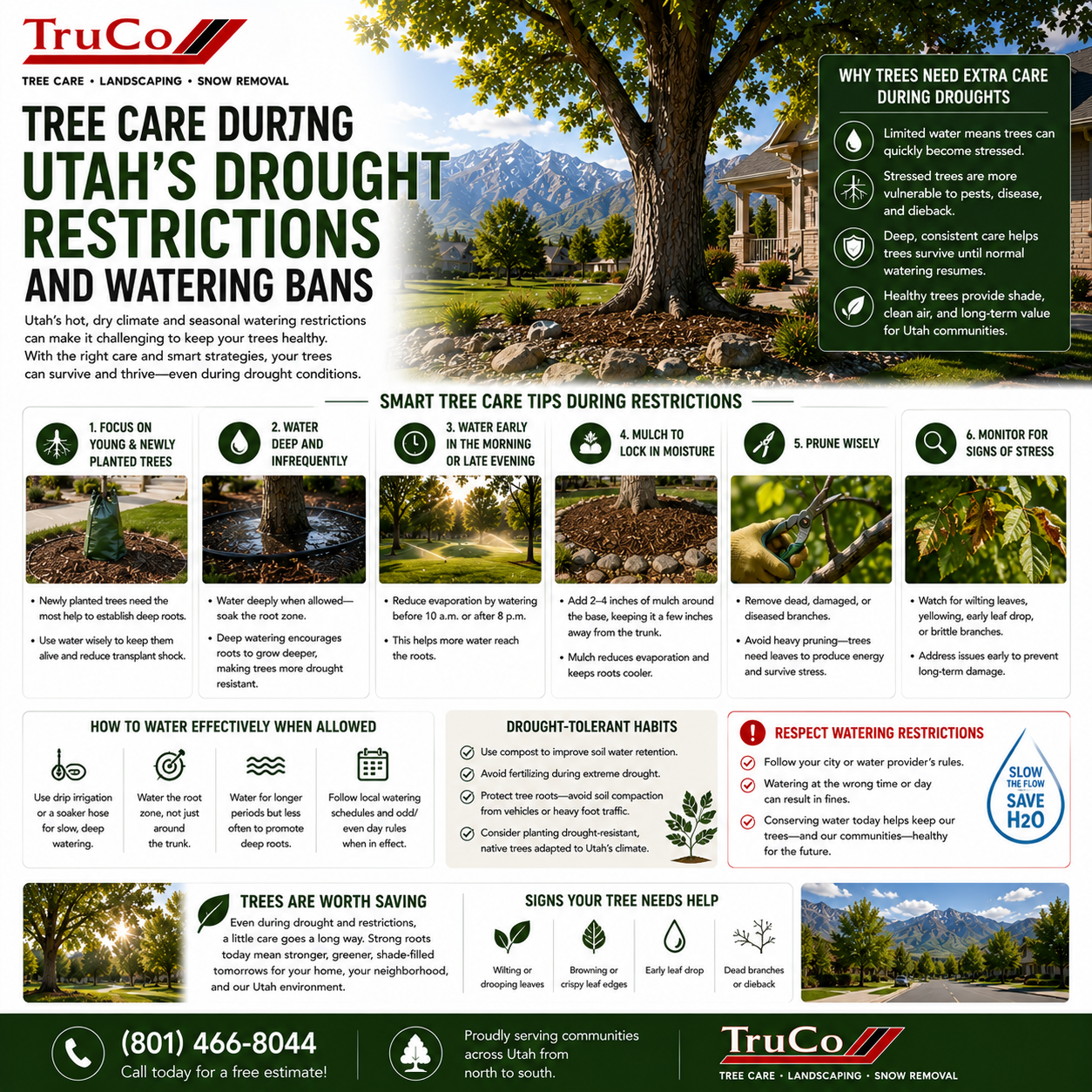
When water is limited, every drop counts. Use these techniques to maximize the benefit of water applied to trees. Water deeply but less frequently — deep watering encourages deep root growth, which makes trees more drought-tolerant. Apply water slowly so it penetrates 12-18 inches deep. In Utah's clay soil, this means watering at a very slow rate for 2-4 hours per tree. Water at the dripline — tree roots extend far beyond the canopy. Apply water at the dripline (the outermost edge of the branches) and beyond, not at the trunk. The most active water-absorbing roots are in this zone. Water in the early morning — between 4 AM and 8 AM is ideal. Less water is lost to evaporation, and water has time to soak in before the heat of the day. In Utah, early morning watering can reduce water loss by 30% compared to mid-day watering. Use soaker hoses or drip irrigation — these methods apply water directly to the soil with minimal evaporation. In Utah, soaker hoses placed in concentric circles around trees are highly efficient. Consider a tree watering bag — slow-release bags (like Treegator) apply 15-20 gallons of water gradually over several hours. They are excellent for young trees during drought. Apply mulch — 2-4 inches of organic mulch over the root zone dramatically reduces evaporation and keeps soil cooler. In Utah, wood chip mulch is widely available and effective. Keep mulch away from the trunk. Prioritize young trees — trees planted within the last 3-5 years have limited root systems and are most vulnerable to drought. Water them first and most frequently. Established trees (over 5 years) can survive with less frequent watering. Prioritize high-value trees — if you must choose, water trees that provide the most shade, have the highest landscape value, or are irreplaceable specimens. Consider letting lawns go dormant to save water for trees.
Water Conservation Strategies for Tree Care
Beyond efficient watering, several strategies help trees survive drought with less water. Graywater use — in Utah, graywater (from sinks, showers, washing machines) can be used for landscape irrigation under certain conditions. Check local regulations — some Utah municipalities allow graywater use for trees and landscaping. Never use water containing bleach, fabric softeners, or other harsh chemicals. Rainwater harvesting — collecting rainwater from roofs into barrels or cisterns provides supplemental water for trees. In Utah, homeowners can collect up to 2,500 gallons of rainwater without a permit. Rainwater is excellent for trees because it has no chlorine or other treatment chemicals. Hydrogel soil amendments — water-absorbing polymers mixed into the soil around trees can hold many times their weight in water, releasing it slowly as the soil dries. These are particularly useful for young trees in Utah's dry climate. Apply at planting time or surface-apply to existing trees. Reduce competition — remove weeds, grass, and other plants growing within the tree's root zone. These plants compete with the tree for water. In Utah, a 3-4 foot diameter mulch ring around the tree eliminates competition and dramatically reduces water needs. Postpone pruning — avoid pruning during drought, as pruning stimulates new growth that increases water demand. Only remove dead or hazardous branches. Delay major pruning until after the drought ends. Reduce fertilizer — do not fertilize trees during drought. Fertilizer stimulates growth that increases water needs. Wait until normal watering resumes. Monitor for pests — drought-stressed trees are more vulnerable to pests like bark beetles, borers, and spider mites. In Utah, drought-stressed evergreens are particularly vulnerable to bark beetle attacks. Inspect regularly and treat promptly.
Signs of Drought Stress in Utah Trees
Recognizing drought stress early allows you to take action before permanent damage occurs. Leaf wilting — leaves that droop or curl during the day, even in the morning. In Utah, wilting is most visible on maples, aspens, and other broadleaf trees. Leaf scorch — browning at the edges of leaves, progressing inward. Common in Utah on maples, lindens, and oaks during drought. Leaf yellowing or early fall color — yellowing or premature fall color development (August-September) indicates drought stress. Early leaf drop — trees shedding leaves in mid-to-late summer to reduce water loss. In Utah, cottonwoods and aspens are most likely to drop leaves early during drought. Dead branch tips — dieback starting at the tips of branches and progressing toward the trunk. Conifer needle browning — evergreens showing brown needles, especially on the south and west sides. In Utah, pines and spruces show drought stress as needle browning starting from the inside of the tree outward. Cankers or oozing sap — drought-stressed trees are more susceptible to canker diseases. Sunken, discolored areas on bark may appear. In Utah, cytospora canker on spruce and poplar is often triggered by drought stress. If you notice any of these signs, begin deep watering immediately (if permitted by restrictions) or contact a certified arborist for assessment. Trees showing significant drought stress may need professional care including deep root watering, anti-transpirant sprays, or other treatments.
Long-Term Drought Preparation for Trees
The best time to prepare trees for drought is before drought strikes. Build deep root systems — deep, infrequent watering throughout the tree's life encourages deep root growth that accesses groundwater during dry periods. Trees watered shallowly and frequently develop shallow roots that are drought-vulnerable. Improve soil organic matter — soil with high organic matter content holds more water and releases it slowly. Apply compost annually to build soil organic matter. In Utah, even small increases in soil organic matter significantly improve water-holding capacity. Choose drought-tolerant species for new plantings — when planting new trees, select species adapted to Utah's dry climate. Bur oak, Kentucky coffeetree, hackberry, honeylocust, and Utah juniper are excellent choices. These species have deep root systems and efficient water use. Install efficient irrigation — drip irrigation or soaker hoses use 30-50% less water than sprinklers. Install permanent tree irrigation that can be used during drought restrictions. Mulch annually — maintain 2-4 inches of organic mulch over the root zone year-round. This is the single most effective drought preparation measure. Plan for water storage — consider installing a rainwater harvesting system or a graywater system that can provide water during drought restrictions. Having an alternative water source gives you options when municipal water is restricted.
Frequently Asked Questions
Can I water my trees during a drought restriction in Utah? Yes, most Utah drought restrictions include exceptions for tree watering. Trees, shrubs, and perennials are typically exempt from lawn watering bans. Use a hand-held hose, drip irrigation, or soaker hoses. Check with your local water district for specific rules.
How much water do trees need during a drought in Utah? The general guideline is 10 gallons of water per inch of trunk diameter, applied every 2-4 weeks during drought conditions. Young trees need more frequent watering (every 1-2 weeks). Adjust based on species, soil type, and weather conditions.
Will my trees die if I stop watering them during a drought? Established, native, and drought-tolerant trees may survive extended dry periods. Young trees, non-native species, and trees in poor soil are at high risk of death without supplemental water. Prioritize watering young and high-value trees during drought restrictions.
Is it better to water trees less often but deeper during drought? Yes. Deep, infrequent watering is more effective than frequent, shallow watering. Deep watering encourages roots to grow downward where soil stays moist longer. Shallow watering encourages surface roots that are more vulnerable to drought.
Should I remove my trees if I can't water them during a drought? No. Trees are valuable assets worth protecting. If you cannot water all your trees, prioritize the most valuable ones. Consider letting lawn grass go dormant (it will recover when water returns) to save water for trees. Consult an arborist before removing any tree.
How do I find out about drought restrictions in my Utah city? Contact your local water provider or municipal public works department. Most Utah water districts post drought restriction information on their websites. The Utah Division of Water Resources also provides statewide drought information and resources.