
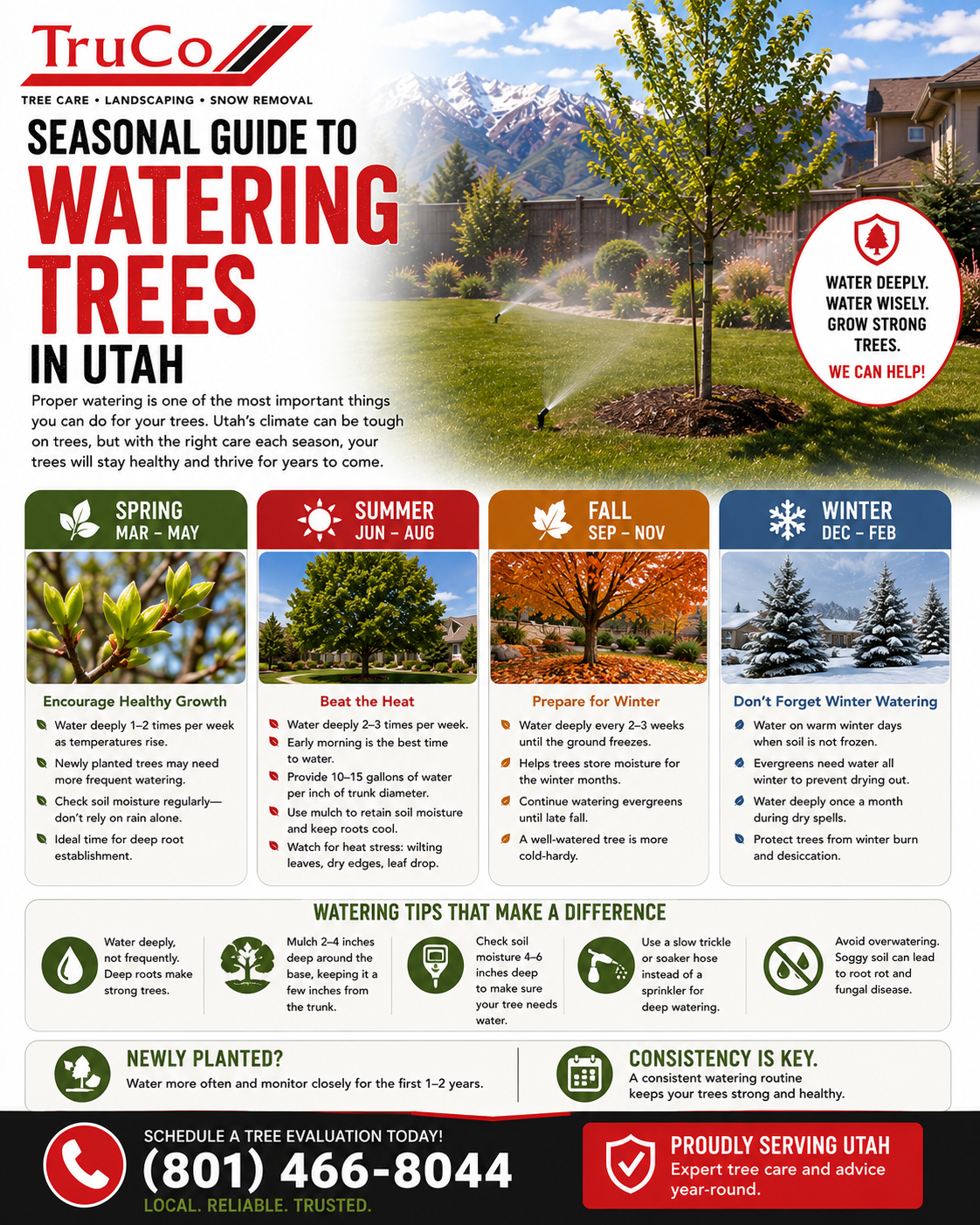
Seasonal Guide to Watering Trees in Utah

Why Seasonal Watering Matters for Utah Trees
Utah's semi-arid climate presents unique challenges for tree watering. With annual precipitation averaging only 12-20 inches along the Wasatch Front — much of it as snow — supplemental watering is essential for tree health throughout the year. However, watering needs change dramatically with the seasons. Overwatering is as dangerous as underwatering in Utah's clay soils, which drain slowly and can suffocate roots if kept too wet. Understanding the seasonal rhythm of tree water needs — from the rapid growth of spring through the heat of summer to the dormancy of winter — is essential for maintaining healthy, resilient trees. Proper seasonal watering also conserves water, an increasingly important consideration in Utah's growing communities. This guide provides a month-by-month approach to tree watering for Utah homeowners, tailored to our specific climate, soil, and tree species.
Spring Watering (March-May)
Spring is a critical transition period for tree watering in Utah. As temperatures rise and trees break dormancy, water demand increases rapidly. In early spring (March), soil is usually moist from snowmelt and spring rains. Most established trees do not need supplemental watering in March. Monitor soil moisture — if the soil is dry 4-6 inches deep, water once. In mid-spring (April), trees leaf out and begin active growth. Begin regular watering if spring rains are insufficient. Water deeply every 10-14 days. Pay attention to new transplants — they need more frequent watering as they establish root systems. Water newly planted trees every 5-7 days in April. In late spring (May), temperatures rise and growth accelerates. Increase watering frequency to every 7-10 days for established trees. For newly planted trees, water every 3-5 days depending on temperature and soil type. May is also the time to start applying iron chelate for chlorotic trees — water it in thoroughly. A key tip for Utah: do not rely on spring rains alone. Utah's spring is often dry, with May being one of the driest months in many Wasatch Front communities.
Summer Watering (June-August)
Summer is the most critical watering season for Utah trees. June — temperatures regularly exceed 85°F. Water established trees deeply every 7-10 days. Newly planted trees need water every 3-5 days. Water early morning (before 8 AM) to reduce evaporation. July — the hottest month in Utah. Water established trees every 5-7 days. For large, mature trees, apply 1.5-2 inches of water per week over the root zone. Water newly planted trees every 2-4 days. Watch for signs of drought stress — wilting, leaf curling, leaf scorch (brown edges on leaves), and early leaf drop. August — continued heat, often with some monsoon moisture. Continue summer watering schedule. Reduce frequency slightly if monsoon rains arrive, but do not stop watering — Utah's monsoon storms are often brief and do not provide adequate deep moisture. Water deeply in the root zone rather than frequent, shallow sprinkling. In Utah's clay soil, deep watering means applying water slowly so it penetrates 12-18 inches. Use soaker hoses or drip irrigation around the drip line of the tree for best results. Move the water source around the root zone — do not water in the same spot every time.
Fall Watering (September-November)
Fall watering is often overlooked but is critical for Utah trees to survive winter. September — continue summer watering schedule as temperatures remain warm. Gradually reduce frequency as temperatures cool, but do not stop watering. October — a critical month for winter preparation. Continue watering every 10-14 days through October. Deep watering now helps trees store moisture for winter dormancy. Do not stop watering when leaves fall — roots continue to absorb water until the ground freezes. November — reduce watering to once or twice, depending on precipitation. Water deeply in early November if the fall has been dry. Stop watering when the ground begins to freeze consistently (usually late November along the Wasatch Front). A common mistake Utah homeowners make is stopping watering too early in fall. Trees that enter winter with dry roots are vulnerable to winter drought stress, a major cause of winter damage and spring decline. Evergreens (pines, spruces, junipers) are especially vulnerable to winter drought because they continue to lose moisture through their needles even when the ground is frozen.
Winter Watering (December-February)
Winter watering is essential for Utah trees, especially evergreens and newly planted trees. During Utah's dry winter months, trees continue to lose moisture through their bark and (for evergreens) needles. When the ground is frozen, roots cannot replace this lost moisture, leading to desiccation. Water your trees during winter whenever the ground is not frozen and temperatures are above 40°F. Water once a month during winter dry spells. Choose a warm day and water in the middle of the day so water can absorb before freezing at night. Apply water slowly to allow it to penetrate. Focus on the root zone area and avoid wetting the trunk. Newly planted trees (those planted within the last 2-3 years) need winter watering most — their root systems are not yet deep enough to access residual soil moisture. Evergreens (pines, spruces, firs, junipers) are the most vulnerable to winter drought and benefit most from winter watering. Established, drought-tolerant trees (honeylocust, Kentucky coffeetree, bur oak) may not need winter watering. Snow cover provides excellent moisture — if you have snow on the ground, you do not need to water. In lower elevation Utah communities with minimal snow cover (St. George, Washington County), continue winter watering throughout the dormant season.
Watering Newly Planted Trees vs. Established Trees
Watering needs differ dramatically between newly planted and established trees. Newly planted trees (first 2-3 years) need frequent, consistent watering to establish their root systems. Water at planting time thoroughly, ensuring the entire root ball is saturated. For the first month, water every 2-3 days. For months 2-12, water every 5-7 days during the growing season. In year 2, water every 7-10 days during the growing season. In year 3, transition to the established tree schedule. Water slowly — a 5-gallon bucket with a small hole or a drip irrigation emitter works well. Water the root ball area, not just the surrounding soil — the root ball dries out faster than surrounding soil. Established trees (3+ years) have extensive root systems that can access water from a larger soil volume. Water deeply and infrequently — every 7-14 days during the growing season depending on temperatures. Water the entire root zone, extending from the trunk to beyond the drip line. For a mature tree, this means applying water over an area 2-3 times the canopy diameter. Use multiple soaker hoses or a sprinkler moved around the root zone. Established trees benefit more from deep, infrequent watering than from frequent, shallow watering, which encourages shallow root growth.
Watering Methods and Best Practices
Different watering methods work best for different situations. Soaker hoses are ideal for tree watering — they apply water slowly and directly to the soil, minimizing evaporation. Arrange the soaker hose in concentric circles around the tree, starting 2-3 feet from the trunk and extending to the drip line. Drip irrigation is efficient and precise. Use multiple emitters (2-4 gph each) spaced around the drip line. Run for 30-60 minutes per session. Deep root watering stakes are effective for deep watering in compacted Utah clay soils. Insert the stake 12-18 inches deep at several points around the root zone. Slow trickle from a garden hose — place the hose on low flow at several points around the drip line, moving every 30-60 minutes. Avoid sprinklers for established trees — they waste water to evaporation and encourage shallow roots. Watering guidelines: apply water at the drip line (the outer edge of the canopy), not at the trunk. For large trees, the most active water uptake happens 6-15 feet from the trunk. Water early morning (before 8 AM) to minimize evaporation. Utah's clay soil absorbs water slowly — if water pools, stop and let it soak in, then continue. Water in multiple sessions if needed to achieve deep penetration.
Signs of Overwatering and Underwatering
Knowing the signs of both overwatering and underwatering helps you adjust your watering schedule. Signs of underwatering include wilting or drooping leaves (especially during the hottest part of the day); leaf curling or cupping, and leaf scorch (brown, crispy edges on leaves); premature fall color or leaf drop in summer; smaller than normal leaves; and branch dieback starting at the tips. Signs of overwatering in Utah's clay soil are often confused with underwatering: yellowing leaves (especially older or lower leaves), mushy or soft spots on the trunk near the soil line, fungal growth or mushrooms at the base of the tree, stunted growth with wet soil, leaf drop while soil is wet, and foul odor from the soil (indicating root rot). In Utah clay soil, overwatering is more common than underwatering because clay holds water for a long time. Always check soil moisture before watering. Insert a screwdriver or soil probe into the soil 6-8 inches deep — if it goes in easily and the soil is cool and moist, wait to water. If it is dry, it is time to water. A simple moisture meter ($10-20) takes the guesswork out of watering.
Tree Watering Restrictions and Conservation
Utah communities increasingly face water restrictions during drought years. Understanding local watering regulations is important for tree watering. Most Utah municipalities allow tree watering even during drought restrictions, recognizing trees as essential infrastructure that requires water to survive. Check with your local water provider about specific restrictions. Hand watering, soaker hoses, and drip irrigation are generally exempt from watering restrictions because they are more efficient than sprinklers. Best practices for water conservation while maintaining healthy trees include mulching — 3-4 inches of organic mulch over the root zone reduces evaporation by 30-50%. Aerate compacted soil — aeration improves water penetration and reduces runoff. Water in the early morning — watering at midday loses 30-50% to evaporation. Group trees with similar water needs together for efficient irrigation. Use rain sensors on automated systems. Design irrigation zones separately for trees and turf — trees need less frequent, deeper watering than lawns. Capture rainwater for tree watering when possible. Utah's water future requires balancing tree health with conservation — smart watering practices achieve both.
Frequently Asked Questions
How much water does a mature tree need in Utah? A mature tree needs 1-1.5 inches of water per week over its root zone during the growing season. For a 50-foot diameter tree, that is approximately 400-600 gallons per week. Adjust based on soil type, temperature, and tree species.
Can I overwater a tree in clay soil? Yes. Overwatering is common in Utah's clay soil, which drains slowly. Saturated soil suffocates roots and promotes root rot. Always check soil moisture before watering. In clay, water deeply but less frequently than in sandy soil.
Do I need to water my trees in winter? Yes, if the ground is not frozen and we have had little snow or rain. Water once a month on warm days (above 40°F). Evergreens and newly planted trees are most vulnerable to winter drought and benefit most from winter watering.
How do I know if my tree is getting enough water? Check soil moisture 6-8 inches deep in the root zone. The soil should be moist but not waterlogged. Look at the leaves — they should be firm and green, not wilted or curled. A moisture meter provides a definitive reading.
Is it better to water trees in the morning or evening? Early morning (before 8 AM) is best. Morning watering minimizes evaporation, allows foliage to dry (reducing disease risk), and gives the tree water for the day's heat. Evening watering is acceptable but can promote fungal growth if foliage stays wet overnight.
Do different tree species need different amounts of water? Yes. Water-loving trees (birch, aspen, willow) need more water than drought-tolerant trees (honeylocust, Kentucky coffeetree, pinyon pine). Know your tree species and its specific water needs. Group trees by water needs for efficient irrigation.