
Sandy UT Permanent Christmas Lights

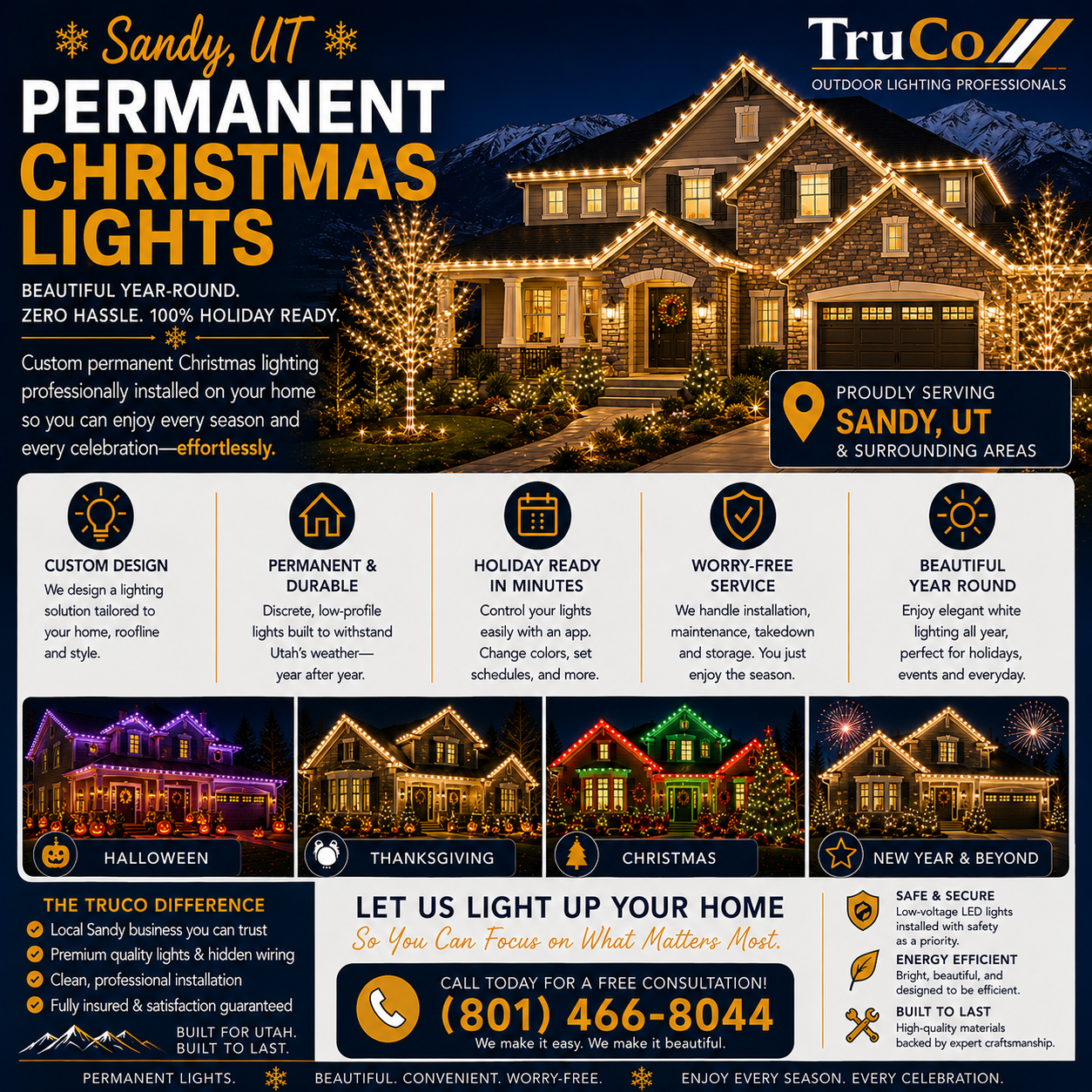
Permanent Christmas lights in Sandy, UT are programmable LED lighting systems installed along a home’s roofline, fascia, soffits, garage peaks, gables, porch trim, and other exterior features. They remain mounted all year, but homeowners can change colors, brightness, schedules, and effects for Christmas, Halloween, game days, birthdays, warm-white architectural lighting, and special events.
The most important point is that permanent holiday lighting is a long-term exterior and electrical improvement—not simply temporary Christmas lights left up year-round. A successful system needs a thoughtful roofline design, durable weather-rated components, an appropriate power source, careful mounting, practical app controls, reasonable brightness settings, and a dependable plan for future service. Sandy homeowners should also consider Utah weather, snow and roof runoff, the condition of gutters and trim, HOA rules, and local permit requirements if the project includes a new outdoor outlet, altered wiring, or circuit work.
This guide explains how Sandy UT permanent Christmas lights work, the primary options available, the problems homeowners can prevent, and the steps that lead to a clean, reliable, easy-to-use result. Professional planning helps ensure the system looks polished in daylight, performs well at night, and remains serviceable over time.
What Are Sandy UT Permanent Christmas Lights?
Sandy UT permanent Christmas lights are exterior LED lighting systems installed as a lasting feature of a home. Rather than hanging temporary string lights for a few weeks each winter, homeowners use a low-profile lighting system designed to remain in place through all seasons.
The system can be programmed for:
Christmas and winter holiday colors
Halloween displays
Patriotic holidays
School and sports-team colors
Birthdays and family celebrations
Graduation, wedding, or party lighting
Warm-white everyday curb appeal
Patio and outdoor entertaining ambiance
You may also see permanent Christmas lighting described as:
Permanent outdoor Christmas lights in Sandy
Sandy permanent holiday lights
Permanent roofline lighting
App-controlled Christmas lights
Year-round LED holiday lighting
Programmable exterior LED lights
Permanent LED trim lights
Smart exterior lighting
Architectural roofline lighting
A professionally planned system typically includes the following components:
ComponentPurposeLED lightsCreate colors, white light, dimming, patterns, and effectsMounting track or channelHolds LEDs straight, evenly spaced, and less visible during daytimeWiring and connectorsDeliver power and, in many systems, control signals between light sectionsControllerReceives commands from the app, remote, timer, or networkPower supplyConverts or distributes electricity for the lighting systemOutdoor electrical connectionProvides safe power through a suitable exterior receptacle or circuitApp or control interfaceLets homeowners choose colors, zones, brightness, schedules, and scenes
For example, a Sandy homeowner may program soft warm-white lighting for nightly curb appeal, switch to red and green in December, use orange and purple in October, and select red-white-and-blue for Independence Day. The lights remain installed; the color scene and schedule are what change.
A standard permanent-lighting project usually includes an assessment, roofline measurement, design, installation, controller setup, system testing, and app training. It may not automatically include electrical modifications, permits, roof or gutter repairs, replacement fascia, removal for a future reroof, or long-term repair labor. Make sure the written proposal identifies those details before installation starts.
8 Key Things to Know Before Installing Permanent Christmas Lights
1. The design determines whether lights look custom or improvised
The quality of the LED product matters, but the finished appearance depends heavily on the design. Permanent lighting should complement the home’s roofline, not simply follow every visible edge without a plan.
A well-designed system accounts for gables, roof peaks, garage lines, porch roofs, dormers, upper-level trim, side elevations, and patio areas. Each of these features can affect spacing, visual balance, wiring, controller placement, and zoning.
Before approving a permanent outdoor Christmas light proposal, ask:
Which rooflines are included?
Where will the lighting start and stop?
Are garage peaks included?
Are porch lines, gables, dormers, and side elevations included?
Will rear patio or backyard areas receive lights?
How will lighting transition around corners and peaks?
Which track color best matches the home’s trim or soffit?
Where will wiring be routed?
Will different roofline sections have separate zones?
A phrase such as “front of house” is not detailed enough. It might mean one straight roofline, or it might include a garage, porch, multiple peaks, and upper sections. Ask for a marked-up house photo, diagram, or written description of exactly what will be installed.
For example, lighting only the main upper roofline may leave a lower garage and porch area looking dark or disconnected. On the other hand, lighting every roofline without considering the home’s architecture may create too much visual activity. A thoughtful plan creates balance.
The best permanent roofline lighting looks discreet when off, clean from the street, and evenly spaced when illuminated.
2. Sandy weather requires more than “waterproof” lights
Sandy homes face sun, wind, snow, rain, ice, dust, heat, cold, roof runoff, and repeated freeze-thaw cycles. Permanent Christmas lights must be selected and installed for all-season exposure—not just December use.
Weather affects every part of the system:
LED housings and lenses
Track or mounting channels
Fasteners
Exterior wiring
Connectors and splices
Power supplies
Controllers
Fascia, soffits, trim, and gutters
A light system can fail early when water enters unprotected connections, wires are exposed to UV damage, mounting tracks loosen over time, or a controller sits under a roof valley where snowmelt drains repeatedly.
A properly designed installation should account for:
Weather-rated components
Protected electrical connections
Appropriate wire routing
Stable mounting surfaces
Roof runoff patterns
Snow and ice at eaves and gutters
Sun exposure on south- and west-facing elevations
Wind movement along upper rooflines
Access for future maintenance and repair
For instance, a controller mounted under a protected eave is generally easier to service and less exposed than a controller placed directly where water drips from the roof edge. Similarly, a supported wire run hidden under appropriate trim protection is more durable than a loose wire stretched across exterior surfaces.
Do not simply ask whether the lights are waterproof. Ask how the full system—including the track, controller, power supply, connectors, and wiring—will be protected from real Utah weather.
3. Electrical planning should happen before installation
Permanent Christmas lights require a reliable, safe power source. They should not depend on an extension cord run through a window, a long-term power strip arrangement, an overloaded garage outlet, or an exposed electrical connection.
Sandy City provides building-permit resources and identifies residential electrical permits and electrical/service permits through its Building Department. Homeowners should contact the city before a project that adds a circuit, changes existing wiring, installs a new exterior receptacle, modifies electrical equipment, or otherwise changes the electrical system.
Before the system is installed, confirm:
Which outlet or circuit will power the lighting system
Whether the outlet is outdoors, accessible, and appropriately located
Whether the outlet has GFCI protection
Whether the circuit has sufficient capacity
Whether a dedicated outlet or circuit is needed
Whether an electrical permit or inspection is required
Who handles city coordination, if needed
Where the controller and power supply will be located
How electrical equipment will be protected from snow, rain, and roof runoff
A GFCI, short for ground-fault circuit interrupter, is especially important outdoors because moisture increases the possibility of a ground fault. The device is intended to quickly interrupt power when it detects an electrical imbalance.
Warning signs include a breaker that repeatedly trips, a GFCI outlet that will not remain reset, lights that flicker unexpectedly, an outlet that feels warm, a burning odor, sparks, or water inside an electrical enclosure. If you see any of these signs, shut off the lighting system and arrange for a qualified evaluation. Do not keep resetting the breaker and hoping the problem disappears.
4. A permanent system should be repairable, not disposable
Permanent outdoor LED lights are designed for long-term use, but no electronic system is immune to wear, accidental damage, power events, failed connections, controller issues, or app connectivity problems. Homeowners should expect eventual service needs and choose a system that can be diagnosed and repaired.
Before signing a contract, ask:
Can an individual light or short section be replaced?
What happens if one zone stops responding?
Does a failed light affect the entire roofline?
How are controllers and power supplies replaced?
Are replacement parts expected to remain available?
Who handles service calls?
What does the warranty cover?
Does warranty coverage include labor?
Are diagnostic fees, travel fees, ladder access, or repair visits covered?
Can the system be expanded if you add another roofline later?
What happens if you replace the roof, gutters, fascia, siding, or trim?
What happens if the app or Wi-Fi setup changes?
For example, a dark garage roofline may result from a failed LED, loose connector, damaged wire, power-supply issue, controller malfunction, software setting, or Wi-Fi-related control problem. A proper diagnosis checks power and communication systematically rather than replacing random components.
The best permanent-light systems are not just attractive when new. They remain practical when a repair is needed years later.
5. Brightness, timing, and effects should be neighborhood-friendly
Permanent lighting systems can be bright, colorful, and highly animated. That flexibility is useful, but it also requires restraint. A display that is too bright, runs too late, flashes rapidly, or shines toward neighboring homes can create glare and complaints.
Sandy City’s streetlight standards use full-cutoff LED fixtures, reflecting the general outdoor-lighting principle that illumination should be controlled and directed rather than allowed to create unnecessary glare.
For permanent holiday lights, responsible use includes:
Use moderate brightness for everyday displays
Program lights to turn off at a reasonable hour
Reserve rapid animations or strobe-style effects for brief holiday or event use
Avoid directing visual attention toward roadways and intersections
Use warm white, soft white, or low-intensity colors for routine evenings
Avoid lighting patterns that shine into nearby bedroom windows
Check HOA rules before installing visible exterior lighting
Adjust your display if a reasonable neighbor concern arises
A clean, evenly spaced warm-white roofline at 30 to 50 percent brightness can often look more refined than multicolor lights running at full brightness. A permanent lighting system should improve curb appeal, not overpower the house or neighborhood.
HOAs may have additional restrictions related to exterior changes, visible track, color displays, lighting hours, brightness, or seasonal décor. Get any required architectural approval before the installation begins.
6. Smart controls should remain simple after the installation
App control is a major advantage of permanent Christmas lights. Homeowners may be able to select color scenes, adjust brightness, create custom effects, divide the house into zones, schedule lights automatically, and save favorite holiday presets.
However, feature overload can become frustrating if the app is difficult to use or if the system depends on a Wi-Fi setup that the homeowner does not understand.
Ask the provider:
Does the system use Wi-Fi, Bluetooth, local controls, cloud service, or several of these?
Can the lights still operate if your internet service is down?
What happens after you replace a router or change a Wi-Fi password?
Can more than one household member use the app?
Can you control separate roofline zones?
Can you set repeating schedules?
Can you dim the lights independently from selecting colors?
Can you save favorites?
Are there easy holiday presets?
Will the provider set up and demonstrate the app on your own phone?
During the final walkthrough, do not just watch the installer use the app. Test it yourself. Turn the lights on and off, select a preset, adjust brightness, test each zone, and set an automatic schedule.
The best system is one that makes normal use simple. You should be able to select a warm-white setting for an ordinary evening just as easily as you can create a Christmas pattern.
7. The home’s exterior must be ready for permanent equipment
Permanent roofline lights attach to your home’s fascia, soffits, trim, or other exterior surfaces. Before installation, those materials should be in good enough condition to support a long-term system.
Inspect for:
Rotting, cracked, or loose fascia
Sagging or leaking gutters
Damaged soffit panels
Peeling paint and deteriorated trim
Roof-edge leaks
Areas prone to ice dams or excessive runoff
Damaged siding
Existing exposed or aging wiring
Loose exterior materials
Future roofing, gutter, siding, fascia, or painting projects
If lights are installed on damaged fascia or near gutters that soon need replacement, the system may have to be removed and reinstalled later. That adds cost and can complicate the exterior repair.
Ask what mounting approach will be used. Permanent systems may use product-specific tracks, clips, mechanical fasteners, or other methods. The correct method depends on the lighting system and the condition of the home’s exterior.
If you expect a roof replacement within the next few years, address the roof before installing permanent roofline lighting whenever possible. The same principle applies to major gutter replacement, fascia repair, siding work, and exterior painting.
Planning in the right order is one of the easiest ways to protect your investment.
8. A detailed quote is more useful than a low price per foot
Permanent Christmas light pricing varies because homes vary. Roofline footage matters, but so do height, complexity, access, equipment choice, zone count, exterior condition, electrical needs, controller placement, and warranty support.
A low per-foot number may not include all the work required for a safe, complete, durable system.
A good written proposal should identify:
Exact roofline locations included
Estimated linear footage
Number of lights or installed lighting sections
Track or channel color
Controller and power-supply locations
Number of zones
App or control features
Any electrical work included or excluded
Permit responsibility, if applicable
Installation schedule
Product warranty
Labor warranty
Service and repair process
Costs or requirements for future removal and reinstallation
Exclusions for roofing, fascia, soffit, gutter, trim, siding, or paint repair
Be cautious with terms such as “whole home,” “full roofline,” or “complete system” unless they are backed by a diagram or detailed description. Ask whether the price includes garage peaks, porch rooflines, side elevations, rear patios, dormers, and upper levels.
The objective is to compare total value—not merely starting price. A complete system with proper planning, weather protection, usable controls, and service support is often the better long-term decision.
How to Choose the Right Provider
Use this checklist before selecting a provider for permanent Christmas lights in Sandy:
The provider has experience with permanent exterior LED systems, not only temporary holiday-light hanging.
The provider assesses your roofline, fascia, soffits, gutters, trim, electrical access, and exterior condition before quoting.
The provider explains the design, mounting approach, wiring route, controller location, zones, and app controls in clear language.
The proposal identifies each included roofline and elevation in writing.
The provider discusses outdoor durability, snow, sun, wind, roof runoff, and weather protection.
The provider explains power requirements and identifies when permits, inspections, or electrical work may be needed.
The provider clearly distinguishes product warranty from labor, diagnostic, access, travel, and repair coverage.
The provider has a defined process for failed lights, dark zones, controllers, power supplies, app issues, and Wi-Fi changes.
The provider considers upcoming roof, gutter, fascia, siding, or painting projects.
The provider is responsive, transparent, and willing to discuss both installation and long-term service needs.
Sandy City directs building permit and inspection questions to its Building and Safety Permit Tech, and the city provides online permit resources for electrical and service-related work.
For regulated work, homeowners can also verify applicable professional licenses through the Utah Division of Professional Licensing.
Common Permanent Lighting Mistakes
Choosing only by the lowest quote. A low price may exclude power planning, weather protection, detailed design, warranty labor, or future support.
Accepting vague layout language. “Full house” or “front lighting” does not identify the exact rooflines, peaks, porches, sides, or patios included.
Installing on damaged trim or gutters. Failing fascia, soffits, gutters, or siding can make future exterior repairs more costly.
Using an unsuitable power source. Permanent lights should not depend on improvised cords, overloaded outlets, or improperly protected electrical connections.
Ignoring future roof or gutter work. Roof replacement and exterior repairs may require lighting removal and reinstallation.
Operating at maximum brightness every night. Overly intense lights and rapid effects can cause glare, distract drivers, and disturb neighbors.
Skipping the final control-system walkthrough. Homeowners should personally test controls, zones, schedules, brightness, and Wi-Fi connectivity.
Assuming all warranties cover labor. Parts, labor, diagnostics, travel, ladder access, weather damage, and accidental damage may have separate terms.
Frequently Asked Questions
What are permanent Christmas lights?
Permanent Christmas lights are exterior LED lights installed along rooflines, fascia, soffits, trim, garages, porches, and other architectural features for year-round use.
Are permanent Christmas lights only for Christmas?
No. Homeowners can use them for holidays, birthdays, graduations, sports events, family gatherings, warm-white architectural lighting, and special occasions.
Are permanent Christmas lights visible during the day?
Many systems are designed to be low-profile and blend with the soffit or trim. Visibility depends on mounting location, track color, exterior color, and viewing distance.
Can I control permanent lights with a phone?
Many systems use mobile apps that allow homeowners to select colors, set schedules, adjust brightness, save presets, and manage separate lighting zones.
Can more than one person use the lighting app?
Often, yes. The exact access options depend on the product and app. Ask whether multiple household members can use the system.
Do permanent lights work when Wi-Fi is down?
That depends on the system. Some retain programmed schedules or permit local control, while others require internet access for remote app functions.
What happens when I change my router?
You may need to reconnect the controller to the new Wi-Fi network. Ask for a written reconnection process and support information.
Can my garage and roofline display different colors?
Usually, yes, if the system is installed with separate lighting zones. Discuss zoning during the design process.
Do permanent Christmas lights use a lot of electricity?
LED systems generally use less electricity than traditional incandescent holiday lights. Actual energy use depends on system size, brightness, operating hours, color scenes, and schedules.
Do I need a new outdoor outlet?
Not always. An existing outlet may work if it is appropriately located, protected, and has adequate circuit capacity. A site assessment should determine whether a new outlet or circuit is needed.
Do permanent lights need a GFCI outlet?
Outdoor receptacles commonly require GFCI protection because outdoor areas are exposed to moisture. Confirm the correct electrical arrangement for your home and lighting system.
Do permanent Christmas lights require a permit in Sandy?
It depends on the scope of work. Sandy City offers residential electrical and electrical/service permit resources. If the project includes new wiring, an altered circuit, a new exterior outlet, or electrical equipment changes, verify requirements with the city before work begins.
Can permanent lights be attached to gutters?
Some systems may be installed near gutters, but many use fascia, soffits, or trim as mounting locations. The best method depends on the system and exterior condition.
Can permanent lights damage my roof?
A carefully planned installation should reduce risk, but roof access, attachment points, water management, and future roof work must all be considered.
Can permanent Christmas lights be installed on fascia boards?
Yes. Fascia, soffits, and trim are common mounting locations when the materials are sound and appropriate for the chosen installation method.
How long do permanent LED lights last?
Their actual useful life depends on product quality, weather exposure, run time, electrical conditions, installation quality, and maintenance. Review the written product and labor warranty.
What if one section of my lights stops working?
A dark section can be caused by a failed LED, connector, wire, controller, power supply, communications issue, app setting, or GFCI/power problem. Proper diagnosis should identify the cause.
Can permanent Christmas lights be repaired?
Many systems can be repaired. The process depends on the design, available parts, type of failure, warranty coverage, and access to the installed roofline.
Can I remove permanent Christmas lights later?
Usually, yes. Depending on the mounting method, removal may require minor exterior repairs, filling attachment points, or touch-up painting.
Can I install permanent lights myself?
DIY systems exist, but installation includes roofline measurement, mounting, weatherproofing, ladder safety, app setup, and electrical considerations. Professional installation is usually preferable for high, complex, or difficult rooflines.
Can I use permanent lights for security lighting?
They may improve general exterior visibility, but they are not a substitute for a properly planned security-lighting system. Excessively bright lighting can create glare and reduce useful visibility.
How bright should permanent Christmas lights be?
Use the lowest brightness that creates the effect you want. Moderate settings are usually more attractive for regular use and more considerate of neighbors.
Can permanent lights bother neighbors?
Yes. Excessive brightness, flashing effects, late-night operation, and lighting directed into windows can create problems. Use dimming, schedules, and considerate settings.
Should I install permanent lights before replacing my roof?
If a roof replacement is likely soon, it is usually better to complete the roofing work first. Otherwise, you may need to pay for light removal and reinstallation.
Do I need HOA approval?
Possibly. HOA rules may regulate exterior modifications, visible equipment, lighting hours, colors, brightness, and holiday displays. Review the rules before installation.
What should a permanent-lighting proposal include?
A detailed proposal should list installation locations, footage, components, track color, controller and power locations, zones, app features, electrical scope, permit responsibility, warranties, exclusions, and future service expectations.
How do I maintain permanent Christmas lights?
Use reasonable schedules and brightness, inspect visible equipment occasionally, avoid tampering with electrical components, and arrange service if you notice flickering, water intrusion, damaged wiring, or repeated breaker trips.
Who should I call for permanent Christmas lights in Sandy?
For help planning, installing, evaluating, or troubleshooting Sandy UT permanent Christmas lights, contact Truco Services at (801) 466-8044.
Key Rules, Laws, and Standards
Permanent holiday lighting does not fall under a single stand-alone “permanent Christmas lights” law. Requirements can depend on the electrical scope, municipal permitting rules, applicable electrical standards, manufacturer instructions, HOA restrictions, and contractor licensing.
Sandy permit and inspection questions
Sandy City provides building-permit and plan-submission resources, including residential electrical and electrical/service permit information. Questions involving permits or inspections can be directed to the city’s Building and Safety Permit Tech.
If an installation requires new wiring, new receptacles, changed circuits, panel work, or other electrical modifications, verify permit and inspection requirements before beginning the project.
Outdoor electrical protection
Outdoor electrical connections must be suitable for moisture, weather, and physical exposure. Outdoor receptacles commonly require GFCI protection. Wiring, connectors, controller enclosures, and power supplies should be selected and installed for their environment.
Outdoor lighting practices
Sandy City’s use of full-cutoff LED streetlight standards reflects the general value of directing light where it is needed and reducing unnecessary glare. Permanent holiday lights should be operated with reasonable brightness, schedules, and effects.
Contractor license verification
If work involves regulated construction or electrical services, verify the appropriate professional license through Utah’s Division of Professional Licensing.
HOA rules
An HOA can impose rules beyond city requirements. Review your CC&Rs, architectural-review policies, exterior-modification rules, lighting restrictions, and holiday-display standards before signing a contract.
Disclaimer: This article is provided for general educational purposes and is not legal, electrical, engineering, building-code, permitting, roofing, HOA, or contractor-selection advice. Local requirements, permit rules, electrical codes, HOA rules, product instructions, and enforcement practices can change. Confirm the requirements that apply to your property with Sandy City, your HOA if applicable, qualified electrical professionals, and the product manufacturer before beginning a permanent lighting project.
Conclusion
Sandy UT permanent Christmas lights can simplify holiday decorating while providing year-round exterior lighting for celebrations, game days, warm-white curb appeal, and special events. The best system is not necessarily the brightest or least expensive option. It is the one designed for your roofline, installed on sound exterior materials, powered safely, protected from Utah weather, easy to control, and supported with clear warranty and service expectations.
Most problems are avoidable with thoughtful layout design, exterior preparation, proper power planning, durable weather protection, reasonable programming, and a detailed written agreement. Plan before installation, ask clear questions, and choose a provider that addresses both the immediate appearance and the long-term ownership experience.
For practical guidance with Sandy UT permanent Christmas lights, contact Truco Services at (801) 466-8044 to discuss a lighting plan tailored to your home, goals, and long-term needs.