
How to Care for Newly Planted Trees in Their First Year in Utah

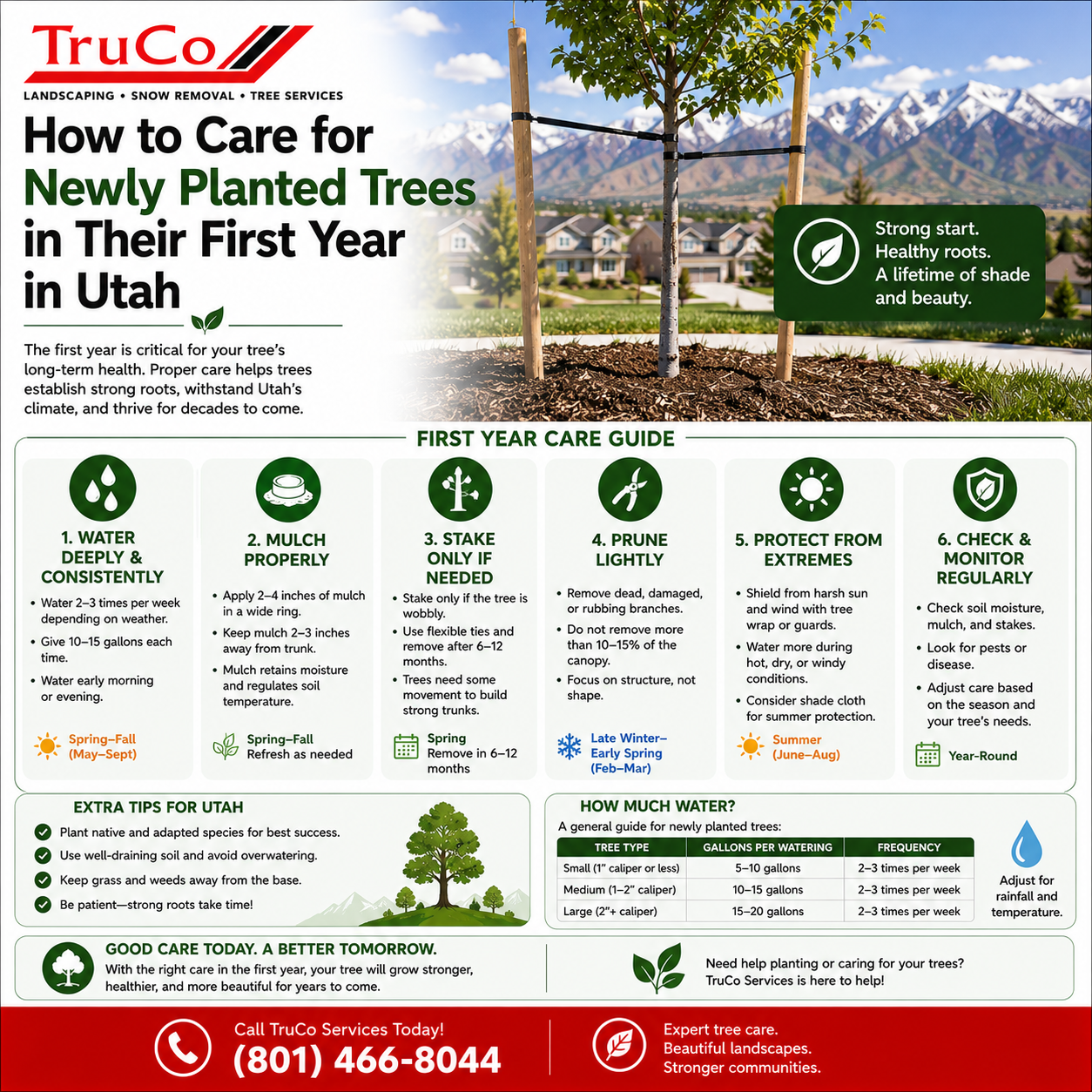
Why the First Year Is Critical for Utah Trees
The first year after planting is the most critical period in a tree's life. During this time, the tree must establish a root system in its new location, adapt to Utah's challenging soil and climate conditions, and survive seasonal stresses including summer heat, winter cold, and spring winds. Studies from Utah State University Extension show that trees receiving proper first-year care have a 90%+ survival rate, while trees neglected in their first year have only a 30-50% chance of survival. The investment of time and resources during this establishment period pays off with a healthy, long-lived tree that will provide decades of benefits. This guide covers everything you need to know to care for newly planted trees through their first year in Utah — from immediate post-planting care through each season, with specific guidance for Utah's unique conditions. Whether you planted a shade tree in your Salt Lake City backyard or an ornamental tree in your Provo front yard, following these guidelines will give your new tree the best possible start.
Immediate Post-Planting Care
The first few days after planting set the foundation for success. Water thoroughly at planting time — apply enough water to saturate the entire root ball and surrounding soil. For a 15-gallon container tree, this means 5-10 gallons of water slowly applied. For balled-and-burlapped trees, use 10-20 gallons depending on root ball size. Check that the root ball is fully saturated — dry pockets in the root ball can kill roots. If you planted in Utah's clay soil, water slowly to allow penetration without runoff. Apply 3-4 inches of organic mulch over the root zone, extending from the trunk to beyond the drip line. Keep mulch 3-6 inches away from the trunk. Proper mulching conserves moisture that the tree needs for establishment. If the tree was staked, ensure ties are not too tight — they should allow some trunk movement. Stakes should be removed after one growing season. Do not fertilize at planting time — the tree needs to focus on root establishment, not leaf growth. Wait until the tree shows signs of active growth (usually 4-6 weeks after planting) before any fertilization. Protect the trunk from sunscald and rodent damage with tree wrap, especially for thin-barked species like maple, redbud, and fruit trees.
Season 1: Spring (First Growing Season)
Spring is when your newly planted tree begins active growth. In Utah, spring planting (March-April) gives the tree a full growing season to establish before winter. Water newly planted trees every 5-7 days during spring. In Utah's clay soil, water less frequently but more deeply than in sandy soils. Check soil moisture 4-6 inches deep before watering — if moist, wait. Water the root ball area, not just the surrounding soil — the root ball dries out faster than the backfill. Monitor for leaf emergence — if the tree leafs out on schedule (usually April-May for most species), it is establishing well. If leaves are late, small, or sparse, the tree may be stressed. Check the root ball for signs of drying — in Utah's dry spring winds, root balls can dry out quickly, especially for above-ground plantings. Apply a slow-release, balanced fertilizer (10-10-10 or similar) 6-8 weeks after planting if the tree shows active growth. Do not fertilize stressed or struggling trees. Watch for pests — aphids often attack new growth on stressed trees. Treat with insecticidal soap or strong water spray. Protect from late spring frosts — if frost is forecast, cover small trees with frost cloth.
Season 2: Summer (Heat and Drought)
Utah's summer is the most challenging season for newly planted trees. Increase watering frequency as temperatures rise. In June, water every 5-7 days. In July and August, water every 3-5 days, especially during heat waves. Water deeply each time — a slow trickle for 30-60 minutes, moving the hose around the root zone. The goal is to moisten the entire root ball and surrounding soil to 12-18 inches deep. Check soil moisture daily during heat waves — Utah's clay soil can crack and pull away from the root ball, creating air pockets that dry out roots. Add a top-up layer of mulch if needed (maintain 3-4 inches total). Do not let mulch touch the trunk. Monitor for heat stress — wilting leaves, leaf scorch (brown edges), and leaf curling indicate the tree needs more water. However, do not overwater — yellowing lower leaves can indicate overwatering in clay soil. Provide afternoon shade for sensitive species using shade cloth or temporary screens. Remove any weeds or grass growing within the mulched area — they compete with the new tree for water. Do not prune during summer except to remove dead or damaged branches. Summer pruning stimulates growth that may not harden off before winter.
Season 3: Fall (Preparation for Dormancy)
Fall care determines how well your tree survives its first Utah winter. Gradually reduce watering frequency as temperatures cool, but do not stop watering. Continue deep watering every 7-10 days through September and October. In November, water once or twice if the ground is not frozen. Deep watering in fall helps the tree store moisture for winter dormancy. Do not fertilize after August — fall fertilization stimulates tender new growth that will be killed by frost. Apply a fresh layer of mulch (2-3 inches) after the first hard frost, keeping it away from the trunk. Remove tree wrap that was applied in spring and reapply fresh wrap if needed for winter protection. Install rodent guards (hardware cloth cylinders) around the trunk, extending above expected snow depth. Protect from deer damage with fencing or repellent if deer are present in your area. Do not prune in fall except to remove dead or hazardous branches — fall pruning can stimulate growth that will not harden off. For thin-barked species, apply white tree wrap to prevent sunscald (southwest winter injury). Consider applying anti-desiccant spray to evergreens to reduce winter moisture loss. Stake or guying may be needed in exposed, windy locations — check existing stakes and adjust if needed.
Season 4: Winter (Dormancy and Protection)
Winter care for newly planted trees is essential in Utah's cold climate. Water monthly during winter dry spells when temperatures are above 40°F and the ground is not frozen. This is especially critical for evergreens and trees planted in the fall — they have had less time to establish roots. Do not water when the ground is frozen — water will not penetrate and may create ice that damages roots. Check stakes and ties — remove them if the tree is stable. Stakes left on too long can girdle the growing trunk. Monitor for snow and ice damage — gently brush heavy snow off branches using an upward motion (never pull down). Inspect trunk wraps and rodent guards — ensure they are intact and protecting the trunk. Make sure mulch is still in place and has not blown away. Avoid piling snow laden with deicing salts around the tree. Protect from winter wind — consider burlap screens on the windward side for evergreens in exposed locations. Do not prune during extreme cold (below 20°F) — wood becomes brittle and bark can tear. Plan your spring care activities while the tree is dormant. Winter is an excellent time to reflect on the tree's first year and plan for year two, when the tree will need less intensive care.
Common First-Year Problems and Solutions
Be prepared to address common problems in newly planted trees. Wilting despite adequate watering can indicate overwatering (root rot in clay soil), underwatering (check soil moisture at root ball depth), or transplant shock (normal for 2-4 weeks after planting). Leaf yellowing could mean iron chlorosis from alkaline soil (treat with iron chelate), nitrogen deficiency (wait to fertilize until tree is established), or overwatering. Leaf scorch (brown leaf edges) is usually from heat stress, wind desiccation, or insufficient water — increase watering depth and ensure mulch is adequate. No new growth by mid-summer may indicate the tree is struggling — check for root ball problems (girdling roots, planting too deep) and consult a certified arborist. Leaning after wind or rain — check that the root ball is still in soil contact and re-stake if needed. Bark splitting on the trunk (sunscald) — wrap the trunk with tree wrap or apply white latex paint (50:50 with water) to the south and southwest sides. Pest infestations — stress from transplanting makes trees more susceptible to pests. Identify the pest and treat appropriately. Most first-year problems are preventable with proper planting, watering, and protection. If problems persist, consult a certified arborist.
First-Year Watering Schedule for Utah
Use this general watering schedule as a guide for newly planted trees in Utah, adjusting for soil type, weather, and tree species. Spring (March-May): water every 5-7 days. In sandy soil, every 3-5 days. In clay soil, every 7-10 days but more deeply. Early summer (June): water every 5-7 days. Increase to every 3-5 days during hot, dry spells. Midsummer (July-August): water every 3-5 days, or daily during extreme heat (over 95°F). Monitor soil moisture daily. Water early morning to reduce evaporation. Late summer (September): water every 5-7 days. Reduce frequency as temperatures cool. Fall (October-November): water every 10-14 days. Continue until the ground freezes. Winter (December-February): water once a month on warm days (above 40°F) if no snow cover. Always check soil moisture before watering — insert a screwdriver or soil probe 6-8 inches deep. If it goes in easily and the soil is cool and moist, wait to water. If it is dry, water deeply. Adjust the schedule based on your specific conditions — trees on south or west sides of buildings need more water, trees in clay soil need less frequent but deeper watering, and trees planted in fall need more attention to winter watering.
Year Two and Beyond
By year two, your tree will need less intensive care. Watering frequency gradually transitions to the established tree schedule (every 7-14 days during the growing season). Continue mulching annually with 2-3 inches of fresh organic mulch. Remove stakes after the first growing season if the tree is stable. If re-staking is needed, use flexible ties and check regularly. Begin a regular fertilization program in year two with a balanced, slow-release fertilizer applied in early spring. Prune to establish good structure — remove crossing branches, low branches, and multiple leaders. Begin annual inspections for pests, diseases, and structural issues. By year three, most trees are established enough to survive with normal watering and care. However, continue to monitor — trees planted in challenging Utah conditions (heavy clay, exposed windy sites, urban heat islands) may take 3-5 years to fully establish. The investment in proper care during the first year pays dividends for the life of the tree. A tree that establishes well in its first year will grow faster, be more resilient to pests and diseases, and live longer than one that struggles through its first season.
Frequently Asked Questions
How often should I water a newly planted tree in Utah? In clay soil, every 5-7 days during the growing season. In sandy or loamy soil, every 3-5 days. Adjust for temperature and rainfall. Always check soil moisture before watering — the goal is consistent moisture, not constant saturation.
Should I fertilize a newly planted tree? Wait 6-8 weeks after planting, and only if the tree shows active growth. Use a slow-release, balanced fertilizer. Do not fertilize stressed trees or trees planted in fall (wait until spring). Overfertilizing a new tree can burn roots and delay establishment.
Why are my new tree's leaves turning yellow? In Utah, yellowing leaves on new trees are most commonly caused by iron chlorosis from alkaline soil, overwatering in clay soil, or transplant shock. Check soil moisture and treat chlorosis with iron chelate if needed.
Do I need to stake my newly planted tree? Only if the tree is in a windy location, has a large canopy relative to its root ball, or is top-heavy. Remove stakes after one growing season. Incorrect or prolonged staking weakens the trunk and can damage the tree.
When is the best time to plant a new tree in Utah? Fall (September-October) is ideal — the tree establishes roots during cool weather and is ready for spring growth. Early spring (March-April) is the second-best option. Avoid planting in summer heat or when the ground is frozen.
How do I know if my newly planted tree is dying? Signs include: no leaf emergence by late spring, leaves that emerge then quickly wilt and die, bark peeling or cracking on the trunk, soft or mushy trunk near the soil line, and no new growth by midsummer. If you see these signs, consult a certified arborist promptly.