
Murray UT Permanent Christmas Lights

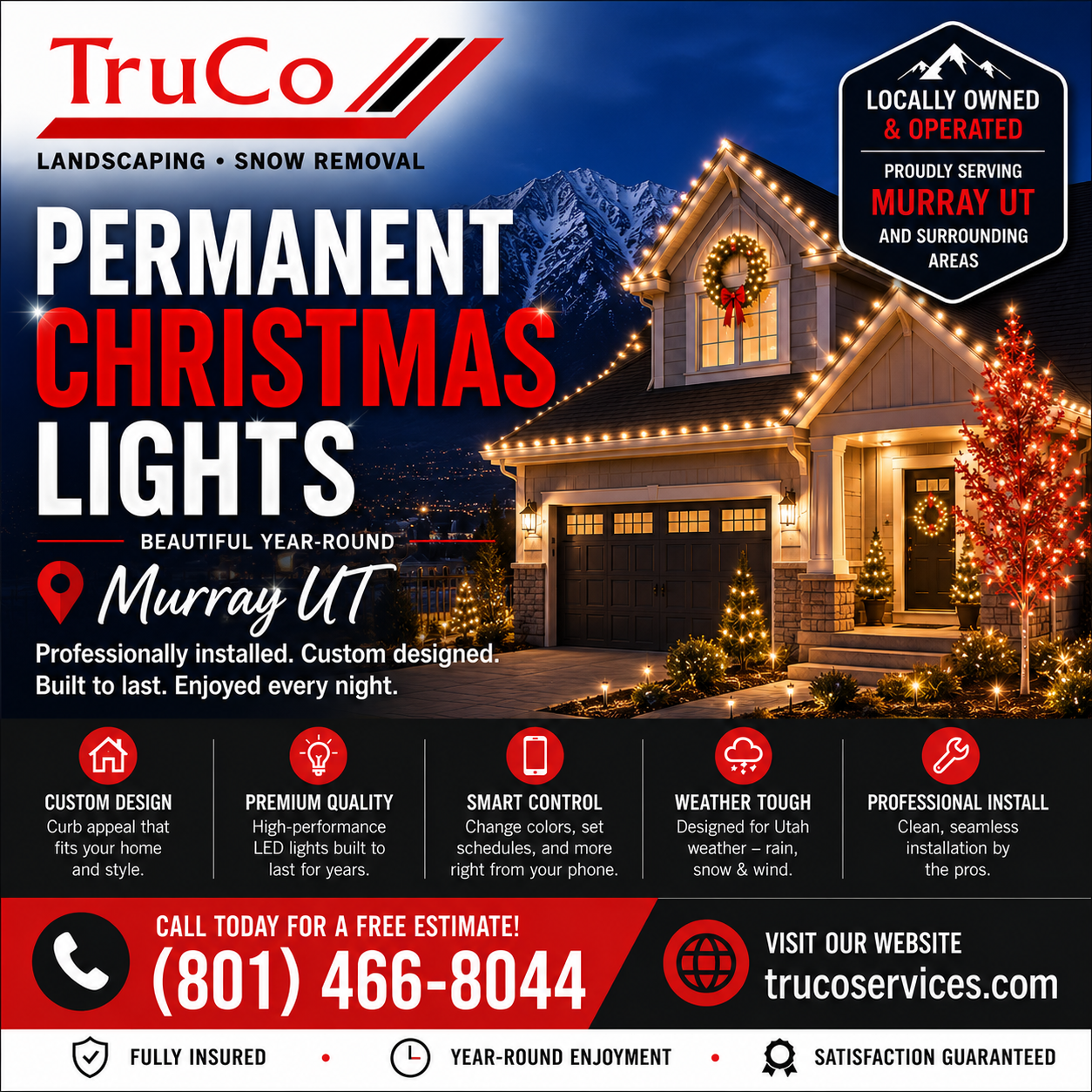
Permanent Christmas lights in Murray, UT are professionally installed, low-profile exterior LED lighting systems designed to stay on your home year-round while giving you app-controlled holiday, event, accent, and security lighting. The most important decision is not simply which color-changing lights look best—it is choosing a system, placement plan, power setup, and installer that will hold up through Utah sun, winter snow, wind, moisture, and years of use without harming your roofline or creating electrical problems.
For homeowners, permanent holiday lighting can replace the annual ladder-and-extension-cord routine with clean, programmable lighting that is ready for Christmas, Halloween, game days, birthdays, patriotic holidays, and everyday architectural accent lighting. But quality varies substantially. A system with poor wire routing, visible tracks, weak mounting, undersized power supplies, or unclear service terms can become expensive to repair.
This guide explains how permanent Christmas lights work, the major decisions that affect performance and appearance, local Murray electrical considerations, common mistakes, costs, options, and how to choose a provider. Professional planning helps ensure your Murray permanent Christmas lights look intentional on day one and remain reliable well beyond the first holiday season.
What Are Permanent Christmas Lights?
Murray UT permanent Christmas lights are permanently mounted exterior LED lights installed along rooflines, eaves, soffits, fascia boards, peaks, gables, patios, or other architectural edges. Unlike traditional holiday string lights, they are not meant to be installed in November and removed in January. The light system remains discreetly mounted throughout the year and is controlled through a dedicated controller, remote, app, timer, or a combination of these tools.
Most modern permanent exterior lighting systems use individually addressable RGB or RGBW LEDs. “Addressable” means that each light—or a small group of lights—can display a different color from the others. This makes it possible to create patterns, color chases, holiday displays, warm-white everyday accent lighting, and team-color combinations.
A typical permanent lighting installation includes:
LED light modules or puck lights.
A track, channel, or mounting system that conceals wiring and positions lights consistently.
Low-voltage wiring or a purpose-built exterior lighting cable.
A controller that receives app, remote, schedule, or automation commands.
A power supply and electrical connection.
Mounting hardware suited to the home’s soffit, fascia, siding, trim, or roofing details.
Setup, testing, programming, and customer instruction.
For example, a Murray homeowner may choose warm white lighting along the front roofline most evenings, switch to red and green for December, orange and purple for Halloween, and red, white, and blue around Independence Day. The same installed system supports each use without hanging new strings or climbing a ladder.
How the Process Usually Works
The process generally starts with an exterior walkthrough and design discussion. A lighting professional measures rooflines, identifies mounting surfaces, checks access and power locations, and discusses what areas should be illuminated. The proposal should clarify the system type, light placement, controller, visible components, electrical needs, warranty terms, and service process.
Next comes installation. The crew mounts the lighting system to appropriate exterior surfaces, routes wiring in a protected and visually clean way, connects the system to power, tests each section, and configures the controller. A good installer will also show the homeowner how to use schedules, colors, brightness, and preset patterns.
Permanent lighting is not the same as a temporary strand of Christmas lights. It is a long-term exterior electrical and cosmetic installation. That distinction matters when evaluating product quality, installation methods, local code questions, insurance concerns, and future maintenance.
Murray City states that updated state construction codes took effect July 1, 2026, including the 2023 National Electrical Code (NEC). Permit applications submitted on or after that date must comply with the updated adopted codes and applicable Utah amendments. Ask about the electrical scope of your project and whether a permit or inspection is needed before work begins.
9 Things to Know Before Installing Permanent Lights
1. The Best System Is Designed for Your Home
Permanent holiday lights should follow the architecture of your house rather than force a generic layout onto it. A straight single-story ranch home, a two-story home with multiple gables, a house with deep eaves, and a home with decorative fascia each require different planning.
The first design decision is what to light. Many homeowners start with the front-facing roofline because it creates the most curb appeal for the investment. Others want peaks, garage lines, front entry features, dormers, patio covers, or backyard entertainment areas. More lighting is not always better. A clean, balanced design often looks more premium than every available edge covered in LEDs.
The mounting location also changes the final look. Lights placed under an eave can create a soft scalloped wash of color on the wall. Lights directed outward from the fascia may be more visible from the street. A professional should discuss which visual effect you prefer before installation.
Poor design produces common disappointments: uneven spacing, bright spots, dark gaps, visible wiring, or a front elevation that looks unbalanced. For example, outlining only one side of an asymmetrical gable may make the roofline feel unfinished. Likewise, installing lights too close to a wall can create small circles of light rather than a smooth, attractive wash.
Before signing a proposal, ask for a clear layout that identifies every illuminated roofline and feature. Confirm whether the price includes peaks, garage trim, second-story areas, controller placement, and wiring concealment. That avoids the frustration of discovering that the “whole-home” estimate only covers a few easy-to-reach front sections.
2. Product Quality Affects Appearance and Lifespan
Not all permanent Christmas lighting products are built for the same purpose. Some are consumer-grade systems intended for homeowner installation; others are contractor-oriented systems with more robust tracks, weather-resistant connectors, expandable controllers, and serviceable parts.
The LEDs themselves matter, but they are only one part of the system. A durable installation also depends on the quality of the light housing, wiring jacket, connectors, power supply, track material, mounting hardware, controller enclosure, and weather sealing.
Look for a system designed for permanent outdoor use, not an indoor or temporary product repurposed for the exterior. The manufacturer’s instructions should address wet-location use, operating temperatures, mounting requirements, extension rules, power limits, and whether the components are listed by a recognized testing laboratory.
A quality track or channel can make a major visual difference. It hides wires, maintains consistent light spacing, and gives the installation a finished appearance in daylight. Ideally, the track color is selected to coordinate with your soffit or fascia so it blends into the home rather than becoming the most noticeable feature.
Cheap or poorly matched components can lead to fading, cracking, loose tracks, water intrusion, corroded connections, inconsistent colors, or early LED failures. The system may work during the first Christmas season but become unreliable after repeated hot summers and winter freeze-thaw cycles.
Ask exactly what brand or system is being installed, who supports the product after installation, whether replacement parts are available, and what happens if a single section fails. A provider should be able to explain the product in plain English rather than relying on vague phrases such as “commercial grade” without details.
3. Utah Weather Makes Installation Quality Critical
Murray homes experience intense sunlight, snow, freezing temperatures, wind, rain, and substantial temperature swings. Those conditions make installation details more important than they may be in a mild climate.
Sun exposure can degrade inferior plastic housings, brittle wire jackets, adhesives, and unprotected cable. Winter conditions can reveal weak mounting methods, especially where snow load, ice, or wind-driven moisture are present. Expansion and contraction across long rooflines can also stress tracks, fasteners, wiring, and connections.
The location of the controller and power components matters. These parts should be protected from unnecessary moisture, physical damage, extreme heat, and accidental disconnection. Exterior connections need appropriate weather protection, strain relief, and routing that does not trap water.
Installation timing can also affect results. Very cold conditions may make some materials less flexible and complicate certain mounting methods. That does not mean winter installation is impossible, but it does mean the installer should use methods suitable for the materials and weather conditions.
Homeowners should also consider roof access. A lighting crew should not compromise shingles, flashing, gutters, soffits, or attic ventilation. Permanent lights are usually mounted to soffits, fascia, trim, or a designed track—not carelessly fastened through roofing materials. If an installer proposes methods that seem likely to puncture roof surfaces or interfere with drainage, ask for an explanation before approving the work.
The goal is a system that looks neat during the holidays and remains stable when it is turned off for much of the year. A properly planned Murray UT permanent lighting installation accounts for weather exposure before the first piece of track is installed.
4. Electrical Planning Is a Safety Issue
Permanent exterior lighting needs safe, appropriate power. It is not a project where an installer should simply overload a convenient outlet, run an exposed extension cord, or hide questionable connections behind trim.
Most systems use LED technology, which typically uses far less electricity than old incandescent holiday lights. Even so, a lighting system still needs correctly designed power distribution, protected connections, suitable wiring, and compliance with applicable electrical requirements. The exact setup depends on the product, total run length, controller type, and the home’s electrical configuration.
Murray City identifies the 2023 National Electrical Code as part of the construction codes applicable to permit applications submitted on or after July 1, 2026. The city’s Building Division is the correct local source for questions about permits, plan review, and inspections.
For homeowners, the practical questions are:
Where will the system receive power?
Is the outlet or circuit appropriate for the equipment?
Is the outdoor electrical equipment protected from moisture?
Will the installation require a new circuit, outlet, hardwired connection, or electrical permit?
Who is responsible for electrical work if it extends beyond plugging in a listed low-voltage power supply?
How will wiring be protected and concealed?
Do not assume a permanent lighting install is automatically permit-free or that every provider performs electrical work. The scope matters. Adding circuits, modifying electrical equipment, or making certain wiring changes can trigger requirements that a qualified professional should evaluate. Murray City also notes that construction documents for covered work must demonstrate compliance with applicable adopted codes and Utah amendments.
A safe installation protects your home, your investment, and the people using the system.
5. Color, Brightness, and Controls Matter More Than Expected
The appeal of permanent holiday lights comes from flexibility, but too many options can create confusion if the controls are poorly set up. Before choosing a system, think about how your household will actually use it.
Many homeowners want more than Christmas lighting. They want warm white roofline accents, Halloween colors, birthday themes, sports colors, party lighting, and simple scheduled operation. Make sure the system supports the functions you care about rather than paying for features you will never use.
Brightness is a major design consideration. Lights that look impressive in a showroom or online video may be overly intense for your property, street, neighbors, or bedroom windows. A well-designed system should allow dimming and should be programmed with appropriate brightness levels for everyday use versus special-event displays.
Color quality also varies. Some RGB systems produce vibrant colors but less convincing warm white. RGBW systems include a dedicated white LED, which can improve the appearance of everyday white lighting. That may matter if you want permanent exterior lighting to serve as architectural accent lighting throughout the year.
Ask to see how the app works. Can you create schedules? Save custom patterns? Divide the home into zones? Dim the lights? Share access with another household member? Does the system still have usable controls if your Wi-Fi goes down? Is there a local controller, remote, or manual override?
A system should simplify life, not create another technical headache. During installation, insist on a walkthrough that includes connecting the app, naming the system, saving common presets, and understanding how to reset or troubleshoot it.
6. Daytime Appearance Is Just as Important
Permanent lights are visible 365 days a year, even when they are switched off. That means the daytime appearance of tracks, wires, junctions, and controllers is just as important as the nighttime show.
The ideal installation is easy to appreciate at night and easy to overlook during the day. Tracks should match or complement the soffit or fascia. Wiring should be concealed where practical. Lines should be straight. Light spacing should be consistent. Transitions around corners, gables, and roofline changes should look deliberate rather than improvised.
This is where an experienced installer adds significant value. A home may have multiple materials—stucco, brick, vinyl, wood trim, metal fascia, and soffits—with different mounting needs. The installer should choose techniques that look clean without damaging or weakening the exterior.
Ask your provider where power supplies and controllers will be placed. A bulky box beside the front door, a loose wire across a wall, or exposed connectors near a downspout can undermine an otherwise attractive project. The best location balances access for service with a discreet appearance.
Request photos of completed installations in daylight, not only nighttime images. Night photos can make nearly any lighting system look appealing, while daytime photos reveal track alignment, visible cable, installation quality, and how well the system blends with the home.
For Murray homeowners who take pride in curb appeal, the daylight standard should be simple: if you can immediately spot wiring, crooked sections, or mismatched track from the sidewalk, the installation may not have received the care a permanent project deserves.
7. Warranties Must Be Read Carefully
“Lifetime warranty” can sound reassuring, but it means little without understanding what is covered, who provides the coverage, and what labor costs may remain. Product warranties and installation warranties are not necessarily the same thing.
A manufacturer may cover a defective light module or controller but not the labor needed to diagnose the problem, reach a second-story roofline, remove a track section, or reinstall components. An installer may guarantee workmanship for a defined period but not cover storm damage, power surges, homeowner modifications, or problems caused by unrelated exterior work.
Before moving forward, ask for warranty terms in writing. Important questions include:
How long is the product covered?
How long is installation workmanship covered?
Are labor, travel, troubleshooting, and replacement parts included?
Is damage from weather, pests, roof work, painting, or renovations excluded?
Who handles warranty service: the installer, manufacturer, or both?
What happens if the installer is no longer in business?
Is warranty transfer available if the home is sold?
A clear service plan is more valuable than a broad marketing promise. Permanent lights are mounted in places that can be difficult to access, so a small issue can become costly if service terms are vague.
Homeowners should keep their contract, system documentation, app credentials, purchase records, product information, and any installation photos. This makes future troubleshooting easier and can be helpful when selling the property or coordinating roof, gutter, painting, solar, or exterior renovation work.
8. Roof, Gutter, and Remodeling Work Can Affect the System
Permanent lighting should be considered part of the home’s exterior maintenance plan. Roof replacement, fascia repairs, painting, gutter installation, siding work, solar projects, and soffit repairs can all affect the lighting system.
For example, a roof replacement contractor may need access near the lighting track or wiring. A painter may need to remove or work around components. A gutter company may need to modify the fascia area. If these trades are not informed in advance, components can be damaged, disconnected, painted over, or reinstalled incorrectly.
The best practice is to tell every exterior contractor that permanent lighting is installed before they begin work. Ask the lighting provider whether removal and reinstallation services are available, what those services cost, and how much notice is required.
This matters especially if your roof is nearing the end of its life. Installing permanent roofline lights immediately before a major reroof can mean paying to remove and reinstall a system sooner than expected. In some cases, it makes sense to coordinate the lighting project after roofing or fascia work is complete.
Also consider drainage and access. Lighting tracks should not obstruct gutters, downspouts, vents, soffit access, or future repairs. The installer should understand the distinction between an attractive mounting location and a location that creates maintenance conflicts.
A permanent exterior system should work with the house, not complicate future upkeep. Planning for other trades protects your lighting investment and avoids unnecessary frustration years later.
9. The Lowest Bid Can Become the Highest Cost
Homeowners naturally compare quotes, but permanent lighting proposals are not interchangeable. A lower price may reflect less coverage, shorter runs, fewer lights, lower-quality components, exposed wiring, excluded electrical work, limited service, or a reduced warranty.
The right comparison is not just “What is the total price?” It is “What am I receiving, how will it look, and what happens if something fails?”
A detailed quote should identify the sections being lit, product system, track color, controller, power approach, installation method, app setup, warranty coverage, likely exclusions, and service process. If one estimate is dramatically lower than the others, ask what is missing rather than assuming the provider has simply found a better deal.
For example, one company may quote the front roofline only, while another includes garage peaks, multiple stories, matched track, concealed wiring, and full programming. The first quote may look less expensive on paper but deliver a much smaller and less finished result.
Price matters, but permanent holiday lights are an installed exterior improvement. A system that needs recurring repairs, looks sloppy during the day, creates electrical concerns, or must be replaced early is rarely a bargain.
Choose based on overall value: appropriate components, clean installation, responsive service, clear expectations, and a provider willing to explain the work without pressure or jargon.
Frequently Asked Questions
What are permanent Christmas lights?
Permanent Christmas lights are exterior LED lighting systems mounted to a home year-round. They are typically controlled by an app, timer, remote, or controller and can display holiday colors, patterns, warm white, and event-specific designs.
Are permanent Christmas lights only for Christmas?
No. Many homeowners use permanent holiday lights for Halloween, Independence Day, birthdays, sports events, parties, warm white accent lighting, and everyday curb appeal.
Do permanent lights stay on all year?
The fixtures remain installed, but the lights do not need to be on all year. You can turn them off, use schedules, or operate them only for selected dates and events.
Can permanent lights be used as everyday exterior lighting?
Yes, many systems can provide warm white or soft accent lighting. However, roofline lighting is not always a replacement for properly designed entry, pathway, security, or landscape lighting.
How long do permanent LED Christmas lights last?
Lifespan depends on the quality of the LEDs, controller, wiring, weather exposure, installation quality, operating habits, and warranty terms. Ask the provider for product-specific information and written coverage details.
Are permanent holiday lights expensive to operate?
LED systems generally use substantially less energy than traditional incandescent holiday lights. Actual cost depends on system size, brightness, daily run time, local electricity rates, and programming.
Can I control permanent lights from my phone?
Many systems offer app-based controls. Features may include color selection, effects, brightness control, zones, schedules, timers, and saved presets. Ask to see the app before purchasing.
Do permanent lights work without Wi-Fi?
That depends on the system. Some need Wi-Fi for app functions, while others provide Bluetooth, remote, local-controller, or manual controls. Confirm how your chosen system operates during an internet outage.
Will permanent lights damage my roof?
They should not when planned and installed correctly. Quality systems are generally mounted to soffits, fascia, trim, or purpose-designed tracks. Discuss mounting methods and avoid unnecessary penetration of roofing materials.
Can permanent lights be installed on a two-story home?
Yes. Multi-story homes are common candidates for permanent lighting, but access, safety, roofline complexity, and serviceability should be factored into the design and price.
Can lights be installed on stucco, brick, vinyl, or wood?
Often, yes, but each material requires an appropriate mounting approach. The provider should evaluate the specific surface rather than use the same method everywhere.
What colors can permanent Christmas lights display?
Most color-changing systems offer a wide range of colors and patterns. RGBW systems may provide a more natural-looking white than RGB-only systems because they include a dedicated white LED.
Can I create custom holiday patterns?
Many app-controlled systems allow custom patterns, color zones, brightness settings, and saved scenes. The available options vary by manufacturer and controller.
Are permanent lights bright enough to see from the street?
Usually, yes. The important question is whether they can also be dimmed enough to avoid glare or an overly harsh appearance. Good lighting should be visible without overwhelming the home or neighborhood.
Can I install permanent lights myself?
DIY installation is possible for some systems, especially on simple, accessible homes. Professional installation may be a better fit for complex rooflines, high elevations, clean wire concealment, long-term service, and electrical planning.
Are permanent Christmas lights waterproof?
Exterior systems should be rated and installed for outdoor conditions, but “waterproof” is not a substitute for correct installation. Connectors, controllers, power supplies, wiring routes, and mounting methods all need weather protection.
Will snow and freezing weather damage the lights?
A system designed and installed for exterior use should be selected with local weather in mind. Damage risk increases when materials, mounting hardware, wire routing, or connections are poor quality or improperly installed.
Do permanent lights require maintenance?
They usually require less work than seasonal string lights, but they may still need occasional app updates, cleaning around accessible components, inspection after storms, and service if a light section or controller fails.
What happens if one light stops working?
The answer depends on the system design. Some systems allow individual light replacement or segment-level repair. Ask how failures are diagnosed, whether components are serviceable, and what labor costs may apply.
Can a permanent lighting system be repaired?
Often, yes. Repairability depends on the product, age of the system, availability of components, wiring layout, and accessibility. A written service policy is important.
Can I add more lights later?
Some systems are expandable, while others have controller, power, voltage-drop, or maximum-run limitations. Plan future additions before the original installation so expansion is possible if desired.
Do permanent lights increase home value?
A well-designed and professionally installed system may improve curb appeal and convenience for some buyers, but it should not be treated as a guaranteed increase in resale value. Good installation quality and clean daytime appearance are essential.
Do I need a permit for permanent Christmas lights in Murray?
It depends on the project’s electrical scope and applicable local requirements. Adding or modifying electrical circuits or equipment can involve permitting or inspection questions. Contact Murray City Building Division or consult a qualified professional before work begins.
What electrical code applies in Murray, Utah?
Murray City reports that, for permit applications submitted on or after July 1, 2026, the state-adopted codes include the 2023 National Electrical Code, along with applicable Utah amendments. Requirements can change and depend on project scope, so verify current requirements with the city.
Are outdoor electrical outlets required to have GFCI protection?
Outdoor electrical safety rules are technical and can vary depending on the installation and adopted code provisions. Utah’s residential code amendments include provisions addressing ground-fault circuit-interrupter protection for specified 125-volt, single-phase 15- and 20-ampere receptacles. Have a qualified professional evaluate the actual power arrangement rather than guessing.
Can permanent lights be installed with solar panels?
They can often coexist, but planning is important. Coordinate with both the lighting provider and solar contractor so roof access, wiring, mounting locations, and future maintenance needs are not compromised.
Can permanent lights be installed before a roof replacement?
They can, but it may be more cost-effective to complete major roof, fascia, or gutter work first. Otherwise, removal and reinstallation could be needed sooner than expected.
Can I leave permanent lights on overnight?
You can, but consider brightness, neighborhood impact, bedroom windows, energy use, and local rules or HOA expectations. Schedules and dimming allow you to enjoy the system responsibly.
Will permanent lights bother my neighbors?
They can if they are excessively bright, rapidly flashing late at night, or directed toward nearby homes. Use reasonable brightness and time schedules, especially in closely spaced neighborhoods.
Are permanent lights safe for pets and children?
The lights themselves are typically mounted out of reach, but electrical components and wiring should still be installed and protected correctly. Do not allow children or pets to tamper with controllers, outlets, or accessible cables.
Can I use permanent lights for security lighting?
They can support general exterior visibility, but they should not be your only security measure. Dedicated motion lighting, properly located entry lighting, cameras, locks, and alarms may be more effective for security needs.
How do I prepare for a permanent lighting estimate?
Decide which rooflines you want lit, identify your preferred use cases, note planned exterior renovations, take photos of the house, and prepare questions about products, power, track color, app controls, warranty, service, and timing.
Key Rules and Standards to Know
Permanent exterior lighting touches several areas of construction and electrical safety. This is not legal or electrical advice, and requirements can change. Always verify the current rules that apply to your exact property and project scope.
Murray’s adopted construction codes: Murray City states that state construction code updates effective July 1, 2026 include the 2023 National Electrical Code. Permit submissions on or after that date must comply with newly adopted codes and applicable Utah amendments.
Local permit and inspection questions: Murray City Building Division provides permit and inspection assistance and can be contacted at 801-270-2431. The city advises property owners, contractors, and design professionals to review adopted codes and Utah amendments before submitting permit applications.
GFCI and outdoor electrical safety: The Utah residential code amendments address GFCI protection for specified receptacles. Electrical requirements depend on voltage, amperage, equipment type, location, wiring method, and the scope of the work.
Manufacturer instructions: Electrical equipment should be installed in accordance with its listing, labeling, and manufacturer instructions. Never modify components, splice wires, overload power supplies, or use unapproved accessories simply to make a system fit.
HOA and neighborhood rules: A homeowners association may regulate exterior alterations, visible equipment, light brightness, operating hours, or architectural changes. Review applicable HOA requirements before installation.
Conclusion
Murray UT permanent Christmas lights can make your home more festive, convenient, and visually appealing throughout the year—but the results depend on much more than choosing colorful LEDs. The best outcomes come from a thoughtful roofline design, durable outdoor-rated components, clean daytime installation, safe power planning, responsive support, and realistic expectations about future maintenance.
Avoid choosing solely on price, overlooking electrical considerations, installing before major roof work, accepting vague warranty language, or ignoring how the system will look when it is switched off. With the right planning, most avoidable problems—uneven lighting, visible wiring, premature failure, difficult service, weather-related issues, and unnecessary rework—can be prevented before installation starts.
For clear guidance on Murray UT permanent Christmas lights, contact Truco Services at (801) 466-8044 to discuss a professionally planned system for your home.