
Millcreek UT Permanent Christmas Lights

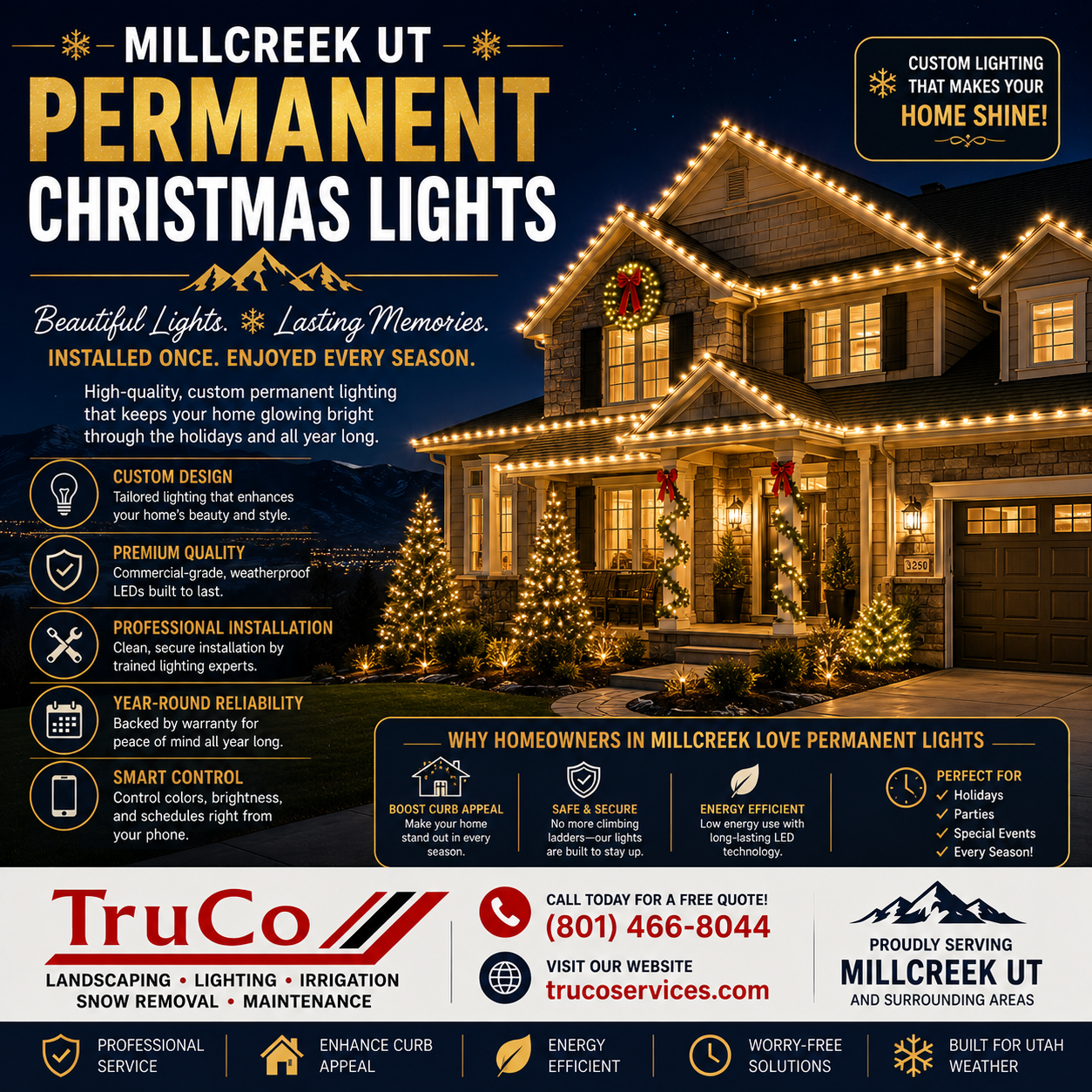
Permanent Christmas lights in Millcreek, UT are programmable LED lighting systems professionally installed along a home’s roofline, soffits, fascia, trim, garage peaks, porches, and similar exterior features. They remain in place through the year, while the homeowner changes colors, brightness, schedules, and effects for Christmas, Halloween, game days, birthdays, warm-white accent lighting, and special events.
The most important point is that permanent holiday lighting is a long-term exterior and electrical project—not simply temporary Christmas lights left up after the holidays. A successful system needs a thoughtful roofline design, outdoor-rated materials, a safe power plan, clean mounting, protected wiring, easy-to-use app controls, reasonable brightness, and a plan for repairs or future roof work. Millcreek homeowners should also consider snow, wind, sunlight, roof runoff, the condition of fascia and gutters, possible HOA requirements, city permit rules, and local outdoor-lighting standards.
This guide explains how Millcreek UT permanent Christmas lights work, what can go wrong, which choices matter most, and how homeowners can avoid expensive mistakes. With careful planning, permanent roofline lighting can make holidays easier while adding a polished, flexible exterior-lighting feature that remains useful year-round.
What Are Millcreek UT Permanent Christmas Lights?
Millcreek UT permanent Christmas lights are exterior LED lighting systems installed as a lasting part of a home. Rather than hanging traditional light strings every December and removing them after the season, homeowners use low-profile LED fixtures that stay mounted and change through programming.
These systems may also be described as:
Permanent outdoor Christmas lights in Millcreek
Millcreek permanent holiday lights
Permanent roofline lighting
Year-round LED Christmas lights
App-controlled holiday lighting
Smart exterior LED lights
Permanent LED trim lights
Programmable house lights
Architectural roofline lighting
Permanent exterior accent lighting
For example, a Millcreek homeowner might use soft warm white at moderate brightness for ordinary evenings, red and green in December, orange and purple in October, patriotic colors in July, or school colors for a graduation celebration. The lights remain mounted; the scene changes through the controller.
A typical installation includes a site assessment, roofline measurements, design planning, power review, installation, testing, app setup, and a final homeowner walkthrough. However, proposals vary. A quote may not include electrical upgrades, permits, roof repairs, gutter repairs, fascia replacement, future removal for reroofing, or post-warranty service. Ask for a written scope that makes those inclusions and exclusions clear.
8 Key Things to Know Before Installing Permanent Christmas Lights
1. A roofline plan matters more than the number of colors available
Homeowners often begin by comparing LED colors, app features, effects, and warranty language. Those details matter, but the finished appearance depends first on design. Permanent lighting should follow the home’s architecture in a balanced, intentional way.
A Millcreek home may have a simple roofline, or it may have multiple gables, dormers, porch roofs, garage peaks, upper-level elevations, side returns, and patio areas. Lighting every visible edge can look cluttered. Lighting too little can make the home look incomplete. The right layout highlights the best architectural lines without overwhelming the property.
Before approving a design, ask:
Which rooflines and elevations are included?
Where will lighting begin and end?
Are garage peaks and porch rooflines included?
Are dormers, upper-level lines, side elevations, and rear patio areas included?
How will corners, valleys, gables, and roofline transitions look?
What track or channel color will blend with the soffit or trim?
Where will visible wiring run?
Where will the controller and power supply be located?
How many independently controlled zones will be included?
Avoid vague phrases such as “front-of-house lighting” or “full-home lighting.” Ask for a marked-up photo, layout diagram, or written scope showing exactly what is included.
For example, if a house has a large front garage, covered porch, and high roof peak, lighting only the upper peak may leave the rest of the façade looking dark. Conversely, lighting every roof edge at full brightness can appear overly busy. A good layout is clean, consistent, and designed for the home rather than copied from a generic template.
2. Millcreek weather demands all-season materials and installation
Permanent outdoor Christmas lights in Millcreek need to perform through snow, ice, rain, wind, dust, direct UV exposure, summer heat, winter cold, roof runoff, and frequent freeze-thaw cycles. The project should be designed for year-round conditions, not only for December.
Weather affects the entire installation:
LED lenses and housings
Mounting tracks or channels
Fasteners
Wire insulation
Connectors and splices
Controllers
Power supplies
Fascia, soffit, and trim materials
Gutters and roof-edge drainage areas
Common weather-related problems include loose track, failed connections, water intrusion, UV-damaged wire insulation, moisture in equipment enclosures, and controller failure caused by poor placement.
Ask the provider how the installation handles:
Snowmelt and roof runoff
Gutter overflow or roof-valley drainage
Outdoor-rated wiring and connectors
UV exposure along sunny elevations
Wind exposure on high rooflines
Secure wire routing
Controller and power-supply protection
Future access for inspection and repair
For example, even a weather-rated controller can be vulnerable if it is mounted directly beneath a roof valley where melting snow and rainwater repeatedly drain. Likewise, an LED module may be durable, but the system can still fail if its wiring or connections are loosely installed or improperly protected.
The right question is not merely, “Are these lights waterproof?” Ask how the entire system is protected against the weather conditions around your home.
3. Electrical safety should be planned before lights go up
A permanent lighting system requires safe, appropriate electrical power. It should not depend on an extension cord used as a permanent solution, a garage power strip, an indoor outlet routed through a window, or an outdoor receptacle with unknown capacity or protection.
Millcreek’s Building Department reviews construction plans for code compliance, issues permits, and performs inspections. The department states that a building permit is required for construction in Millcreek except for listed exemptions, and it identifies the 2023 National Electrical Code among the codes it uses.
If permanent Christmas lighting requires a new exterior outlet, circuit modification, added wiring, panel work, or another electrical change, homeowners should confirm the permit and inspection requirements before installation begins.
Before work starts, determine:
Which outlet or circuit will power the system
Whether the outlet is accessible and appropriate for outdoor use
Whether the circuit has enough available capacity
Whether outdoor power has appropriate GFCI protection
Whether a dedicated outlet or circuit is needed
Whether an electrical permit or inspection applies
Who is responsible for permit coordination
Where controllers and power supplies will be placed
How weather-exposed wiring and connections will be protected
A GFCI, or ground-fault circuit interrupter, is especially important outdoors because rain, snow, wet hands, sprinklers, and melting ice create increased electrical-shock risks. It is designed to shut off power quickly when it detects an imbalance that may indicate a ground fault.
If a breaker trips repeatedly, a GFCI will not stay reset, an outlet gets hot, lights flicker, you smell burning, or you see water in an electrical enclosure, switch the system off and arrange for proper diagnosis.
4. Permanent should mean repairable—not impossible to service
Permanent LED lighting can eliminate yearly hanging and removal, but it is not guaranteed to be maintenance-free. LEDs, wire, connectors, controllers, power supplies, and app-based controls are electronic components. Eventually, a section may fail or need service.
The practical issue is whether the system can be repaired without replacing large portions of the installation.
Before you commit, ask:
Can individual lights or smaller lighting segments be replaced?
If one LED fails, will one light, one zone, or the whole system stop working?
How are controllers and power supplies replaced?
Are replacement parts available?
Who provides service after installation?
Does the warranty cover parts, labor, diagnostics, travel, and ladder access?
Can the system be expanded later?
What happens if the roof, gutters, fascia, siding, or trim need work?
How will app or Wi-Fi issues be handled?
For example, a dark garage section could be caused by one failed light, a loose connection, water intrusion, a damaged wire, a power-supply issue, a controller problem, an app setting, or a communication fault. Replacing random lights may not resolve the problem.
A capable provider should troubleshoot in a defined order: confirm electrical power, check the GFCI and controller, isolate the affected zone, inspect wire runs and connectors, and identify the failed component. Ask about this service process before purchasing.
The best permanent-lighting system is not just attractive at installation. It remains practical when a repair is needed several years later.
5. Brightness and direction matter in Millcreek
Permanent exterior lighting should enhance your home without creating glare, light trespass, nighttime distraction, or conflict with neighbors. Modern LED systems can be very bright and capable of flashing, chasing, or rapidly changing effects. Those features should be used thoughtfully.
Millcreek’s outdoor-lighting standards aim to protect dark skies and limit glare, unnecessary lighting, and light trespass. The city’s summary says residential lighting upgrades, landscape lighting, and holiday lighting are generally exempt from those standards unless tied to a site-plan process. Even so, the city’s broader principles are useful for homeowners: use only the light needed, keep it purposeful, and minimize impacts on nearby properties.
For permanent Christmas lights, practical habits include:
Use moderate brightness for ordinary nights
Use timers so lights do not run until morning
Choose warm white or soft colors for routine accent lighting
Limit rapid flashes, chasing scenes, and strobe-style effects
Avoid displays that distract drivers near streets, intersections, and driveways
Keep the visual focus on the home, not on neighboring windows
Review HOA rules before installation
Adjust the display if a reasonable neighbor concern arises
A simple warm-white roofline display at 30 to 50 percent brightness can often look more polished than a full-intensity animated display. The goal is curb appeal, not visual overload.
6. Smart controls need to be useful in daily life
App controls are one of the strongest reasons to choose permanent holiday lighting. They can allow homeowners to select colors, create zones, dim lights, schedule operation, save favorite scenes, and change displays without using ladders.
However, a long list of app effects does not guarantee an easy ownership experience. You should understand how to operate the system after installation—not rely on the installer every time you want a different color.
Ask:
Does the system use Wi-Fi, Bluetooth, local control, cloud access, or a combination?
Can it continue to run saved schedules if internet service is unavailable?
What happens when you replace your router or change a Wi-Fi password?
Can multiple household members use the app?
Can you create independent zones for the garage, porch, main roofline, and patio?
Can brightness be adjusted separately from color?
Can you create recurring schedules?
Can you save favorite scenes?
Are there easy presets for Christmas, Halloween, warm white, and other events?
Will the provider demonstrate the controls on your own phone?
During final walkthrough, personally turn the system on and off, change colors, test lighting zones, dim the lights, select presets, and set a schedule.
The best permanent Christmas-light system should make everyday use simple. You should be able to set low-brightness warm white for an ordinary evening just as easily as a multicolor holiday display.
7. Fascia, gutters, soffits, and roof edges should be inspected first
Permanent lights are mounted to a home’s exterior, so the condition of the mounting surface matters. Lights should not be installed to cover rotted fascia, loose soffits, unstable gutters, peeling trim, damaged siding, or unresolved roof-edge issues.
Before installation, look for:
Cracked, loose, soft, or rotted fascia
Sagging, leaking, or poorly secured gutters
Loose or water-damaged soffit material
Peeling paint and deteriorated trim
Damaged siding
Roof-edge leaks
Persistent roof runoff
Areas prone to ice dams
Existing damaged exterior wiring
Planned roof, gutter, fascia, siding, or painting projects
If a gutter system or fascia board must be replaced after permanent lights are installed, the lighting track may need to be removed and later reinstalled. That can create added labor and cost.
Ask the provider how the lights will be mounted. Depending on the product and exterior material, a system may use a purpose-built track, clips, mechanical fasteners, or another manufacturer-approved approach. The mounting strategy should match the condition and material of the home.
If you expect to replace your roof soon, it generally makes sense to complete roofing work before permanent roofline lighting is installed. The same is true for major gutter, fascia, siding, and exterior-painting projects.
8. A clear proposal is more valuable than a low price per foot
Price per foot can help compare permanent-lighting proposals, but it should not be the only factor. Similar roofline footage can produce very different project costs because homes vary in height, access, roof complexity, electrical needs, number of zones, controller placement, and exterior condition.
A detailed proposal should identify:
Exact roofline sections and elevations included
Estimated linear footage
Track or channel color
Number of installed lighting zones
Controller and power-supply locations
App and control features
Electrical work included and excluded
Permit responsibility, if applicable
Installation timing
Product warranty
Labor warranty
Service and repair process
Future removal or reinstallation expectations
Exclusions for roof, gutter, fascia, trim, siding, and paint work
Be cautious with general terms such as “full house,” “complete installation,” or “whole roofline.” Ask whether the garage, porch, upper levels, side elevations, dormers, and rear patio are included.
A low quote may exclude the electrical plan, weather protection, detailed layout, service labor, or future support. Compare total value and clarity—not only the initial price.
The Real Cost of Getting Permanent Christmas Lights Wrong
A poorly planned permanent-lighting project can cost much more than replacing a failed LED. Since the system is attached to exterior building materials and connected to power, mistakes can affect electrical safety, roofline components, maintenance, appearance, and neighborhood relationships.
Financial costs can include:
Replacement LEDs, wires, controllers, connectors, or power supplies
Electrical corrections after an unsuitable power connection
New outdoor receptacle or circuit work added after installation
Repairs to fascia, soffits, trim, gutters, siding, or exterior paint
Removal and reinstallation for roof replacement or gutter work
Diagnostic, travel, ladder-access, and repair-labor fees
Replacement of a system that is difficult or impossible to service
HOA-related correction or removal costs
Time costs may include reconnecting the system to Wi-Fi, troubleshooting an app, identifying a dark zone, coordinating service calls, or resolving an unclear warranty issue.
There can also be emotional costs. Homeowners choose permanent Christmas lights to reduce holiday stress. A system that fails before a gathering, creates conflict over glare, or comes with poor service support can do the opposite.
Most of these problems are avoidable. A sound layout, appropriate power, durable outdoor components, weather-aware installation, a written scope, practical app training, and transparent service terms can reduce the risk of costly surprises.
How to Choose the Right Provider
Before selecting a provider for permanent Christmas lights in Millcreek, use this checklist:
The provider has experience with permanent exterior LED systems, not only temporary holiday-light installation.
The provider evaluates rooflines, fascia, soffits, gutters, trim, exterior condition, power access, and roofline access before quoting.
The provider explains the layout, mounting approach, wiring path, controller placement, zones, and app controls in plain language.
The written scope defines each included roofline, elevation, and feature.
The provider explains outdoor durability, snow, wind, sun, roof runoff, controller protection, and wire routing.
The provider addresses electrical requirements and identifies when permits or inspections may apply.
The provider can explain how failed lights, dark sections, power supplies, controllers, apps, wiring, and Wi-Fi changes are handled.
The provider distinguishes product warranty coverage from labor, diagnostics, travel, roofline access, and repair coverage.
The provider considers future roofing, gutter, fascia, siding, and painting work.
The provider is responsive and willing to discuss both installation and long-term ownership needs.
Millcreek’s Building Department requires contractor information when a contractor pulls a permit and identifies the 2023 National Electrical Code among the standards used for building-code compliance. Utah residents can also use the state’s official license-search resources to verify applicable professional credentials.
Common Permanent Lighting Mistakes
Choosing solely by price. A cheap proposal may omit electrical planning, outdoor protection, detailed design, labor warranty, or service support.
Accepting a vague layout. “Full roofline” or “whole home” does not identify whether garage peaks, porch lines, gables, side elevations, or patios are included.
Installing on damaged exterior surfaces. Failing fascia, loose soffits, leaking gutters, damaged siding, or deteriorated trim can make future repairs more expensive.
Using an unsuitable power source. Permanent lights should not rely on a long-term extension cord, overloaded outlet, or improvised exterior power arrangement.
Not planning around future roof work. Roofing, gutters, fascia repair, siding replacement, and painting can require light removal and reinstallation.
Running full brightness every night. Excessive brightness or rapid effects can create glare, reduce curb appeal, and disturb neighbors.
Skipping app training. Homeowners should personally test brightness, zones, presets, schedules, and Wi-Fi connection before final project completion.
Assuming all warranties are the same. Parts, labor, service calls, diagnostics, travel, ladder access, accidental damage, and weather-related failures may have different coverage terms.
Frequently Asked Questions
What are permanent Christmas lights?
Permanent Christmas lights are exterior LED lighting systems installed along rooflines, fascia, soffits, trim, garages, porches, patios, and other architectural features for year-round use.
Are permanent Christmas lights only for Christmas?
No. They can be used for Halloween, birthdays, graduations, patriotic holidays, sports events, special occasions, warm-white accent lighting, and family gatherings.
Are permanent holiday lights visible during the day?
Many systems are designed to be low-profile and blend with soffits or trim when switched off. Daytime visibility depends on the mounting location, track color, exterior color, and viewing distance.
Can permanent Christmas lights be controlled by a phone?
Many systems offer mobile-app controls for color selection, brightness, zones, schedules, preset scenes, and animated effects.
Can more than one household member control the lights?
Often, yes. The number of users and access methods depend on the system and its app. Ask about shared access before installation.
Do permanent lights work when Wi-Fi is down?
It depends on the product. Some systems retain schedules or allow local control, while others may require internet access for certain remote features.
What happens if I replace my Wi-Fi router?
The controller may need to be reconnected to the new network. Ask for written instructions and support expectations before installation.
Can my garage and main roofline have different colors?
Usually, yes, when the system is designed with separate zones. Discuss zoning during the layout stage.
Do permanent LED lights use much electricity?
LED systems generally use less electricity than older incandescent holiday lights. Actual use depends on the number of lights, brightness, color scene, schedule, and total operating hours.
Do I need a new outdoor outlet?
Not always. An existing outlet may work if it is suitably located, appropriately protected, and has enough available circuit capacity. A site assessment should determine whether a new outlet or circuit is needed.
Do permanent lights need GFCI protection?
Outdoor receptacles commonly require GFCI protection because exterior locations are exposed to moisture. Confirm the appropriate electrical arrangement for your home and lighting system.
Do permanent Christmas lights require a permit in Millcreek?
Requirements depend on the scope. Millcreek’s Building Department says building permits are required for construction except for listed exemptions. If your project includes a new exterior outlet, altered wiring, a circuit change, or other electrical work, confirm permit and inspection requirements before starting.
Are permanent holiday lights exempt from Millcreek outdoor-lighting rules?
Millcreek’s outdoor-lighting summary says residential lighting upgrades, landscape lighting, and holiday lighting are generally exempt from the standards unless a major site change or approval process applies. However, homeowners should still use reasonable brightness, timing, and direction to avoid glare and neighbor impacts.
Can permanent lights be installed on gutters?
Some systems may be installed near gutters, but many mount to fascia, soffits, or trim. The proper location depends on the product and the condition of the exterior.
Can permanent lights damage the roof?
A properly planned installation should minimize risk, but roof access, attachment points, drainage, and future roof replacement should be considered before installation.
Can permanent lights be mounted on fascia boards?
Yes. Fascia, soffits, and trim are common mounting locations when the surfaces are sound and appropriate for the selected installation method.
How long do permanent LED Christmas lights last?
Useful life varies based on product quality, installation quality, electrical stability, weather exposure, operating hours, and maintenance. Review written product and labor warranty details.
What if one section of lights stops working?
The issue may involve an LED, connector, wire, controller, power supply, app setting, communications problem, GFCI interruption, or other power issue. A systematic diagnosis should identify the cause.
Can permanent Christmas lights be repaired?
Many systems can be repaired. Repair options depend on the system design, part availability, type of failure, warranty coverage, and roofline access.
Can permanent lights be removed later?
Usually, yes. Removal may require touch-up paint, filling attachment points, or minor exterior restoration depending on the mounting method.
Can I install permanent lights myself?
DIY systems are available, but installation involves roofline measurement, ladder and roof safety, exterior mounting, weatherproofing, controls, and electrical limitations. Professional help is often preferable for high, complex, or difficult rooflines.
Can permanent lights be used for security lighting?
They can improve general exterior visibility, but they should not replace a dedicated security-lighting plan. Excessive brightness can cause glare and reduce useful visibility.
How bright should permanent Christmas lights be?
Use the lowest brightness that creates the effect you want. Moderate settings are generally better for nightly use and more considerate of neighboring properties.
Can permanent lights bother neighbors?
Yes. Bright, flashing, late-night, or poorly directed displays can disturb neighbors. Use timers, dimming, and restrained animation to minimize concerns.
Should I install permanent lights before replacing my roof?
If roof replacement is likely soon, complete the roofing work first whenever possible. Otherwise, you may have to pay for lighting removal and reinstallation.
Do I need HOA approval?
Possibly. HOAs may regulate exterior modifications, visible tracks, lighting hours, colors, brightness, and holiday displays. Review governing documents before proceeding.
What should a permanent-lighting quote include?
It should identify the exact roofline sections, footage, system components, track color, controller and power locations, zones, app features, electrical scope, permit responsibility, warranties, exclusions, and future service expectations.
How do I maintain permanent Christmas lights?
Use reasonable schedules and brightness, inspect visible equipment periodically, do not alter electrical components yourself, and arrange service if you notice flickering, water intrusion, exposed wiring, or repeated breaker trips.
Who should I contact for permanent Christmas lights in Millcreek?
For planning, installation guidance, permanent-lighting system evaluation, and troubleshooting support, contact Truco Services at (801) 466-8044.
Key Rules, Laws, and Standards
Permanent Christmas lights are not controlled by one single “holiday lighting” law. The requirements that may apply can involve city building permits, electrical standards, outdoor-lighting rules, manufacturer instructions, contractor licensing, and HOA restrictions.
Millcreek permits and inspections
Millcreek’s Building Department reviews construction plans for code compliance, issues building permits, and performs inspections. It states that a building permit is required for construction in Millcreek except for listed exemptions and identifies the 2023 National Electrical Code as one of the codes it uses. Confirm city requirements before projects involving new outlets, circuits, wiring, service components, or other electrical modifications.
Millcreek’s published fee schedule also lists electrical permit categories for work such as circuit changes, electrical service work, power to a panel, and temporary panels.
Outdoor-lighting rules
Millcreek’s outdoor-lighting standards are designed to protect dark skies, reduce glare and light trespass, and limit lighting to functional purposes. The city’s summary says residential lighting upgrades, landscape lighting, and holiday lighting are generally exempt unless connected to a major site change requiring approval. Confirm applicability if your property is part of a broader development or site-plan project.
Outdoor electrical protection
Outdoor wiring, connectors, controllers, power supplies, enclosures, and receptacles must be suitable for exterior conditions. Outdoor receptacles commonly require GFCI protection because rain, snow, and other moisture can create shock hazards.
Contractor credentials
When regulated construction or electrical work is involved, verify the appropriate professional’s license through Utah’s official license-search system.
HOA and private restrictions
HOA rules may be more restrictive than city requirements. Review CC&Rs, architectural-review procedures, exterior-change rules, lighting-hour limits, brightness restrictions, and holiday-display standards before signing a contract.
Disclaimer: This article provides general educational information and is not electrical, legal, engineering, building-code, permitting, roofing, HOA, or contractor-selection advice. Laws, local ordinances, adopted codes, permit processes, product instructions, HOA policies, and enforcement practices can change. Confirm the requirements that apply to your specific Millcreek property with Millcreek City, your HOA if applicable, qualified electrical professionals, and the lighting-system manufacturer before beginning work.
Conclusion
Millcreek UT permanent Christmas lights can make holiday decorating simpler while giving homeowners flexible, year-round exterior lighting for celebrations, sports events, warm-white curb appeal, and special occasions. The best system is not necessarily the brightest, the cheapest, or the one with the most effects. It is the one that fits the home’s roofline, is installed on sound exterior materials, is powered safely, handles Utah weather, uses thoughtful brightness, is easy to control, and can be serviced when needed.
Most permanent-lighting problems are preventable. Start with a detailed design, inspect the roofline and mounting surfaces, confirm electrical requirements, plan around future roofing or gutter work, understand warranty terms, and use schedules and moderate brightness to protect neighbors and curb appeal.
For practical guidance with Millcreek UT permanent Christmas lights, contact Truco Services at (801) 466-8044 to discuss a lighting plan tailored to your home, goals, and long-term needs.