
How to Care for Mature and Old-Growth Trees in Utah

Why Mature Tree Care Is Different
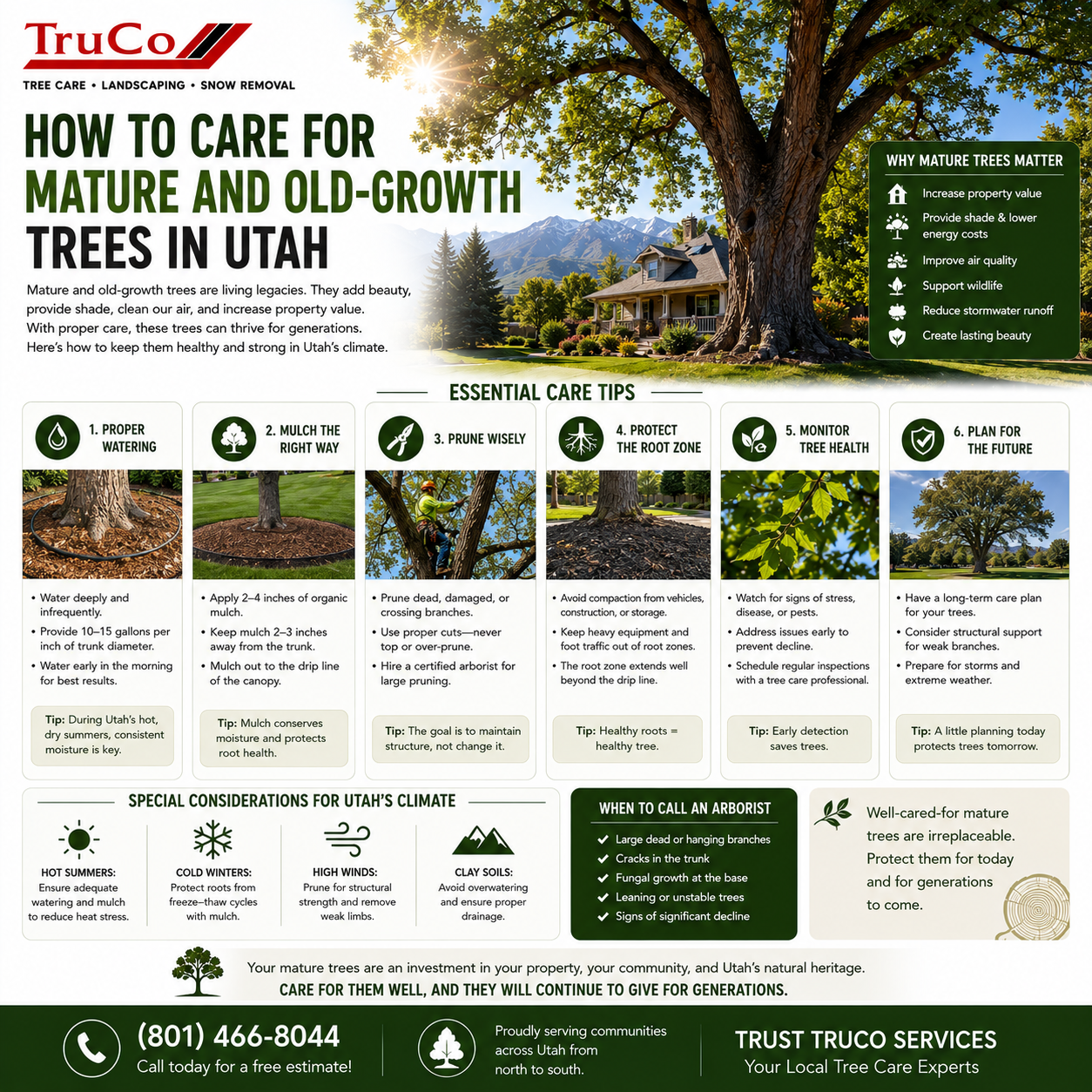
Caring for mature and old-growth trees in Utah requires a fundamentally different approach than young tree care. A mature tree — one that has reached at least 75% of its full size — has a complex root system, a heavy canopy, and specific physiological needs. Old-growth trees, those that predate development, are irreplaceable assets that provide immense environmental, aesthetic, and property value benefits. Along the Wasatch Front, mature trees in historic neighborhoods like Salt Lake City's Avenues, Ogden's Eccles Avenue, and Provo's historic district require specialized care to extend their useful lifespan. Unlike young trees that respond quickly to corrective pruning and fertilization, mature trees react slowly and any mistakes in their care can be fatal. Professional arborists trained in mature tree management are essential for preserving these community treasures.
Assessing the Health of Mature Trees
Regular health assessments are the foundation of mature tree care. A comprehensive assessment evaluates the tree's structure — trunk, major branches, codominant stems, lean, and included bark; vitality — leaf size, color, density, shoot growth, and canopy transparency; root zone — soil compaction, grade changes, root damage, and girdling roots; pests and diseases — signs of decay fungi, boring insects, cankers, and foliar diseases; and environmental stress — drought damage, salt damage from deicing salts, and construction impact. Utah State University Extension recommends annual assessments for mature trees in urban settings. Certified arborists use tools like resistograph drills, sonic tomography, and aerial inspections to detect internal decay and structural weakness not visible from the ground. Cost: $200-$600 per assessment depending on tree size and complexity. For high-value specimen trees, comprehensive assessments every 2-3 years are a worthwhile investment.
Cabling, Bracing, and Structural Support
Mature trees in Utah often develop structural issues that require support. Cabling and bracing systems provide supplemental support for trees with weak branch unions, heavy limbs, or codominant stems. In Utah's climate, heavy snow loads and spring winds stress these weak points. Cables are installed high in the canopy to limit branch movement and reduce failure risk. Braces are rigid rods that connect stems or branches near the union. Modern systems use dynamic cabling that allows some natural movement, promoting compartmentalization and reducing stress at attachment points. Installation costs range from $300-$1,500 per tree depending on the number of cables needed. Cables should be inspected annually and replaced every 5-10 years as the tree grows. Not every structurally weak tree needs cabling — an arborist should evaluate whether the tree has good long-term potential before investing in support systems.
Pruning Mature Trees: Less Is More
Pruning mature trees follows a different philosophy than young tree pruning. For mature trees, pruning goals are safety (remove dead, dying, diseased, and hazardous branches), preservation (maintain the tree's natural form and health), and clearance (raise canopy for pedestrians, vehicles, and structures). The key principle for mature trees is to remove as little live wood as possible — ideally no more than 10-15% of live foliage at a time. Overpruning a mature tree causes severe stress, stimulates excessive water sprouts, and shortens the tree's life. Focus on deadwood removal, crossing or rubbing branches, and branches with weak attachment. Use three-cut method for all branches over 1 inch in diameter to prevent bark tearing. In Utah, the dormant season (November through March) is the best time for mature tree pruning, as it minimizes stress and allows the tree to compartmentalize wounds before spring growth.
Soil Management for Mature Trees
Mature tree root zones require careful soil management. The critical root zone (CRZ) extends from the trunk to the drip line, and often beyond. In Utah's urban settings, this zone is frequently compromised by compaction from foot traffic, vehicles, and construction; soil grade changes that cut roots or bury them too deeply; and soil contamination from deicing salts, petroleum products, and other pollutants. Best practices for mature tree soil management include vertical mulching — drilling holes 12-18 inches deep across the root zone and filling with organic matter to improve aeration and drainage; deep root fertilization — injecting slow-release fertilizer 6-12 inches below the surface; soil decompaction — using compressed air or high-pressure water to loosen compacted soil without damaging roots; and maintaining proper mulch cover with 3-4 inches of organic mulch over the CRZ, not touching the trunk. For mature Utah trees growing in compacted urban soils, these treatments every 3-5 years dramatically improve tree health and longevity.
Watering Mature Trees in Utah's Climate
Mature trees in Utah need consistent deep watering, especially during our hot, dry summers. A mature tree's root system extends far beyond the drip line, so watering should cover the entire root zone. The general rule is 1-1.5 inches of water per week during the growing season, applied slowly to ensure deep penetration. For a large mature tree with a 50-foot canopy diameter, this means 400-600 gallons of water per week during summer. Soaker hoses, drip irrigation, or deep root watering stakes are more effective than sprinklers. Water deeply every 7-14 days rather than shallowly every day. In fall and spring, reduce frequency but continue deep watering. Winter watering is critical for Utah trees — water mature trees monthly during winter dry spells (when temperatures are above 40°F and the ground is not frozen) to prevent winter drought stress, a common cause of mature tree decline in Utah.
Protecting Mature Trees During Construction
Utah's continuing development is a major threat to mature trees. Construction activities — trenching, grading, soil compaction, and equipment traffic — can severely damage or kill mature trees. Before any construction near a mature tree, establish a tree protection zone (TPZ) with fencing at the drip line or beyond. No construction activity should occur within this zone. If trenching is necessary near a tree, use horizontal directional drilling or tunneling under the root zone rather than trenching through it. Grade changes are particularly dangerous — even 4-6 inches of fill over tree roots can kill a mature tree within 2-5 years. If grade must be changed, install aeration wells and drainage systems. A certified arborist should be involved in planning any construction near mature trees. The cost of protective measures is far less than the cost of removing a dead mature tree ($1,000-$5,000 for large tree removal) and replacing it with a new tree that will take decades to provide comparable benefits.
Recognizing Signs of Decline in Mature Trees
Early detection of decline symptoms allows intervention before a mature tree is lost. Watch for canopy dieback (dying branches at the top of the canopy, progressing downward), epicormic sprouting (clusters of small branches growing from the trunk or main branches, indicating stress), small or sparse leaves compared to normal, early fall color or leaf drop in summer, dead branches throughout the canopy, fungal conks or mushrooms growing on the trunk or at the base, cracks or splits in the trunk or major limbs, peeling bark or oozing sap not caused by boring insects, and root decay or soil heaving at the base. If you notice any of these signs, consult a certified arborist promptly. Early intervention — improved watering, soil aeration, or pest treatment — can often slow or reverse decline. The survival rate for trees caught in early decline is 60-80%, while trees in advanced decline have only a 10-20% chance of recovery.
When to Remove a Mature Tree
Despite our best efforts, some mature trees reach a point where removal is the safest option. Indicators that a mature tree should be removed include more than 50% canopy dieback — a tree this compromised cannot photosynthesize enough to sustain itself; extensive trunk decay — cavities that compromise more than 30% of the trunk circumference; major root decay or severing — trees with significant root loss are unstable; severe lean combined with root damage; and trees with large dead branches that pose imminent risk to people or property. In Utah, mature tree removal costs $800-$3,000 for a large tree, depending on location, accessibility, and complexity. Before removing any mature tree, get at least two opinions from certified arborists. If removal is necessary, consider planting a replacement tree of an appropriate species that will thrive in Utah's conditions. A new tree properly planted today can become a valuable mature tree in 20-30 years.
Frequently Asked Questions
How long do mature trees typically live in Utah? It varies by species. Utah-adapted species like bur oak and honeylocust can live 150-300 years. Aspens live 40-80 years. Maples in Utah may live 80-150 years. Urban stress typically reduces lifespan by 30-50%.
Should I fertilize my mature tree? Fertilize only if soil tests or visual symptoms indicate a deficiency. Overfertilization of mature trees can stimulate excessive growth at the expense of root development and make trees more susceptible to pests. Let a soil test guide your fertilization program.
Can I build a patio or deck under my mature tree? Not without careful planning. Any construction within the critical root zone can damage roots. If you must build, use pier footings (not a concrete slab), minimize soil excavation, and consult an arborist before starting.
How much is a mature tree worth? Mature trees add $1,000-$10,000 or more to property value depending on size, species, condition, and location. Large specimen trees in Utah's historic districts are particularly valuable. The Council of Tree and Landscape Appraisers publishes standardized valuation methods.
What is the biggest threat to mature trees in Utah? Construction damage and soil compaction are the biggest threats to Utah's mature urban trees. Drought stress and iron chlorosis are also significant issues. Proactive care and protection during development are essential for preserving mature tree canopy.
Can a mature tree recover from drought stress? Yes, with proper care. Deep watering, mulching, and soil improvement can help drought-stressed trees recover over 2-3 years. However, severe drought can cause permanent root damage, and recovery depends on the extent of the damage.