
Lightning Protection for Large Trees in Utah

Utah's Thunderstorm Season
Utah's monsoon season — July through September — brings frequent cloud-to-ground lightning. The Wasatch Front from Ogden to Provo experiences intense afternoon storms. Utah averages 300,000 to 500,000 cloud-to-ground lightning strikes annually, with highest concentrations along the Wasatch Front foothills. Properties in bench areas of Salt Lake City, Holladay, Cottonwood Heights, and Utah County are statistically more exposed.
How Lightning Damages Trees
A lightning bolt carries 100 million to 1 billion volts, heating air to 50,000°F. It vaporizes water inside tree cells into steam, causing explosive expansion. Damage types include explosive damage where the trunk shatters; bark stripping where lightning travels under the bark blowing it off; and internal damage where roots and vascular tissue are cooked with no visible external signs.
Most Vulnerable Trees in Utah
Oaks (bur oak) are frequently struck due to high moisture content. Cottonwoods along the Jordan, Provo, and Weber Rivers are extremely vulnerable. Pines — Austrian and ponderosa — attract lightning due to height and conical shape. Maples are moderately susceptible. Less vulnerable: beech, birch, and honeylocust have lower moisture content and are poorer conductors.
Lightning Protection Systems
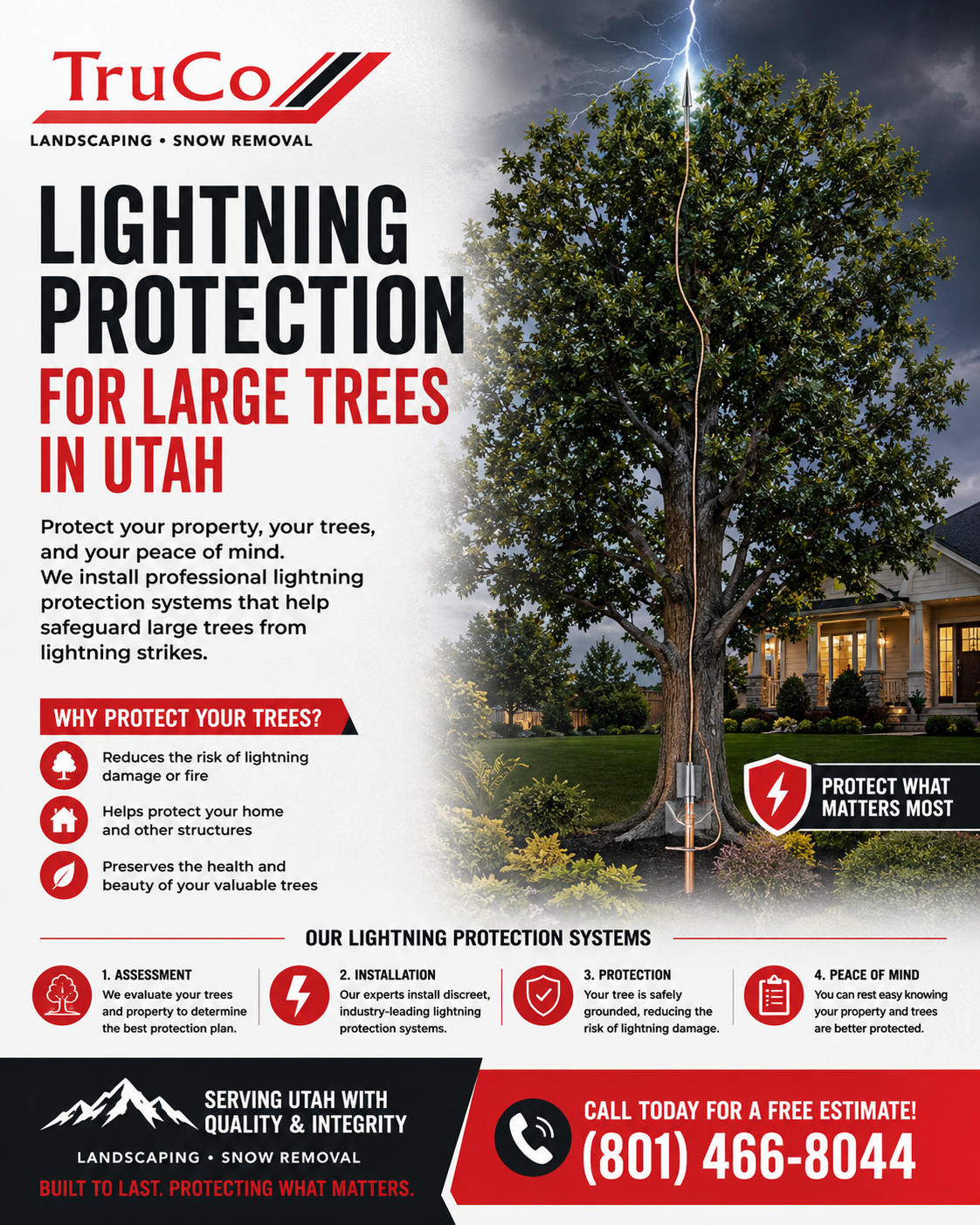
Systems provide a safe path for current to reach ground without passing through living tissue. Components: air terminals (copper rods extending above the highest branches), down conductors (cables running down the trunk), and grounding systems (rods driven 8-10 ft into ground). Installation follows NFPA 780 and UL 96A standards. In Utah, rocky clay soil can make grounding challenging.
Cost in Utah
Typical cost: $500-$1,500 per tree depending on size, number of terminals, grounding complexity, and accessibility. Considering a mature bur oak adds $5,000-$15,000 to property value, and removal of a damaged tree costs $1,000-$3,000, lightning protection pays for itself for high-value trees.
What to Do After a Strike
Wait 30 minutes after the last thunderclap. Assess from a distance for fire, splitting, or leaning. Call a certified arborist immediately. Document damage with photos for insurance. Do not remove loose bark. The arborist will determine if pruning, cabling, or removal is needed.
Storm Preparation
Prune weak branches before monsoon season. Remove dead or declining trees near structures. Consider lightning protection for specimen oaks, cottonwoods, or pines taller than your home. Cable and brace weak limbs. Maintain tree health with proper watering, mulching, and pest management.
Long-Term Monitoring
Internal damage may cause decline over time. Watch for leaf scorch, upper canopy dieback, fungal conks at the base, cankers, sparse foliage, or insect infestations. Monitor for at least two full growing seasons after a strike.
Frequently Asked Questions
Should I plant less vulnerable trees? Placement matters more than species. Beech, birch, and honeylocust are somewhat less vulnerable but no tree is immune.
Will a house lightning rod protect trees? No. Each high-value tree needs its own protection system.
Are protection systems ugly? Modern systems are discreet. Copper cables weather to a dark patina and blend into the canopy.
Tree looks fine after strike — should I worry? Yes. Internal damage is common. Have an arborist assess and monitor for two years.
Does insurance cover lightning damage? Most Utah homeowners' policies cover tree damage, often $500-$1,000 per tree. Damage to structures is typically covered.
How long until a struck tree dies? Some die within days. Others decline over 1-3 years. Some with minor damage recover fully.