
How to Prevent and Treat Iron Chlorosis in Utah Trees

What Is Iron Chlorosis?
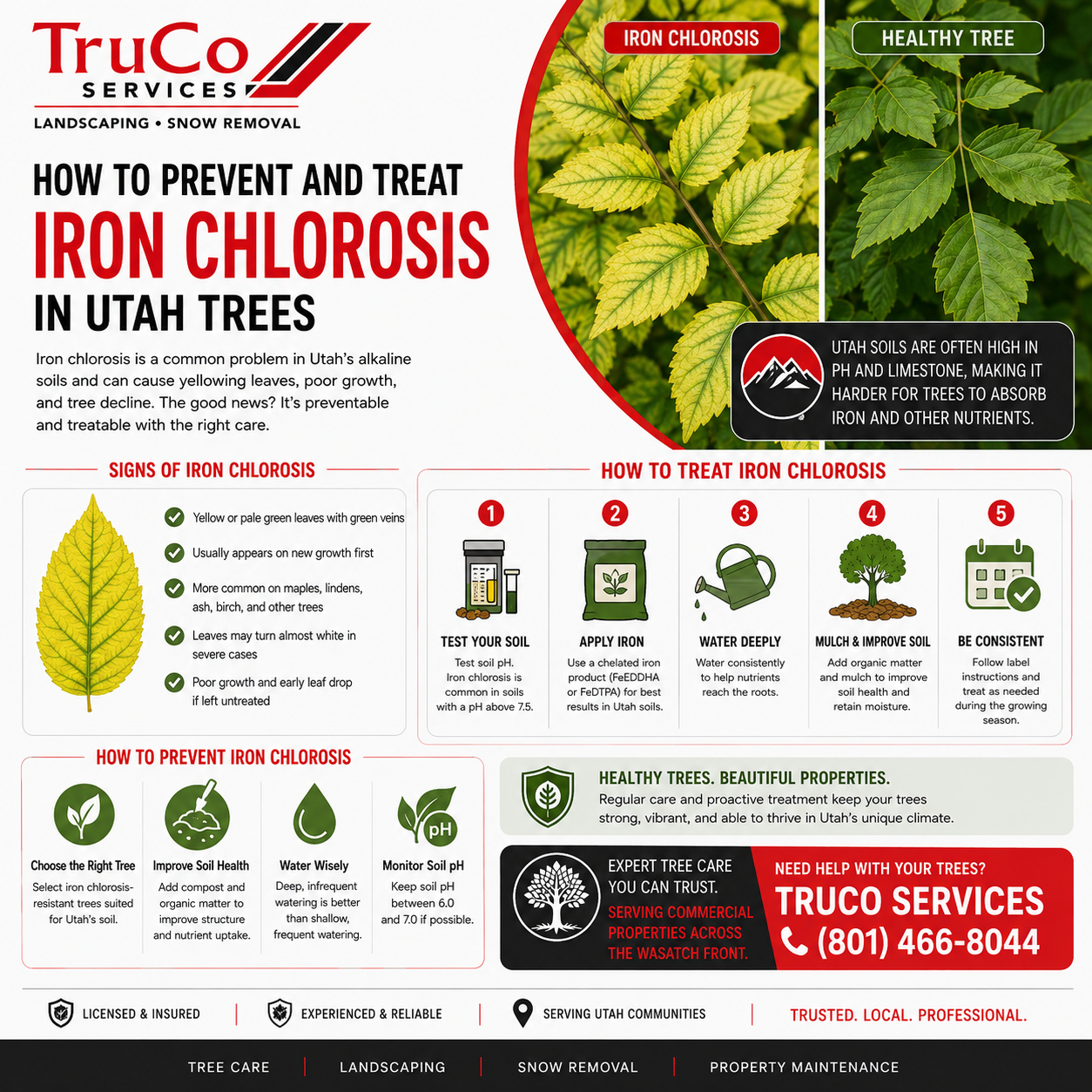
Iron chlorosis is the most common nutrient deficiency affecting trees in Utah. It occurs when a tree cannot absorb enough iron from the soil, even though iron is present. The result: leaves turn pale yellow or yellow-green while the veins remain dark green, creating a distinctive striped pattern. In severe cases, leaves may turn completely white, develop brown scorched edges, and drop prematurely. Affected trees grow slowly, produce smaller leaves, and are more susceptible to pests, diseases, and winter injury. Along the Wasatch Front, iron chlorosis is especially common in maples, oaks, birches, aspens, and fruit trees planted in our alkaline clay soils.
Why Utah's Soil Causes Chlorosis
Utah's soil is naturally alkaline, with pH levels typically ranging from 7.5 to 8.5. At high pH levels, iron in the soil forms insoluble compounds that tree roots cannot absorb. The problem is not a lack of iron — Utah soils contain plenty of iron — but the soil chemistry makes it unavailable. Several factors make chlorosis worse in Utah: high soil pH (alkaline soils lock up iron), compacted clay soils (poor aeration reduces root activity), poor drainage (waterlogged soils inhibit iron uptake), cold spring soils (iron uptake is slower in cold soil, which is why chlorosis often appears in spring), and root damage from construction, trenching, or soil compaction. Trees growing in Utah's native clay soils in older neighborhoods like the Avenues in Salt Lake City or the bench areas of Ogden and Provo are particularly susceptible.
Which Trees Are Most Susceptible
Some tree species are more prone to iron chlorosis than others. Highly susceptible trees include silver maple, red maple, and sugar maple (Norway maple is more tolerant), quaking aspen and other poplars, river birch and European white birch, pin oak and red oak (bur oak is more tolerant), flowering dogwood, sweetgum, and many fruit trees including apple, cherry, peach, and plum. Moderately susceptible trees include Autumn Blaze maple, northern red oak, and some ornamental pear varieties. Tolerant trees that rarely show chlorosis include honeylocust, Kentucky coffeetree, hackberry, bur oak, Austrian pine, Colorado blue spruce, and junipers. If you are planting a new tree in Utah's alkaline soil, choosing a tolerant species is the most effective prevention.
Prevention: Choosing the Right Tree and Site
The best treatment for iron chlorosis is prevention. Before planting, test your soil pH. Utah State University Extension offers soil testing for a small fee. If your pH is above 7.5, choose chlorosis-tolerant species. If you must plant a susceptible species, prepare the planting site carefully. Dig a wide planting hole (3-5 times the root ball width) and amend the backfill with organic matter (compost, peat moss) and elemental sulfur to lower the pH in the root zone. Do not use aluminum sulfate — it can damage roots. Plant high — position the root ball slightly above grade to improve drainage. Mulch with 3-4 inches of organic mulch to moderate soil temperature and moisture. Avoid overwatering, which makes chlorosis worse by reducing oxygen in the root zone. For existing trees, preventive treatments include annual deep root fertilization with iron chelate and maintaining proper soil moisture.
Treatment: Soil Application of Iron Chelate
For mild to moderate chlorosis, soil application of iron chelate is the most common and cost-effective treatment. Iron chelate is a form of iron that remains available to plants even in alkaline soil. The most effective chelate for Utah soils is EDDHA (ferric ethylenediamine-N,N'-bis(2-hydroxyphenylacetic acid)), marketed as Sequestrene 138 or similar products. Apply in spring when leaves first emerge, or in fall after leaf drop. For a mature tree, mix the recommended amount of chelate in water and apply it evenly over the root zone (extending from the trunk to the drip line). Water deeply after application to carry the chelate into the root zone. For best results, aerate the soil before applying (by poking holes 6-12 inches deep every 2-3 feet across the root zone). One application typically lasts 1-2 years, depending on soil conditions and tree health. Cost: $50-$100 for DIY application, or $200-$400 for professional deep root injection.
Treatment: Trunk Injection
For severe chlorosis or for trees where soil treatment has failed, trunk injection is the most effective option. An arborist drills small holes into the trunk at the base and injects iron chelate directly into the vascular system. Results are visible within 2-4 weeks, compared to 4-8 weeks for soil treatment. The effects last 2-3 years. Trunk injection is more expensive ($300-$600 per treatment for a mature tree) but is the most reliable treatment for severely chlorotic trees. It also carries some risk — drilling holes can introduce decay, though modern injection systems minimize this. Trunk injection is best reserved for high-value trees where soil treatment has been ineffective. It should only be performed by a certified arborist with proper injection equipment.
Treatment: Foliar Sprays
Foliar sprays (liquid iron applied directly to leaves) provide the fastest greening but the shortest duration. Leaves absorb iron through their surfaces, and green color returns within days. However, the effect is temporary — treated leaves remain green, but new leaves that emerge after treatment will still be chlorotic. Foliar sprays are best used as a quick fix for chlorotic trees in spring when you want immediate greening, or for small trees where soil treatment is impractical. Multiple applications may be needed during the growing season. Use a chelated iron spray formulated for foliar application and apply when temperatures are below 85°F to avoid leaf burn. Cost: $20-$50 for DIY or $150-$300 for professional application.
Cultural Practices to Reduce Chlorosis
Several cultural practices can reduce chlorosis severity. Avoid overwatering — Utah's clay soils drain slowly, and waterlogged roots cannot absorb iron effectively. Water deeply but infrequently. Aerate compacted soil around trees to improve oxygen levels in the root zone. Apply 3-4 inches of organic mulch under the canopy (not touching the trunk) to moderate soil temperature and moisture. Avoid applying high-phosphorus fertilizers near chlorotic trees — phosphorus binds with iron and makes it less available. Use a fertilizer with no phosphorus (0-0- or low-P formulation) for trees with chlorosis. Do not apply nitrogen fertilizers in excess — lush growth stimulated by nitrogen can worsen chlorosis symptoms. Maintain proper soil pH by applying elemental sulfur if needed, though this is difficult to do effectively on a large scale.
Long-Term Management and Monitoring
Iron chlorosis is a chronic condition that requires ongoing management for susceptible trees in Utah. Monitor your trees each spring when leaves first emerge. If you see yellowing, begin treatment promptly — early treatment is more effective than waiting until leaves are severely chlorotic. Keep a log of treatments and their effectiveness. If a tree requires treatment every year without improvement, consider replacement with a chlorosis-tolerant species. In some cases, severely chlorotic trees that have been untreated for years may be too weak to recover fully. The cost of annual treatment over 10 years ($2,000-$4,000 for professional care) may exceed the cost of removing the tree and planting a tolerant replacement ($500-$2,000). For high-value trees with sentimental or landscape significance, ongoing treatment is worthwhile. For struggling trees of susceptible species, replacement may be the better long-term investment.
Frequently Asked Questions
Can iron chlorosis kill a tree? Yes, if left untreated for several years. Chronic chlorosis weakens the tree, reduces photosynthesis, and makes it more susceptible to pests, diseases, and environmental stress. Severely chlorotic trees may die within 3-5 years.
Is iron chlorosis the same as nitrogen deficiency? No. Nitrogen deficiency causes uniform yellowing of older leaves (bottom of the tree). Iron chlorosis causes yellowing between green veins on new leaves (top of the tree and branch tips). They require different treatments.
How quickly does iron treatment work? Soil-applied chelate: 4-8 weeks. Trunk injection: 2-4 weeks. Foliar spray: 3-7 days (but temporary). Spring applications work faster than fall applications.
Can I use rusty nails or iron filings to treat chlorosis? No. Metallic iron is not soluble in alkaline soil and will not be available to trees. Only chelated iron (EDDHA or similar) is effective in Utah's alkaline soil.
Will chlorosis spread to other trees? No. Iron chlorosis is a soil chemistry problem, not a disease. It does not spread from tree to tree. However, trees of the same species growing in the same soil conditions may all show similar symptoms.
Is there a way to permanently fix chlorosis? Not easily. Lowering soil pH across an entire root zone is difficult in Utah's naturally alkaline soil. The most permanent solution is to plant chlorosis-tolerant species. For existing susceptible trees, ongoing treatment is usually necessary.