
How to Identify and Manage Invasive Tree Species in Utah

What Makes a Tree Invasive?
Non-native trees that cause environmental or economic harm. They produce abundant seed, grow quickly, tolerate wide conditions, and lack natural predators. In Utah, many have deep roots that access groundwater, alter soil chemistry, and change fire regimes.
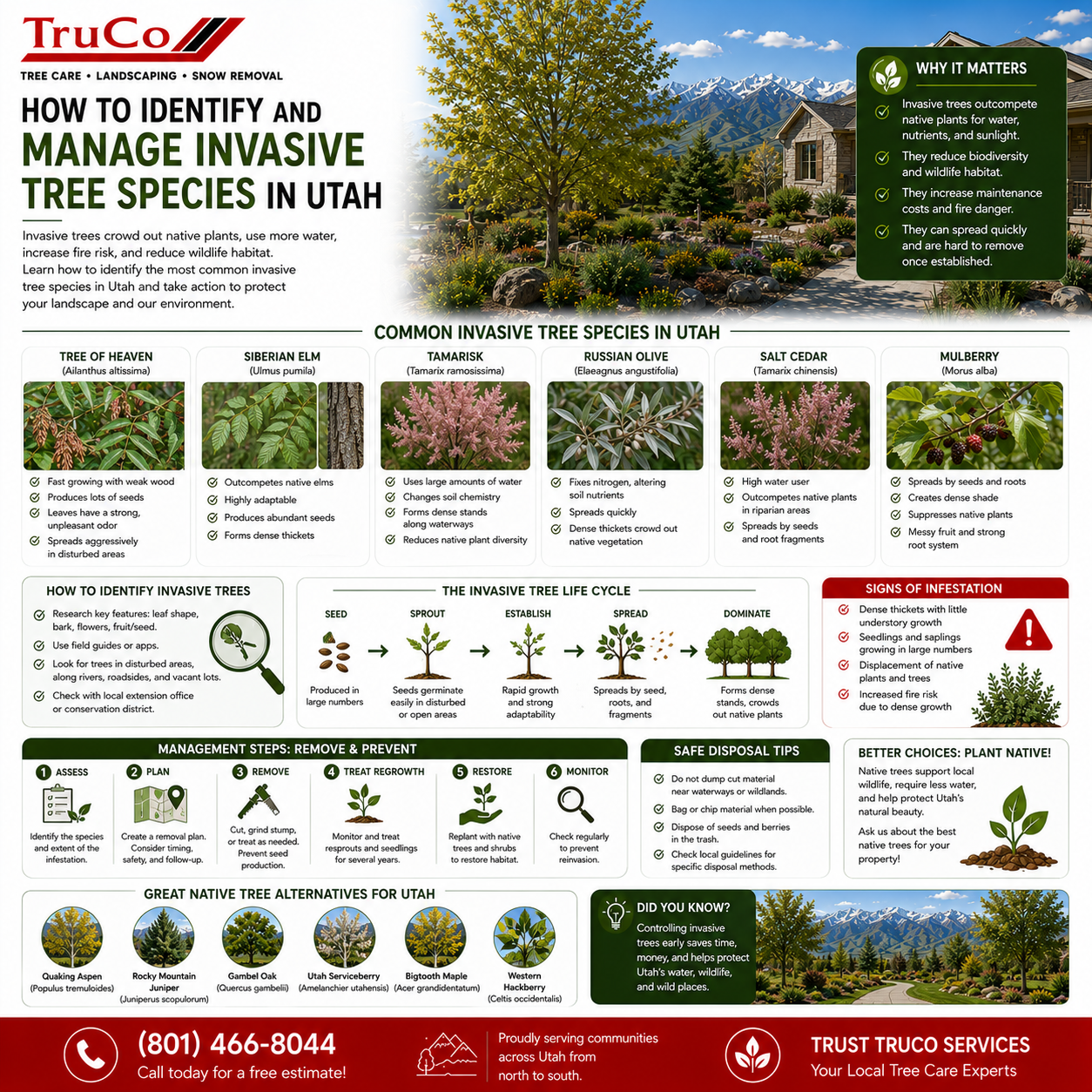
Siberian Elm — The Worst Invader
Small elliptical leaves with serrated edges and asymmetrical base. Produces millions of seeds annually. Grows in poor compacted soil throughout Salt Lake Valley. Wood is notoriously weak — the most common cause of tree-related property damage along the Wasatch Front. Control: pull small trees, cut larger ones with immediate herbicide application to stump. Resprouts aggressively.
Tree of Heaven
Compound leaves with 11-41 leaflets that smell like rancid peanut butter when crushed. Spreads through seeds and aggressive root suckers. Produces allelopathic chemicals that suppress nearby plants. Preferred host for spotted lanternfly. Control: cutting alone is ineffective — use hack-and-squirt method with undiluted glyphosate in late summer. Monitor for suckers for 2+ years.
Russian Olive
Narrow silvery-gray leaves. Planted for windbreaks but now invades riparian areas along the Weber and Provo Rivers. Nitrogen-fixing roots alter soil chemistry. Thorns create impenetrable barriers. Control: cut and treat stump with glyphosate in late summer/fall. Replant with native cottonwoods and willows.
Tamarisk (Saltcedar)
Small scale-like leaves, feathery appearance, pink flowers. Deep roots tap groundwater. Excretes salt, increasing soil salinity. Individual trees use 100-200 gallons of water daily. Difficult to control — requires mechanical removal plus herbicide. Listed as state noxious weed.
Norway Maple
Milky white sap in leaf stems (key identifier). Produces shade-tolerant seedlings that invade canyons (City Creek, Millcreek, Provo Canyon). Dense canopy prevents native understory growth. Control: seedlings hand-pull, larger trees cut and treat stump. Does not resprout as aggressively as others.
Replacement Natives
Replace Siberian elm with bur oak, hackberry, or Kentucky coffeetree. Replace tree of heaven with Gambel oak or serviceberry. Replace Russian olive with native cottonwoods. Replace Norway maple with bigtooth maple (Utah's native maple with spectacular fall color).
Utah Regulations
Russian olive and tamarisk are listed as state noxious weeds — property owners must control them. It is illegal to sell or plant them. Tree of heaven is on some county noxious weed lists. Many cities prohibit planting Siberian elm on public property. Check with county weed board for specific requirements.
Cost of Removal
Small trees (under 6 ft): $0-50 DIY or $50-150 professional. Medium (6-20 ft): $200-800. Large (over 20 ft): $800-3,000. Annual monitoring: $150-300. The cost of leaving them is higher — sewer repairs ($2,000-8,000), roof damage ($1,000-15,000), foundation damage ($3,000-20,000).
Frequently Asked Questions
Are all non-natives invasive? No. London plane tree, littleleaf linden, and ornamental fruit trees are well-behaved. Check the Utah Invasive Species Council list before planting.
Can I control without herbicides? Yes for small infestations — hand-pulling and repeated cutting. But Siberian elm, tree of heaven, and Russian olive resprout vigorously. Herbicides are most cost-effective for larger infestations.
Best season for removal? Late summer to early fall (Aug-Oct) for herbicide treatments when trees translocate nutrients to roots.
Will removal harm wildlife? Short-term displacement, long-term benefit. Native trees support 4-5x more bird and insect species. Stage removal over 2-3 seasons and replant immediately.
Neighbor's invasive tree spreading? Trim branches/roots on your property line. You cannot enter neighbor's property. Manage seedlings on your property regardless of source. Contact city code enforcement if safety hazard.