
How to Identify Utah Trees by Their Bark and Leaves

Why Learn to Identify Utah Trees?
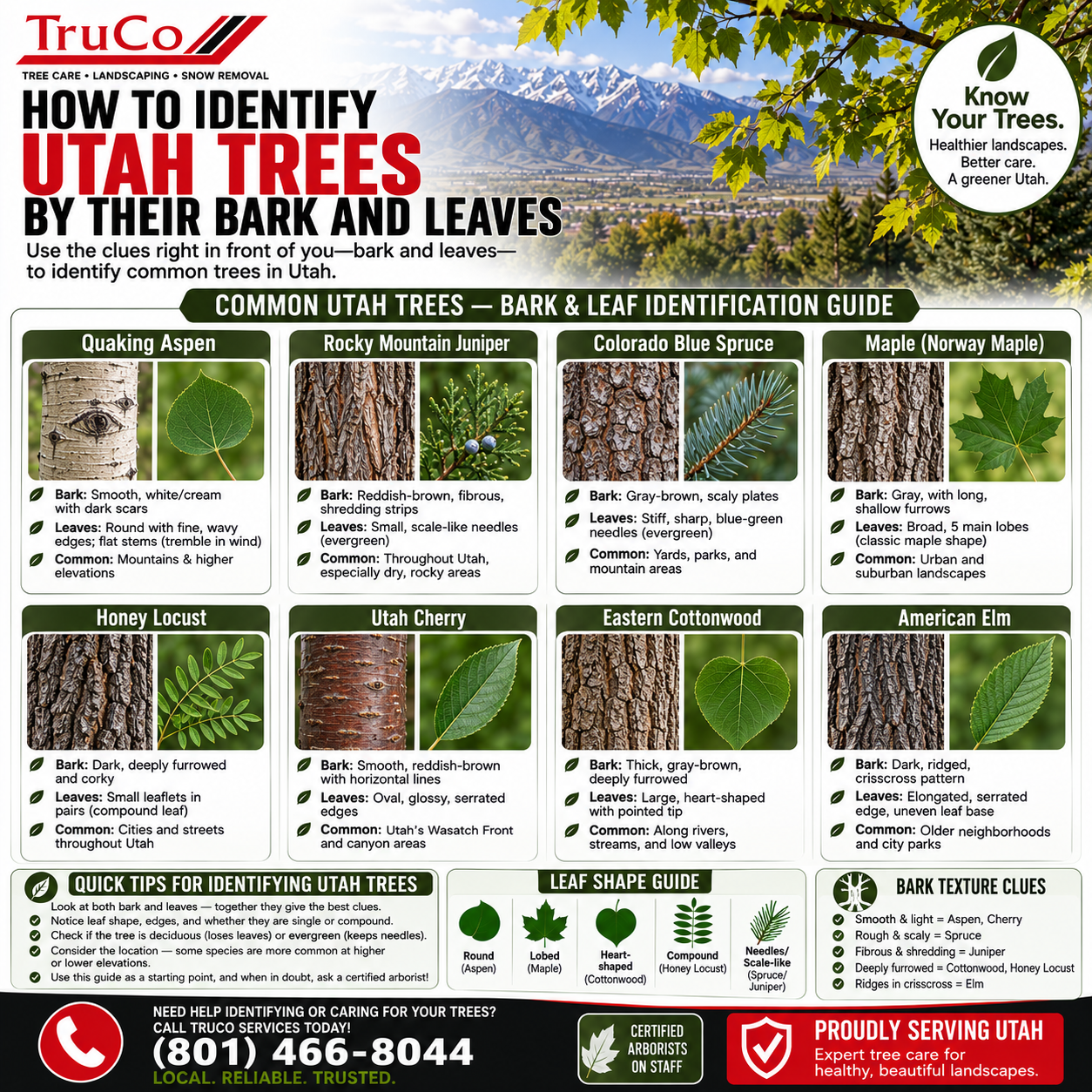
Being able to identify trees by their bark and leaves is a valuable skill for any Utah homeowner, gardener, or outdoor enthusiast. Tree identification helps you choose the right trees for your landscape, diagnose problems correctly (a sick maple needs different treatment than a sick oak), understand your tree's specific care needs, appreciate Utah's diverse native tree species, identify hazardous trees before they cause problems, and communicate effectively with arborists and nursery staff. Utah is home to dozens of native and naturalized tree species, plus hundreds of cultivated varieties in our urban landscapes. Learning to identify the most common species by their bark and leaves — the features most visible year-round — gives you a practical skill you can use every day. This guide covers the most common Utah trees and their key identification features, focusing on bark and leaves that can be observed from the ground.
Bark Identification Basics
Tree bark is one of the best identification features because it is visible year-round. When learning to identify bark, look at these characteristics. Color — bark ranges from white (paper birch) to nearly black (black walnut). Utah's native trees show a wide range of bark colors from the white of quaking aspen to the reddish-brown of Rocky Mountain juniper to the gray of bigtooth maple. Texture — smooth (young aspen, young maple), rough (oaks), furrowed (honeylocust), scaly (pines), peeling (birch, paperbark maple), or blocky (persimmon, mature hackberry). In Utah's older trees, bark becomes more rugged and distinctive with age. Pattern — bark patterns include vertical furrows (oaks), horizontal lenticels (birch, cherry), diamond patterns (young honeylocust), exfoliating patches (sycamore, London planetree), and interlaced ridges (black walnut). Peculiar features — corky wings (sweetgum, some elms), thorns (honeylocust, hawthorn, black locust), blisters (balsam poplar), and sap oozing from wounds (many species). Bark changes as trees age. Young trees often have smoother bark that becomes furrowed or plated as they mature. A young honeylocust has smooth, gray bark with prominent lenticels, while an old honeylocust has long, peeling bark strips and a rugged appearance. Bark can also vary on the same tree — the north side may be smoother or more mossy than the south side. Practice observing bark on trees you already know and gradually expand your skills to unfamiliar species. Take photos and compare with field guides or online resources. In Utah, winter is the best time to practice bark identification when leaves are absent and bark is fully exposed.
Leaf Identification Basics
Leaves are the most reliable identification feature during the growing season. Key characteristics to observe include leaf type — simple (one leaf blade per stem) or compound (multiple leaflets per stem). Compound leaves can be pinnate (leaflets along a central stem, like honeylocust) or palmate (leaflets radiating from one point, like horse chestnut). Leaf arrangement — alternate (one leaf per node, alternating sides), opposite (two leaves per node), or whorled (three or more leaves per node). In Utah, opposite leaf arrangement is relatively rare and can help narrow down possibilities. Maple, ash, dogwood, and viburnum have opposite leaves. Most other trees have alternate leaves. Leaf shape — oval (elm), heart-shaped (redbud, catalpa), star-shaped (sweetgum, maple), needle-shaped (pines, spruces, firs), scale-like (junipers), and fan-shaped (ginkgo). Leaf margin — smooth (entire), toothed (serrated), double-toothed, or lobed. Leaf texture — smooth, hairy, waxy, or leathery. Leaf color — both upper and lower surfaces, including fall color. Vein pattern — pinnate (one main vein with branching side veins) or palmate (several main veins radiating from the base). Leaf base and tip shape can also be distinctive. In Utah, leaf identification is most useful from spring through fall. Take photos of leaves from different parts of the tree and note the arrangement, shape, and other features. Compare with field guides specific to Utah or the Intermountain West. The Utah State University Extension website has excellent resources for identifying Utah trees by their leaves.
Native Utah Conifers: Identification Guide
Utah conifers can be identified by their needles, cones, and bark. Pines (Pinus species) have needles in bundles (fascicles) of 2-5. Ponderosa pine has 3 needles per bundle, 5-8 inch needles, and distinctive "jigsaw puzzle" bark (orange-brown with dark crevices). Pinyon pine has 1-2 needles per bundle, 1-2 inch needles that are curved inward, and gray-brown bark in irregular plates. Limber pine has 5 needles per bundle, 2-4 inch flexible needles, and smooth gray bark when young, becoming furrowed with age. Austrian pine has 2 needles per bundle, 3-6 inch stiff, dark green needles, and dark gray-brown deeply furrowed bark. Spruces (Picea species) have single, 4-sided needles attached to small pegs on the twig. Colorado blue spruce has stiff, sharp needles (1-1.5 inches), blue-green to silvery color, and thin, scaly gray-brown bark. Engelmann spruce has shorter (½-1 inch), more flexible needles, dark blue-green color, and thin, reddish-brown scaly bark. Firs (Abies species) have single, flat needles that leave circular scars when they fall. White fir has 1-2 inch needles, blue-green with white bands on underside, and smooth gray bark with pitch blisters when young, becoming furrowed with age. Subalpine fir has shorter (½-1 inch) needles, dark green with silvery bands, and smooth gray bark. Junipers (Juniperus species) have scale-like or awl-shaped needles (not true needles). Rocky Mountain juniper has scale-like needles in opposite pairs, gray-green color, and shredding reddish-brown bark. Utah juniper has scale-like needles, gray-green to blue-green color, and gray-brown shredding bark. Douglas-fir (Pseudotsuga menziesii) — not a true fir — has ½-1½ inch flat needles, soft to the touch, with distinctive forked bracts on cones that look like mouse feet. Bark is smooth gray on young trees, becoming thick and corky with deep furrows on old trees.
Native Utah Deciduous Trees: Identification Guide
Deciduous trees can be identified by their leaves, bark, fruit, and growth habit. Bigtooth maple (Acer grandidentatum) has opposite, simple, 3-5 lobed leaves similar to sugar maple but smaller. Bark is gray-brown, smooth on young trees, becoming furrowed with age. Brilliant orange-red fall color. Quaking aspen (Populus tremuloides) has nearly round leaves (1½-3 inches) with small teeth and flattened leaf stems that cause them to "quake" in the slightest breeze. Bark is smooth, white to cream-colored with black horizontal lenticels and scars. Brilliant yellow fall color. Gambel oak (Quercus gambelii) has deeply lobed leaves (3-6 inches), dark green above, lighter below. Bark is light gray-brown, scaly to furrowed. Acorns are ½-1 inch with a scaly cup. Orange-red fall color. Serviceberry (Amelanchier species) has simple, oval leaves (1-3 inches) with fine teeth. Bark is smooth, gray, with vertical stripes. White spring flowers, purple-black berries in summer. Yellow to red fall color. Narrowleaf cottonwood (Populus angustifolia) has narrow, lance-shaped leaves (2-4 inches) with fine teeth. Bark is smooth, yellow-green on young trees, becoming gray-brown and furrowed with age. Fluffy cotton seeds in spring. Curlleaf mountain mahogany (Cercocarpus ledifolius) has small, thick, leathery leaves (½-1 inch) with rolled edges. Distinctive feathery seed plumes persist through winter. Bark is dark reddish-brown, furrowed. Rocky Mountain maple (Acer glabrum) has opposite, simple, 3-5 lobed leaves (1-3 inches) with double teeth. Bark is smooth, reddish-brown to gray. Yellow fall color. Chokecherry (Prunus virginiana) has simple, oval leaves (2-5 inches) with fine teeth. Bark is gray-brown with horizontal lenticels. White flower clusters in spring, dark red to purple berries in summer. Singleleaf ash (Fraxinus anomala) has opposite, compound leaves with 1-5 leaflets (most commonly 3). Bark is gray, scaly. Small, inconspicuous flowers. Winged seeds.
Common Urban and Ornamental Trees: Identification
Beyond native species, Utah's urban landscapes contain many planted ornamental trees. Honeylocust (Gleditsia triacanthos inermis) has compound leaves (8-14 leaflets) that are alternate and 6-8 inches long. Bark is smooth, gray with prominent lenticels when young, becoming dark brown with long, peeling strips when mature. Thornless varieties have no thorns. Kentucky coffeetree (Gymnocladus dioicus) has large, bipinnately compound leaves (12-36 inches long) that emerge late in spring. Bark is gray-brown with distinctive scaly, curling plates. Large, flat seed pods persist through winter. Bur oak (Quercus macrocarpa) has large, deeply lobed leaves (6-12 inches) with rounded lobes. Bark is gray-brown, deeply furrowed. Large acorns (1-2 inches) with fringed caps. Goldenrain tree (Koelreuteria paniculata) has compound leaves (6-15 inches) with 7-15 leaflets. Bark is light brown, smooth with shallow furrows. Showy yellow flowers in summer, followed by papery seed pods. European mountain ash (Sorbus aucuparia) has compound leaves with 9-15 leaflets. Bark is smooth, gray. Clusters of white flowers in spring, bright red berries in fall. Japanese tree lilac (Syringa reticulata) has simple, oval leaves (3-6 inches) with smooth margins. Bark is shiny, reddish-brown with prominent horizontal lenticels (resembling cherry bark). Large panicles of creamy-white flowers in June. Crabapple (Malus species) has simple, oval to round leaves (1-4 inches) with fine teeth. Bark is gray-brown, scaly. Showy spring flowers in white, pink, red, or magenta. Small ornamental fruit (½-1 inch) in fall. Amur maple (Acer tataricum subsp. ginnala) has opposite, simple, 3-lobed leaves (1-3 inches) with double teeth. Bark is gray-brown, smooth. Brilliant red fall color. European white birch (Betula pendula) has triangular leaves (1-3 inches) with double teeth. Distinctive white, peeling bark with black horizontal lenticels. Weeping branch tips.
Seasonal Changes in Tree Identification
Tree identification features change with the seasons in Utah. Spring — leaves emerge with distinctive characteristics. Early spring flowers (redbud, serviceberry, crabapple, fruit trees) provide additional identification clues. Leaf size and color are most consistent in spring. Summer — full leaf development provides the most complete identification features. Flowers and fruit develop on many species. Bark may be partially obscured by foliage. Fall — leaf color provides dramatic identification clues — maple (red-orange), aspen (bright yellow), oak (gold-orange), serviceberry (yellow-red), and honeylocust (golden-yellow). Fruit and seeds may be visible. Winter — the most challenging but also most rewarding time for identification. Bark features are fully visible. Branch structure, bud arrangement, and persistent fruit (seed pods on honeylocust, acorns on oaks, berries on crabapples) provide clues at close range. The silhouette (overall shape) is most visible in winter. Use all available clues throughout the year. A tree you identify by its spring flowers can be studied for its summer leaf characteristics, fall color, and winter bark. Over time, you will learn to recognize trees by combinations of features that are unique to each species. Take photos of trees in all seasons and create a reference collection for your property. This is especially useful for Utah trees, where the dramatic seasonal changes provide multiple opportunities for identification.
Frequently Asked Questions
What is the easiest tree to identify in Utah? Quaking aspen is one of the easiest — its white bark and quaking leaves are distinctive. Honeylocust (compound leaves, peeling bark) and Colorado blue spruce (blue needles, stiff form) are also easy to identify once you know their features.
How can I identify a tree in winter in Utah? Focus on bark characteristics (color, texture, pattern), branch structure, bud arrangement and size, persistent fruit or seed pods, and overall tree silhouette. Winter is an excellent time for bark identification. Take a field guide or use a plant identification app for assistance.
What are the best tree identification apps for Utah? iNaturalist (free) is excellent for Utah — it uses AI to suggest identifications and connects you with experts. PlantNet and Seek are also useful. For Utah-specific identification, the USU Extension website has excellent resources. PictureThis is accurate but requires a subscription for full features.
Do male and female trees look different in Utah? Some species are dioecious (male and female flowers on separate trees). Honeylocust, ash, cottonwood, and junipers have male and female trees. Female honeylocust produce seed pods; male trees do not. Female cottonwoods produce cotton; males do not. Male junipers produce pollen cones; females produce berries.
How do I identify Utah trees by their seed pods? Seed pods are distinctive for many species. Honeylocust has flat, twisted, dark brown pods (6-18 inches). Kentucky coffeetree has large, flat, leathery pods (5-10 inches). Catalpa has long, bean-like pods (8-20 inches). Goldenrain tree has papery, lantern-like pods. Acorns identify oaks. Samaras (winged seeds) identify maples and ashes.
Can I identify a tree from a single leaf? Often yes, especially with distinctive leaves. A single maple or oak leaf can usually be identified to genus. For species-level identification, you need multiple features including bark, branch structure, and habitat. Take photos of the leaf, bark, and overall tree for the most accurate identification.