
How to Identify and Manage Tree Galls in Utah

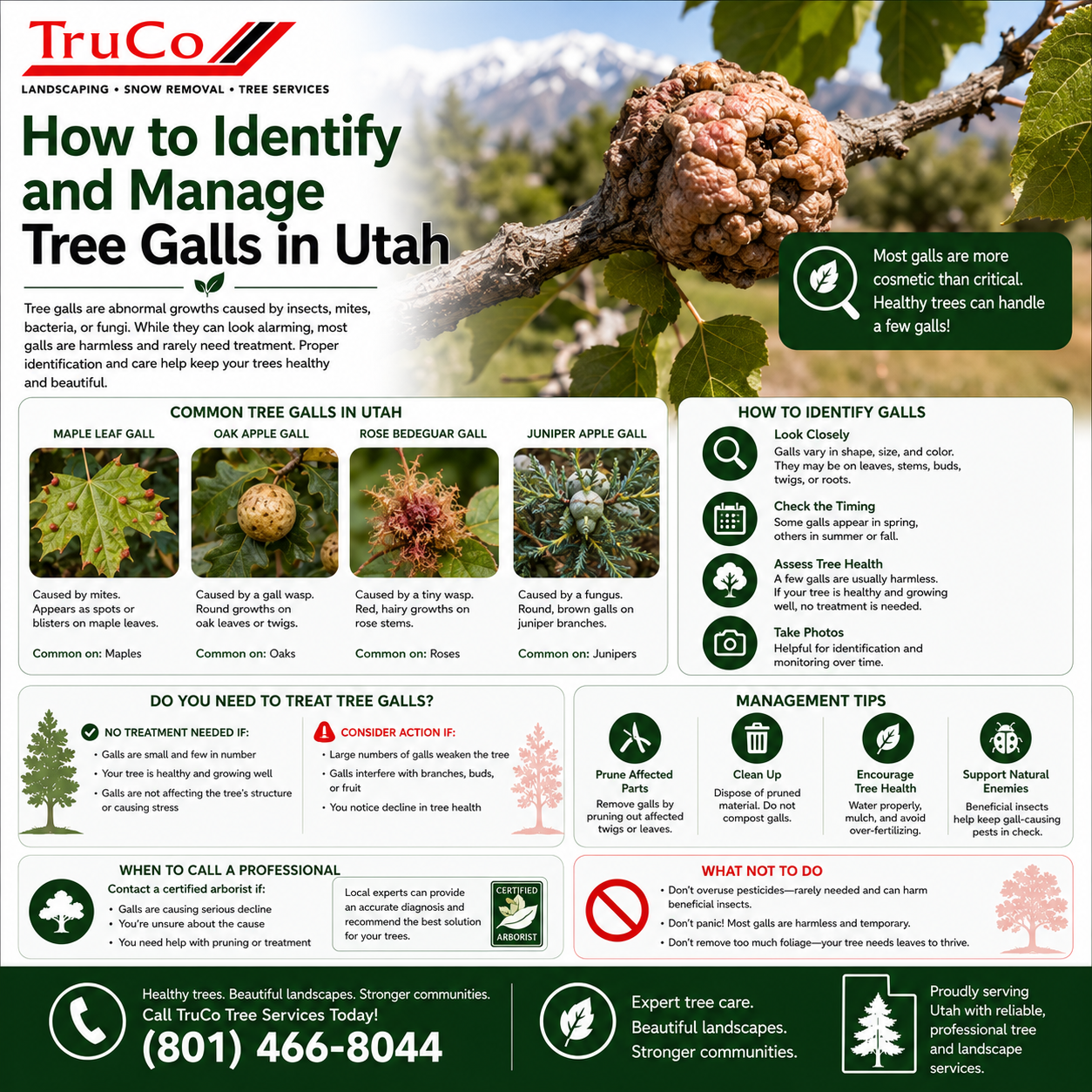
What Are Tree Galls and Why Do They Appear in Utah?
Tree galls are abnormal growths that form on tree leaves, twigs, branches, or roots. They are one of the most common but least understood tree problems in Utah. Galls can look alarming — large swellings, lumpy growths, colorful bumps, or fuzzy masses — but most are more cosmetic than harmful. They are typically caused by insects, mites, or bacteria that stimulate the tree's tissue to grow abnormally. In Utah, galls are particularly common on oaks, cottonwoods, willows, and maples. The majority of galls are not harmful to healthy trees, and treatment is often unnecessary. However, some galls can cause significant damage, especially to young or stressed trees. Heavy gall infestations can distort leaves, reduce photosynthesis, stunt growth, and weaken branches. Understanding the difference between harmless and harmful galls, and knowing when and how to manage them, is essential for Utah tree owners. This guide covers the most common galls found on Utah trees, how to identify them, and when treatment is needed.
Common Galls on Utah Trees
The most common galls in Utah affect specific tree species and are caused by specific insects or mites. Oak galls are extremely common in Utah. Oak apple gall — round, apple-like growths up to 2 inches in diameter, caused by gall wasps. Found on the leaves and twigs of various oak species. Usually harmless to healthy trees. Can be unsightly but rarely requires treatment. Oak leaf blister — raised, blister-like areas on oak leaves caused by fungi or mites. In Utah, common on Gambel oak and scrub oak. Typically cosmetic and does not harm the tree. Oak gall wasp — creates woody galls on oak twigs and branches. Large infestations can weaken branches. In Utah, this is common on bur oak and other oaks in urban landscapes. Heavily infested branches may need pruning. Cottonwood and poplar galls are widespread in Utah. Poplar petiole gall — spindle-shaped swellings on leaf stems caused by aphids. Leaves may drop early in heavy infestations. Common on cottonwood and poplar trees throughout Utah's riparian areas and urban landscapes. Usually harmless. Poplar twig gall — round swellings on poplar and cottonwood twigs caused by gall wasps or aphids. Heavy infestations can distort branch growth. In Utah, common on Lombardy poplar and hybrid poplars. Willow galls are common on Utah's native willows. Willow pinecone gall — cone-shaped galls at the tips of willow branches, caused by gall midges. Common on various willow species in Utah. Can distort branch tips but rarely causes serious harm. Willow bead gall — small, bead-like galls on willow leaves. Cosmetic only. Maple galls are common on Utah maples. Maple bladder gall — small, round, red or green galls on the upper surface of maple leaves, caused by mites. Very common on silver maple, Norway maple, and Freeman maple in Utah. Cosmetic only — no treatment needed. Maple spindle gall — elongated, spindle-shaped galls on the upper leaf surface. Caused by mites. Common on silver and sugar maples. Looks alarming but is harmless. Linden and elm galls also appear in Utah. Linden leaf gall — raised areas on linden leaves. Caused by mites. Cosmetic only. Cockscomb gall on elm — large, fleshy, wrinkled galls on elm leaves, caused by aphids. Can cover much of the leaf surface. In Utah, common on Siberian elm and American elm. Usually harmless to healthy trees.
When Tree Galls Are a Problem
While most galls are harmless, there are situations where they require management. Severe infestations — when galls cover more than 50% of the leaves or multiple branches, they can reduce photosynthesis and stress the tree. In Utah, severe gall infestations are most common on oak, willow, and cottonwood. Young or newly planted trees — trees under 3 years old are more vulnerable to gall damage. A heavy gall infestation can stunt growth or even kill a young tree. In Utah, protect young trees by monitoring for galls and treating when necessary. Stressed trees — trees already stressed by drought, poor soil, disease, or other factors are less able to tolerate gall infestations. In Utah, drought-stressed trees are most vulnerable. Gall-related branch dieback — some gall-forming insects can cause branch dieback. If you see dead branches with heavy gall infestations, prune them out. In Utah, oak gall wasps and poplar twig gall can cause branch dieback in severe cases. Aesthetic concerns — while galls rarely harm trees, they can be unsightly. Homeowners may choose to manage galls for purely cosmetic reasons. In Utah, oaks with heavy oak apple gall infestations are common complaints. Repeated severe infestations — if the same tree shows severe gall infestations year after year, it may indicate an underlying health issue. Address the tree's overall health rather than focusing solely on gall treatment.
Managing Tree Galls: Prevention and Treatment
For most galls, management focuses on tree health and preventative measures rather than direct treatment. Maintain tree health — healthy trees tolerate gall infestations without significant damage. Proper watering, mulching, and fertilization (based on soil tests) keep trees strong and resilient. In Utah, deep watering during dry periods is the most important health maintenance practice. Rake and remove fallen leaves — many gall insects overwinter in fallen leaves. Removing and disposing of leaves in fall reduces the population of gall-forming insects the following year. In Utah, leaf removal is particularly effective for oak leaf galls and maple galls. Do not compost infested leaves unless your compost pile reaches high temperatures that kill the insects. Prune infested branches — for galls on twigs and branches (like oak gall wasp or poplar twig gall), pruning and disposing of infested branches can reduce the population. Prune in winter when insects are dormant and the tree is leafless. In Utah, winter pruning is effective for gall management. Avoid broad-spectrum insecticides — these products kill beneficial insects that naturally control gall-forming insects. They are rarely effective for gall management because the insects are protected inside the gall tissue. In Utah, most insecticide treatments for galls are ineffective and unnecessary. Use systemic insecticides only for severe, persistent infestations on high-value trees. These products are absorbed by the tree and kill gall insects as they feed. Application timing is critical — they must be applied before galls form in spring. In Utah, this means applying in early spring (March-April) before bud break. A certified arborist should handle systemic insecticide applications. Accept cosmetic galls — for most trees, the best approach is to accept galls as a natural phenomenon. They rarely harm the tree and treatment is often ineffective. In Utah, many tree owners worry unnecessarily about galls. A little education and reassurance goes a long way. A certified arborist can assess whether gall infestations on your specific trees require treatment. In Utah, most gall infestations do not require intervention.
Gall-Like Growths That Are Not Galls
Not all abnormal growths on trees are galls. Some are more serious. Bacterial canker — sunken, oozing areas on branches or the trunk, often with cracked bark. These are caused by bacteria, not insects. Unlike galls, cankers can kill branches or entire trees. In Utah, bacterial canker is common on fruit trees and some ornamentals. Crown gall — rough, warty growths at the base of the tree or on roots, caused by the bacterium Agrobacterium tumefaciens. This is a serious disease that can weaken and eventually kill the tree. Unlike insect galls, crown gall requires professional management. In Utah, crown gall is most common on fruit trees, roses, and some ornamentals. Flatheaded borer damage — swellings and callus tissue around borer entry holes. These indicate borer infestation, not galls. In Utah, bronze birch borer and flatheaded appletree borer are common. Fungal conks — shelf-like growths on the trunk or branches, indicating internal decay. These are fungal fruiting bodies, not galls. In Utah, artist's conk and sulfur shelf fungus are common. Nodules on roots — small nodules on tree roots can be beneficial nitrogen-fixing nodules (on legumes like locust and alder) or harmful root-knot nematode galls. A certified arborist or soil lab can identify which is which. If you're unsure whether an abnormal growth is a gall or something more serious, consult a certified arborist. In Utah, USU Extension offices also provide plant diagnostic services.
Frequently Asked Questions
Will tree galls kill my tree in Utah? In almost all cases, no. Galls are primarily cosmetic and do not harm healthy, established trees. The galls themselves are abnormal tree tissue, not something growing on the tree. Most gall-forming insects have natural predators that keep populations in check. Only severe, repeated infestations on young or stressed trees may require treatment.
How do I get rid of galls on my oak tree in Utah? For most oak galls, treatment is unnecessary. If you want to reduce gall populations, rake and remove fallen leaves in autumn to reduce overwintering insects. Prune infested twigs in winter. Maintain tree health with deep watering and mulching. Systemic insecticides are rarely needed and should only be used by professionals.
Are tree galls contagious to other trees? Gall-forming insects are often species-specific. The insect that causes galls on oak will not affect a neighboring maple. However, if you have multiple trees of the same species, galls may spread among them. Maintaining tree health and diversity helps prevent widespread gall problems.
Can I spray my tree to prevent galls? Spraying is generally ineffective for gall prevention. By the time you see the gall, the insect is already protected inside the gall tissue. Preventative sprays must be applied at exactly the right time (before eggs are laid) and require precise timing that is difficult for homeowners to achieve. Professional systemic treatments are more effective but rarely necessary.
Do galls mean my tree is unhealthy? Not necessarily. Galls can appear on perfectly healthy trees, especially in years when gall insect populations are high. However, repeated severe gall infestations on the same tree year after year may indicate that the tree is stressed and should be evaluated by a certified arborist. Focus on overall tree health rather than the galls themselves.