
How to Identify Common Tree Species in Utah

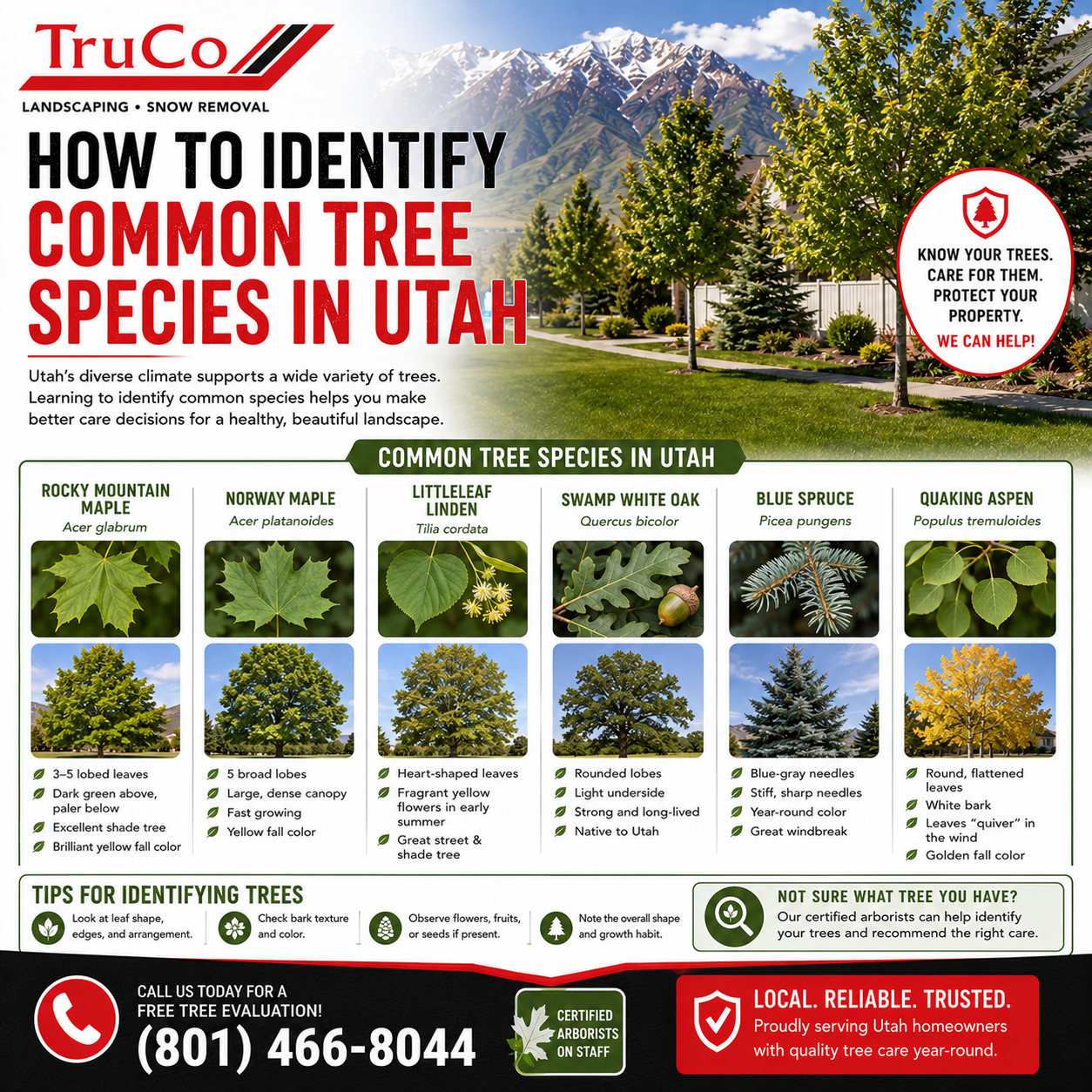
Identifying Trees in Utah
Utah's landscape spans hardiness zones 4a to 8a, supporting a wide variety of trees. Along the Wasatch Front from Ogden to Provo, alkaline clay soil, a semi-arid climate, and cold winters shape which trees thrive. Identifying what's growing in your yard is the first step to proper care.
Norway Maple
One of the most planted shade trees along the Wasatch Front. Large leaves 5-7 inches across with five pointed lobes. The foolproof identifier: milky white sap oozes from a snapped leaf stem. Bark starts smooth grayish-brown, developing interlacing ridges with age. Fall color is uniform bright yellow. Produces paired samaras that spread almost horizontally. Common in older Salt Lake City, Holladay, and Bountiful neighborhoods.
Silver Maple
Fast-growing, reaching 60-80 ft. Leaves are deeply five-lobed with jagged edges, bright green on top and silvery-white underneath. Bark on older trees develops long, thin, scaly plates. First to leaf out in spring along the Wasatch Front and first to drop leaves in fall. Fall color is lackluster yellow-brown. Branches often droop at tips but curve upward. Common in Sandy, West Jordan, and along the Weber River.
Bur Oak
The most adaptable oak for Utah. Leaves 6-12 inches long with deep rounded lobes, often described as fiddle-shaped. Bark is thick, grayish-brown, and deeply furrowed with broad, flat-topped ridges. Produces the largest acorns of any Utah oak — up to 1.5 inches with a deep fringed cap. Fall color is yellow-brown to gold. Matures at 60-80 ft with a broad, open crown. Handles alkaline clay, drought, and cold winters better than almost any other shade tree.
Gambel Oak
Utah's only native oak. Grows as a large shrub or small tree, 6-15 ft at lower elevations, up to 30 ft in ideal conditions. Leaves 4-7 inches with 5-9 rounded lobes. Dominates the foothills above Salt Lake City, Provo, and Ogden. If you hike the Bonneville Shoreline Trail, you're walking through Gambel oak thickets.
Plains Cottonwood
Native along Utah waterways. Triangular leaves with coarse rounded teeth and a flattened stem that makes them flutter in the breeze. Bark becomes thick, deeply furrowed, and gray-brown with age. Grows 3-6 ft per year, reaching 80-100 ft. Produces masses of white cottony seeds in late spring. Aggressive roots can damage sewer lines and foundations. Prone to limb breakage in storms. Bright yellow-gold fall color.
Quaking Aspen
Utah's most widespread native tree and state tree. Nearly round leaves, 1.5-3 inches across, with fine teeth and a flattened stem causing the characteristic trembling. Bark is smooth, creamy white with dark horizontal scars. Grows 40-60 ft with narrow upright crown. Brilliant golden yellow fall color famous along the Alpine Loop and in Little Cottonwood Canyon. Struggles in alkaline clay soil and is short-lived at lower elevations.
Honeylocust
One of the most planted street trees in Utah. Bipinnately compound leaves with 20-30 small leaflets create delicate dappled shade. Bark has long, narrow, scaly plates that curl at edges. Produces long twisted seed pods 8-18 inches. Clear yellow fall color. Grows 40-60 ft with vase-shaped crown. Extremely tolerant of alkaline soil, salt, drought, and compacted urban conditions.
Kentucky Coffeetree
Massive twice-compound leaves up to 3 ft long — the largest of any Utah tree. One of the last to leaf out in spring. Bark is distinctive: dark gray with scaly ridges that curl outward, described as looking like corn flakes. Produces large woody seed pods. Grows 50-70 ft with open irregular crown. Handles alkaline clay, drought, and cold exceptionally well.
Colorado Blue Spruce
Utah's most popular evergreen. Needles 1-1.5 inches, stiff, sharply pointed, four-sided, ranging from green to intense silver-blue. Bark is thin and scaly on young trees, becoming thicker and furrowed. Cones 3-5 inches long. Grows 50-75 ft with pyramidal shape. Prefers well-drained soil. Native to the Rocky Mountains.
Austrian Pine
Widely planted along the Wasatch Front. Needles in bundles of two, 4-6 inches long, stiff, dark green to almost black. Bark is thick, dark grayish-brown, deeply furrowed into broad scaly plates. Grows 40-60 ft with dense pyramidal to rounded crown. Extremely tolerant of alkaline soil and drought. Susceptible to Diplodia tip blight in recent years.
How to Use These Features
Start with leaves: look at shape, edge type, arrangement, and whether simple or compound. Examine bark: smooth, peeling, furrowed, or corky. Note overall tree shape and consider the site conditions. Most reliable performers for Utah soil: bur oak, honeylocust, Kentucky coffeetree, hackberry, and Colorado blue spruce.
Frequently Asked Questions
What is the most common tree in Utah? Norway maple, silver maple, and honeylocust are most commonly planted. Gambel oak and aspen dominate natural areas.
How to tell Norway from red maple? Snap a leaf stem — milky sap means Norway. Norway has U-shaped notches between lobes; red has V-shaped notches.
Which trees handle clay soil? Bur oak, honeylocust, Kentucky coffeetree, hackberry, Austrian pine, and Colorado blue spruce all handle alkaline clay well.
Best fast-growing shade tree? Honeylocust is better long-term than silver maple due to stronger wood.
Can I grow an oak in Utah? Yes — bur oak is the best choice, handling our soil and climate superbly. Slow-growing but long-lived.
How to identify trees in winter? Focus on bark, branch arrangement, overall shape, buds, and persistent fruits or seed pods.