
How to Use Landscape Fabric for Weed Control in Utah

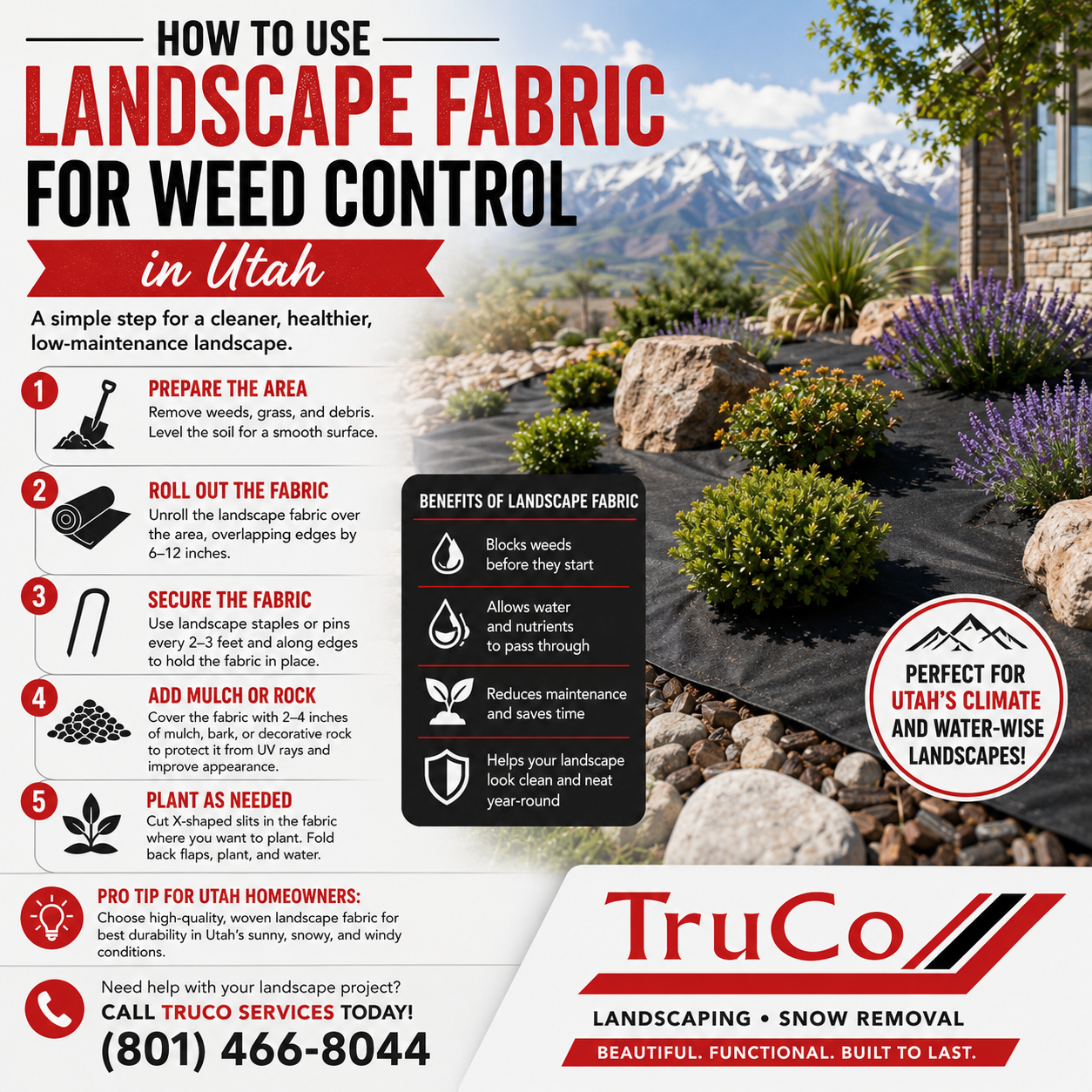
What Is Landscape Fabric and When to Use It in Utah
Landscape fabric (also called weed barrier fabric or geotextile) is a permeable material placed on the soil surface to suppress weeds while allowing water and air to pass through. In Utah landscapes, landscape fabric is a valuable tool for weed control in specific applications, but it's often misunderstood and misused. When used correctly, landscape fabric reduces weed growth by 80-95%, eliminates the need for chemical herbicides, conserves soil moisture by reducing evaporation, prevents soil erosion on slopes, and separates different soil layers for drainage. In Utah, landscape fabric is most effective under rock and gravel mulches, in pathway and driveway bases, under decks and sheds, behind retaining walls, and in drainage applications. It is NOT recommended under organic mulches (bark, wood chips, compost) because weeds germinate in the mulch layer on top of the fabric, and the fabric prevents the organic matter from decomposing into the soil below. Landscape fabric comes in different grades — standard woven polypropylene (3-5 year lifespan, $0.10-0.30 per sq ft), heavy-duty woven polypropylene (10-15 year lifespan, $0.30-0.60 per sq ft), non-woven geotextile (excellent drainage, $0.40-0.80 per sq ft), and perforated film (low-cost but poor drainage, $0.05-0.15 per sq ft). For Utah landscapes, heavy-duty woven fabric rated for 10+ years UV exposure is the best value — cheap fabric degrades in Utah's intense sun within 1-2 years and creates more problems than it solves.
Types of Landscape Fabric for Utah Applications
Choose landscape fabric based on your specific application and Utah's climate conditions. Woven polypropylene fabric — the most common type for Utah landscapes. Made of polypropylene fibers woven into a durable fabric. Allows water and air to pass through. Fabric weight: 3-6 oz per sq yd for standard use, 6-10 oz for heavy-duty. UV-stabilized for sun resistance. Best for: under rock and gravel beds, landscape pathways, and around trees and shrubs. In Utah, use heavy-duty woven (6+ oz per sq yd) for rock beds — lighter fabric tears easily when rock is spread and shifted. Cost: $0.20-0.50 per sq ft. Non-woven geotextile fabric — made of polyester or polypropylene fibers bonded together. More permeable than woven — water passes through in all directions. Excellent filtration properties — allows water through while holding soil particles in place. Best for: drainage applications (French drains, behind retaining walls), under permeable pavers, and erosion control on slopes. In Utah, use non-woven geotextile for drainage projects where water flow is critical. Cost: $0.40-0.80 per sq ft. Perforated polyethylene film — thin plastic sheet with holes punched for water penetration. Low-cost but poor performance — holes clog with soil, limiting drainage. Tears easily. Not UV-stabilized. Not recommended for permanent Utah landscapes. Best only for: temporary weed control (1-2 seasons) in vegetable gardens. Cost: $0.05-0.15 per sq ft. Woven polypropylene with laminated backing — heavy-duty fabric with a plastic backing for complete weed blocking. Excellent for permanent rock beds. Reduces water penetration somewhat — best for areas where you don't want water reaching the soil (like under drip lines). Cost: $0.50-0.80 per sq ft. Biodegradable landscape fabric — made from jute or coir (coconut fiber). Decomposes in 1-3 years. Best for: temporary erosion control on slopes during plant establishment. In Utah's dry climate, biodegradable fabric lasts longer but still breaks down. Cost: $0.30-0.60 per sq ft. For Utah homeowners, the best all-around choice is heavy-duty woven polypropylene fabric (6+ oz per sq yd, UV-stabilized) for rock beds and under decks, and non-woven geotextile for drainage applications.
How to Install Landscape Fabric in Utah
Proper installation is critical for landscape fabric performance in Utah. Clear the area of all vegetation, rocks, and debris before laying fabric. Remove existing weeds by hand or with a hoe — any weed left under the fabric will decompose but can create air pockets that cause fabric to settle unevenly. Level and smooth the soil surface — fabric lays best on a flat, even surface. In Utah's clay soil, rake the area smooth and remove rocks over 2 inches in diameter. For new garden beds, incorporate compost and amendments into the soil before laying fabric — adding amendments after fabric is impossible. Roll out the fabric across the prepared area with the labeled side down or up per manufacturer instructions. Overlap seams by 6-12 inches — in Utah, use 12-inch overlaps for rock beds where shifting is more likely. For sloped areas, start at the bottom and work upward, overlapping upper pieces over lower pieces (shingle style) so water runs over rather than under the fabric. Secure the fabric with landscape fabric pins (6-8 inch galvanized steel U-shaped pins). Space pins 3-5 ft apart in the field and every 1-2 ft along edges and seams. In Utah's windy conditions, use closer spacing on exposed areas. For pathways and high-traffic areas, use 8-10 inch pins. Cut X-shaped slits for planting — never cut round holes, which restrict root spread and create openings for weeds. Each slit should be just large enough for the root ball. Fold back the fabric flaps, plant, then close flaps around the plant stem. For trees and large shrubs, cut a circle of fabric 12-24 inches wider than the root ball — don't wrap fabric tight around the trunk. Cover the fabric with mulch immediately after installation and securing. For rock beds, spread 2-4 inches of rock or gravel. In Utah, 3 inches is minimum for standard river rock. For heavy-traffic pathways, use 4+ inches of compacted gravel. If using organic mulch, remember that landscape fabric under organic mulch is not recommended — but if you must, use 3-4 inches of mulch. In Utah's dry climate, exposed fabric degrades quickly in the sun — cover completely within 24 hours of installation.
Common Landscape Fabric Mistakes in Utah
Avoid these common mistakes that reduce landscape fabric effectiveness and lifespan in Utah. Using cheap, lightweight fabric — light fabric ($0.10-0.20 per sq ft) degrades in Utah's UV within 1-2 years. It tears when rocks are placed on it, and weeds penetrate through tears. Invest in heavy-duty fabric ($0.30-0.60 per sq ft) rated for 10+ years. Not overlapping seams enough — 6-inch minimum overlap with pins on both pieces. Weed roots find gaps as small as 1/2 inch. In Utah, bindweed and quackgrass are particularly good at finding seam gaps. Not pinning adequately — wind in Utah's open areas can lift unsecured fabric, exposing it to UV and allowing weeds underneath. In windy Utah locations (Davis County, Tooele Valley), use pins every 2 ft on edges and 4 ft in the field. Installing fabric under organic mulch — the most common mistake. Weeds germinate in bark and wood mulch on top of fabric. The fabric prevents the organic matter from incorporating into the soil below. Over 2-3 years, the mulch layer becomes a perfect seed bed on top of the fabric. Instead, use fabric only under rock or gravel. Not covering fabric completely — exposed fabric edges accelerate UV degradation. Cut fabric to fit precisely and tuck edges under border edging or cover with 3+ inches of mulch. Using fabric under turf — never install landscape fabric under sod or seeded lawn. Turf roots need to grow into the soil below. Fabric under turf creates a root barrier that results in thin, weak grass. In Utah, this is especially problematic because turf needs deep root systems to survive summer heat. Not removing existing weeds first — perennial weeds (bindweed, Canada thistle, quackgrass) will grow through fabric over time. Kill existing weeds with herbicide or thorough hand removal before fabric installation. In Utah, bindweed is particularly persistent — use systemic herbicide 2-3 weeks before fabric installation.
Landscape Fabric Maintenance and Replacement in Utah
Even properly installed landscape fabric needs occasional maintenance in Utah. Annually: inspect fabric edges for UV damage — exposed edges become brittle and crack. If found, trim damaged fabric and extend mulch coverage. In Utah's intense sun at 4,000+ ft elevation, fabric edges exposed to direct sun degrade within 6-12 months. Check for weeds growing through fabric — if you see weeds, they're coming from gaps in seams, tears, or from above (windblown seeds germinating in the rock layer). Pull weeds immediately before they establish deep roots. In Utah, bindweed and puncture vine are the most common weeds to penetrate fabric — if bindweed establishes, you may need to remove rock, replace the fabric, and re-cover. Replenish mulch depth to maintain 2-4 inches. In Utah's wind and rain, rock and gravel gradually thin out over time. Add 1-2 inches of fresh rock every 3-5 years. After 10-15 years (or when fabric fails): remove rock or gravel with a shovel. Pull up old fabric — heavy-duty fabric may break apart when removed (it degrades underground too). Dispose of old fabric (check if your waste hauler accepts it — some Utah cities accept landscape fabric in green waste if clean). Inspect the soil below — if it's compacted, aerate or till before laying new fabric. Install new fabric following the installation guidelines. For beds where you want to change the design, fabric removal is part of the renovation. In Utah, many homeowners find that after 5-7 years with fabric under rock, soil has accumulated on top and weeds are growing in it — at this point, the fabric is no longer effective and needs replacement or removal.
Frequently Asked Questions
Does landscape fabric work in Utah? Yes, when used correctly under rock and gravel mulches with proper installation. Heavy-duty woven fabric lasts 10-15 years in Utah's climate. Fabric under organic mulch (bark, wood chips) is not recommended — weeds grow in the mulch layer above the fabric.
What is the best landscape fabric for Utah? Heavy-duty woven polypropylene fabric (6+ oz per sq yd, UV-stabilized) for rock beds and pathways. Non-woven geotextile for drainage applications. Avoid cheap fabric under $0.20 per sq ft — it degrades quickly in Utah's sun.
How long does landscape fabric last in Utah? Heavy-duty fabric with UV stabilizers: 10-15 years. Standard woven fabric: 3-5 years. Cheap fabric: 1-2 years. Biodegradable fabric: 1-3 years. Protect all fabric from UV exposure with 3+ inches of rock or gravel.
Can I use landscape fabric in my Utah vegetable garden? It's better to use organic mulch or cardboard in vegetable gardens. Landscape fabric prevents soil improvement from organic matter decomposition. If using fabric for weed control in vegetable beds, use biodegradable fabric that can be tilled in at season's end.
What are the alternatives to landscape fabric in Utah? Cardboard + thick organic mulch — biodegradable, improves soil, and suppresses weeds for 1-2 seasons. Newspaper — 6-8 layers thick under mulch, decomposes in 3-6 months. Corn gluten meal — natural pre-emergent herbicide for lawns (not for beds). Hand weeding with proper mulching — most effective for small beds.