
How to Test and Improve Your Utah Lawn Soil

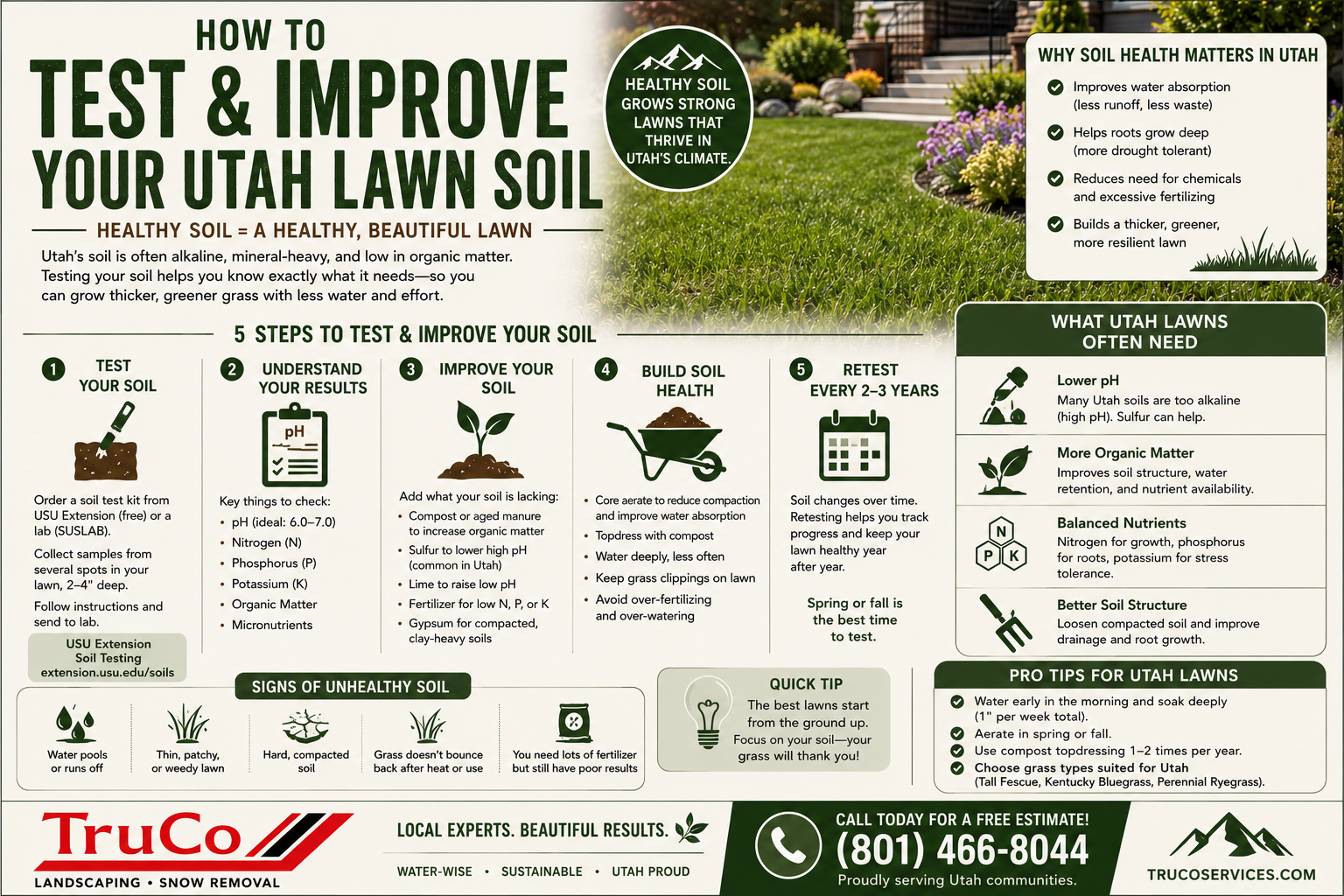
Why Soil Testing Matters in Utah
Utah's soil is naturally alkaline (pH 7.5-8.5) and often deficient in organic matter, iron, and nitrogen. These conditions directly affect lawn health — high pH locks up essential nutrients, making them unavailable to grass even when they're present in the soil. Common Utah lawn problems like yellowing grass, slow growth, and weed invasion often trace back to soil imbalance rather than lack of water or fertilizer. Soil testing provides a baseline measurement of pH, macronutrients (nitrogen, phosphorus, potassium), micronutrients (iron, zinc, manganese), organic matter content, and soil texture. Utah State University Extension offers soil testing through their analytical laboratory for $15-25 per sample — this is the most reliable option for Utah homeowners. Test your lawn soil every 2-3 years, or annually if you're correcting known deficiencies. Spring (March-April) and fall (September-October) are the best times to test.
How to Collect a Soil Sample
Proper sampling technique ensures accurate results. Use a clean trowel, spade, or soil probe. Collect samples from 8-10 locations across your lawn — avoid unusual spots like pet areas, near driveways, or under trees where conditions differ. Remove grass, thatch, and roots from each sample. For each sampling location, collect soil from 4-6 inches deep — this is the root zone for Utah lawns. Combine all samples in a clean plastic bucket and mix thoroughly. Spread about 1-2 cups of the mixed soil on a clean surface to air dry for 24 hours — do not oven-dry or microwave the sample. Place the dried sample in a clean plastic bag or the soil test container provided by USU Extension. Label the bag with your name, address, lawn type (Kentucky bluegrass, tall fescue), and any specific concerns. Submit the sample to the USU Analytical Labs in Logan or your local USU Extension office. Results typically arrive by email within 7-14 business days with detailed recommendations for amendments.
Understanding Your Utah Soil Test Results
Your USU Extension soil test report includes several key measurements. Soil pH: optimal range for Utah lawns is 6.5-7.5. Above 7.5, iron and manganese become unavailable, causing yellowing. Below 6.5, supplement with lime — uncommon in Utah. Organic matter: target 3-5% for healthy soil. Utah's mineral soils often test below 2%, indicating low biological activity and poor water retention. Nitrogen: Utah soils are almost always nitrogen-deficient — apply based on grass type and growing season. Phosphorus (P) and Potassium (K): levels vary — Utah's native soils are often adequate in potassium but variable in phosphorus. Iron: Utah soils typically test adequate in total iron, but high pH makes it unavailable — this is called iron chlorosis. Look for a "DTPA iron" measurement — below 4.5 ppm indicates need for iron supplementation. Cation Exchange Capacity (CEC): 10-20 is ideal — this measures the soil's ability to hold nutrients. Utah clay soils typically have higher CEC (15-25) while sandy soils have lower CEC.
Amending Utah's Alkaline Soil
Lowering soil pH in Utah's naturally alkaline conditions is challenging but achievable. Elemental sulfur is the most effective amendment — apply 5-15 pounds per 1,000 square feet depending on current pH and soil type. Sulfur works slowly — apply in fall for spring results. Repeat applications over 2-3 years may be needed to achieve target pH. Iron supplements: apply chelated iron (Fe-EDDHA or Fe-DTPA) for rapid greening — EDDHA works better in high-pH Utah soil than DTPA. Follow package rates for liquid or granular applications. Compost: apply 1/4 to 1/2 inch of high-quality compost annually — this builds organic matter, improves soil structure, buffers pH, and adds beneficial microorganisms. In Utah, compost from USU's Green Waste facility or local municipal compost programs is cost-effective at $20-40 per cubic yard. Gypsum: apply 40-80 pounds per 1,000 square feet to improve clay soil structure and reduce sodium — especially important if using secondary (untreated) irrigation water which can have high sodium. Avoid adding sand to clay soil — this creates a concrete-like texture.
Seasonal Soil Care Calendar for Utah
Spring (March-April): aerate compacted soil, apply compost (1/4 inch), add sulfur if pH correction is needed, apply pre-emergent herbicide (do not overseed for 6-8 weeks after), test soil if not done in the past 2 years. Summer (June-August): apply 1-2 pounds of nitrogen per 1,000 square feet using slow-release fertilizer, water deeply 1-2 times per week, monitor for iron chlorosis — apply chelated iron if grass shows yellowing with green veins. Fall (September-October): core aerate — this is the most important soil care practice for Utah lawns, overseed thin areas, apply 1 pound of nitrogen per 1,000 square feet with winterizer fertilizer (higher potassium), add compost or organic matter. Winter (November-February): minimize traffic on frozen or saturated soil to prevent compaction, apply gypsum if sodium is a concern from irrigation water, plan spring amendments based on soil test results. Consistent, seasonal soil care builds healthier turf that requires less water, fertilizer, and pest control — saving both time and money in Utah's challenging growing conditions.
Frequently Asked Questions
How do I know if my Utah lawn needs iron? Signs of iron deficiency: yellow or pale green grass with dark green veins (interveinal chlorosis), most visible on new growth. Apply chelated iron (Fe-EDDHA) for rapid results — greening occurs within 3-5 days.
Can I test my soil pH at home in Utah? DIY pH test kits and meters provide rough estimates but miss nutrient deficiencies. USU Extension lab testing ($15-25) is recommended for complete nutrient analysis and specific amendment recommendations for Utah conditions.
How much compost should I add to my Utah lawn? Apply 1/4 to 1/2 inch of compost annually. Too much compost (over 1 inch) can bury grass crowns and smother the lawn. Use screened, fully composted material — avoid unfinished compost that competes for nitrogen.
Does Utah's alkaline soil cause lawn problems? Yes — high pH (7.5-8.5) locks up iron, manganese, and phosphorus, causing yellowing, poor growth, and weed invasion. Regular soil testing and targeted amendments are essential for Utah lawn health.
Should I use lime on my Utah lawn? No — lime raises soil pH, and Utah soil is already too alkaline. Lime is only needed if your soil pH tests below 6.5, which is rare in Utah. Use elemental sulfur to lower pH if needed.