
How to Store and Season Firewood in Utah

Why Proper Firewood Storage Matters in Utah
Properly seasoned firewood burns hotter, produces less smoke and creosote, and costs less per BTU than green (unseasoned) wood. In Utah's climate, where wood-burning fireplaces and stoves provide supplemental heat from October through April, having a reliable firewood supply is essential. Seasoned firewood has moisture content below 20%, compared to 50-60% for freshly cut wood. Burning green wood wastes 30-40% of the heat energy on evaporating water, creates dangerous creosote buildup in chimneys (leading cause of chimney fires in Utah), produces excessive smoke, and contributes to air quality problems in Utah's inversion-prone valleys. Utah's dry climate (14 inches annual precipitation in Salt Lake Valley) actually helps firewood season faster than in humid regions. However, Utah's freeze-thaw cycles, snow, and afternoon monsoon thunderstorms require proper storage to keep firewood dry. In Utah, firewood is typically sold by the cord (128 cubic feet), face cord (1/3 cord), or truckload.
Choosing Firewood Species in Utah
Hardwoods provide the best heat output. Oak is the gold standard — Utah sources include Gambel oak (scrub oak) from the Wasatch foothills. Oak is dense, burns slowly, produces 24-28 million BTUs per cord, and creates excellent coals. Maple (box elder, bigtooth maple) is abundant in Utah canyons — burns clean with 20-24 million BTUs per cord. Ash is excellent for burning without seasoning fully (lower moisture content when alive) — 20-24 million BTUs per cord. Birch burns hot and fast with pleasant aroma — 20-22 million BTUs per cord, but rots quickly if not stored properly. Fruit woods (apple, cherry) from Utah orchards burn with sweet aroma — ideal for fireplaces and outdoor fire pits. Softwoods burn faster with more creosote. Pine (ponderosa, lodgepole) is common in northern Utah — ignites easily, burns fast, 15-18 million BTUs per cord. Douglas fir — 18-20 million BTUs, moderate creosote. Juniper (cedar) — burns hot with pleasant aroma, 18-20 million BTUs, pops and sparks. In Utah, avoid cottonwood — it burns poorly, produces excessive smoke, and has low heat value (12-15 million BTUs). Aspen burns clean but fast with low heat value (14-16 million BTUs). For the best results in Utah, mix hardwoods for steady heat with softwoods for easy ignition.
How to Season Firewood in Utah
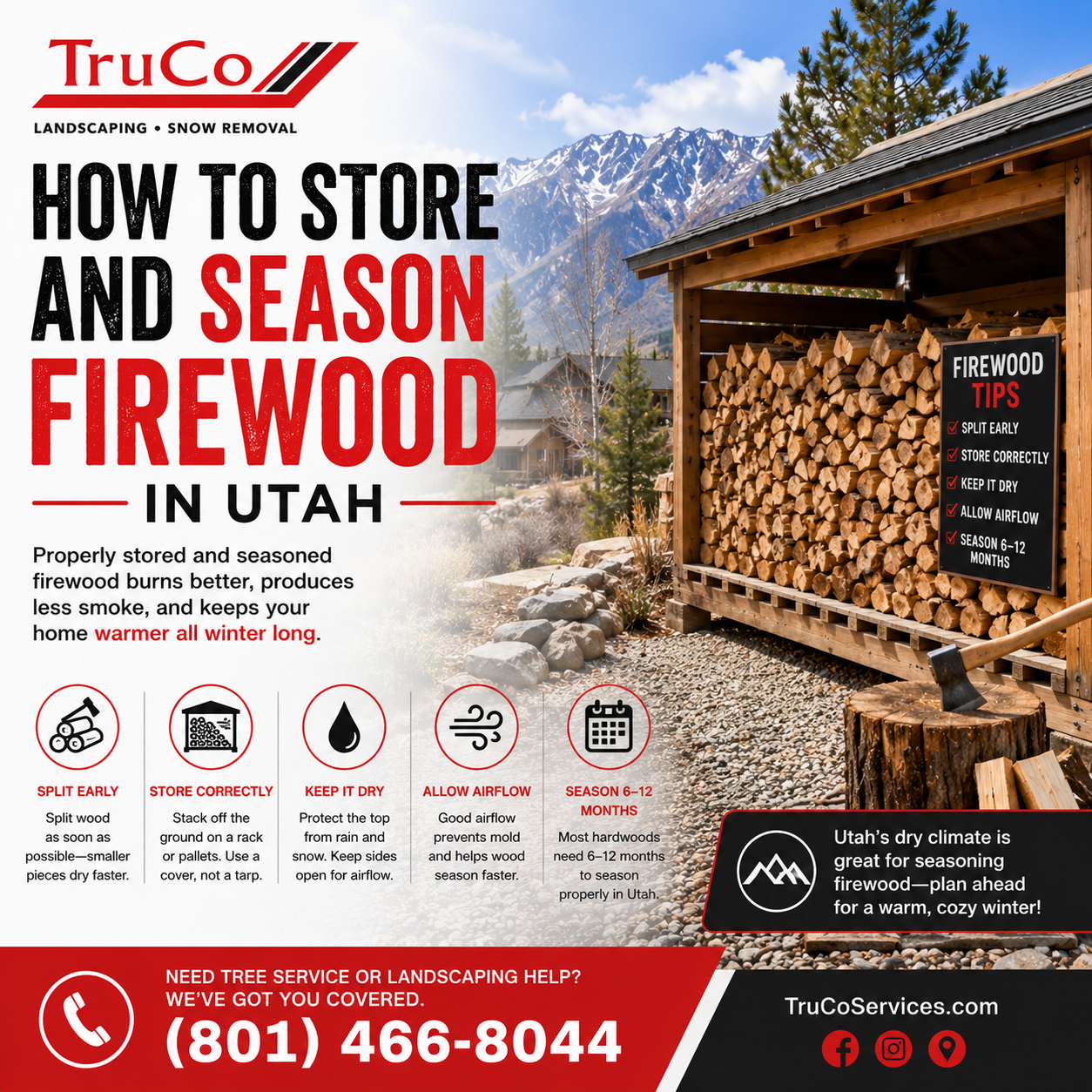
Seasoning is the process of drying wood to optimal moisture content. Cut wood to stove length (16-18 inches) — shorter pieces dry faster. Split wood — splitting exposes interior surfaces to air, speeding drying. For large rounds, split to 4-6 inch thickness. Stack wood in a single row (not piled) — single rows allow air circulation on all sides. Stack with bark facing up to shed rain. Leave 1-2 inches between pieces for airflow. Cover the top 1/3 of the stack — leave sides exposed for ventilation. In Utah, use metal roofing, tarps, or wood covers. Weight the cover to prevent wind blowing it off. Place the stack in full sun — sun exposure speeds drying significantly. In Utah's sunny climate, wood in full sun dries 2-3 times faster than in shade. Elevate the stack off the ground — use pallets, 4x4 runners, or treated lumber. Airflow underneath prevents ground moisture absorption. Seasoning time in Utah: hardwood split and stacked in spring (April-May) is ready for burning by October (6 months). Softwood dries in 3-4 months. Wood stacked in fall needs a full year to season. Test seasoning with a moisture meter ($20-40 online) — wood below 20% moisture is ready. Split wood should show radial cracks (checks). Two pieces struck together make a sharp CLINK sound, not a dull THUD.
Building a Firewood Rack in Utah
A good firewood rack keeps wood dry, allows airflow, and prevents rodent harborage. DIY rack: use 4x4 pressure-treated posts set in concrete, with 2x4 rails. Build the rack 4-8 ft long for easy access. Use galvanized or stainless steel screws — standard screws rust in Utah's weather. Leave the front open for easy loading and removal. For a simple rack, use pallets — stack 2 pallets side-by-side on concrete blocks for elevation. Commercial firewood racks ($100-300) are available at hardware stores in Utah (Home Depot, Lowe's, IFA). Look for racks with covers. Place the rack within 50 ft of the house for convenient access in winter. Avoid stacking against the house — it attracts termites, carpenter ants, and rodents. Keep firewood at least 2 ft from siding. In Utah's mountain areas, consider mosquito and wasp prevention — wood piles attract both. In areas with heavy winter snow, build a roof over the rack to prevent snow loading. In St. George, provide shade or partial covering to prevent wood from drying too fast and splitting excessively.
Storing Firewood for Utah Winters
Organize firewood by seasoning status. Stack recently cut wood in a separate seasoning area, ready-to-burn wood near the house. Practice first-in, first-out — use the oldest seasoned wood first. In Utah, most homeowners burn through 2-4 cords per winter depending on home size and heating needs. A cord of firewood (4x4x8 ft stack) weighs 3,000-5,000 lbs. Ensure your rack can support this weight. In northern Utah (zones 4-5), the burning season runs October through April — you'll need 6-7 months of supply. In St. George (zone 8), the burning season is November through February — 3-4 months. Bring 3-7 days worth of firewood indoors before burning to warm to room temperature — cold wood burns less efficiently. Store indoor firewood in a firewood holder or rack near the fireplace or stove, away from combustible materials. In Utah, be aware of burn bans — many Salt Lake Valley cities have no-burn days during inversions (typically November-February). Check with the Utah Department of Environmental Quality before burning.
Pests and Safety Considerations
Firewood can harbor pests that become problems in Utah homes. Common firewood pests: carpenter ants — nest in moist, rotting wood, can invade homes. Powderpost beetles — emerge from seasoned wood as tiny beetles leaving fine sawdust. Termites — subterranean termites in Utah can travel from wood piles to foundations. Bark beetles — some species emerge from firewood. To prevent infestations: stack wood away from the house (minimum 2 ft). Don't store wood on the ground — use a raised rack. Inspect wood before bringing indoors — discard pieces with active insect activity. Use wood within 6-12 months of splitting — old wood degrades and attracts more pests. Don't spray firewood with pesticides — burning treated wood releases toxic chemicals. Avoid stacking firewood under decks or porches — this creates hidden pest pathways. Safety: store firewood away from propane tanks, gas meters, and electrical panels. Keep the area around the wood pile clear of dry leaves and debris — reduces fire risk. Don't stack wood near wooden fences or structures. In Utah, wood piles can attract snakes — be cautious when retrieving wood, especially in spring and fall.
Frequently Asked Questions
How long does firewood take to season in Utah? Hardwoods need 6-12 months of seasoning in Utah's dry climate. Softwoods (pine, fir) season in 3-6 months. Split wood stacked in spring is usually ready by fall. Use a moisture meter to confirm.
What is the best firewood for Utah? Oak is the best overall for heat output and burn time. Maple and ash are excellent alternatives. Juniper burns with pleasant aroma — great for outdoor fire pits. Avoid cottonwood and willow.
How much firewood do I need for winter in Utah? A typical Utah home burns 2-4 cords per winter. Factors: home size, insulation, furnace supplement, number of fires per week. First-time buyers: overestimate — better to have leftover than run out.
Can I store firewood in my garage in Utah? Short-term storage (1-2 weeks) in the garage is fine. Long-term garage storage is not recommended — reduced airflow slows seasoning and increases pest risk. Store seasoned wood outside and bring in small batches.