
How to Revive a Drought-Stressed Tree in Utah

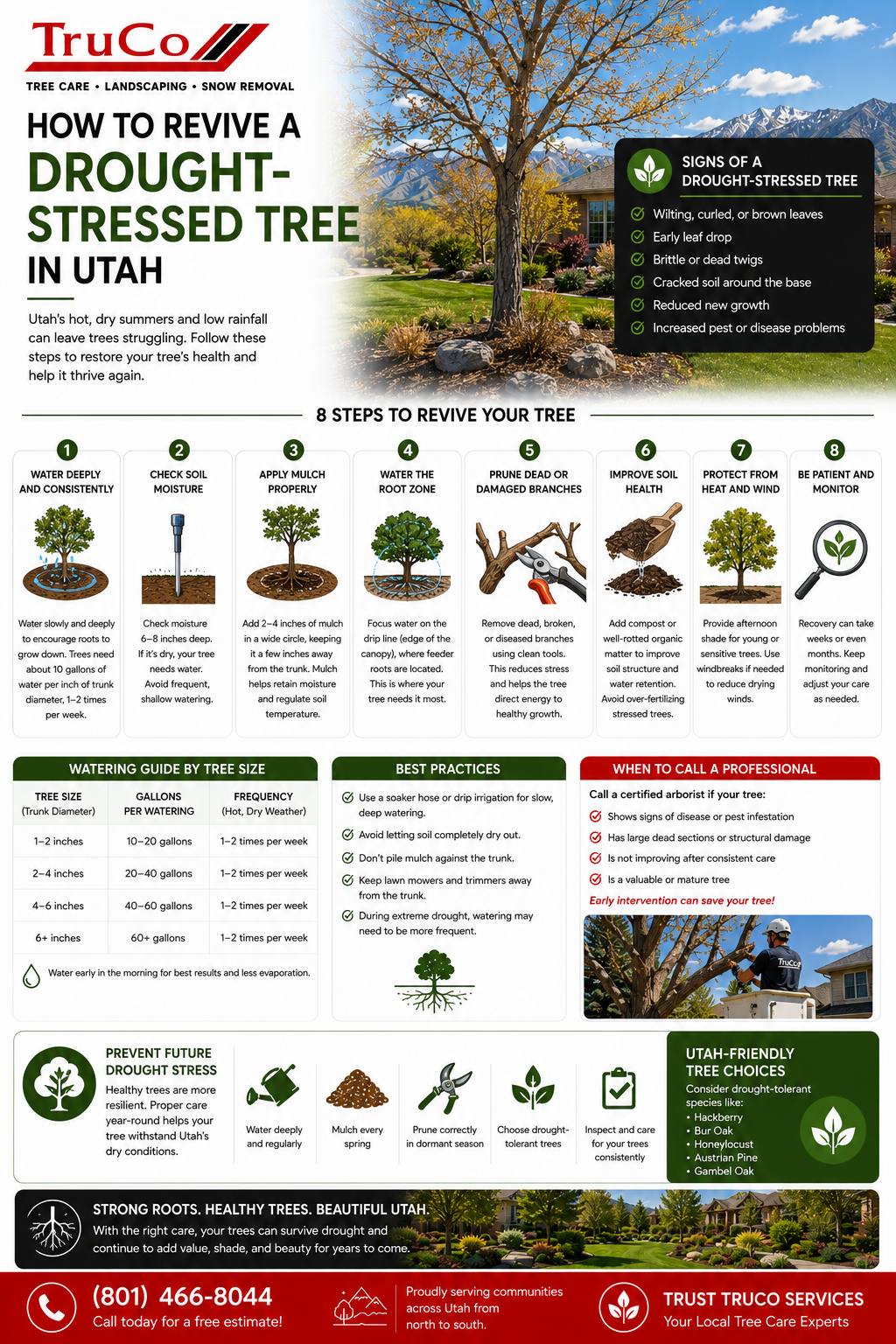
How to Revive a Drought-Stressed Tree in Utah
Utah's dry climate and periodic droughts put trees under significant water stress. Drought-stressed trees are more susceptible to pests, diseases, and structural failure. Recognizing the signs early and taking corrective action can save a stressed tree and restore it to health over time.
Signs of Drought Stress in Utah Trees
Leaf scorch: browning at leaf edges and between veins, appearing first on the south and west sides. Early fall color: leaves turning yellow or red weeks or months early. Wilting: leaves that droop during the day and partially recover at night. Thinning canopy: more sky visible through the tree than normal. Branch dieback: branches dying from the tips inward, starting in the upper crown. Needle browning on evergreens: especially on the south and west sides, from the tips inward. Epicormic shoots: clusters of small branches sprouting from the trunk indicating stress. Reduced growth: smaller annual twig growth than normal.
Deep Watering Techniques for Clay Soil
Utah's clay soil requires special watering techniques. Water slowly — apply water at a rate of 5 gallons per hour to prevent runoff. Water at the dripline, not at the trunk — feeder roots are at the dripline and beyond. Use a soaker hose or drip irrigation for even distribution. Water deeply — apply enough water to penetrate 12-18 inches into the soil. A good rule is 10 gallons per inch of trunk diameter per watering. Water every 7-14 days during drought, depending on soil type and tree species. For mature trees, water 2-3 times per month during severe drought.
Soil Amendment Strategies
Improve your soil's ability to hold moisture and deliver nutrients. Apply 2-4 inches of organic mulch (wood chips or shredded bark) in a ring extending to the dripline. Keep mulch 2-3 inches away from the trunk. Aerate compacted soil around trees using an air spade or radial trenching — this is especially important for trees in Utah's clay soils that have been compacted by construction or foot traffic. Add organic matter like compost to the soil surface — earthworms will incorporate it. Avoid fertilizing drought-stressed trees until they recover — fertilizer can burn already-stressed roots.
Pruning Drought-Damaged Branches
Wait until the tree has recovered before pruning. A stressed tree needs all its leaves to produce energy. Prune dead branches after the drought has passed and the tree has recovered — typically the following spring. Use proper pruning cuts at the branch collar. Do not remove more than 15% of live canopy in a single year.
Long-Term Recovery Care
Recovery from drought stress takes 2-5 years for most trees. Continue deep, infrequent watering for at least 2-3 years after the drought. Monitor for secondary pests — bark beetles, borers, and spider mites attack stressed trees. Maintain a healthy mulch layer. Do not prune heavily for at least 2 years. Consider using a tree growth regulator to reduce stress. Consult an arborist if the tree does not show improvement after one growing season of proper care.
Frequently Asked Questions
Can a drought-stressed tree recover? Yes, if less than 50% of the canopy is affected and the tree has been properly watered and cared for. Recovery takes 2-5 years.
How much water does a stressed tree need? 10 gallons per inch of trunk diameter per watering, every 7-14 days during drought.
Should I fertilize a drought-stressed tree? No — wait until the tree has fully recovered. Fertilizer can burn stressed roots.
What trees are most vulnerable to drought in Utah? Aspen, birch, maple, and newly planted trees. Bur oak, Kentucky coffeetree, and hackberry are most drought-tolerant.
When should I call an arborist? If the tree has more than 30% canopy dieback or does not improve after one growing season of proper care.