
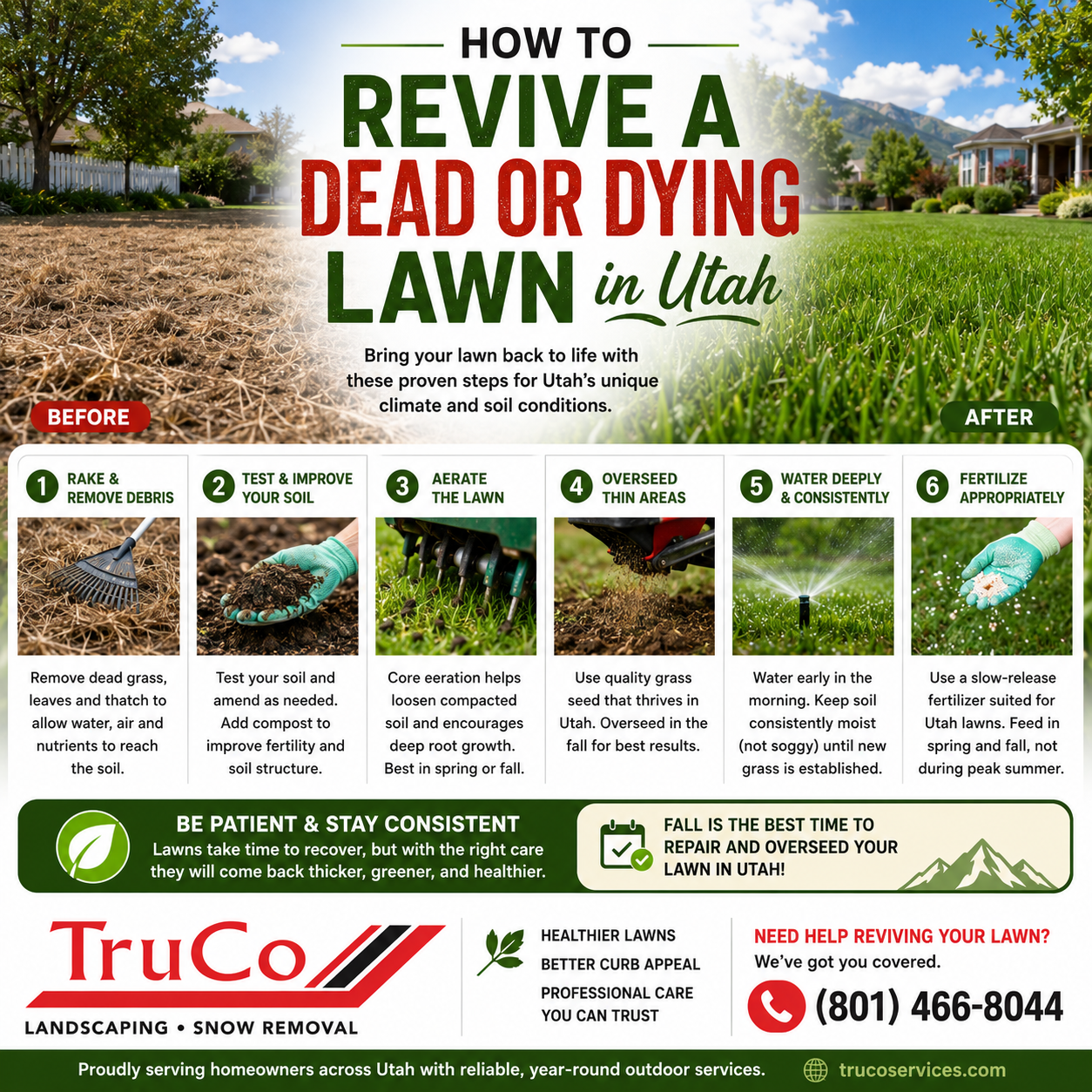
How to Revive a Dead or Dying Lawn in Utah

Diagnosing Why Your Utah Lawn Is Dying
Before spending time and money on lawn revival, identify the cause of decline. Utah lawns suffer from several common problems. Drought stress: grass turns dull blue-gray, then tan — footprints remain visible after walking across the lawn. This is the most common cause of brown lawns in Utah's arid summers. Over-watering: grass turns yellow or light green, soil feels constantly wet, and mushrooms or moss appear — more common in lawns with automatic timers running daily. Compaction: water pools on the surface, grass thins despite adequate watering, and roots are shallow — common in Utah's clay soils and high-traffic areas. Grub damage: dead patches that pull up like carpet with no roots — white C-shaped grubs feed on grass roots. Fungal disease: circular brown patches with a dark ring, or irregular dead areas after wet weather. Thatch buildup: spongy feel when walking, grass thins, and water beads on the surface. Soil pH imbalance: yellow grass with green veins indicates iron chlorosis from Utah's alkaline soil. Correct diagnosis guides the right treatment — treating for drought when the problem is compaction wastes time and water.
Rescue Watering for Drought-Stressed Lawns
Drought-stressed Utah lawns can often be revived with proper watering. If the grass is completely dormant (uniformly tan/brown with no green at the crown), it has entered survival dormancy. Dormant grass needs 1/2 inch of water every 2-3 weeks to keep the crown alive — do not fully water dormant grass because that triggers it to break dormancy and then require consistent watering. If the grass is partially green with brown patches, it's stressed but not fully dormant — water deeply with 1-1.5 inches immediately, then resume a normal schedule of 1-2 inches per week. Water between 4-8 AM for best absorption — Utah's low humidity means significant evaporation loss during daytime watering. Use a rain gauge or tuna can to measure sprinkler output. For lawns with poor water penetration (water runs off), apply a wetting agent or liquid aeration product to help water infiltrate Utah's clay soil. Core aeration before watering dramatically improves water penetration. During Utah's July and August heat, stressed lawns benefit from a 1/4 inch mid-afternoon syringing (light watering) to cool the grass — this reduces heat stress without triggering full growth.
Core Aeration and Overseeding
Aeration and overseeding are the most effective lawn revival treatments for Utah lawns. Late summer to early fall (August 15 to October 1) is the ideal time in Utah — soil is warm for seed germination, and cooler temperatures reduce stress on new grass. Rent a core aerator from Home Depot or IFA ($50-80 per day) or hire a professional service ($150-250 for a typical residential lawn). Make 2-3 passes in different directions for maximum soil penetration — the cores should be 2-3 inches long. Leave cores on the lawn to break down and return nutrients. After aeration, spread quality grass seed at 3-5 pounds per 1,000 square feet for overseeding. Use a blend appropriate for Utah: Kentucky bluegrass for sunny areas, fine fescue for shade, and perennial ryegrass for quick germination. Top-dress with 1/4 inch of compost to improve soil organic matter and hold moisture around seeds. Keep the soil consistently moist for 3-4 weeks after overseeding — water 2-3 times daily for 5-10 minutes until germination, then gradually reduce frequency. In Utah, September overseeding has the highest success rate because the grass establishes before winter dormancy.
Soil Restoration for Dead Patches
Bare or dead patches need targeted soil restoration. Remove dead grass and loosen the top 2-3 inches of soil with a garden rake or cultivator. Test soil pH — if above 7.5, mix elemental sulfur into the soil at 2-5 pounds per 100 square feet. Add 1-2 inches of compost mixed into the top 6 inches. For clay soil, add 1/2 inch of coarse sand or fine decomposed granite to improve drainage — never add sand alone to clay. Smooth and level the area, then seed or lay sod. For lawn replacement, kill the existing lawn with solarization: cover with clear plastic for 4-6 weeks during Utah's summer heat (June-August) to bake the soil and kill weed seeds and pathogens. Alternatively, use cardboard smothering: layer cardboard over the dead lawn, wet it, and cover with 4-6 inches of compost or topsoil. This method builds new soil while killing existing vegetation. In Utah, soil restoration is most effective when done in conjunction with irrigation system evaluation — poor sprinkler coverage is a common cause of persistent dead patches. Adjust sprinkler heads or add new ones to ensure complete coverage.
Seasonal Lawn Recovery Calendar for Utah
Follow this timeline for maximum lawn recovery success. Late summer (August): test soil, order seed and amendments, schedule aeration, repair sprinkler heads. Early fall (September): core aerate, overseed, apply compost top-dressing, water 2-3 times daily for germination. Mid-fall (October): reduce watering frequency, apply high-potassium winterizer fertilizer (1 pound per 1,000 square feet), mow at 2.5 inches for the last mowing, continue watering as needed. Late fall (November): winterize irrigation system, apply 1/4 inch of compost as winter mulch, minimize foot traffic on new grass. Spring (April): apply pre-emergent herbicide (organic: corn gluten meal), fertilize with slow-release nitrogen, water deeply 1-2 times per week. Summer (June-August): raise mowing height to 3.5-4 inches, water 1-2 inches weekly, spot treat weeds, monitor for drought stress. Full lawn recovery from severe decline typically takes 1-2 growing seasons. Be patient and consistent — Utah lawns respond well to proper care but don't recover overnight. Document progress with monthly photos to track improvement.
Frequently Asked Questions
Can brown grass turn green again in Utah? Yes — drought-dormant grass turns green again within 7-14 days of consistent watering. Grass that has been dead for more than 4-6 weeks may not recover and needs reseeding or resodding.
How do I know if my lawn is dead or dormant in Utah? Tug on the grass — if it pulls up easily with no roots, it's dead. If it holds firm but is brown, it's likely dormant. Scratch the crown (base of the plant) — green tissue means it's alive and dormant.
What is the best grass seed for reviving a Utah lawn? A blend of 50-60% Kentucky bluegrass and 40-50% tall fescue works best for sun. For shade, use fine fescue blends. Purchase seed from local Utah suppliers for varieties adapted to the region.
Should I fertilize a dying lawn in Utah? No — never fertilize a stressed or dying lawn. Fertilizer burns stressed roots and encourages weed growth. First correct the underlying problem (water, compaction, pH), then fertilize when grass is actively growing.
How long does it take to revive a lawn in Utah? Minor drought stress: 1-2 weeks. Moderate decline: 4-8 weeks with consistent care. Severe damage (bare patches, compaction, grubs): 1-2 full growing seasons for complete recovery.