
How to Prune Trees and Shrubs During Utah Summers

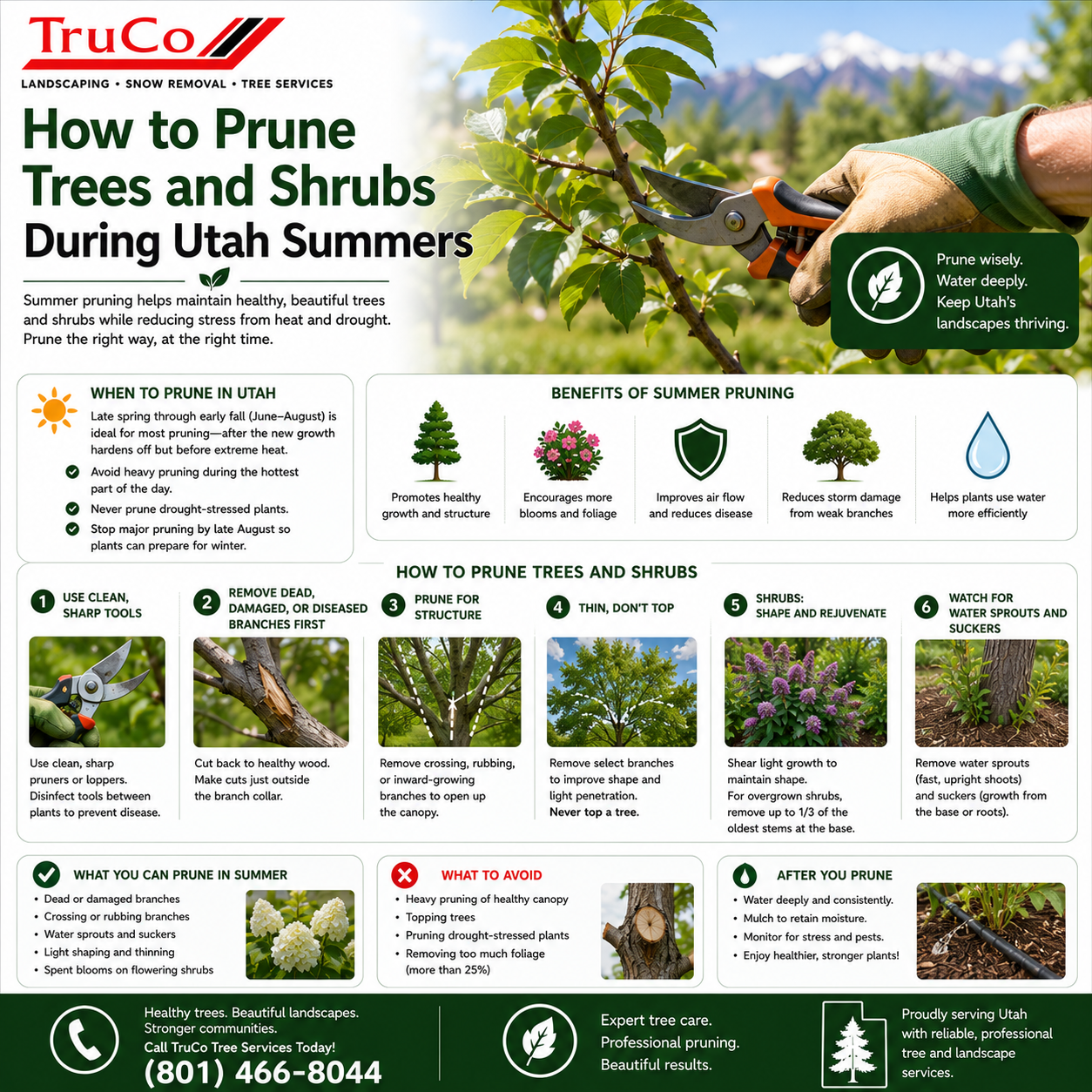
Why Summer Pruning Matters in Utah
Summer pruning helps control growth, remove damaged branches, and shape trees and shrubs during the active growing season. Utah's intense summer sun means proper pruning reduces stress on plants and promotes healthy growth. Unlike dormant pruning done in winter, summer pruning slows vigorous growth and directs energy into fruit production or flower bud development. It also allows you to see the tree or shrub in full leaf, making it easier to identify dead, diseased, or crossing branches that need removal.
When to Prune in Summer
Prune after spring growth matures, typically from June through August in Utah. The best window is after the first flush of growth has hardened off but before the heat of midsummer peaks. Avoid pruning during heat waves when temperatures exceed 95°F, as this adds stress. Early morning pruning is ideal since the plant is well-hydrated and temperatures are cooler. Avoid pruning within 24 hours of a scheduled deep watering or rainfall, as wet plants are more susceptible to disease entry through fresh cuts.
Which Trees and Shrubs to Prune in Summer
Summer-blooming shrubs like roses, butterfly bush, caryopteris, and lavatera benefit from summer pruning after they flower. Remove spent blooms to encourage a second flush of flowers. Fruit trees like apples, pears, and peaches can be summer-pruned to improve air circulation and light penetration, which enhances fruit quality. Remove suckers and water sprouts from any tree or shrub — these vigorous vertical shoots waste energy and create clutter. Spring-blooming shrubs like lilac, forsythia, and flowering quince should NOT be pruned in summer — they set next year's flower buds in summer, and pruning now removes those buds.
Summer Pruning Techniques
Use clean, sharp tools for every cut. Bypass pruners are best for live branches up to 3/4 inch, loppers for branches up to 1.5 inches, and a pruning saw for larger branches. Make cuts at a 45-degree angle just above a bud or lateral branch that faces the direction you want growth to go. Remove dead, diseased, or crossing branches first. Thin crowded branches to improve airflow, which reduces disease pressure in Utah's summer humidity. Remove no more than 25% of the canopy in a single season. For trees, focus on the three D's — dead, damaged, and diseased wood — plus any rubbing or crossing branches.
Tools and Sanitation
Clean tools between each tree or shrub to prevent disease spread. A solution of 1 part bleach to 9 parts water or 70% isopropyl alcohol works well. Wipe blades dry to prevent rust. Keep tools sharp throughout the season — a sharp tool makes clean cuts that heal faster. Consider having two sets of pruners so you can rotate while one set is being sharpened. Wear proper safety gear including gloves, safety glasses, and long sleeves when pruning larger branches.
Frequently Asked Questions
Can I prune any tree in summer? Avoid pruning oaks and elms in summer to prevent disease transmission. Oak wilt and Dutch elm disease are spread by beetles attracted to fresh cuts. Prune these species only during winter dormancy.
How much should I prune in summer? Remove no more than 25% of the canopy. Summer pruning is meant to be lighter than dormant pruning.
Should I seal pruning cuts? No. Trees have natural compartmentalization processes and seal wounds themselves. Pruning sealers can trap moisture and promote decay.
What is the difference between thinning and heading cuts? Thinning cuts remove a branch at its point of origin, maintaining the tree's natural shape. Heading cuts shorten a branch, stimulating dense growth at the cut point. Use thinning cuts for most summer pruning.
Can I prune maple trees in summer? Yes, but maples bleed sap heavily in spring. Summer pruning after leaves are fully developed minimizes sap flow.
How do I prune a shrub that has overgrown? Rejuvenation pruning removes 1/3 of the oldest stems at ground level each year for three years. This gradually replaces the shrub without shocking it.