
How to Plant and Care for Oak and Elm Trees in Utah

Best Oak Species for Utah
Oaks are magnificent shade trees that thrive in Utah's climate with proper selection. Bur oak (Quercus macrocarpa) is the most reliable for Utah — it tolerates alkaline soil, drought, and urban conditions, reaching 60-80 feet at maturity. Its deep taproot makes it extremely wind-resistant, ideal for Utah's spring windstorms. English oak (Quercus robur) adapts well to Utah's climate and grows 40-60 feet — varieties like Fastigiata offer a narrow, columnar form perfect for smaller yards. Gambel oak (Quercus gambelii) is Utah's native oak, naturally growing as a large shrub or small tree reaching 15-30 feet — excellent for naturalized landscapes and wildlife habitat. Pin oak (Quercus palustris) is less recommended for Utah — it prefers acidic soil and often develops iron chlorosis (yellowing) in Utah's alkaline conditions. Swamp white oak (Quercus bicolor) is more adaptable and grows well in Utah's clay soils with moderate watering. All oaks grow slowly to moderately in Utah's climate — patience is essential for these long-lived trees that can survive 200-300 years.
Best Elm Species for Utah
Elms were historically the most popular street tree in Utah until Dutch elm disease changed the landscape. Disease-resistant elm cultivars make them viable again. American elm cultivars like Princeton and Valley Forge are resistant to Dutch elm disease and tolerant of Utah's urban conditions — they grow 60-80 feet with the classic vase-shaped canopy. Slippery elm (Ulmus rubra) is native to eastern North America but adapts well to Utah's climate — it grows 50-60 feet and tolerates alkaline soil. Lacebark elm (Ulmus parvifolia) is smaller at 40-50 feet with attractive exfoliating bark — it performs well in Utah along the Wasatch Front. Hybrid elms like Frontier, Triumph, and Homestead combine Dutch elm disease resistance with heat and drought tolerance suited to Utah's climate. Avoid Siberian elm (Ulmus pumila) — it is invasive in Utah, has weak wood that breaks in windstorms, and produces abundant seeds that germinate everywhere. Always choose named, disease-resistant cultivars to avoid the problems that have plagued elms in Utah and across the United States.
Planting Oaks and Elms in Utah
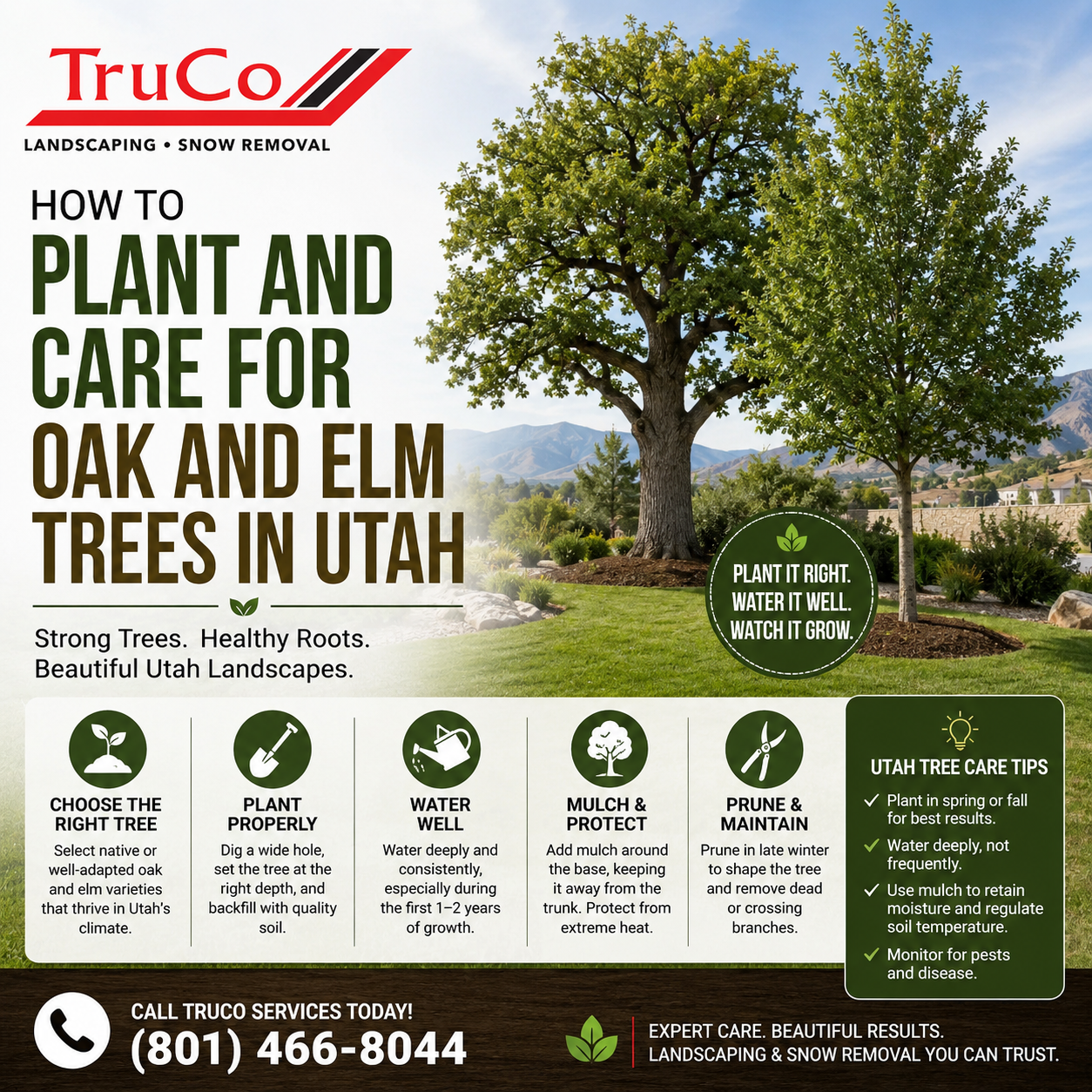
Proper planting technique determines long-term tree health. Plant in spring (April-May) or fall (October) when temperatures are moderate. Dig a saucer-shaped hole 2-3 times wider than the root ball but no deeper than the root ball height. The root flare — where the trunk widens at the base — must be visible above the soil line after planting. Planting too deep is the most common cause of tree decline in Utah. Backfill with native soil only — do not add compost, peat moss, or fertilizer to the planting hole. Studies show trees establish faster in native soil. Water deeply after planting to eliminate air pockets. Apply 3-4 inches of organic mulch over the root zone (not touching the trunk). Space oaks 30-50 feet apart and elms 25-40 feet apart depending on the variety — these are large trees that need room to reach full size. Stake only if the tree is in a windy location — remove stakes after the first growing season. In Utah, protect young tree trunks from sun scald by painting with white tree wrap or using tree guards on the south and west sides.
Watering and Fertilizing
Oaks and elms have different water needs in Utah's climate. Water newly planted trees deeply every 5-7 days during the first growing season — apply 5-10 gallons per inch of trunk diameter. Established oaks (after 3 years) are drought-tolerant and need deep watering every 2-4 weeks during dry periods. Established elms need more consistent moisture — water every 2-3 weeks during drought. For both species, water slowly at the drip line (outer edge of the canopy) to encourage deep root growth. Avoid frequent shallow watering that encourages surface roots and weak trees. Fertilizer: established oaks generally don't need fertilizer in Utah — they grow slowly and naturally. If growth is poor, apply a slow-release 16-8-8 fertilizer in early spring. Elms benefit from annual fertilization in spring — apply 1-2 pounds of nitrogen per 1,000 square feet of canopy area. For both species, avoid fertilizing during drought or after July 1 — late-season fertilization encourages tender growth that winter-kills in Utah.
Common Pests and Diseases
Oaks and elms face specific pest and disease issues in Utah. For oaks: oak wilt is a fungal disease spread by sap beetles — prune oaks only in late fall through winter (November-February) when beetles are inactive. Oak anthracnose causes leaf spots and early leaf drop in wet springs but rarely kills healthy trees. Powdery mildew appears as white coating on leaves during humid summer conditions. Scale insects and aphids can weaken oaks — treat with horticultural oil. For elms: Dutch elm disease remains a threat — plant only resistant cultivars. Elm leaf beetles skeletonize leaves in summer — they rarely kill trees but reduce vigor. Control with systemic insecticide applied by a professional. Elm yellows (phloem necrosis) is a fatal disease spread by leafhoppers — affected trees show yellowing leaves and inner bark discoloration with no cure. In Utah, the most common cause of decline for both oaks and elms is improper watering — over-watering causes root rot, while under-watering during drought stresses trees and attracts bark beetles.
Frequently Asked Questions
How fast do oak trees grow in Utah? Oaks are slow to moderate growers in Utah. Bur oaks grow 12-24 inches per year, English oaks 18-24 inches per year. Patience is essential — oaks are long-term investments that provide shade for generations.
Are elm trees good for Utah yards? Disease-resistant elm cultivars are excellent shade trees for Utah — they tolerate alkaline soil, grow 2-3 feet per year, and reach 60-80 feet with a beautiful vase shape. Avoid Siberian elm which is weak-wooded and invasive.
Do elm trees cause allergy problems in Utah? Yes — elms produce significant pollen in early spring (February-March) that can trigger allergies. Consider oak or other low-allergy trees for allergy-sensitive households.
What causes yellow leaves on oak trees in Utah? Iron chlorosis (yellow leaves with green veins) is common in Utah's alkaline soil. Apply chelated iron (Fe-EDDHA) in spring or fall. Over-watering can also cause yellowing by drowning roots.
Can I prune oak trees in summer in Utah? No — prune oaks only in late fall through winter (November-February). Summer pruning attracts sap beetles that can transmit oak wilt, a fatal fungal disease. Seal all pruning cuts on oaks immediately.