
How to Mow Your Lawn Properly in Utah: Height, Timing, and Patterns

Why Mowing Technique Matters in Utah
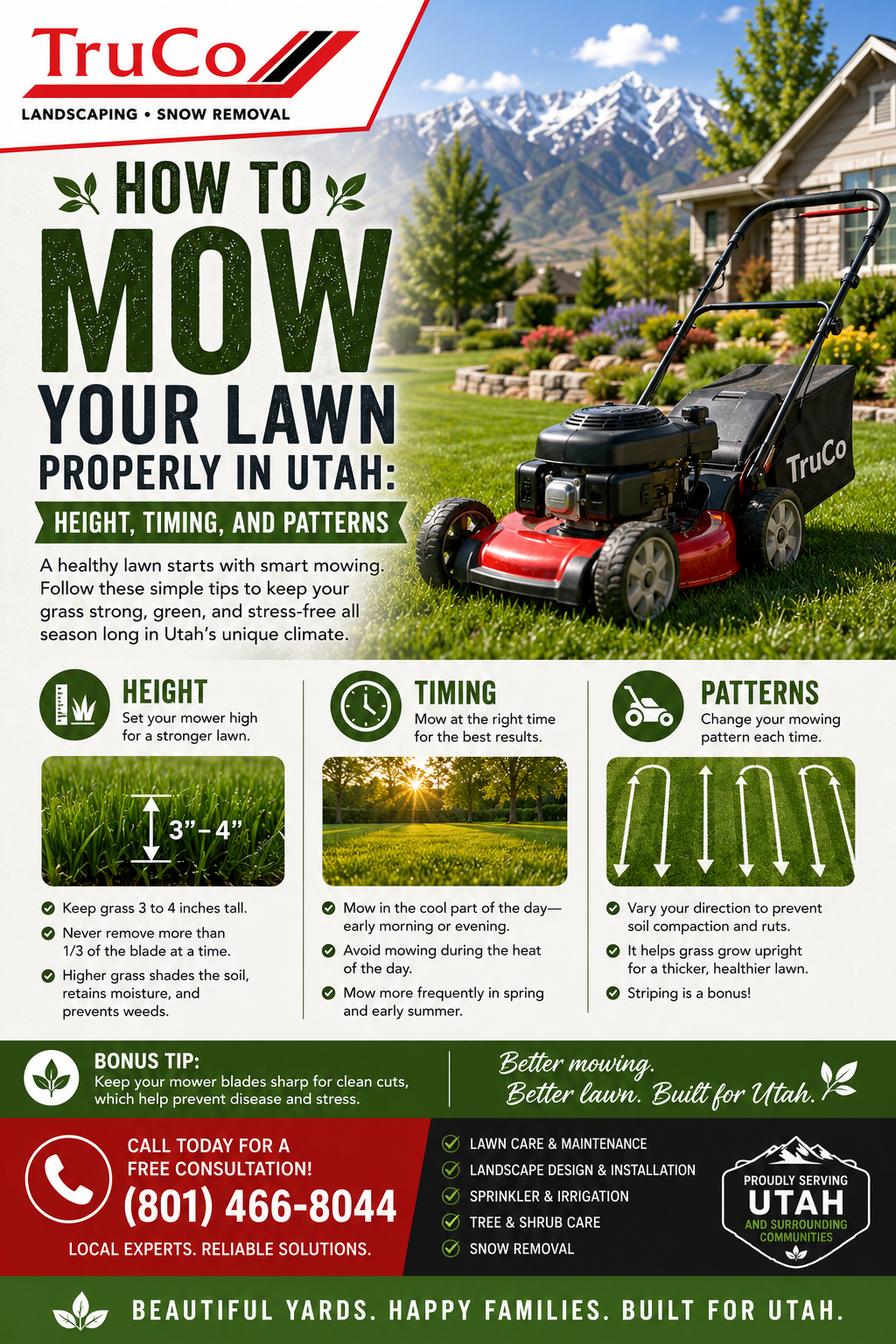
Proper lawn mowing is one of the most important — and most misunderstood — aspects of lawn care in Utah. The way you mow affects root depth, drought tolerance, weed pressure, and disease resistance. Most Utah homeowners mow too short, too often, or at the wrong time. Kentucky bluegrass and tall fescue, the two most common grasses in Utah lawns, have different mowing requirements, and getting them right pays off through our hot, dry summers. The golden rule of mowing: never remove more than one-third of the grass blade height at any single mowing. Cutting more stresses the grass, weakens roots, and invites weeds and disease. In Utah's climate, taller grass grows deeper roots — a 3-inch blade of grass supports roots reaching 4-6 inches deep, which access water during summer heat. Grass mowed too short (1-1.5 inches) has shallow roots that dry out quickly, turning brown and patchy in Utah's July and August heat. The correct mowing height for Utah lawns is 2.5-3.5 inches for Kentucky bluegrass and 2.5-3 inches for tall fescue. Mowing at the correct height also shades the soil, reducing evaporation and keeping soil temperatures cooler — critical when Utah summer air temperatures exceed 95 degrees. Proper mowing alone can reduce your lawn's water needs by 20-30% in Utah's climate.
Choosing the Right Mowing Height for Utah Grasses
Mowing height varies by grass type and season in Utah. Kentucky bluegrass — the most common Utah lawn grass. Recommended height: 2.5-3.5 inches. In summer, mow at the higher end (3-3.5 inches) to protect roots from heat and drought. In spring and fall, 2.5-3 inches is ideal. Tall fescue — increasingly popular in Utah for drought tolerance. Recommended height: 2.5-3 inches. Tall fescue should never be cut below 2.5 inches — shorter cutting exposes its crown and weakens it. Fine fescue — used in shade areas and low-water lawns. Recommended height: 2.5-4 inches. Fine fescues grow slowly and need less frequent mowing. Bermuda grass (southern Utah) — recommended height: 1-1.5 inches. Bermuda is a warm-season grass that grows best in St. George and other southern Utah locations. In northern Utah, where lawns are cool-season grasses, keep heights above 2.5 inches. Seasonal adjustments in Utah: Spring (April-May) — mow at 2.5-3 inches as grass wakes up. During Utah's spring growth surge, you may need to mow every 4-5 days. Summer (June-August) — raise mower to 3-3.5 inches. The taller grass shades the soil, conserves moisture, and withstands 100-degree days better. In extreme heat, raise to 3.5 inches. Fall (September-October) — gradually lower to 2.5-3 inches before winter. This prevents snow mold and gives the lawn a clean start in spring. Avoid scalping — cutting below 2 inches — at any time in Utah. Scalped lawns are more susceptible to heat stress, drought, weeds, and disease. If your Utah lawn has been mowed too short for years, gradually raise the mower 1/4 inch every 2 weeks until you reach the recommended height — don't raise it all at once, which shocks the grass.
Mowing Frequency and Timing in Utah
Mowing frequency depends on growth rate, which varies dramatically through Utah's seasons. Spring (April-May): mow every 4-7 days. Utah's cool-season grasses grow rapidly in spring's mild temperatures and adequate moisture. Summer (June-August): mow every 7-14 days. Growth slows in Utah's heat, especially during drought. If your lawn goes dormant (turns brown), stop mowing — dormant grass needs no mowing. When it greens up after rain or watering, resume. Fall (September-October): mow every 5-10 days. Growth picks up again as temperatures cool. Mow until the grass stops growing, typically late October or November in northern Utah. The one-third rule applies to frequency: if grass is 4.5 inches tall and you're mowing at 3 inches, you're removing one-third — correct. If grass reaches 5 inches before you mow, you're removing too much. In that case, mow high first (3.5 inches), then mow to 3 inches a few days later. Time of day matters in Utah. Mow in the late afternoon or early evening (4-8pm) when temperatures cool and grass has dried from morning dew or irrigation. Morning mowing on wet grass — common with automatic sprinklers — clumps, tears the grass blades, and spreads disease. If the lawn is wet from irrigation, wait until it dries. In Utah, irrigate on days you don't mow, or water early enough that grass dries by evening. Never mow in the heat of the day (11am-3pm) in Utah summers — the grass is stressed, and mowing adds additional stress. During Utah's windy afternoons, mow early or late to avoid uneven cuts and clippings blowing into beds.
Mowing Patterns and Equipment in Utah
Vary your mowing pattern each time you mow. Mowing the same direction every week creates ruts and compacts soil in Utah's heavy clay. Alternate patterns: north-south one week, east-west the next, diagonal the third. This encourages upright growth and prevents grain development. For a striped lawn look (popular in Utah), use a mower with a roller on the back — grass blades bend in opposite directions, creating light and dark stripes. Striping is purely aesthetic; it doesn't affect lawn health. Mower blade sharpness is critical. A dull blade tears grass rather than cutting it cleanly, leaving ragged tips that turn brown within 24 hours. In Utah, sharpen your mower blade at least twice per season — more often if you mow frequently or hit rocks. A sharp blade gives a clean cut that resists disease and retains moisture. Signs of a dull blade: brown-tipped grass, ragged cut edges, and increased mowing time. Lawn mower types for Utah: rotary mowers — most common, suitable for most Utah lawns. Mulching mowers — return clippings to the lawn, returning nitrogen to the soil. In Utah, mulching is recommended — grass clippings provide 25-30% of the lawn's nitrogen needs. Bagging mowers — remove clippings, useful for the first spring mowing (removes winter debris) or when grass is overgrown. Reel mowers — best for very short grass (putting greens, Bermuda in southern Utah), give the cleanest cut. Self-propelled mowers — recommended for Utah's larger lots (0.25+ acres) and slopes. Consider a mower with a side-discharge or rear-bag option for flexibility. In Utah, many homeowners hire professional lawn mowing services (like TruCo) for consistent, correct-height mowing — professional crews mow on schedule, sharpen blades regularly, and adjust height seasonally.
Grass Clippings: To Bag or Not to Bag in Utah
Grass clippings are a valuable resource for Utah lawns. Leave clippings on the lawn (grasscycling) whenever possible. Clippings decompose quickly in Utah's dry climate and return nitrogen, phosphorus, and potassium to the soil. Leaving clippings can supply 25-30% of your lawn's annual fertilizer needs — saving you money on fertilizer. Clippings do NOT cause thatch. Thatch is caused by over-fertilization, compaction, and certain grass types — not by clippings. Clippings are 80-90% water and decompose rapidly. When to bag clippings in Utah: if the grass is overgrown (removing more than 1/3 blade height), if the lawn has a disease problem (removes infected material), if you want a pristine look before an event, or if clippings would blow into flower beds or walkways. In Utah's fall, bag the last few mowings to remove leaves mixed with clippings. When grass is long and wet, bag to avoid clumping. Avoid leaving long clumps of clippings on the lawn — they smother the grass beneath. If clumps form, break them up with a rake or re-mow over them. Mow more frequently in spring to avoid heavy clipping accumulation. In Utah's hot summer, grasscycling is especially beneficial — the clippings act as a thin mulch, reducing soil temperature and moisture loss.
Frequently Asked Questions
How tall should I mow my lawn in Utah? Mow Kentucky bluegrass at 2.5-3.5 inches and tall fescue at 2.5-3 inches. In Utah's summer heat, mow at the higher end (3-3.5 inches) to protect roots and conserve moisture. Never cut below 2 inches — scalping damages Utah lawns.
How often should I mow in Utah? Every 4-7 days in spring, 7-14 days in summer, and 5-10 days in fall. Follow the one-third rule: never remove more than one-third of the grass blade at once. In extreme summer heat or drought dormancy, stop mowing until grass resumes growth.
Should I leave grass clippings on my Utah lawn? Yes. Clippings return 25-30% of nitrogen to the soil, reduce fertilizer needs, and act as a light mulch in Utah's heat. Clippings do not cause thatch. Bag only when grass is overgrown, diseased, or when clippings would blow into beds.
What time of day should I mow in Utah? Late afternoon or early evening (4-8pm). Avoid mowing wet grass in the morning, and avoid mowing during the heat of the day in summer. In Utah's windy afternoons, mow early or late for the cleanest cut.
How do I get a striped lawn in Utah? Use a mower with a rear roller and alternate mowing directions each week. The roller bends grass blades in opposite directions, creating light and dark stripes. Striping is aesthetic only — it doesn't affect lawn health or growth.