
How to Keep Deer and Rabbits Out of Your Utah Garden

Understanding Deer and Rabbit Pressure in Utah
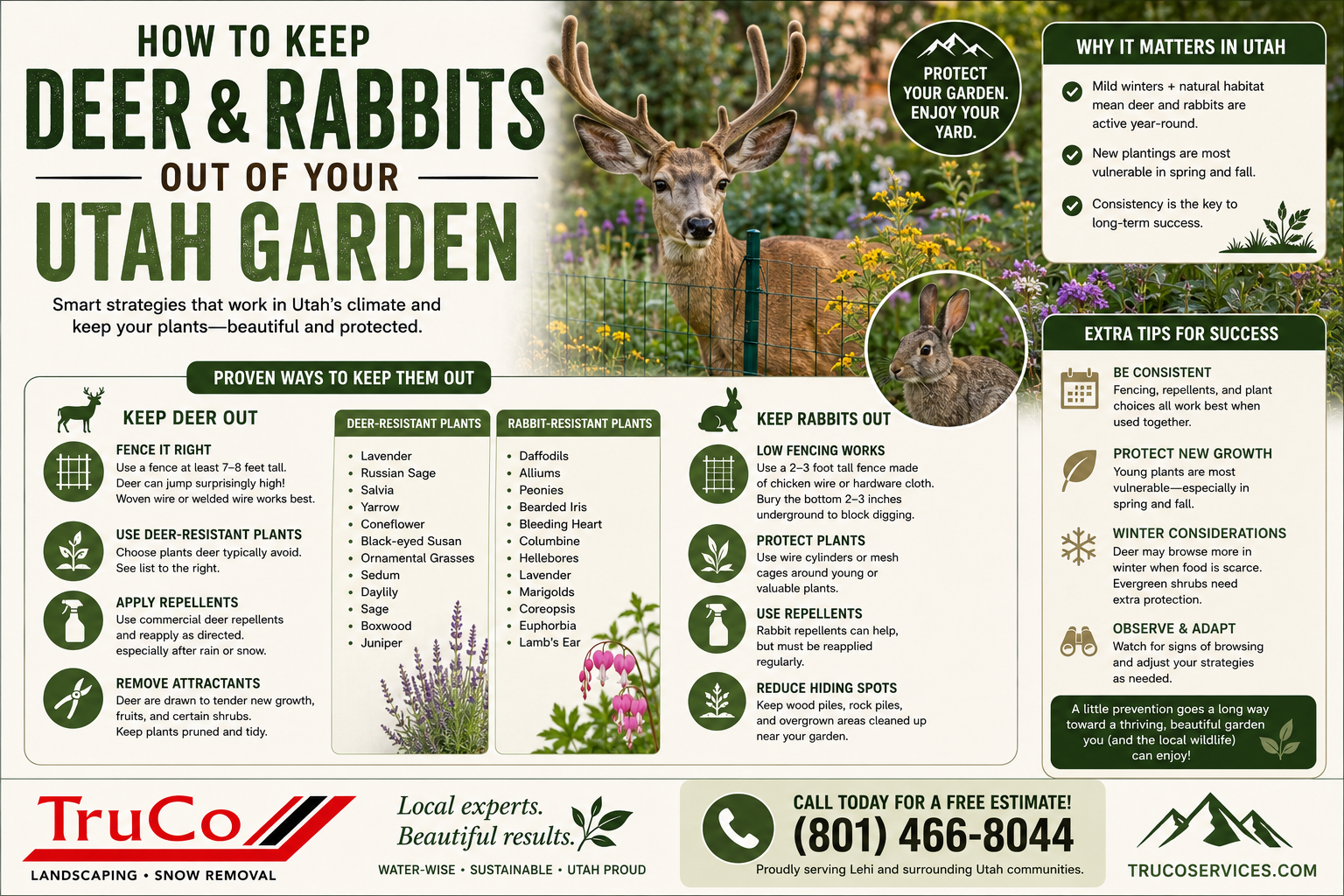
Utah's growing deer population — estimated at over 300,000 statewide — increasingly ventures into suburban and urban areas as development expands into foothill habitats. Mule deer are the primary species causing garden damage along the Wasatch Front, particularly in communities near the foothills like Salt Lake City's east bench, Draper, Sandy, and Park City. Rabbits (cottontail and jackrabbit) are ubiquitous throughout Utah and breed prolifically from February through September. Deer damage is most severe in late winter and early spring when natural food is scarce — they will eat almost any plant, including arborvitae, fruit trees, and rose bushes. Rabbit damage peaks in spring when tender new growth emerges and again in fall when they prepare for winter. Recognizing the damage pattern helps identify the culprit: deer leave ragged, torn branches with no clean cut edge, while rabbits make clean 45-degree cuts on stems up to 24 inches high.
Fencing Solutions for Utah Properties
Fencing is the most effective long-term solution for both deer and rabbits. For deer: install fencing 7-8 feet tall — deer can easily clear 6-foot fences in Utah. Use black polypropylene deer netting (easy to install, nearly invisible), woven wire fence (most durable), or electric fencing (cost-effective for large properties). Deer fences can be angled outward at 45 degrees from 4 feet high to reduce the height needed to 5 feet. For rabbits: use 1-inch or smaller mesh chicken wire or hardware cloth, 24-36 inches tall, buried 6-10 inches below ground. Fold the bottom 6 inches outward at a 90-degree angle below ground to prevent digging. Protect individual trees and shrubs with 4-foot tall wire cages — crucial for Utah's new plantings where deer and rabbit pressure is high. For vegetable gardens, combine a 7-foot deer fence with a 2-foot rabbit fence extension buried at the base. Check fences regularly for gaps after Utah's winter snow load has compressed or damaged sections.
Deer-Resistant and Rabbit-Resistant Plants for Utah
While no plant is completely deer-proof, some Utah-adapted plants are consistently avoided. Deer-resistant perennials: lavender, Russian sage, yarrow, catmint, salvia, penstemon, iris, peony, and daffodils. Deer-resistant shrubs: boxwood, juniper, barberry, potentilla, spirea, and smokebush. Deer-resistant trees: Colorado blue spruce, Austrian pine, honey locust, and bur oak. Plants deer love (avoid in high-pressure areas): tulips, hostas, daylilies, roses, fruit trees, arborvitae, and euonymus. Rabbit-resistant plants: most plants deer avoid are also rabbit-resistant. Rabbits particularly avoid plants with strong scents (lavender, rosemary, sage, thyme), fuzzy or prickly leaves (lamb's ear, barberry), and toxic plants (daffodils, foxglove, poppies). In Utah's foothill communities, create a plant buffer zone of deer-resistant species near the property perimeter, with more desirable plants closer to the house where wildlife is less likely to venture.
Repellents and Deterrents
Repellents provide temporary protection and work best when rotated to prevent habituation. Scent-based repellents: putrescent egg solids (Deer Out, Liquid Fence) create a sulfur odor that deters deer — apply every 30-60 days and after rain. Garlic and hot pepper sprays deter both deer and rabbits. Commercial predator urine (coyote, fox) can deter rabbits but needs frequent reapplication. Taste-based repellents: bitter compounds sprayed on plants make them unpalatable. Apply before deer establish feeding patterns. Motion-activated deterrents: sprinklers (Orbit Yard Enforcer) startle deer and rabbits with water bursts — effective for small yards. Ultrasonic devices have limited effectiveness in University studies. Visual deterrents: reflective tape, pinwheels, and scarecrows work for a few days until wildlife habituates. In Utah, the most effective integrated approach combines perimeter fencing with strategic repellent use during critical periods (spring growth, fall preparation) and planting resistant species in high-pressure zones.
Habitat Modification Strategies
Modify your Utah landscape to make it less attractive to deer and rabbits. Remove brush piles, tall grass, and dense ground cover that provide shelter for rabbits — rabbits prefer habitats with thick vegetation for hiding. Keep lawn mowed short, especially near garden edges. Install gravel borders 2-3 feet wide around garden beds — deer and rabbits prefer not to cross open, exposed areas. Remove fallen fruit from under trees — it attracts deer during late summer and fall. In foothill properties, create a transitional zone between wildland and landscaped areas using deer-resistant plants that serve as a buffer. Eliminate standing water sources that attract wildlife. For daytime deer activity, install motion-activated lights — deer prefer to feed at dawn and dusk. Coordinate with neighbors — deer and rabbit control is most effective when implemented across multiple adjacent properties. In areas with chronic deer pressure (eastern Salt Lake Valley, Park City, Draper), community-wide deer management programs may be more effective than individual property efforts.
Frequently Asked Questions
What is the best deer fence for Utah? An 8-foot tall woven wire fence is most durable. For affordability, 7-foot polypropylene deer netting is nearly invisible and effective for residential properties.
Do motion-activated sprinklers work for deer in Utah? Yes — Orbit Yard Enforcer sprinklers effectively deter deer from small to medium yards. Deer dislike unexpected water bursts. Effectiveness decreases if deer are habituated or food is scarce.
What plants do deer eat in Utah? Deer prefer tulips, hostas, daylilies, roses, arborvitae, fruit trees, euonymus, and pansies. They also browse on newly planted trees and shrubs, especially in late winter when natural food is limited.
How do I protect fruit trees from deer in Utah? Install 4-foot tall wire cages around young trees — deer can strip bark and break branches. Use plastic tree guards for trunk protection. Fence the entire orchard for mature trees.
Will rabbits eat my vegetable garden in Utah? Yes — rabbits eat beans, peas, lettuce, carrots, beets, and most leafy greens. A 2-foot tall chicken wire fence buried 6 inches underground is the most effective protection for vegetable gardens.