
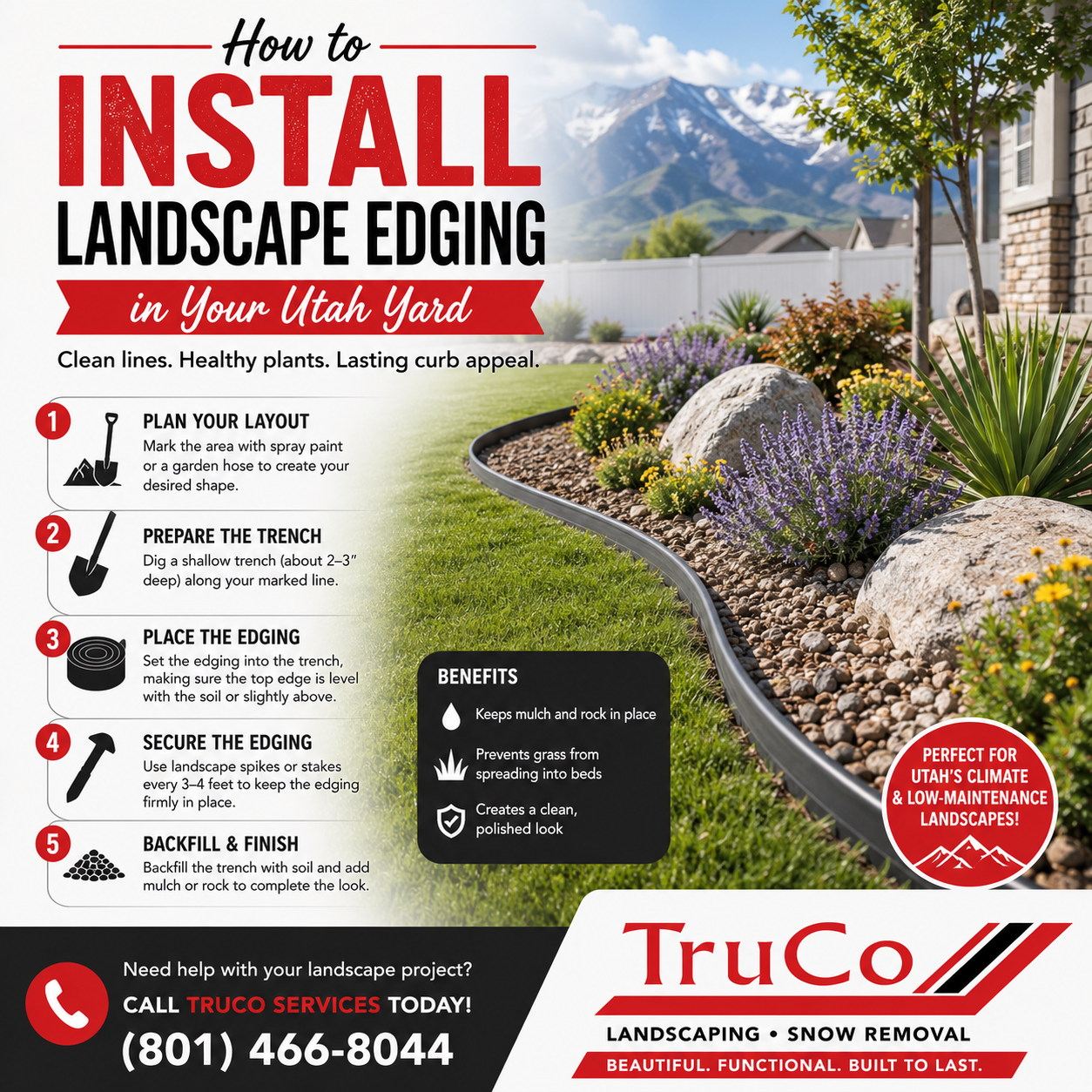
How to Install Landscape Edging in Your Utah Yard

Why Landscape Edging Matters in Utah Yards
Landscape edging creates clean, defined borders between different areas of your yard — separating lawn from garden beds, hardscape from softscape, and pathways from planting areas. In Utah landscapes, edging serves both functional and aesthetic purposes. It prevents grass from creeping into flower beds — a constant battle in Utah's growing season where Kentucky bluegrass rhizomes spread aggressively. Edging keeps mulch and rock in place during Utah's monsoon thunderstorms and spring winds. It creates clean lines for mowing — a defined edge allows you to mow right up to the border without trimming. In Utah, edging also prevents soil erosion on sloped properties and defines drainage channels for stormwater management. A well-edged landscape looks professional and intentional. For Utah homeowners, edging is one of the most cost-effective landscape improvements — it instantly elevates the look of any yard. The cost of landscape edging in Utah ranges from $1-5 per linear ft for DIY materials to $5-20 per linear ft installed by a professional. A typical 150-ft edging project (around a medium front yard) costs $150-750 DIY or $750-3,000 professionally. Edging materials are available at Utah garden centers — Millcreek Gardens, Western Garden Centers, IFA Country Stores, and Home Depot/Lowes all carry edging products, with best selection in spring (March-May).
Types of Landscape Edging for Utah
Choose edging material based on function, style, and Utah's climate conditions. Steel edging — the most durable option for Utah. Powder-coated galvanized steel won't rust and lasts 20+ years. Available in 1/8 inch thick by 4-5 inch tall strips. Ideal for straight lines and gentle curves. Handles freeze-thaw well — steel flexes with ground movement. Professional-grade product used by landscapers. Cost: $3-5 per linear ft for materials. Installation: requires trenching and hammering stakes. Best for separating lawn from beds and defining driveway edges. Aluminum edging — lighter than steel but still durable for Utah. 3/16 inch thick, 4 inch tall, 12-16 ft lengths. Won't rust. Easier to curve than steel. Good for moderate-use areas. Cost: $2-4 per linear ft. Plastic/composite edging — budget-friendly option. Black rigid vinyl or recycled rubber/polymer blends. Available in coil rolls (20-100 ft) or interlocking sections. Plastic edging can become brittle and crack in Utah's freeze-thaw after 3-5 years. Composite edging with UV stabilizers lasts longer (5-10 years). Best for low-traffic garden beds. Cost: $1-3 per linear ft. Concrete edging — permanent, high-end option. Poured concrete with forms creates a custom mowing strip. Can be colored and stamped. Lasts indefinitely but requires professional installation. In Utah, concrete edging needs control joints every 4-6 ft to prevent freeze-thaw cracking. Cost: $8-15 per linear ft installed. Natural stone edging — flagstone, fieldstone, or river rock set as border. Beautiful and permanent. Natural stone blends with Utah landscapes. In freeze-thaw, stone can shift over time — resetting may be needed every 3-5 years. Cost: $5-20 per linear ft depending on stone type. Brick edging — classic, durable. Brick set on edge (soldier course) or flat (runner course). Mortared brick is permanent; dry-set brick shifts with freeze-thaw but is easy to reset. Cost: $3-8 per linear ft for materials, $8-15 installed. Timbers and railroad ties — rustic look for larger properties. Treated 4x4 or 6x6 timbers. In Utah, use pressure-treated lumber rated for ground contact and seal ends to prevent moisture absorption. Timbers last 10-15 years in Utah's dry climate. Cost: $2-5 per linear ft for materials.
How to Install Landscape Edging in Utah
Proper installation determines how long edging lasts in Utah's freeze-thaw climate. For steel and aluminum edging: Mark the edging line with spray paint or a garden hose for curves. Dig a trench along the line — 4-6 inches deep for steel edging (including 1-2 inches for below-grade support), 3-4 inches for aluminum. The trench should be slightly wider than the edging material. Place edging in the trench and adjust to the desired height — edging for lawn areas should be 1-2 inches above ground level with the rest below grade. Drive stakes on the lawn side every 3-4 ft using a hammer or mallet. In Utah's hard clay soil, pre-drill stake holes with a hammer drill if needed. Connect edging sections with manufacturer-supplied connectors. Overlap joints by 2-3 inches and stake on both sides. Backfill the trench with compacted soil. For concrete edging: Excavate trench 6 inches deep, 6-8 inches wide. Add 4 inches of compacted gravel base. Install forms (2x4 lumber or specialized edging forms). Pour 3,000 psi concrete with fiber reinforcement. Finish with steel trowel, add color or stamp if desired. Cut control joints every 4 ft. Cure for 7 days. In Utah, pour concrete edging in spring or fall — avoid summer heat (above 90 degrees) which causes rapid curing and cracking. For stone and brick: Excavate trench 4-6 inches deep. Add 2-3 inches of compacted gravel base. Add 1 inch of sand bed. Set stones or bricks level and at correct height. Tap into place with rubber mallet. Fill gaps with sand or polymeric sand. Sweep dry sand into joints and water to activate (for polymeric). For natural stone, use larger stones at curves and corners. In Utah's clay soil, add a perforated drainage pipe behind deep edging to prevent water pressure that dislodges stones during heavy rain. For plastic and composite: Install stakes at manufacturer-recommended spacing (typically 2-3 ft). Connect sections and secure to stakes. In Utah, use metal stakes instead of plastic stakes — plastic stakes break in hard frozen ground during fall installation. Backfill and compact. For all edging types in Utah, install a 6-mil polyethylene weed barrier strip under the edging to prevent grass and weeds from growing under the border. This is especially important in Utah where aggressive Bermuda grass and bindweed can penetrate under shallow edging.
Landscape Edging for Utah's Specific Needs
Different areas of your Utah landscape need different edging approaches. Lawn-to-bed transitions: steel edging is best for clean separation. The straight, low profile creates a mowing strip that allows the mower wheel to ride along the edge. For curved beds, use flexible steel edging that follows gentle arcs. Utah's Kentucky bluegrass spreads aggressively via rhizomes — steel edging 5-6 inches deep stops rhizome penetration effectively. For deep-rooted Bermuda grass (common in southern Utah), use 6-8 inch deep edging. Mowing strips help — 4-6 inch wide paving strips create a maintenance-free trim area. In Utah, install mowing strips at the same level as the lawn for wheel clearance. Pathway edging: use edging that complements the pathway material. For flagstone paths, use natural stone edging or steel edging painted to match. For concrete paths, cast-in-place concrete edging or brick edging. For gravel paths, use aluminum or steel edging that contains the gravel and prevents it from migrating into beds. In Utah's monsoon season, gravel migration is a real problem — good edging keeps gravel contained. Tree rings: define the area around trees with a 3-6 ft diameter ring. Use flexible steel or composite edging that allows the tree trunk to expand. Avoid rigid edging in a tight circle around the trunk — as the tree grows, it can girdle itself. In Utah, tree rings should be at least 3 ft in diameter for small trees and 5-6 ft for established trees. Fill with 2-3 inches of mulch — never pile mulch against the trunk. Raised beds: use timber, stone, or brick edging to create raised beds. In Utah's clay soil, raised beds improve drainage and extend the growing season. For vegetable gardens, use untreated cedar or redwood — avoid treated lumber for edible gardens. For perennial beds, stone or brick creates permanent, attractive borders. Driveway and walkway edges: use heavy-duty steel or concrete edging along driveways to prevent lawn encroachment and define the edge for snow removal. In Utah, clear driveway edges make snow plowing easier — defined edges reduce the risk of plowing into the lawn.
Maintaining Landscape Edging in Utah
Landscape edging needs seasonal care in Utah's climate. Spring (March-April): inspect edging for frost heave — reset any sections that lifted during winter. In Utah, 30-60 freeze-thaw cycles per winter can shift edging. Check for loose stakes and tighten or replace. Repair any cracks in concrete edging — use concrete patch for small cracks, replace sections for larger damage. Clean stone and brick edging with a pressure washer on low setting. Reapply polymeric sand to brick joints if washed out. Steel and aluminum edging — check for rust (steel only). Touch up powder coating with rust-inhibiting paint. In Utah, road salt used on nearby streets can accelerate corrosion of steel edging — rinse edging in early spring. Plastic or composite edging — replace any cracked or brittle sections. Utah's UV degrades plastic after 3-5 years. Consider upgrading to steel or aluminum for longer life. Fall (October-November): clear leaves and debris from edging lines. In Utah, wet leaves against edging can stain stone and concrete. Inflate or repair raised beds if needed. Drain any irrigation lines near edging before freeze. Add fresh mulch to defined beds to maintain a clean edge through winter. Winter care: avoid using metal snow removal tools near edging — plastic shovels only. Snow plows can damage concrete and stone edging — mark edging with reflective stakes if needed. For all edging types, ensure proper drainage behind the edge — water pooling behind edging during freeze-thaw can heave and shift it. Add drainage gravel behind deep edging if needed. Properly installed and maintained landscape edging in Utah lasts 20+ years for steel and concrete, 10-15 years for stone and brick with periodic resetting, and 3-5 years for basic plastic edging.
Frequently Asked Questions
What is the best landscape edging for Utah? Steel edging is the best overall choice for Utah — it handles freeze-thaw, lasts 20+ years, creates clean lines, and prevents grass invasion. Concrete edging is best for permanent installations. Plastic edging is budget-friendly but shorter-lived in Utah's climate.
How much does landscape edging cost in Utah? DIY: $1-5 per linear ft for materials. Professional installation: $5-20 per linear ft depending on material. A typical home edging project (150-200 linear ft) costs $150-750 DIY or $750-3,000 professionally.
How deep should landscape edging be in Utah? Minimum 4-6 inches below ground for steel edging to prevent grass rhizomes from growing underneath. For areas with aggressive Bermuda grass, 6-8 inches deep. Above ground, 1-2 inches is standard for separating lawn from beds.
Do I need edging around all garden beds in Utah? Yes, especially between lawn and beds. Without edging, Kentucky bluegrass rhizomes invade beds within one growing season. Edging also keeps mulch in place during Utah's monsoon storms and creates a clean mowing line that eliminates hand trimming.
Can I install landscape edging in winter in Utah? It's possible but difficult — frozen ground makes trenching hard. Spring and fall are best for edging installation in Utah. If installing in cold weather, use a pickaxe or power edger to cut through frozen soil, and use metal stakes (plastic stakes break in frozen ground).