
How to Install a Sprinkler System in Utah: Design and Cost Guide

Why Install a Sprinkler System in Utah
A properly designed sprinkler system is the foundation of a healthy Utah lawn. Utah's semi-arid climate averages only 12-20 inches of precipitation per year, while a healthy lawn needs 25-40 inches of water annually. Without irrigation, a Utah lawn simply cannot survive. Sprinkler systems deliver water evenly and automatically, saving time, water, and money compared to manual watering. In Utah, a professionally installed sprinkler system uses 20-40% less water than manual hose watering because it applies water uniformly at optimal times. The upfront cost of a sprinkler system in Utah ranges from $2,500-6,000 for a typical residential lawn (0.25-0.5 acre), with an average cost of $0.50-1.50 per sq ft. Installation is a significant investment, but a well-designed system lasts 20+ years with proper maintenance, pays for itself in water savings within 3-5 years, and increases home value. In Utah, where water conservation is critical and municipalities enforce watering restrictions, an efficient sprinkler system with a smart controller is the most effective way to keep a lawn healthy while complying with local regulations. Sprinkler systems in Utah must be installed according to city codes — most Utah municipalities require permits for irrigation installation, and backflow prevention devices are mandatory to protect the drinking water supply.
Designing a Sprinkler System for Utah Lawns
Proper design is critical for an efficient sprinkler system in Utah. The goal is head-to-head coverage — each sprinkler's spray should reach the adjacent sprinkler so no dry spots exist. Start with a site plan: measure your property and sketch the lawn areas, planting beds, and hardscape. Mark water source locations, existing underground utilities (call 811 Blue Stakes before digging), and sun exposure patterns. Determine water pressure and flow rate: use a pressure gauge on an outside spigot — Utah residential water pressure typically ranges from 40-80 psi. The flow rate (gallons per minute) determines how many sprinkler heads you can run per zone. Measure flow by timing how long it takes to fill a 5-gallon bucket. In Utah, city water pressure varies by municipality — Salt Lake City, Sandy, and West Jordan have different pressure profiles that affect system design. Divide the property into zones: a zone is a group of sprinkler heads on one valve. Zones allow different areas to be watered on different schedules — lawn zones need more water than shrub zones in Utah's climate. A typical Utah residential system has 4-8 zones. Lawn zones should use rotary heads (Rotor) for large areas or spray heads for smaller areas. Shrub and flower bed zones use drip irrigation or low-flow heads. Select the right sprinkler heads for Utah: pop-up spray heads (4-inch pop-up, spray radius 8-15 ft, good for small lawns and beds), rotary heads (gear-driven, radius 15-40 ft, efficient for large lawn areas, use 30-50% less water than sprays), rotary nozzles (multi-stream, radius 15-30 ft, high efficiency for medium lawns), and drip irrigation (for beds — uses 30-50% less water than spray heads). In Utah, consider high-efficiency heads with pressure regulation — they distribute water more evenly, reducing runoff on our clay soils.
Materials and Components for Utah Sprinkler Systems
Quality materials are essential for a sprinkler system that survives Utah's freeze-thaw cycles. Piping: PVC pipe is the standard choice for Utah irrigation systems. Use schedule 40 PVC for main lines (1-1.5 inch) and schedule 40 or class 200 for lateral lines (0.5-1 inch). In Utah, bury pipes below frost depth — 12-18 inches for laterals, 18-24 inches for main lines in northern Utah. Deeper burial protects pipes from freezing and from damage during landscaping. Valves: anti-siphon valves are required in most Utah municipalities — they prevent contaminated irrigation water from backflowing into the drinking water supply. Install valves in accessible valve boxes. In Utah, a master valve is recommended — it shuts off water to the entire system when not in use, preventing leaks and water waste. Sprinkler heads: choose heads rated for Utah's climate — brass or heavy-duty plastic construction, with stainless steel risers for durability. In Utah, heads can be damaged by lawn mowers and snow plows — set heads at proper depth and use mower-friendly designs. Controllers: a smart controller is highly recommended for Utah. Smart controllers use local weather data and soil moisture sensors to adjust watering automatically. In Utah, where watering restrictions change by season and drought level, smart controllers ensure compliance and efficiency. Popular models: Rachio, Rain Bird, Hunter, Orbit. In Utah's water-wise programs, smart controllers qualify for rebates — Salt Lake City and other municipalities offer $75-100 rebates for qualifying smart controllers. Backflow prevention: in Utah, an approved backflow prevention device (PVB — pressure vacuum breaker or RPZ — reduced pressure zone) is mandatory and must be installed at the water source. Installation must meet city code and is typically inspected by the city. The backflow device must be tested annually by a certified tester in most Utah cities.
Installing a Sprinkler System in Utah
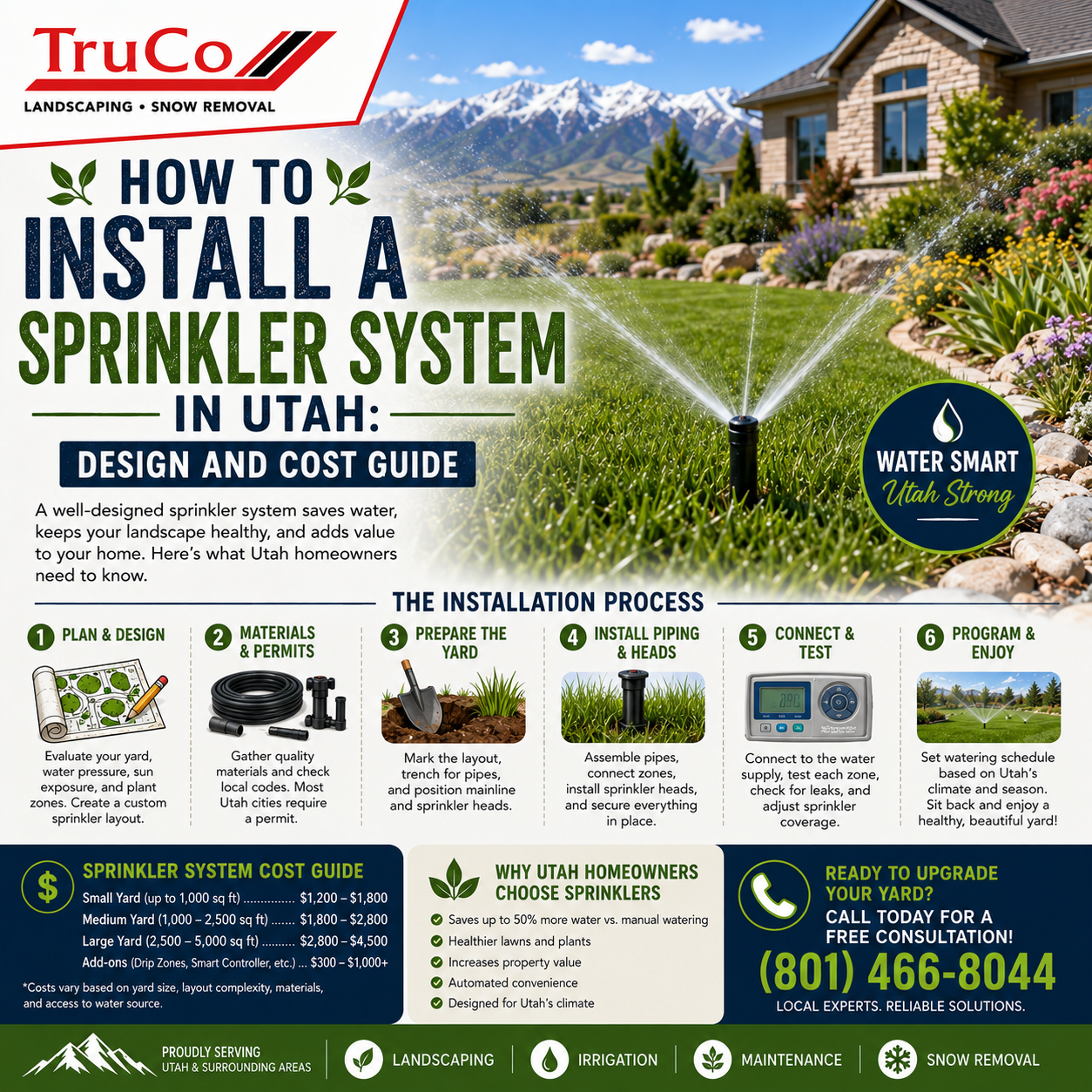
Professional installation is recommended for most Utah homeowners, but understanding the process helps you work with your contractor. Step 1: Permits and planning — pull an irrigation permit from your city (typically $50-150). Call 811 Blue Stakes at least 48 hours before digging to mark underground utilities. Step 2: Trenching — excavate trenches 12-18 inches deep (main lines deeper). In Utah's clay soil, use a trencher machine for efficiency. Trenching a typical residential system takes 4-8 hours. Step 3: Lay main line — install the main line from the water source to the valve manifold. Use PVC with primer and solvent cement on all joints. Step 4: Install valves — place the valve manifold in a valve box near the water source. Wire valves to the controller with 18-gauge multi-conductor wire, color-coded per zone. Step 5: Lay lateral lines — run pipe from valves to each sprinkler head location. Keep pipes at consistent depth. Step 6: Install heads — connect sprinkler heads to risers. Set heads flush with the soil surface — in Utah, heads slightly below grade (1/4 inch) prevent mower damage. Step 7: Flush and test — flush lines to remove debris, then pressurize and test each zone. Adjust spray patterns and radii for head-to-head coverage. Step 8: Controller wiring — mount the controller indoors or in a weatherproof outdoor enclosure. Program zones, run times, and watering days. Step 9: Backfill and restore — fill trenches, compact soil, and replace sod. In Utah, most homeowners hire a licensed irrigation contractor for installation — the cost ranges from $2,500-6,000 for a typical system including labor. DIY installation costs $800-2,000 in materials for the same system, but requires significant skill with PVC plumbing, wiring, and design. In Utah, licensed irrigation contractors (with Utah contractor licenses) guarantee their work and handle permits, inspections, and backflow testing.
Programming and Watering Schedules for Utah
Proper programming is essential for an efficient sprinkler system in Utah. Utah's watering needs change dramatically by season. Spring (April-May): water 1-2 times per week, 15-25 minutes per zone for sprays, 30-45 minutes for rotors. Water deep and infrequently to encourage deep roots. Summer (June-August): water 2-4 times per week in northern Utah, 3-5 times in southern Utah. Spray zones: 15-20 minutes. Rotor zones: 30-45 minutes. In Utah's July heat, lawns need 1.5-2 inches of water per week. Fall (September-October): reduce to 1-2 times per week, then stop when the lawn goes dormant. In Utah, most lawns can be watered once weekly in September and stopped by late October. Watering time: early morning (4-7am) is best in Utah — low evaporation, wind, and disease pressure. Watering at night promotes fungal diseases in Utah's climate. Most Utah municipalities restrict watering to certain days (odd/even addresses) and times (before 10am or after 6pm). Check your city's watering restrictions — Salt Lake City, Sandy, and West Jordan all have specific schedules, and drought restrictions can tighten them. Smart controller programming: set the controller to "smart" mode using local weather data. The controller automatically adjusts watering based on temperature, rainfall, and soil moisture. In Utah, smart controllers typically reduce water use by 20-30% compared to manual scheduling. Seasonal adjustment: most controllers have a seasonal adjust setting — reduce watering by 30-50% in spring and fall, and adjust for Utah's monsoon storms (July-September) which provide natural irrigation. Always skip watering when rain is expected — the smart controller does this automatically. Watering during Utah's annual watering restrictions: when municipalities declare watering bans (typically 2 days per week), the smart controller can be programmed to comply automatically.
Frequently Asked Questions
How much does a sprinkler system cost in Utah? A typical residential system costs $2,500-6,000 installed ($0.50-1.50 per sq ft). DIY materials cost $800-2,000. Costs vary by lot size, number of zones, and system complexity. Smart controllers and drip zones add cost but save water long-term.
Do I need a permit for a sprinkler system in Utah? Yes. Most Utah cities require an irrigation permit ($50-150). Backflow prevention devices must be installed per code and are typically inspected. In Utah, unpermitted irrigation work can create insurance and liability issues.
What type of sprinkler heads are best for Utah lawns? Rotary heads for large lawn areas — they use 30-50% less water than spray heads. High-efficiency rotary nozzles are excellent for medium lawns. Pop-up spray heads for small areas and beds. Drip irrigation for planting beds uses the least water.
How often should I water my lawn in Utah? 2-4 times per week in summer (northern Utah), 3-5 times (southern Utah). Water deep and infrequently: 15-25 minutes for sprays, 30-45 minutes for rotors. In spring and fall, reduce to 1-2 times per week. Follow your city's watering restrictions.
Do smart controllers really save water in Utah? Yes. Smart controllers adjust watering based on weather and soil moisture, reducing water use by 20-30% in Utah's climate. They also ensure compliance with watering restrictions. Many Utah cities offer $75-100 rebates for smart controllers.