
How to Install a Greenhouse or Cold Frame in Utah

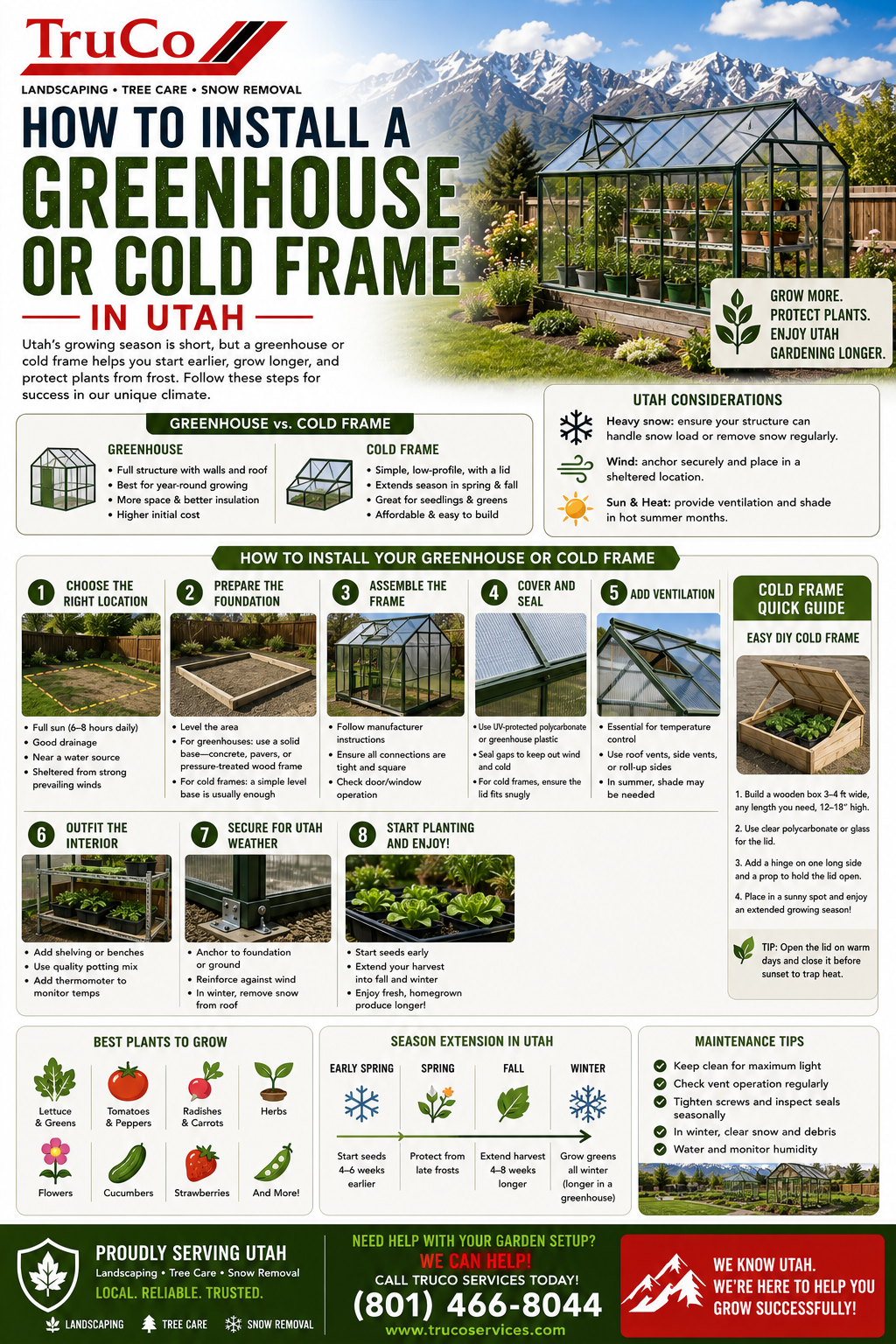
Greenhouse vs Cold Frame: Which Is Right for Utah?
Greenhouses and cold frames both extend Utah's growing season but serve different purposes. Greenhouses are full-sized structures (typically 6x8 to 12x20 feet) with heating, ventilation, and irrigation systems — they allow year-round growing in Utah's climate. Cold frames are small, unheated structures with transparent covers that protect plants from frost and cold winds — they extend the season by 4-8 weeks in spring and fall. A cold frame is essentially a mini-greenhouse that relies on passive solar heating. For Utah gardeners, cold frames are ideal for starting seedlings in March and growing cold-hardy greens into November. Greenhouses allow year-round production of warm-season crops. Greenhouse costs range from $3,000-15,000 installed while cold frames cost $100-500 for DIY or $500-2,000 for pre-built models.
Greenhouse Styles and Materials for Utah Snow Loads
Utah's heavy winter snow loads require greenhouse designs that shed snow effectively. Gothic arch greenhouses with peaked roofs are ideal for Utah — the steep angle prevents snow accumulation. A-frame designs also shed snow well but have less usable growing space. Quonset (hoop) greenhouses are affordable but may collapse under Utah's heavy wet snow — use heavy-gauge 1.9-inch or larger hoop frames with 4-foot spacing. Glass greenhouses provide the best light transmission but break easily under hail — use tempered or polycarbonate glazing instead. Twin-wall polycarbonate panels (6-10mm) are the best choice for Utah — they provide excellent insulation, diffuse light, and withstand hail up to 1 inch. Avoid single-layer polyethylene film for year-round greenhouses in Utah — it tears easily and provides minimal insulation. Position the greenhouse with the long side facing south for maximum winter light exposure.
Site Preparation and Foundation
Choose a level site with full sun exposure — minimum 6 hours of direct sunlight daily, with southern exposure preferred. In Utah, avoid low spots where cold air settles — frost pockets can drop 5-10 degrees colder than surrounding areas. Grade the site for drainage away from the greenhouse. Foundations for Utah greenhouses include pressure-treated lumber skids (easiest for movable greenhouses), concrete slab (best for permanent glass structures with heating), and gravel base with landscape timbers (good balance of drainage and stability). For heated greenhouses, insulate the foundation perimeter with 2-inch rigid foam board extending 24 inches below grade to reduce heat loss in winter. Install water and electrical lines during site preparation — trench below frost line (30-36 inches in northern Utah) to prevent pipe freezing. Consider a rainwater collection system from the greenhouse roof for irrigation.
Heating and Ventilation for Utah Winters and Summers
Greenhouses in Utah require both heating (winter) and ventilation (summer) systems. For winter heating, options include electric heaters (most efficient for small greenhouses under 200 sq ft), propane or natural gas heaters (best for large greenhouses with thermostat control), and passive solar storage using 55-gallon water barrels painted black. Each barrel stores enough heat to protect 20-100 square feet from frost. Maintain minimum temperatures of 45-50 degrees for frost protection, 60-65 degrees for warm-season crops. For summer ventilation, install roof vents on both sides — hot air rises and escapes through ridge vents. Automatic vent openers (wax cylinder type) open vents at 70-75 degrees without electricity. Exhaust fans with intake shutters provide active ventilation for larger greenhouses — fan capacity should exchange greenhouse air volume every 1-2 minutes. In Utah's high-elevation sun, shade cloth (30-50%) is essential from June through August to prevent heat stress on plants.
Building a Cold Frame for Utah Gardens
Cold frames are simple, affordable structures that dramatically extend Utah's growing season. Build the frame from rot-resistant cedar or pressure-treated lumber — standard dimensions are 3x6 feet with the back wall 18 inches high and front wall 12 inches high for a sloped top that captures sunlight. Use twin-wall polycarbonate or old storm windows for the transparent top. Position the cold frame facing south with northern exposure protection from a wall or fence. Bury the cold frame partially in the ground (6-12 inches deep) for natural insulation — geothermal heat keeps the interior warmer. In Utah, cold frames can be used from March through November. On sunny March days, interior temperatures can reach 80-90 degrees even when outside is 40 degrees — prop the lid open to prevent overheating. At night, close the lid and cover with an old blanket or frost blanket when temperatures drop below 25 degrees.
Season Extension Calendar for Utah
Plan your greenhouse and cold frame use around Utah's growing seasons. Late January-February: start warm-season seedlings (tomatoes, peppers, eggplant) in heated greenhouse. March-April: cold frame for hardening off seedlings; direct-sow cold-hardy crops (lettuce, spinach, peas, carrots) in cold frame. May: transplant warm-season crops into garden; move seedlings from greenhouse. June-August: greenhouse shade cloth; grow heat-loving crops (basil, okra, melons) in greenhouse. September-October: cold frame for fall crops (kale, broccoli, Brussels sprouts); extend tomato harvest in greenhouse. November-December: heated greenhouse for winter greens (mache, claytonia, winter lettuce); cold frame for overwintering hardy herbs. January: minimal activity — use greenhouse for seed starting for the coming season. In Utah's lower elevations (St. George, Zion area), the season extends 4-6 weeks earlier and later than the Wasatch Front.
Frequently Asked Questions
Do I need a permit for a greenhouse in Utah? Greenhouses over 200 square feet or attached to a house typically require building permits. Cold frames under 50 square feet generally do not require permits.
How warm does a cold frame stay in Utah winter? On sunny winter days, a cold frame can reach 60-80 degrees inside when outside is 30-40 degrees. At night, it typically stays 5-10 degrees warmer than outside air temperature.
Can I grow vegetables year-round in a Utah greenhouse? Yes, with supplemental heating and lighting, you can grow cold-hardy greens, herbs, and root vegetables through Utah winter. Warm-season crops require heat and supplemental light from November through February.
How do I ventilate a cold frame? Prop the lid open with a stick or use automatic vent arms that open at set temperatures. On warm days, open the lid 6-12 inches. Close it before temperatures drop in late afternoon.
Should I insulate my greenhouse for Utah winter? Yes — use bubble wrap insulation on interior walls, insulate the north wall, seal gaps, and use thermal mass (water barrels) for passive heat storage. These measures reduce heating costs by 30-50%.