
How to Identify and Control Common Lawn Weeds in Utah

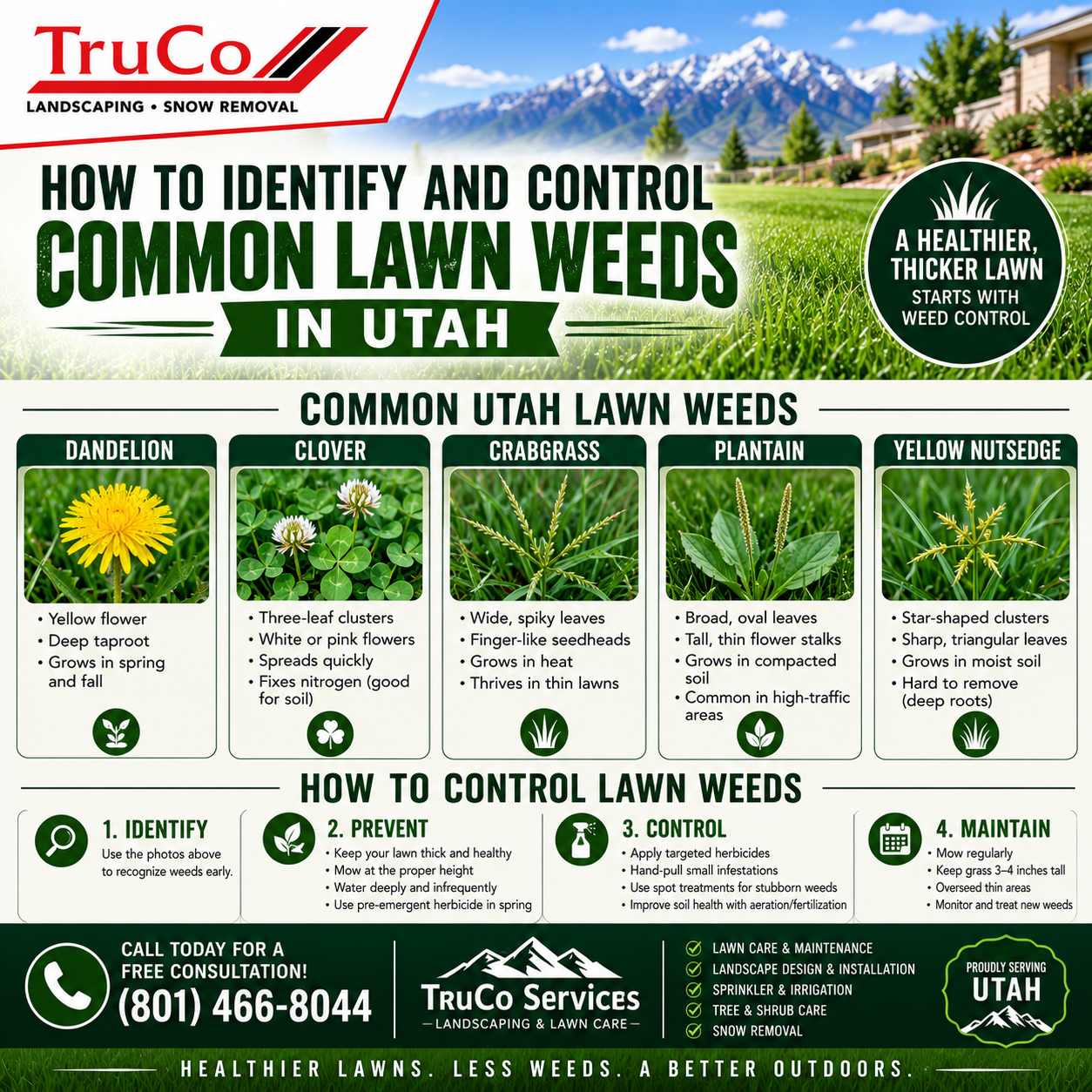
Common Lawn Weeds in Utah
Utah lawns face a distinctive set of weeds adapted to our climate — intense sun, alkaline clay soil, low humidity, and cold winters. Knowing what weed you're dealing with is the first step to controlling it effectively. The most common lawn weeds in Utah fall into three categories: broadleaf weeds (dandelion, clover, bindweed, plantain), grassy weeds (crabgrass, quackgrass, foxtail), and sedges (yellow nutsedge). Each requires a different control strategy. Dandelion (Taraxacum officinale) — the most recognizable Utah lawn weed. Yellow flowers in spring (April-June) and fall. Deep taproot (6-12 inches). Thrives in compacted, thin lawns. Each plant produces up to 15,000 wind-dispersed seeds. Clover (Trifolium repens) — white clover is common in Utah lawns, often indicating low nitrogen in the soil. Spreads by creeping stems and seeds. Bees love it, which can be a concern for families with pets or barefoot children. Bindweed (Convolvulus arvensis) — field bindweed is the most difficult weed in Utah. White-pink morning-glory flowers, vine-like growth, and an extensive root system reaching 10+ ft deep. Extremely persistent. Quackgrass — a coarse perennial grass that spreads aggressively by underground rhizomes. Distinctive clasping auricles at the base of the leaf blade. Crabgrass — an annual grassy weed that germinates in late spring (May-June in Utah) and thrives in thin, sun-baked lawns. Yellow nutsedge (Cyperus esculentus) — grass-like weed with triangular stems, produces underground tubers (nutlets) that make it very hard to control. Plantain (broadleaf and narrowleaf) — rosette-forming broadleaf weeds with distinctive ribbed leaves. Common in compacted, wet, or mowed-too-short lawns. Foxtail — an annual grass with bristly seed heads that can harm pets. Common along Utah roadsides and unmowed areas.
Identifying Lawn Weeds in Utah
Accurate identification determines your control strategy. Broadleaf weeds have wide, netted-veined leaves and grow from a central point. Examples: dandelion, clover, bindweed, plantain, thistle, spurge, knotweed. Broadleaf weeds are the easiest to control with selective herbicides because they have a different structure than grass. Grassy weeds look like grass and blend into the lawn. They have narrow leaves with parallel veins and hollow, jointed stems. Examples: crabgrass, quagrass, foxtail, annual bluegrass. Grassy weeds are harder to control — selective herbicides for grassy weeds are more limited. Sedges look like grass but have solid, triangular stems (feel for the triangle) and grow in wet areas. Example: yellow nutsedge. Sedges require specialized herbicides — standard weed killers don't work on them. To identify a weed in your Utah lawn: examine the leaf shape (broad or narrow), check the stem (round, hollow, or triangular), look at the growth habit (rosette, vine, clump, spreading), examine the flower or seed head, note where it grows (sun, shade, wet, dry, compacted areas). In Utah, key weeds by season: early spring (March-April) — dandelions, annual bluegrass. Late spring (May-June) — crabgrass germination, bindweed emerges. Summer (July-August) — spurge, knotweed, foxtail thrive in heat. Fall (September-October) — dandelions return, winter annuals germinate. Take photos of weeds you can't identify and compare to online resources, or bring a sample to a Utah garden center or your county extension office. The Utah State University Extension Service offers free weed identification services for Utah homeowners.
Preventing Lawn Weeds in Utah
Prevention is the most effective and economical weed control strategy in Utah. The best weed prevention is a healthy, dense lawn. Weeds are opportunistic — they invade thin, stressed lawns. Cultural practices that prevent weeds: mow at the correct height (2.5-3.5 inches in Utah) — taller grass shades the soil, preventing weed seed germination. Mowing too short invites weeds. Water deeply and infrequently (1-1.5 inches per week in summer) — frequent shallow watering encourages weed seeds at the surface and weakens grass roots. Fertilize appropriately — in Utah, fertilize 3-4 times per year (spring, early summer, fall, late fall). Healthy grass outcompetes weeds. Aerate annually — core aeration (September in Utah) relieves compaction, allowing grass roots to grow deeper and crowd out weeds. Overseed thin areas — overseed in September with quality Utah-adapted grass seed to fill gaps where weeds grow. Pre-emergent herbicides stop weed seeds from germinating. In Utah, apply pre-emergent in early spring (March-April) for summer annuals (crabgrass, foxtail) and early fall (August-September) for winter annuals. Corn gluten meal is an organic pre-emergent that prevents seed germination and provides 10% nitrogen. Apply in March-April and again in August-September in Utah. Avoid overwatering — Utah's clay soil stays wet at the surface, encouraging shallow-rooted weeds. Deep, infrequent watering discourages weeds while promoting deep grass roots. Avoid scalping and bare spots — repair bare areas immediately with seed and compost. In Utah, bare patches in July-August are prime crabgrass territory. Maintain proper soil pH — Utah's alkaline soil (pH 7.5-8.0) favors some weeds. Sulfur applications can help, but most Utah weeds tolerate alkaline soil, so focus on grass health instead.
Controlling Broadleaf Weeds in Utah Lawns
Broadleaf weeds are the most common and easiest to control in Utah lawns. Selective broadleaf herbicides kill broadleaf weeds without harming grass. Products containing 2,4-D, MCPP, dicamba, or triclopyr (Weed-B-Gone, WeedStop, Trimec) are effective. In Utah, apply broadleaf herbicide in early spring (April) or fall (September-October) when weeds are actively growing. Fall is the best time in Utah — weeds are transporting nutrients to their roots, so herbicide moves down to kill the taproot. Temperature matters: apply when temperatures are 50-85 degrees. In Utah, avoid applying during June-August heat — herbicide can damage grass and volatilize. Spray on a calm day — Utah's afternoon wind can carry herbicide onto garden plants. Water the lawn 24-48 hours after application to move herbicide into the root zone. Spot-treat individual weeds with a sprayer or use a hose-end applicator for whole-lawn treatment. For dandelions specifically: use a dandelion weeder tool (dig out the entire taproot — any root left regrows) for small infestations, or apply selective herbicide for large infestations. Dig dandelions in spring before flowering for best results. For clover: clover indicates low nitrogen — fertilize the lawn to encourage grass, which crowds out clover. Apply selective herbicide in fall. For bindweed (the toughest Utah weed): systemic herbicides (containing 2,4-D + dicamba, or glyphosate spot-treatment) applied repeatedly. Bindweed requires multiple applications — one treatment kills the top growth but the deep root system regrows. In Utah, treat bindweed in spring when it starts flowering and again in fall. Pulling bindweed is counterproductive — it breaks the root and stimulates more shoots. For plantain: dig out or apply selective herbicide. Plantain responds well to fall treatment. Organic control options for broadleaf weeds in Utah: hand-pulling (works for small lawns — use a weeder tool), boiling water (spot treatment for cracks and walkways — pour carefully), vinegar-based herbicides (acetic acid kills top growth but not roots — repeat applications needed; use 20% horticultural vinegar, not household 5%), and corn gluten meal (preventive). For organic control, expect multiple applications over 2-3 seasons — organic options are less aggressive than synthetic herbicides.
Controlling Grassy Weeds and Sedges in Utah
Grassy weeds and sedges require different strategies than broadleaf weeds in Utah. Crabgrass: prevention is key — apply pre-emergent herbicide in early spring (March-April in Utah) before soil temperatures reach 55 degrees. Crabgrass germinates when soil warms to 55-60 degrees — typically late April to mid-May in northern Utah. If crabgrass appears, hand-pull before it sets seed. Post-emergent crabgrass herbicides (quinclorac, dithiopyr) work on young plants. In Utah, apply in May-June when crabgrass is small. Quackgrass: the most difficult grassy weed in Utah lawns. Quackgrass has underground rhizomes that spread aggressively. No selective herbicide kills quackgrass without harming lawn grass. Control options: spot-treat with glyphosate (Roundup) — kills both quackgrass and the surrounding grass, requiring reseeding, or hand-dig the entire clump including rhizomes — remove 6 inches of soil around the plant. In Utah, quackgrass is most common in new lawns (contaminated seed or sod) and along property edges. Foxtail: mow before seed heads form — in Utah, foxtail sets seed by June. Use pre-emergent in spring. Hand-pull plants before flowering. Yellow nutsedge: grows in wet, poorly drained areas — common in Utah lawns with overwatering or clay soil compaction. Control: reduce watering frequency (nutsedge thrives in consistently moist soil), apply a sedge-specific herbicide (halosulfuron, sulfentrazone — SedgeHammer, Dismiss) in late spring when nutsedge is actively growing, and repeat applications as new shoots emerge. In Utah, treat nutsedge in May-June and again in August. Fix drainage issues to prevent recurrence. Annual bluegrass (Poa annua): a light-green, clumping annual grass that appears in spring and dies in summer heat. Control: pre-emergent in fall (September) for winter germination, reduce watering, and overseed with desirable grass. In Utah, annual bluegrass is most common in wet, shaded areas. For any grassy weed, maintaining a dense, healthy lawn is the best prevention — thick grass crowds out grassy weeds.
Frequently Asked Questions
What is the most common weed in Utah lawns? Dandelions are the most common broadleaf weed, followed by clover and bindweed. Crabgrass is the most common grassy weed. Bindweed is the most difficult weed to control in Utah due to its deep root system.
When should I apply weed killer in Utah? For pre-emergents: early spring (March-April) and early fall (August-September). For post-emergent broadleaf herbicides: spring (April) and fall (September-October) — fall is most effective. Avoid applying in summer heat above 85 degrees.
How do I get rid of bindweed in my Utah lawn? Bindweed requires persistence: apply systemic herbicide (2,4-D + dicamba or spot glyphosate) in spring when flowering and again in fall. Expect multiple seasons of treatment. Do NOT pull bindweed — broken roots regrow vigorously. Improve lawn density to crowd it out.
Is corn gluten meal effective for weeds in Utah? Yes, as a preventive. Corn gluten meal prevents weed seed germination when applied in March-April and August-September. It provides 10% nitrogen. It does not kill existing weeds — use it as part of a complete program.
Why does my Utah lawn have so many weeds? Weeds are symptoms of lawn stress. Common causes: mowing too short (below 2.5 inches), overwatering (shallow watering), under-fertilizing, compacted soil, and bare patches. Fix the underlying lawn health issues and weed pressure drops significantly.