
How to Get Rid of Clover in Your Utah Lawn Naturally

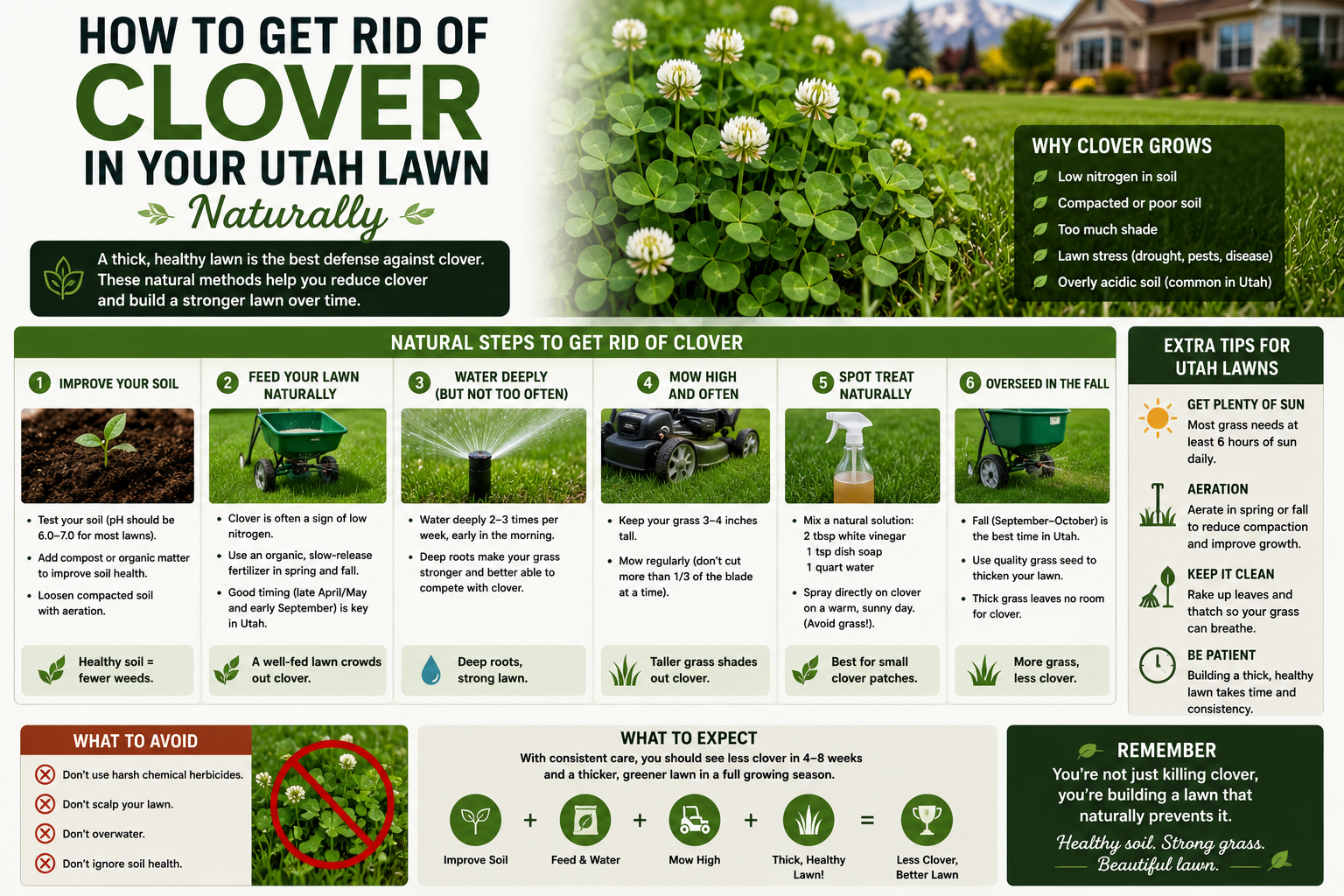
Why Clover Invades Utah Lawns
White clover (Trifolium repens) thrives in Utah lawns because our soil conditions and lawn care practices create the perfect environment for it. Clover is a legume that fixes its own nitrogen from the atmosphere, which means it actually thrives in low-nitrogen soils where grass struggles. If your Utah lawn has clover, it's not random bad luck — it's a signal that your lawn needs specific care adjustments.
Clover spreads through seeds and creeping stolons (horizontal stems that root at nodes). A single clover plant can produce 150-200 seeds that remain viable in soil for 3-5 years. That's why hand-pulling rarely solves the problem long-term — the soil seed bank keeps producing new plants.
Utah's alkaline soil (pH 7.5-8.5 across the Wasatch Front) favors clover over turfgrass. Cool-season grasses like Kentucky bluegrass and fescue prefer slightly acidic soil (pH 6.0-7.0). When soil pH swings alkaline, grass growth slows and clover moves in to fill the gaps.
Under-fertilized lawns are clover magnets. Most Utah homeowners under-fertilize their cool-season lawns, applying only 1-2 pounds of nitrogen per 1,000 square feet per year. Cool-season grasses need 3-5 pounds. The nitrogen deficit creates open soil that clover colonizes. Over-watered, compacted soil with poor drainage creates anaerobic conditions that roots hate, but shallow-rooted clover tolerates easily.
Natural Clover Control Methods
The most effective natural approach combines cultural practices that make conditions unfavorable for clover while strengthening your grass. Here's a comprehensive strategy organized by season.
Spring (March-April): Test your soil pH. Utah State University Extension offers soil testing for $10-20. Apply elemental sulfur at 5-10 pounds per 1,000 square feet to lower pH if needed. Core aerate to relieve compaction — rent an aerator from Sunpro or Home Depot for $60-80/day. Apply a slow-release organic fertilizer like Milorganite or Jonathan Green at 1 pound of nitrogen per 1,000 square feet.
Late Spring (May-June): Hand-pull visible clover patches before they flower and seed. The key is pulling the entire taproot — use a dandelion digger or fishtail weeder. Spot-treat stubborn patches with an organic herbicide containing iron-based active ingredients like iron HEDTA (brand names: Fiesta, IronX). These kill clover by disrupting photosynthesis without harming grass.
Summer (July-August): Mow at 3.5-4 inches — taller grass shades the soil surface, reducing clover seed germination. Water deeply and infrequently (1-1.5 inches per week) to encourage deep grass roots. Shallow, frequent watering favors clover's shallow root system. Use a rain gauge or tuna can to measure irrigation output.
Fall (September-October): This is the most important season for clover control. Core aerate again, then overseed with a dense, aggressive turf-type tall fescue or Kentucky bluegrass blend. Thick grass is the best natural weed preventer. Apply a final organic fertilizer application with higher potassium (K) to improve winter hardiness and root density. Fall fertilization should deliver 1.5-2 pounds of nitrogen per 1,000 square feet.
Winter (November-February): While clover goes dormant, plan your spring strategy. Test soil pH now if you haven't. Apply lime only if your soil pH is below 6.0 (unlikely in Utah). Consider applying a thin layer of compost (1/4 inch) after the last mow to build soil organic matter.
Organic Herbicides vs Homemade Remedies
Iron HEDTA-based herbicides kill clover within 24-48 hours and are safe for children and pets once dry. Corn gluten meal prevents clover seed germination but won't kill established plants. Vinegar-based herbicides (acetic acid) kill foliage but don't affect roots — clover regrows within 2-3 weeks. Soap-based herbicides work on young clover seedlings but are ineffective on established patches.
Homemade remedies rarely work on clover. Dish soap and vinegar mixtures may burn foliage but don't affect the root system. Boiling water kills anything it touches and leaves bare soil for more weeds. Baking soda raises pH, making soil even more alkaline and favoring clover. Salt kills all vegetation and contaminates soil for months.
Preventing Clover Long-Term
Maintain proper soil fertility — get a soil test every 2-3 years through USU Extension and follow their recommendations. Mow at the right height — 3.5-4 inches for cool-season grasses in Utah. Water correctly — deep, infrequent irrigation (1-1.5 inches per week). Overseed annually in the fall to maintain turf density. Core aerate at least once per year. Manage thatch — if thatch exceeds 1/2 inch, remove it with power raking or core aeration. Avoid over-watering — Utah's clay soils hold moisture longer than sandy soils, so adjust irrigation run times accordingly.
When to Call a Professional
If natural methods haven't reduced clover coverage after 2 full growing seasons, it may be time for professional help. A lawn care professional can provide comprehensive soil testing with detailed amendment recommendations, professional core aeration and overseeding with commercial-grade equipment, liquid iron HEDTA applications for full-lawn coverage, and a customized fertility program based on your specific grass type, soil conditions, and microclimate.
Frequently Asked Questions
Does clover mean my soil is poor quality? Not necessarily, but it does indicate conditions that favor clover over grass — typically low nitrogen, compacted soil, and/or alkaline pH. Address these issues and the clover will naturally diminish.
Will clover eventually take over my entire lawn? Without intervention, clover can spread to cover 50-80% of a lawn over 3-5 years. But it rarely eliminates grass entirely — it fills gaps where grass is weak.
Is clover bad for my lawn? Clover itself is not harmful — it adds nitrogen to the soil and stays green with minimal water. Many homeowners actively plant micro-clover lawns. The issue is aesthetic inconsistency — clover has a different texture, color, and growth habit than turfgrass.
Can I just overseed and ignore the clover? Overseeding alone won't eliminate established clover. You need to address the underlying conditions (low nitrogen, alkaline pH, compaction) while overseeding. Clover fills gaps — eliminate the gaps and overseed fills them with grass instead.
How long does it take to get rid of clover naturally? With consistent cultural practices (proper fertilization, mowing height, irrigation, aeration, overseeding), expect 1-2 growing seasons to see significant reduction. Natural control is slower than chemical herbicides but creates a healthier lawn overall.
Does clover fix nitrogen in my lawn? Yes, clover hosts Rhizobium bacteria that convert atmospheric nitrogen into plant-available form. A clover patch can fix 50-100 pounds of nitrogen per acre per year — enough to fertilize surrounding grass. This is why clover was historically included in lawn seed mixes before broadleaf herbicides made it "undesirable."
What's the best organic clover killer? Iron HEDTA (Fiesta or IronX) is the most effective organic option. It kills clover in 1-2 days without harming grass. Apply when temperatures are 60-85°F and clover is actively growing.
Can I overseed directly into clover patches? Yes, but first pull or kill the clover, then rake the area to expose soil, seed at the recommended rate (3-5 pounds per 1,000 square feet for tall fescue), keep the area consistently moist for 14-21 days until new grass establishes, and apply a starter fertilizer (10-20-10) at seeding time.