
How to Get Rid of Ant Hills in Your Utah Lawn

Identifying Ant Types
Pavement ants build small mounds (2-4 inches) near paved surfaces. Field ants build mounds 6-10 inches in open lawn. Thatching ants build very large mounds up to 12-18 inches and are the most destructive in Utah lawns.
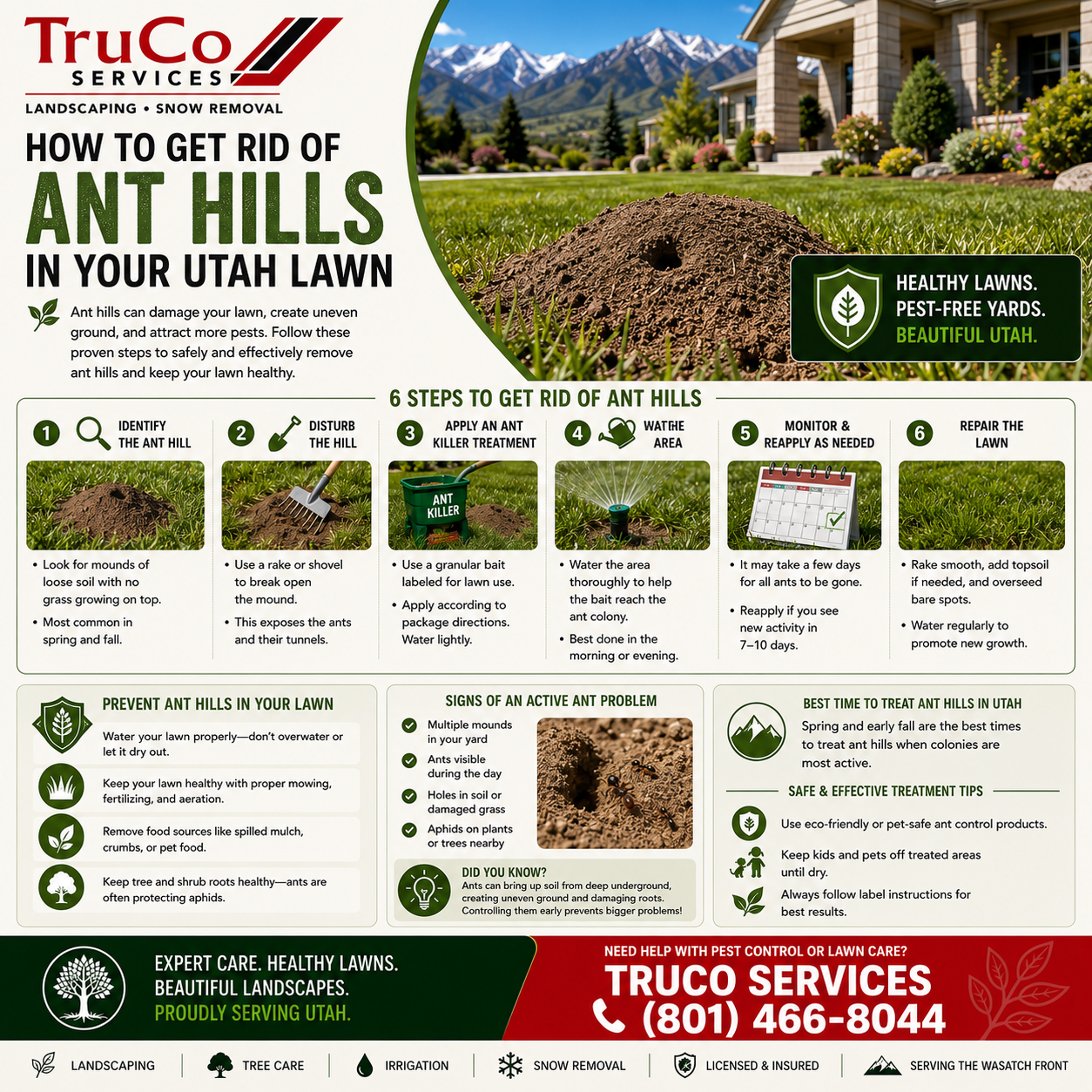
Baiting for Colony Control
Ant baits are most effective because ants carry poison back to the colony. Place bait near mounds in the evening. Use protein bait in spring, sugar bait in summer. Do not disturb mounds after baiting. Baiting takes 1-3 weeks.
Direct Mound Treatment
Use contact insecticide with bifenthrin as a mound drench. Treat in early morning or evening. Follow up with baiting for complete control.
Natural Control
Diatomaceous earth sprinkled on mounds dehydrates ants. Boiling water (2-3 quarts per mound) kills ants on contact. Beneficial nematodes control soil-dwelling ants.
Frequently Asked Questions
Why do I have ant hills? Ants build mounds for ventilation in healthy, moist soil.
Will ant hills kill grass? Yes, large mounds smother grass and tunneling dries soil.
Best time for ant control? Early spring (April-May) and late summer (August-September).
Natural Ant Control Methods
For Utah homeowners who prefer non-chemical approaches, several natural methods effectively control ants. Diatomaceous earth — food-grade powder — dehydrates ants on contact. Sprinkle around ant hills and along foundation edges. Reapply after rain or irrigation. Boiling water poured directly into ant hills kills the colony instantly but may also damage surrounding grass — use on bare soil areas. Cornmeal or grits expand in ants' digestive systems, though this method takes 1-2 weeks to show results. Citrus oil sprays (orange or lemon oil mixed with water) disrupt ant trails and deter colonies.
Baiting Strategies for Long-Term Control
Ant baits are the most effective long-term solution. Worker ants carry poison back to the colony, eliminating the queen and entire colony. Use gel baits, granular baits, or bait stations. Place baits near ant trails and hills — not directly on hills. For Utah's most common lawn ants (pavement ants, thatch ants, and field ants), choose protein-based baits in spring and sugar-based baits in summer when ant dietary preferences shift. Important: do not spray insecticides near baits — this deters ants from feeding.
Preventing Future Ant Hills in Utah Lawns
A healthy, thick lawn naturally resists ant infestation. Core aerate compacted soil annually — ants prefer loose soil for tunneling. Maintain proper watering: ants thrive in dry soil conditions. Remove thatch buildup (over 1/2 inch) through dethatching. Seal cracks in foundation and driveway edges where ant colonies establish. Trim vegetation away from the house perimeter. Apply pre-emergent insect barrier treatments around foundation in early spring.
Frequently Asked Questions
Are ants in lawn harmful? Most lawn ants are beneficial — they aerate soil and eat other pests. Only control them when hills become unsightly or ant activity moves indoors.
Do ant hills kill grass? Ant hills can smother grass underneath them. Grass typically recovers once the hill is removed and the colony is gone.
How fast do ant colonies grow? A single colony can produce 3,000-5,000 workers in one season. Multiple queens can establish satellite colonies rapidly.
Best time to treat ant hills? Early morning or evening when ants are most active. Avoid treating during rain or before irrigation.