
How to Fertilize Trees in Utah

Why Utah Trees Need Special Fertilization
Utah's soil presents unique challenges for tree nutrition. The alkaline soil along the Wasatch Front typically has a pH of 7.5 to 8.5, which locks up essential nutrients like iron, manganese, and zinc, making them unavailable to tree roots. Utah's native soil is also low in organic matter — typically 1 to 2 percent — which means fewer natural nutrients are available. Combined with the state's semi-arid climate (12-15 inches of annual precipitation) and a short growing season, trees in Utah need targeted fertilization to thrive.
Signs Your Tree Needs Fertilizer
Look for these signs that indicate a Utah tree needs fertilization:
Pale or yellow-green leaves — indicates nitrogen deficiency or iron chlorosis
Small leaf size — leaves are smaller than normal for the species
Thin canopy — you can see more sky than leaves through the crown
Slow growth — less than half the expected annual growth for the species
Early fall color — leaves change color earlier than neighboring trees
Dead branches in the upper crown — dieback from the top indicates long-term stress
Leaf scorch — brown edges on leaves, often combined with nutrient deficiency
Not all yellow leaves mean the tree needs fertilizer. A soil test through USU Extension for $20-40 provides definitive answers.
Best Fertilizer Types for Utah's Alkaline Soil
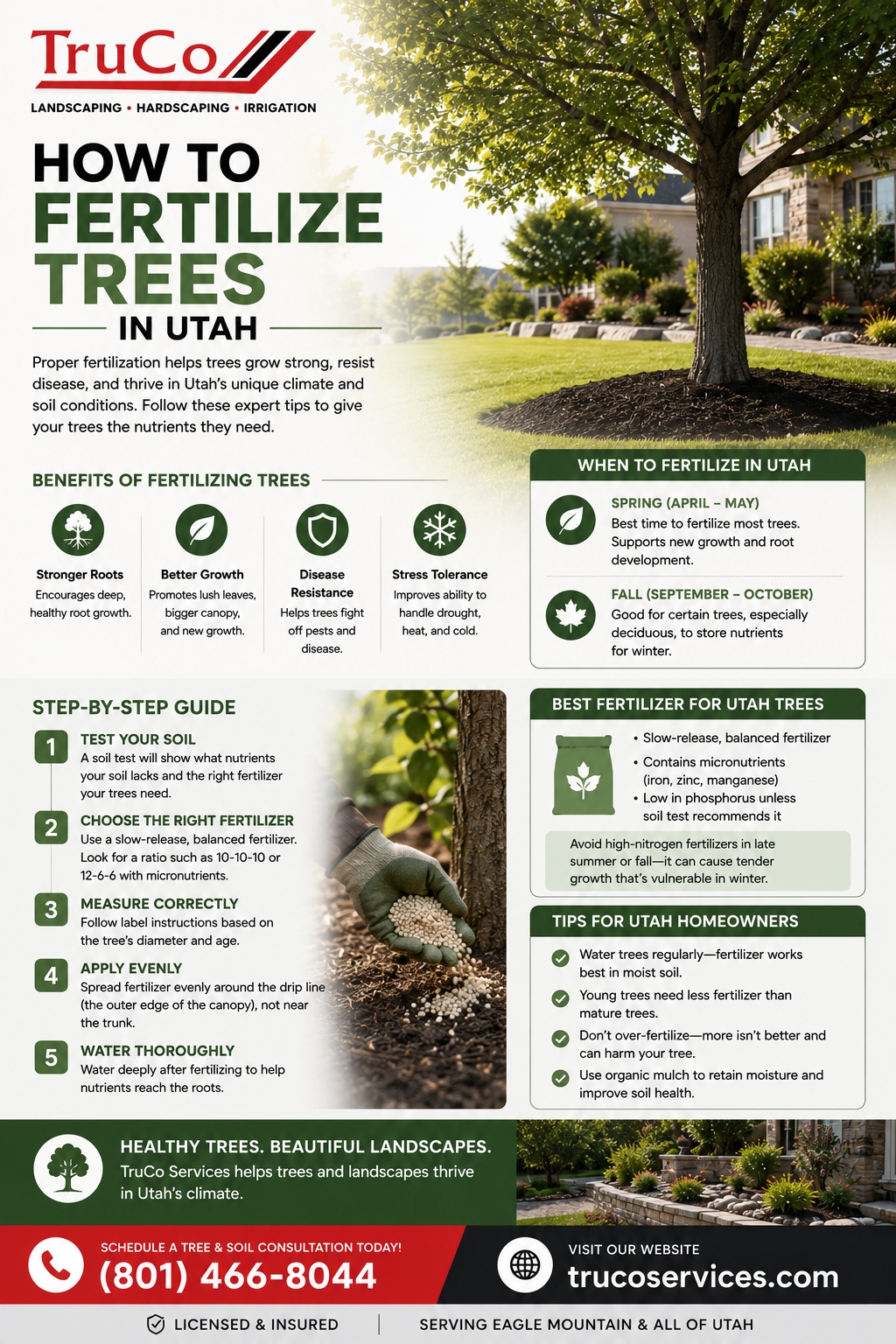
For most Utah trees, a slow-release granular fertilizer with an N-P-K ratio around 16-8-8 or 20-10-10 works well.
Nitrogen (N): Highest number — promotes leaf and shoot growth
Phosphorus (P): Moderate — Utah soils are naturally phosphorus-rich
Potassium (K): Moderate to high — supports root development and stress tolerance
For trees with iron chlorosis, use a fertilizer supplemented with chelated iron. Fe-EDDHA is most effective in alkaline soil.
When to Fertilize Trees in Utah
Early spring (March-April): Apply a balanced slow-release fertilizer just as buds begin to swell. This is the most important application for most Utah trees.
Late fall (October-November): Apply after leaf drop but before the ground freezes. Use a lower-nitrogen, higher-potassium formula for fall applications.
Summer (June-August): Generally not recommended. Fertilizing during drought or heat stress can burn roots.
Winter (December-February): Do not fertilize. Trees are dormant.
How to Apply Fertilizer: Deep Root Feeding
Surface broadcasting: Spread granular fertilizer evenly over the root zone. Water in thoroughly.
Deep root feeding: Use a deep root feeder probe attached to a garden hose. Insert the probe 6-12 inches deep at intervals of 2-3 feet around the dripline.
Tree spike method: Hammer fertilizer spikes into the soil around the dripline. Least effective method.
How Much Fertilizer to Use
Apply 1 pound of actual nitrogen per 1,000 square feet of root zone per application. For most Utah trees, one spring application and one fall application per year is sufficient.
Organic vs Synthetic Tree Fertilizers
Organic fertilizers release nutrients slowly. Benefits: improve soil structure, don't burn roots. Drawbacks: slow results, variable nutrient content.
Synthetic fertilizers provide nutrients immediately. Benefits: fast results, precise ratios. Drawbacks: can burn roots, don't improve soil.
Iron Chlorosis: Treating Yellow Leaves
Iron chlorosis is the most common nutrient deficiency in Utah trees. Yellow leaves with green veins indicate iron deficiency caused by alkaline soil.
Treatment options: Soil application of chelated iron (Fe-EDDHA) is most effective. Foliar iron spray provides quick but temporary results. Trunk injection by a certified arborist for severe cases.
Common Tree Fertilization Mistakes
Fertilizing without a soil test
Over-fertilizing — more is not better
Fertilizing a stressed or newly planted tree
Applying fertilizer too close to the trunk
Using high-phosphorus fertilizers in Utah
Fertilizing in late summer
Frequently Asked Questions
How often should I fertilize my trees in Utah? One to two times per year — early spring and optionally late fall.
What is the best fertilizer for maple trees in Utah? A balanced slow-release fertilizer like 20-10-10 supplemented with chelated iron.
Can I over-fertilize a tree? Yes. Excess nitrogen causes weak growth and pollution runoff.
Do evergreen trees need fertilizer in Utah? Yes, but only in spring. Do not fertilize evergreens after July.
How do I treat yellow leaves on my aspen tree? Apply chelated iron (Fe-EDDHA) to the soil. Results take 2-4 weeks.
Should I fertilize trees in the fall? Yes — fall fertilization supports root growth through winter.
How do I get a soil test in Utah? Contact USU Extension through your county extension office. USU Analytical Laboratories offer soil testing for $20-40.