
How to Build a Garden Pathway or Walkway in Utah

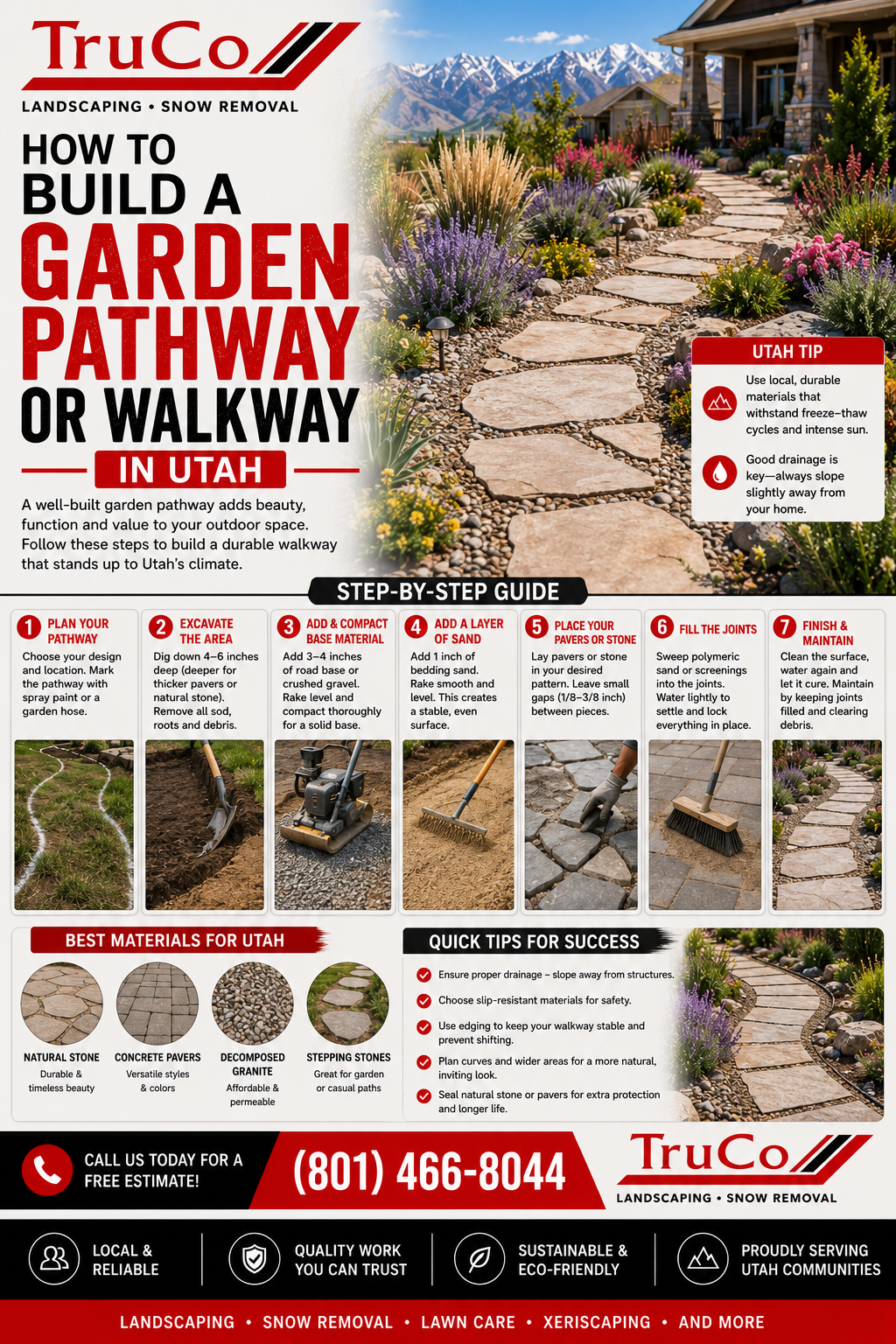
Why Build a Garden Pathway or Walkway in Utah
Garden pathways and walkways serve both practical and aesthetic purposes in Utah landscapes. They direct foot traffic through your yard, prevent soil compaction on lawn areas, provide access to garden beds during wet spring weather, and create visual structure in your landscape design. In Utah's climate, walkways are essential for navigating muddy yards during spring snowmelt (March-April) and monsoon season (July-September). A well-designed pathway also increases your property's value and curb appeal. Materials must withstand Utah's freeze-thaw cycles — 100-150 cycles per year in the Salt Lake Valley. Walkways connect different areas of your landscape: front door to driveway, patio to garden, driveway to side yard, and around the house for maintenance access. In Utah, proper base preparation is critical — heaving from frost can destroy a walkway in one winter. Budget for a 4x20 ft walkway: $400-1,200 for DIY, $1,200-3,000 for professional installation.
Choosing Materials for Utah Walkways
Flagstone is the most popular natural stone for Utah walkways. Utah flagstone (typically Wasatch or Colorado sandstone) comes in irregular or cut shapes, costs $3-8 per sq ft for materials, and lasts indefinitely. It requires a sand or gravel base and can be set on compacted sand for a dry-laid installation. Flagstone handles freeze-thaw well if properly installed with a base that drains. Concrete pavers are interlocking units available in many shapes and colors. Cost: $3-6 per sq ft for materials. They resist freeze-thaw when installed on a compacted gravel base with polymeric sand joints. Pavers are easier to repair than poured concrete — replace individual units. Poured concrete is the most affordable option at $5-12 per sq ft installed. In Utah, use air-entrained concrete with control joints every 4-6 feet to prevent cracking. Exposed aggregate concrete adds texture and slip resistance — important for Utah's icy winter conditions. Stepping stones create a casual, natural look. Space stones 24-30 inches apart (center to center). Use concrete rounds, flagstone squares, or natural stone slices. Budget option: $2-5 per sq ft. Gravel walkways are the most affordable at $1-3 per sq ft. Use crushed gravel (3/4 inch minus) that compacts well. Pea gravel is decorative but shifts underfoot and needs edging. Gravel walkways require regular topping up but handle freeze-thaw well.
Base Preparation for Utah's Freeze-Thaw Climate
Proper base preparation determines walkway longevity in Utah. Minimum excavation depth: 8-10 inches for pedestrian walkways, 10-12 inches for driveways. Remove all organic material (sod, roots) from the base. For clay soils common along the Wasatch Front, excavate deeper (12 inches) to accommodate additional base material. Base layers: 4-6 inches of compacted crushed gravel (3/4 inch minus road base). Compact in 2-inch lifts with a plate compactor ($50-80/day rental). 2 inches of leveling sand for pavers or flagstone. For concrete: 4-6 inches of compacted gravel base. In areas with poor drainage, install a perforated drain pipe along the edge. Landscape fabric between soil and gravel prevents weed growth and soil migration. Edge restraints are essential in Utah — plastic, steel, or concrete edging prevents the walkway from spreading under freeze-thaw movement. In Utah, avoid using limestone screenings as a base — they hold moisture and heave more than crushed granite or gravel. Slope the walkway 1/4 inch per foot away from buildings for drainage. For walkways through lawns, install flush with or slightly below the grass surface to allow mowing without scalping.
Installing a Flagstone Walkway in Utah
Step 1: lay out the path with garden hose or marking paint — curves look more natural than straight lines. Step 2: excavate to 8 inches deep, sloping away from buildings. Step 3: compact the soil with a plate compactor. Step 4: install landscape fabric. Step 5: add 4-6 inches of crushed gravel, compacting in 2-inch lifts. Step 6: add 2 inches of coarse sand and screed smooth. Step 7: lay flagstones, starting from the most visible area. Select stones for best fit — stagger joints, avoid long continuous seams. Step 8: use a rubber mallet to level each stone, checking with a 4-ft level. Step 9: fill gaps with stone dust or polymeric sand. Sweep sand into joints, tamp with plate compactor, sweep more sand. Step 10: wet the sand to activate (for polymeric sand). In Utah, seal flagstone with a penetrating sealer to prevent staining and make winter ice removal easier. For irregular flagstone, leave 1-3 inch gaps for a natural look. For cut flagstone (patterned), 1/4 to 1/2 inch gaps are appropriate. Cost for a 50 sq ft flagstone walkway: $300-700 for materials, $800-1,500 for professional installation.
Installing Paver Walkways for Utah Climate
Concrete pavers are popular for Utah walkways because they handle freeze-thaw well and allow individual replacement if damaged. Excavation and base preparation follow the same steps as flagstone. After compacting the gravel base and sand: install edge restraints on both sides of the walkway. Lay pavers in your chosen pattern (running bond, herringbone, basket weave). Herringbone is strongest for areas with vehicle traffic. Use a rubber mallet to seat each paver. Leave the finished surface 1/8 to 1/4 inch above edging to allow for settling. After all pavers are laid, spread polymeric sand over the surface and sweep into joints using a push broom or leaf blower. Compact the entire surface with a plate compactor (use a rubber pad to avoid damaging pavers). Sweep more sand into joints after compacting. Mist with water to activate the polymer — sand hardens to lock pavers in place. In Utah, allow 24-48 hours before foot traffic, 72 hours before heavy use. Seal pavers after installation and reseal every 2-3 years. Cost for 50 sq ft paver walkway: $250-500 for materials, $600-1,200 for professional installation.
Maintaining Walkways in Utah Winters
Winter maintenance affects walkway longevity. Use plastic shovels instead of metal to avoid scratching stone and concrete. Avoid deicing salts (sodium chloride) on concrete and unsealed stone — they cause spalling and deterioration. Use calcium magnesium acetate or sand instead. For flagstone and pavers, use sand for traction rather than salt. Clear snow promptly after each storm — freeze-thaw cycles damage saturated walkways. In spring, inspect for heaving, cracking, or settled pavers. Re-sand joints as needed. Reset any shifted pavers or stones. In Utah, walkway maintenance is highest in March-April when daily freeze-thaw cycles are most active. Apply a sealer every 2-3 years (flagstone and pavers) to protect from moisture penetration. In northern Utah, many homeowners install radiant heating under walkways for snow melting — costs $15-30 per sq ft installed but eliminates shoveling and salt damage.
Frequently Asked Questions
What is the best walkway material for Utah? Flagstone and concrete pavers are the best choices for Utah's freeze-thaw climate. Both allow water to drain through joints and can be repaired individually. Avoid poured concrete without proper jointing.
How much does a walkway cost in Utah? Gravel: $2-5 per sq ft installed. Concrete: $8-14 per sq ft. Pavers: $12-20 per sq ft. Flagstone: $16-30 per sq ft. Larger projects cost less per square foot.
Do I need a permit for a walkway in Utah? Walkways under 4 ft wide typically don't need permits in most Utah cities. Check with your local building department. Permits are needed for walkways near streets or in easements.
How do I prevent walkway ice in Utah? Install snow melt systems for the best results ($15-30/sq ft). Use calcium magnesium acetate instead of salt. Apply sand for traction. Proper drainage prevents ice from forming in the first place.