
How to Build a Backyard Water Feature or Pond in Utah

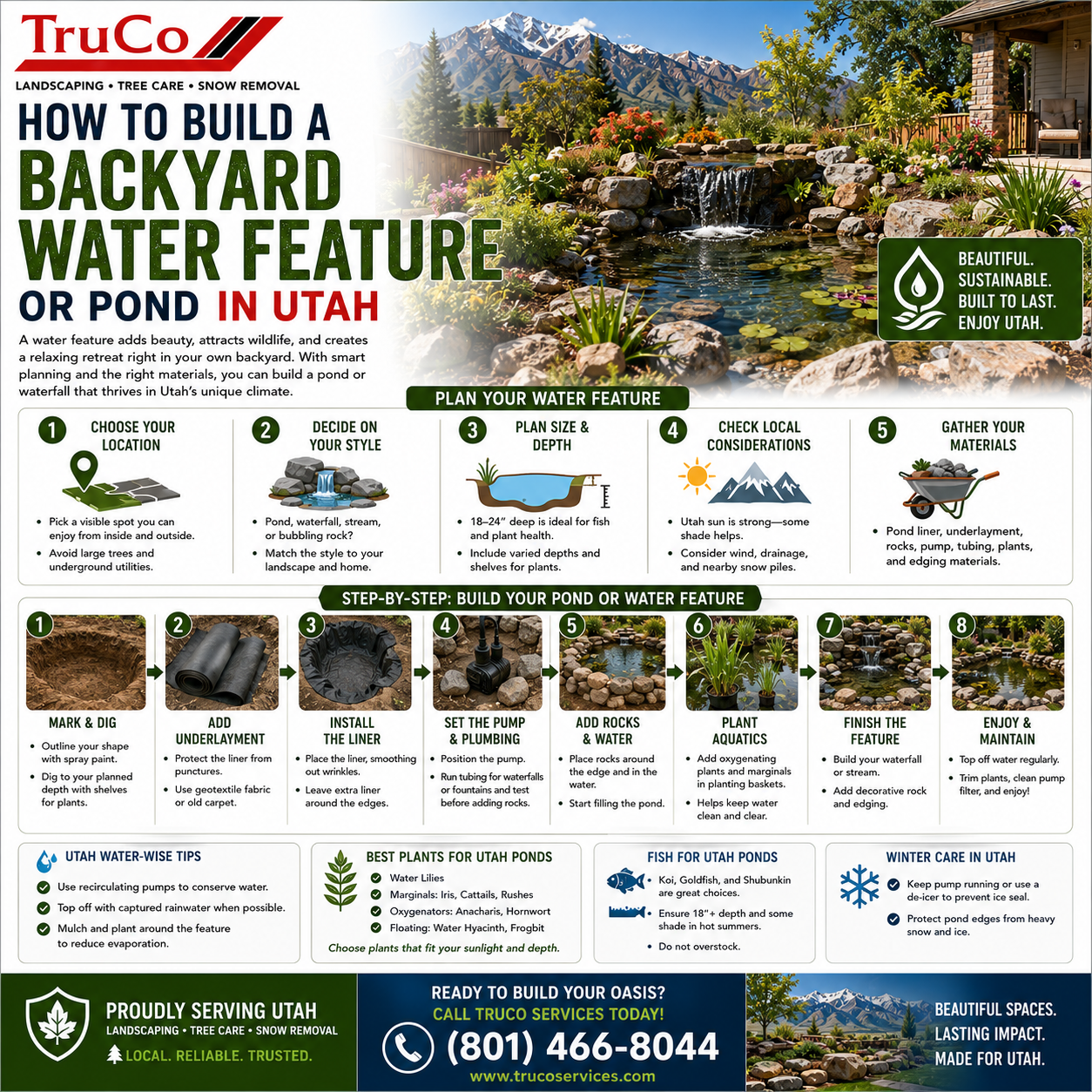
Water Feature Options for Utah Yards
Water features add beauty, tranquility, and increased property value to Utah landscapes. Garden ponds range from 50-gallon preformed mini-ponds to 2,000+ gallon custom-lined ponds with fish and aquatic plants. Waterfalls and streams create the sound of running water without the maintenance of a full pond — recirculating pumps move water from a hidden reservoir over rocks. Fountain features are self-contained units ideal for patios and small yards — ceramic, stone, and metal options are available at Utah garden centers. Pondless waterfalls are popular in Utah — water cascades over rocks into a hidden gravel reservoir, eliminating the safety concerns of open water. Koi ponds require deeper water (3-4 feet minimum) and specialized filtration systems. In Utah's climate, all water features must be designed for freeze protection. Budget $500-3,000 for a basic pondless waterfall, $2,000-8,000 for a lined garden pond, and $200-800 for self-contained fountains.
Choosing a Location in Your Utah Yard
Location determines your water feature's success. Choose a spot visible from your main living areas — near a patio, deck, or window where you'll enjoy the sight and sound. Partial shade (3-5 hours of sun) is ideal for ponds — full sun promotes algae growth and excessive evaporation, while full shade limits aquatic plant options. Avoid areas under deciduous trees — falling leaves decompose in pond water, creating sludge and nutrient imbalance. In Utah, locate ponds away from cottonwood and willow trees whose roots can damage the pond liner. Check underground utilities before digging — call 811 for marking. Ensure the site has adequate drainage — don't place a pond in a low spot where runoff enters it. Consider proximity to electrical service — pumps and filters need GFCI-protected outdoor outlets. In Utah, choose a location that receives some winter sun to help ice melt faster in spring. For pondless waterfalls, proximity to a seating area maximizes enjoyment of the water sound.
Installation Steps for Utah Gardens
Step 1: mark the pond outline with a garden hose or spray paint. Step 2: excavate 12-24 inches deeper than the desired water depth to account for the liner and underlayment. Create shelves at different depths (6-inch shelves for marginal plants, 12-inch shelves for larger plants, 24+ inches for fish). Step 3: line the hole with 2 inches of sand or pond underlayment fabric to protect the liner from rocks and roots. Step 4: install EPDM rubber liner (the most durable for Utah's freeze-thaw cycles) — allow 12-18 inches of overlap beyond the pond edge. Step 5: fill with water to stretch the liner into place. Step 6: install the pump and filter system — submersible pumps are placed in the deepest part of the pond. Step 7: place rocks around the edge to hide the liner — use Utah field stone or flagstone for a natural look. Step 8: add aquatic plants and wait 2-3 weeks before adding fish to allow water chemistry to stabilize. In Utah, all pond installations should include a bottom drain for easy cleaning and a pre-filter to protect the pump from debris.
Pumps, Filters, and Plumbing
Proper water circulation is critical for pond health. Choose a pump rated to circulate the entire pond volume every 1-2 hours — a 1,000-gallon pond needs a 500-1,000 GPH pump. Pump head height (vertical lift) reduces flow — account for the height of waterfalls or streams above the pond surface. External pumps are more efficient and easier to maintain than submersible pumps for large ponds over 1,500 gallons. Filtration: mechanical filters (foam, brush, or filter mat) trap solid waste. Biological filters (bio-balls, lava rock, or ceramic media) grow beneficial bacteria that convert toxic ammonia from fish waste into less harmful nitrates. UV clarifiers kill suspended algae, keeping pond water clear without chemicals — highly recommended for Utah ponds that receive direct sun. Install all electrical components on a GFCI-protected circuit. In Utah, use flexible PVC pipe for plumbing — it withstands freeze-thaw without cracking. Run plumbing below the frost line (30-36 inches) or drain the system completely before winter. Consider adding a bottom drain during initial installation — retrofitting one later requires draining and relining the pond.
Winter Care for Utah Ponds
Winter preparation is essential for Utah ponds — temperatures can drop below zero for weeks. Stop feeding fish when water temperatures fall below 50 degrees Fahrenheit (usually October in northern Utah). Remove tropical plants and store indoors. Cut back hardy plants to 2-3 inches above the water surface. Install a pond de-icer or floating heater to keep a small area of the pond surface ice-free — this allows toxic gases to escape and oxygen to enter. Do not break ice by hammering — the shock waves can kill fish. Use a pond aerator to maintain oxygen levels through winter. For ponds without fish, drain the system, clean the pump, and store it indoors. For pondless waterfalls, drain the reservoir and pump, and cover the waterfall with a tarp to protect from ice damage. In Utah's mountain areas (Park City, Heber Valley), fish ponds need a minimum depth of 3-4 feet to prevent winterkill. In lower elevations (St. George), winter care is minimal — a simple de-icer is sufficient.
Frequently Asked Questions
How much does a pond cost in Utah? Pondless waterfall: $500-3,000. Lined garden pond 300-500 gallons: $2,000-5,000. Koi pond with filtration: $5,000-15,000. Professional installation adds 50-100% to material costs.
Do ponds attract mosquitoes in Utah? Moving water from pumps prevents mosquito breeding. Add mosquito dunks (Bacillus thuringiensis israelensis) to still water areas. Gambusia (mosquitofish) eat mosquito larvae in larger ponds.
Can I keep fish in a Utah pond year-round? Yes — goldfish and hardy koi survive Utah winters in ponds 3-4 feet deep with a de-icer. Do not feed fish when water is below 50 degrees. Stop feeding completely by October.
How do I keep pond water clear in Utah? Use a UV clarifier to control algae, maintain adequate filtration, avoid overfeeding fish, and plant 40-60% of the pond surface with aquatic plants that compete with algae for nutrients.
Do I need a permit for a pond in Utah? Small ponds under 200 gallons typically don't need permits. Larger ponds or those near property lines may require permits. Ponds deeper than 18 inches may require safety fencing in some Utah cities. Check local regulations.