
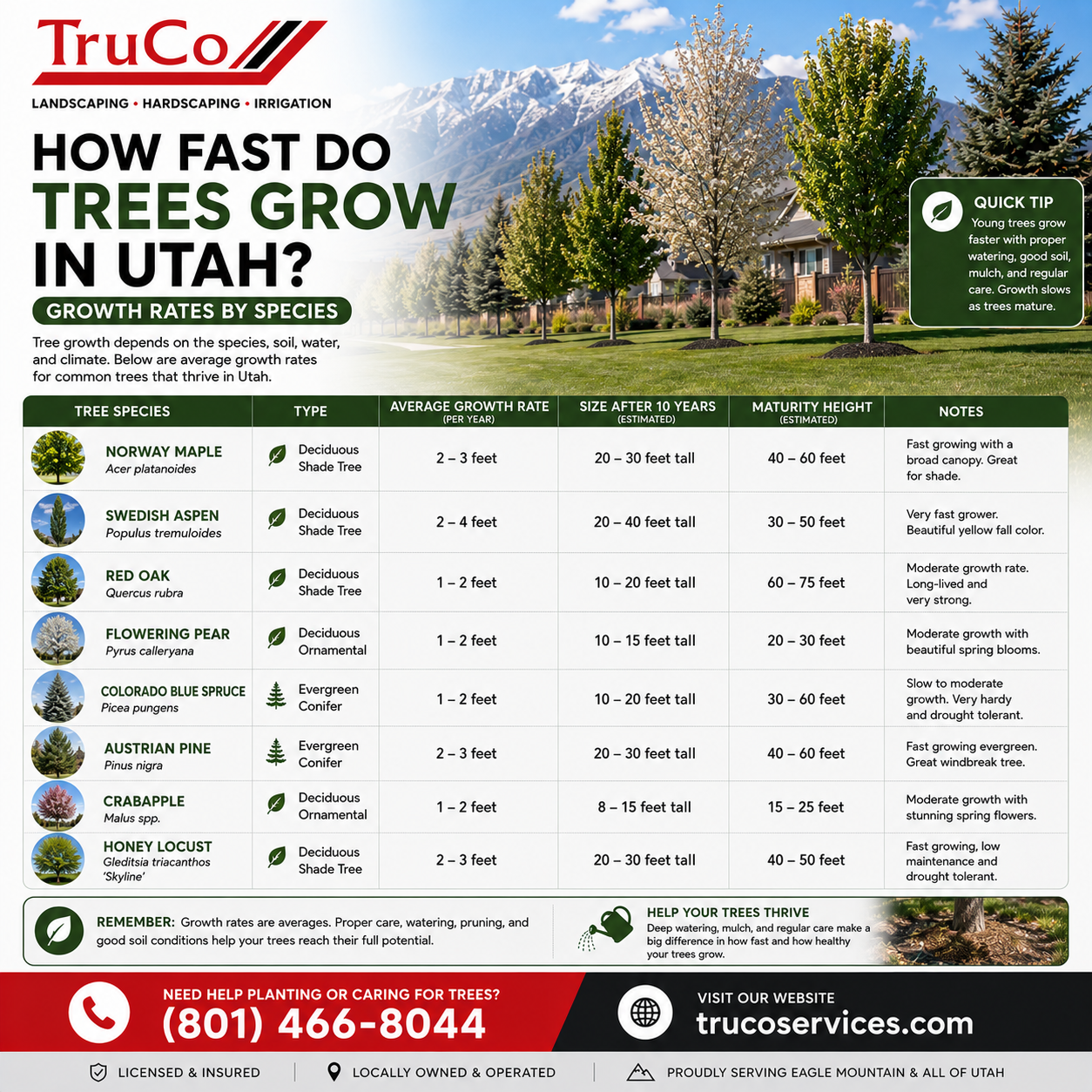
How Fast Do Trees Grow in Utah? Growth Rates by Species

How to Choose the Right Tree for Your Utah Property
Choosing the right tree for your Utah property is the single most important decision for long-term tree health and property value. A well-chosen tree can thrive for decades with minimal maintenance. A poor choice may struggle, decline, and need removal within 10-15 years. Utah's climate requires trees that tolerate alkaline soil (pH 7.5-8.5), endure temperature swings ranging from -30°F in winter to 100+°F in summer, survive with 12-20 inches of annual precipitation, and withstand clay soil that dominates along the Wasatch Front.
Understanding Utah's Growing Zones
Most of Utah's populated areas are in USDA hardiness zones 5a to 7a. The Wasatch Front from Ogden to Provo is zone 5b-6b. St. George and southern Utah are zones 7a-8a. Park City and mountain areas are zone 4b-5a. Pick trees rated for your specific zone. Consider microclimates on your property — south-facing slopes near buildings can be one zone warmer.
Site Assessment: Sunlight, Soil, and Space
Measure the amount of direct sunlight your planting site receives — full sun 6+ hours, part sun 4-6 hours, shade less than 4 hours. Test your soil pH using a home test kit from any Utah garden center, or send a sample to the Utah State Extension soil lab. Calculate available space — overhead utility lines require trees under 25 feet tall. Distance from foundations: large trees at least 20 feet, small trees 10-15 feet. Distance from driveways and sidewalks: large trees 10-15 feet. Underground utilities: call 811 before digging.
Tree Size at Maturity Matters
Most Utah planting mistakes involve trees that outgrow their space. Small trees under 25 feet mature height include Japanese tree lilac, crabapple, Amur maple, eastern redbud, serviceberry, and Adams hawthorn — suitable near power lines and small yards. Medium trees 25-40 feet include hackberry, honeylocust, Kentucky coffeetree, and Austrian pine — good for standard lots. Large trees 40+ feet include bur oak, Colorado blue spruce, and Douglas fir — only for large properties with no overhead constraints.
Drought Tolerance: A Critical Factor in Utah
Water restrictions during Utah droughts make drought tolerance essential. Highly drought-tolerant trees include Kentucky coffeetree, hackberry, bur oak (once established), honeylocust, and Rocky Mountain juniper. Moderately drought-tolerant include Austrian pine, littleleaf linden, and red oak. Require regular water include paper birch, weeping willow, and river birch — these need supplemental watering throughout Utah's dry summers.
Shade Trees for Utah Summers
The best shade trees for Utah properties provide dense canopy, fast to moderate growth, and adaptability to alkaline soil. Kentucky coffeetree grows 40-50 feet, is highly drought-tolerant, and tolerates alkaline soil. Bur oak grows 60-80 feet with massive canopy and is highly adaptable. Hackberry grows 40-60 feet and tolerates heat, drought, and alkaline soil. Honeylocust grows 30-45 feet with dappled shade and is very adaptable. Littleleaf linden grows 50-70 feet with aromatic flowers but needs moderate water.
Ornamental Trees That Thrive in Utah
Japanese tree lilac grows 20-25 feet with creamy white flowers in June and is very alkaline-tolerant. Crabapple grows 15-20 feet with spring flowers and persistent fruit and is alkaline-tolerant. Amur maple grows 15-20 feet with brilliant red fall color and very alkaline-tolerant. Eastern redbud grows 20-30 feet with pink spring flowers and moderate alkaline tolerance. Serviceberry grows 15-25 feet with white spring flowers, edible berries, and good fall color — it is moderately alkaline-tolerant.
Evergreens for Utah Landscapes
Colorado blue spruce grows 50-75 feet, tolerates clay soil, and needs moderate water. Austrian pine grows 40-60 feet and tolerates alkaline soil and drought. Rocky Mountain juniper grows 20-30 feet and is very drought-tolerant and alkaline-tolerant. Concolor fir grows 60-80 feet and tolerates heat and some drought. Pinyon pine grows 15-30 feet and is adapted to Utah's dry climate.
Fruit and Nut Trees for Utah
Fruit trees can thrive in Utah with proper care. Apples and crabapples: most varieties do well with fire blight-resistant varieties recommended. Pears: Bartlett, Bosc, and Comice are good choices. Peaches and nectarines: Reliance, Redhaven, and Elberta are reliable. Cherries: Bing, Rainier, and Montmorency do well in Utah. Plums: Stanley, Santa Rosa, and Toka are recommended. Apricots: Moorpark, Goldcot, and Perfection thrive in Utah's climate. Walnuts: Carpathian English walnut. For fruit trees, choose late-blooming varieties to avoid spring frost damage.
Frequently Asked Questions
What is the best tree to plant in Utah? Kentucky coffeetree, hackberry, bur oak, and Japanese tree lilac are excellent choices that tolerate Utah's challenging growing conditions.
Can I plant a tree near power lines in Utah? Only trees under 25 feet at maturity. Japanese tree lilac, Amur maple, and crabapple are good choices.
What is the fastest-growing shade tree in Utah? Kentucky coffeetree and hackberry both grow 2-3 feet per year once established. Honeylocust grows 2-3 feet per year.
Do I need to amend the soil when planting a tree in Utah? In most Utah soils, amending the backfill is not recommended — plant in native soil and mulch on top. For very heavy clay, consider a raised berm.
What is the best time to plant trees in Utah? Spring (March-May) or fall (September-October) are best. Fall planting gives trees a head start on root establishment before summer heat.