
Draper UT Permanent Christmas Lights

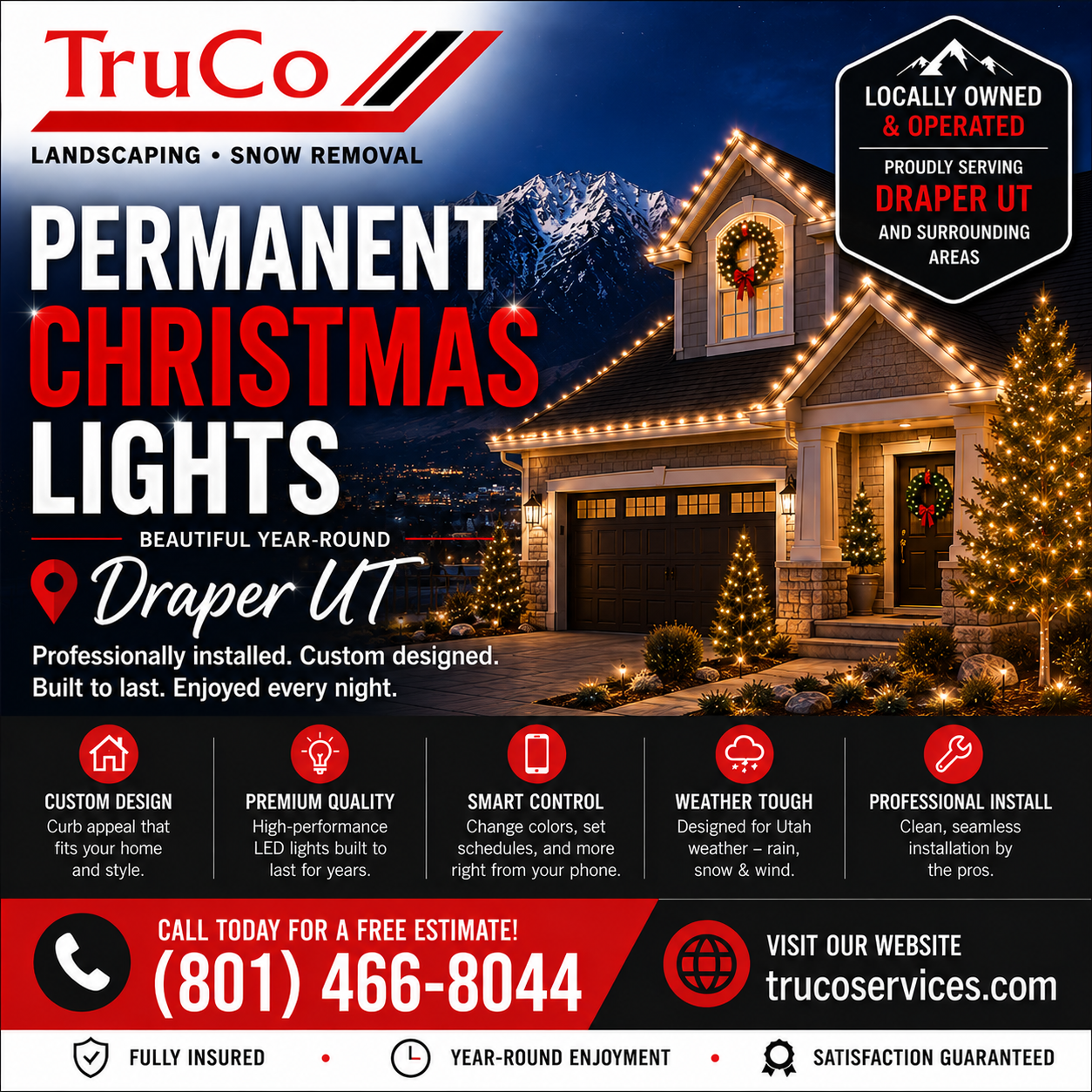
Draper UT permanent Christmas lights are professionally installed, app-controlled exterior LED lighting systems that stay on your home year-round while giving you easy access to holiday colors, warm white accent lighting, custom patterns, and event lighting. For homeowners, the biggest advantage is convenience: no annual ladder work, tangled strings, roof clips, temporary extension cords, or storing bins of holiday lights.
The most important takeaway is that permanent lighting is an exterior improvement—not just a seasonal decoration. Product quality, roofline design, weather-resistant installation, power planning, daylight appearance, service terms, and local electrical requirements all affect whether the system remains attractive and reliable over time. A low-priced system that is poorly mounted, visibly wired, underpowered, or difficult to service can cost more than a well-planned installation.
This guide explains how permanent Christmas lights work in Draper, what system options exist, the most common problems to avoid, how to evaluate costs and warranties, and what local rules may apply. An experienced lighting professional can help you create a clean, durable setup that complements your home in every season—not only during December.
What Are Draper UT Permanent Christmas Lights?
Permanent Christmas lights are exterior LED light systems mounted along rooflines, soffits, fascia boards, gables, garage lines, patio covers, or other architectural features. The hardware remains on the home year-round, but homeowners can turn the lights on only when desired.
Unlike traditional holiday strings, permanent exterior lighting is intended to blend into the home during the day and provide programmable illumination at night. Most systems use individual LED “pucks” or modules set inside a track that matches the home’s soffit, fascia, or trim. The track helps conceal wiring, maintain even spacing, and create a more polished appearance.
A typical Draper permanent holiday lighting system includes:
Color-changing LED light modules or pucks
A track, channel, or mounting system
Outdoor-rated wiring and connectors
A controller for managing colors, zones, schedules, and effects
A power supply or electrical connection
A smartphone app, remote, timer, or local-control option
Installation, programming, testing, and homeowner instruction
For example, a homeowner in Draper might use warm white lighting along the front roofline in spring and summer, orange and purple for Halloween, red and green during Christmas, and school or team colors for special events. The system can remain subtle most of the year while becoming more festive when the occasion calls for it.
How Permanent Lighting Works
The process begins with a site evaluation. A lighting professional measures the home’s visible rooflines, reviews soffit and fascia conditions, checks access requirements, identifies potential power locations, and discusses how the homeowner plans to use the system.
After the design is approved, the installer mounts tracks or lighting components, routes and secures wiring, places the controller and power components, tests every section, and sets up the controls. The homeowner should receive a clear walkthrough of the app, brightness settings, scheduling tools, presets, and basic troubleshooting steps.
The exact electrical scope matters. Draper City maintains a standalone electrical permit option for electrical work that is not attached to an active building permit. Its permit page says this work must be completed by a Utah State Licensed Electrical Contractor, or by the residential homeowner acting as an owner-builder.
Permanent lighting may be simple plug-in, low-voltage equipment in some installations, while other projects may involve new circuits, exterior outlets, hardwired equipment, or other electrical changes. Homeowners should not assume all projects are treated the same. Ask about power needs, permit responsibility, and whether licensed electrical work is required before installation begins.
9 Important Things to Know
1. A Good Lighting Design Follows the Home’s Architecture
The best permanent Christmas lights in Draper, Utah do not simply place LEDs along every available edge. They follow the home’s architecture in a balanced, intentional way.
Your roofline, gables, garage, dormers, entryway, patio cover, and upper-level eaves all affect the right design. A simple single-story home may look excellent with only the primary front roofline and garage highlighted. A larger home with multiple peaks may benefit from selective illumination that emphasizes symmetry without looking crowded.
The first question is not, “How many feet of lights can I install?” It is, “Which lines make the home look its best from the street?” This approach helps avoid over-lighting, uneven visual weight, and unnecessary cost.
For example, illuminating only the left side of a prominent front gable may make the home look incomplete. Outlining the main gable but leaving an attached garage roofline dark can create an awkward break. On the other hand, outlining every minor roof edge can make a home look busy and overly bright.
A professional design should account for viewing distance, street orientation, landscaping, neighboring homes, roof height, and the surfaces where lights will be mounted. It should also make sense when the lights are off. Permanent lighting is visible every day, so track placement and wire concealment matter as much as nighttime color effects.
Before approving an installation, ask for a written scope or visual layout that identifies every roofline and feature included. Confirm whether peaks, garage edges, second-story lines, patio covers, and side elevations are part of the price. This simple step prevents misunderstandings and helps you compare estimates accurately.
2. Product Quality Is More Than LED Brightness
Many homeowners focus on LED color options and app features. Those matter, but the long-term quality of a permanent holiday lighting system depends on much more than the bulbs.
A complete system includes the light modules, wiring, connectors, mounting track, controller, power supply, weather protection, and installation hardware. A failure in any one of these components can affect the entire display.
Exterior lighting in Draper needs to handle high sun exposure, winter cold, snow, wind, moisture, and temperature changes. Lower-quality plastics may become brittle or discolored. Poor connectors can allow moisture intrusion. Undersized wire or power equipment can create dimming, flickering, or failures near the end of a long run.
The mounting track also matters. A color-matched, purpose-built track can conceal wiring and hold each light at a consistent angle. A poorly selected or visibly mounted system can look improvised, especially in daylight.
Ask the provider these questions:
What brand and model of permanent lighting system will be installed?
Is it designed and listed for permanent exterior use?
Is the track color matched to my soffit or fascia?
How are wires, connectors, and power components protected?
Can individual lights or sections be repaired?
Are replacement parts expected to be available in the future?
Who provides product support if the manufacturer has a warranty claim?
Avoid relying only on broad phrases such as “commercial-grade” or “premium.” Ask for specific product information and a written explanation of what is included. A durable system is one that looks neat, performs consistently, and can be serviced without replacing the entire installation.
3. Draper Weather Makes Installation Details Essential
Draper’s climate can be demanding on exterior materials. Strong sunshine, snow, cold temperatures, wind, rain, and freeze-thaw cycles can expose weak installation practices that may not show up immediately.
A permanent lighting system must remain secure through changing seasons. Tracks should be mounted properly. Wiring should be supported and protected. Connections should be weather-resistant. Controller and power equipment should be located where they are accessible for service but not needlessly exposed to water, physical impact, or direct weather.
Thermal movement is also important. Exterior materials expand and contract. Over long rooflines, a rigid or poorly secured track can shift, bow, pull away, or stress connectors. A competent installer accounts for the manufacturer’s mounting instructions and the home’s exterior materials.
Roof access deserves special attention. Lighting should not be installed in a way that compromises shingles, flashing, gutters, fascia, venting, or drainage. Permanent Christmas lights are normally mounted to a soffit, fascia, trim board, or purpose-designed channel—not carelessly attached through roofing surfaces.
Weather also affects timing. Installation can often be performed outside traditional holiday months, which gives homeowners more scheduling flexibility. Completing the project before peak holiday demand may make it easier to plan carefully, avoid rushed decisions, and have the system ready before seasonal events begin.
A quality installation should still look clean and remain firmly attached after its first winter. If an estimate does not explain mounting method, track material, wire routing, or weather protection, ask for those details before committing.
4. Electrical Planning Is Not an Afterthought
Permanent Christmas lights may use LED technology and relatively low energy compared with older incandescent strings, but they are still an exterior electrical installation. Correct power planning helps prevent overloads, unreliable operation, unsafe cords, weather-exposed connections, and costly rework.
A lighting system may be powered from an existing exterior receptacle, a dedicated outlet, a new circuit, or a properly installed power source based on the product design and scope of work. The right option depends on system length, wattage, controller requirements, available circuits, and the home’s existing electrical setup.
Draper City incorporates the most recent versions of state-adopted construction codes and Utah amendments, including the National Electrical Code, into its city construction-code framework.
For any work that goes beyond a plug-in, manufacturer-designed lighting setup, confirm who is handling the electrical scope. Draper’s electrical permit application states that standalone electrical work must be performed by a Utah State Licensed Electrical Contractor, or, for a residential property, the homeowner acting as an owner-builder.
Homeowners should ask:
Where will the lighting system receive power?
Is the existing receptacle or circuit appropriate for the system?
Is the connection protected from weather and accidental damage?
Is GFCI protection relevant to the proposed outlet or equipment?
Does the planned scope require an electrical permit?
Who is responsible for permit applications and inspections, if required?
Is any part of the installation hardwired or modifying existing electrical equipment?
Never accept exposed extension cords as a permanent solution. Also avoid overloading an outlet with lights, decorations, patio equipment, and seasonal appliances. Safe electrical planning protects your home, supports dependable operation, and avoids a frustrating failure during the holidays.
5. Daytime Appearance Determines Whether It Looks Permanent
A lighting system can look impressive at night but unattractive in the daytime. Since permanent Christmas lights remain on the home all year, their daytime appearance should be a major part of the buying decision.
The best installations are subtle when switched off. Tracks should blend with the soffit, fascia, or trim. Wires should be hidden where practical. Corners should be crisp. Light spacing should be even. Controller boxes and power components should be placed discreetly while remaining serviceable.
The wrong track color can stand out against white soffits, dark fascia, wood trim, stucco, or siding. Uneven alignment can make the roofline look crooked. Visible dangling wires or connectors may be more noticeable than the lights themselves.
Request photographs of completed projects during the day. Nighttime marketing photos show the color effects, but daylight photos reveal the details that matter year-round: straightness, track matching, wire concealment, corner treatment, and the installer’s general workmanship.
Also discuss the location of power supplies and control boxes before installation. A system may work technically even if a controller is mounted in an awkward or prominent location. Good planning balances convenience, access, weather protection, and visual discretion.
For a home in Draper with visible front elevations, elevated lots, or open street views, daylight appearance may be especially important. The goal is simple: neighbors should notice the lighting when it is on—not a maze of hardware when it is off.
6. App Controls, Zones, and White-Light Quality Matter
Most homeowners want permanent holiday lighting because it is flexible. However, not every system offers the same control experience.
Basic systems may let you choose colors and a few effects. More advanced systems can divide the house into zones, create custom patterns, schedule activation times, save scenes, adjust brightness, and allow multiple household members to control the display.
Before choosing a system, think about how you will use it. If you only want red and green in December, a simpler control package may be enough. If you want soft warm white for everyday use, school-color patterns, different colors for multiple rooflines, and scheduled holiday scenes, choose a controller that supports those features.
White-light appearance deserves special attention. Some RGB systems create white by blending red, green, and blue light. This can appear cool, bluish, or less natural than a dedicated white LED. RGBW systems include a separate white channel, which may produce better-looking warm white or architectural accent lighting.
Brightness is equally important. A system should look festive without creating glare for your household or neighbors. Ask whether the lights can be dimmed and whether brightness can be adjusted by zone or scene.
Finally, ask what happens if Wi-Fi is interrupted. Some systems use Wi-Fi for app control but may also provide Bluetooth, remote, local-controller, or manual options. You should not be locked out of your lighting system because of a temporary internet issue.
A provider should configure the system with you before leaving, demonstrate the controls, and help you save a few useful presets: warm white, Christmas, Halloween, off, and a modest late-night setting.
7. Warranty and Service Terms Need Plain-English Answers
Permanent Christmas lighting is meant to be a long-term investment, so warranty and service terms matter. The problem is that broad promises can hide important exclusions.
A manufacturer warranty may cover defective parts but not the labor to diagnose the issue, access a high roofline, remove a track, replace a component, and restore the system. An installation warranty may cover workmanship for a certain time but exclude storm damage, roof work, pest damage, painting, owner modifications, electrical surges, or product failures outside the installer’s control.
Before hiring a provider, request written answers to these questions:
How long are lights, wiring, tracks, controllers, and power supplies covered?
Is installation workmanship covered separately?
Who pays for diagnostic visits and labor?
Are service calls included, limited, or billed separately?
What weather-related damage is excluded?
Are product and labor warranties transferable if the home is sold?
What happens if exterior work damages the lights?
How quickly can routine service usually be scheduled?
A real warranty should be understandable without legal interpretation. If a provider cannot clearly explain what is covered and what is excluded, do not assume you are receiving full protection.
Keep your installation agreement, product information, warranty language, photos, receipts, controller details, app login, and service contacts in one place. This helps if you need repairs years later or if you coordinate with a roofer, painter, gutter installer, or solar contractor.
8. Future Roof and Exterior Work Can Affect Your Lights
Permanent lights become part of your home’s exterior systems. That means future roof replacement, gutter work, fascia repairs, repainting, siding updates, solar installation, and soffit maintenance can affect the lighting system.
A roofer may need clear access near the roofline. A gutter company may need to work on fascia areas where a track is installed. A painter may need to remove or protect lighting hardware. A solar company may need to route equipment or access roof surfaces near installed lights.
If those contractors are not informed in advance, lighting tracks can be damaged, wires can be cut, connectors can be displaced, or hardware can be reinstalled incorrectly. The resulting repair may not be covered by the lighting manufacturer or installer.
If you expect to replace your roof in the next few years, consider completing that project before installing permanent roofline lighting. This may avoid removal and reinstallation costs. If the lighting is already installed, ask whether the provider offers removal and reinstallation services and whether the work affects warranty coverage.
Tell every exterior contractor about your permanent lighting system before work starts. Provide photos of wiring routes and controller locations if needed. Do not allow untrained workers to cut, splice, or remove lighting components without a plan for proper reinstallation.
A well-designed permanent lighting project anticipates these issues. The installer should place components where they can be serviced and explain how to coordinate future exterior maintenance.
9. The Lowest Quote Is Not Always the Lowest Cost
Comparing permanent Christmas light estimates can be difficult because two quotes may appear similar while covering very different systems and service levels.
One provider may include only an easy front roofline. Another may include garage lines, gables, second-story runs, track color matching, concealed wiring, app setup, weather-protected equipment, and a clear service process. The first quote may have a lower number but deliver a much smaller or less complete project.
When comparing permanent lighting quotes, evaluate:
Total linear footage and exact rooflines included
Number and spacing of LED modules
Product brand and model
Track or channel material and color
Controller type and app features
Power source and electrical scope
Wire concealment and controller placement
Warranty coverage for products, labor, and service
Troubleshooting and repair process
Whether permit-related electrical work is included or excluded
A cheap installation can become expensive when it has visible wiring, poor track alignment, inadequate power planning, limited support, early component failures, or expensive service calls. Permanent lighting is not just a product purchase; it is an installation and support relationship.
Choose value instead of a price alone. The right provider should give you a clear, written scope and answer your questions without pressure, vague promises, or hidden exclusions.
Frequently Asked Questions
What are permanent Christmas lights?
Permanent Christmas lights are outdoor LED lighting systems installed on a home year-round. They can be controlled with an app, timer, remote, or controller and programmed for holidays, events, warm white accent lighting, and custom patterns.
Are permanent Christmas lights only for December?
No. They can be used for Christmas, Halloween, birthdays, patriotic holidays, school colors, sports events, parties, warm white architectural lighting, and other occasions.
Do permanent lights stay on all year?
The system remains installed, but the lights can be turned off whenever you want. Many homeowners use schedules so the lights operate only during selected hours or holidays.
Can permanent lighting replace landscape lighting?
Not completely. Permanent roofline lighting can improve curb appeal and create ambient light, but it does not replace properly placed pathway, entry, security, or landscape illumination.
How are permanent Christmas lights controlled?
Many systems use a smartphone app. Features may include color selection, dimming, effects, schedules, saved scenes, and zone control. Some systems also offer remotes or local-controller controls.
Do permanent lights work if Wi-Fi goes out?
It depends on the system. Some systems require Wi-Fi for app control but offer Bluetooth, remote, or local controls. Ask about backup control options before selecting a product.
Can permanent lights be dimmed?
Most quality systems offer brightness controls. Dimming is important for reducing glare, respecting neighbors, and creating a softer warm-white look for everyday use.
What is RGBW lighting?
RGBW lighting includes red, green, blue, and a dedicated white LED. The white channel can provide a more natural white-light effect than RGB-only systems that create white by mixing colors.
Are permanent Christmas lights waterproof?
They should be designed for outdoor use, but the entire installation still needs correct weatherproofing. Product ratings, connectors, wiring routes, power equipment, and mounting methods all matter.
Do permanent lights work in snow and cold weather?
A properly selected and installed exterior lighting system should be designed with local weather conditions in mind. Performance depends on component quality, proper mounting, weather protection, and power planning.
Will permanent lights damage my roof?
They should not when installed correctly. Many systems mount to soffits, fascia, trim, or purpose-built tracks rather than penetrating roof shingles. Ask the provider to explain the mounting method.
Can permanent lighting be installed on a two-story house?
Yes. Two-story homes are common candidates, but roof access, safety, line length, serviceability, and overall design may affect cost and installation approach.
Can permanent lights be installed on stucco or brick?
Often, yes, but the mounting method should be selected for the specific exterior material. A provider should assess the surface rather than applying a one-size-fits-all approach.
How long do permanent Christmas lights last?
Longevity depends on the system design, component quality, weather exposure, usage, installation quality, and warranty terms. Ask for manufacturer-specific information rather than relying on generic lifespan claims.
Are permanent LED lights expensive to run?
LED lighting generally uses far less electricity than traditional incandescent holiday lights. Actual operating cost depends on total system wattage, brightness, hours of use, and electricity rates.
Can I add more lights later?
Some systems can be expanded, but controller capacity, power limits, maximum run length, and voltage-drop considerations may restrict additions. Discuss possible future expansion before installation.
What happens if one light stops working?
The answer depends on the system. Some allow individual light or segment replacement, while others require a different repair approach. Ask about diagnostics, component availability, labor, and service fees.
Can permanent holiday lights be repaired?
Many systems can be repaired. Repair options depend on the product, system age, location of the failure, accessibility, and availability of replacement components.
Do permanent lights require maintenance?
They usually require less seasonal work than temporary strings, but occasional inspection, software updates, resetting, storm checks, and service may still be needed.
Should I install lights before reroofing?
Usually, it is better to complete major roofing, fascia, gutter, or siding work first if it is expected soon. Otherwise, you may need to pay for removal and reinstallation.
Can solar panels affect permanent Christmas lights?
They can coexist, but both systems should be planned together. Coordinate roof access, wiring paths, mounting areas, and future maintenance needs with both providers.
Do I need a permit for permanent lights in Draper?
The answer depends on the work scope. Draper has a standalone electrical permit process for electrical work not tied to an active building permit. Confirm the requirements for your specific installation before work begins.
Who can perform electrical work in Draper?
Draper’s electrical permit page says standalone electrical work must be performed by a Utah State Licensed Electrical Contractor, or, on residential properties, by the homeowner acting as an owner-builder.
What construction codes apply in Draper?
Draper adopts the most recent state-adopted versions of major construction codes and Utah amendments, including the National Electrical Code. The applicable requirements depend on the project and current state adoption.
Are outdoor outlets required to have GFCI protection?
GFCI requirements depend on the outlet location, equipment type, voltage, amperage, current code adoption, and scope of work. Ask a qualified electrical professional or Draper City whether the specific proposed setup requires protection or modification.
Can permanent lights be left on overnight?
They can, but use common sense. Adjust brightness, consider neighbors and bedroom windows, use schedules, and avoid late-night flashing effects that may be disruptive.
Will permanent lights bother my neighbors?
They can if excessively bright, rapidly flashing, or operated late at night. Dimming, time schedules, and courteous programming help preserve neighborhood comfort.
Can permanent lights improve curb appeal?
A clean, well-designed system can enhance curb appeal, especially when used with warm white or tasteful color settings. Poor alignment, visible wires, or excessive brightness can have the opposite effect.
Do permanent lights add resale value?
They may appeal to some buyers as a convenience and exterior feature, but no resale increase is guaranteed. Quality, serviceability, documentation, and daytime appearance matter.
Can permanent lights be used for security?
They can improve general exterior visibility, but they are not a complete security system. Consider dedicated motion lighting, entry lighting, locks, cameras, and alarms for a comprehensive approach.
What should I ask during an estimate?
Ask about exact rooflines included, product brand, track color, wire routing, controller location, power needs, app features, nighttime brightness, daytime appearance, warranty coverage, service fees, and permit responsibility.
Key Rules and Standards
Permanent exterior lighting is not a legal or electrical do-it-yourself guide. Requirements may change, and the correct approach depends on the exact product, property, electrical setup, and installation scope.
Draper construction codes: Draper City adopts the current versions of state-adopted construction codes and Utah amendments, including the National Electrical Code, International Residential Code, International Building Code, plumbing, mechanical, energy, and fuel-gas codes.
Electrical permits: Draper provides a standalone electrical permit process for electrical work not connected to an active building permit. Its portal specifies that the work must be done by a Utah State Licensed Electrical Contractor or, on a residential property, the homeowner acting as an owner-builder.
Building-permit compliance: Draper’s building-permit code requires submitted project information to include applicable designs and a statement that actual construction will comply with relevant local ordinances and building codes.
Manufacturer instructions: Outdoor lighting equipment should be installed according to its listing, labeling, and manufacturer instructions. Do not modify wiring, connectors, power supplies, or control equipment outside approved installation methods.
HOA rules: Some Draper neighborhoods may have HOA requirements regarding exterior modifications, visible components, lighting intensity, architectural approval, or operating hours. Review your HOA documents before installation.
Conclusion
Draper UT permanent Christmas lights can give your home a polished, convenient, year-round lighting solution—but only when the system is selected and installed with the same care you would give any other exterior improvement. The difference between a reliable, subtle, attractive installation and an expensive frustration often comes down to design, materials, power planning, mounting quality, warranty clarity, and professional guidance.
Most problems are avoidable. Plan around your roof and future exterior work, choose a system built for outdoor use, prioritize clean daytime appearance, understand the electrical scope, use reasonable brightness settings, and get service terms in writing.
For practical guidance on Draper UT permanent Christmas lights, contact Truco Services at (801) 466-8044 to discuss a permanent exterior lighting plan tailored to your home.