
How to Document Tree Damage for Insurance Claims in Utah

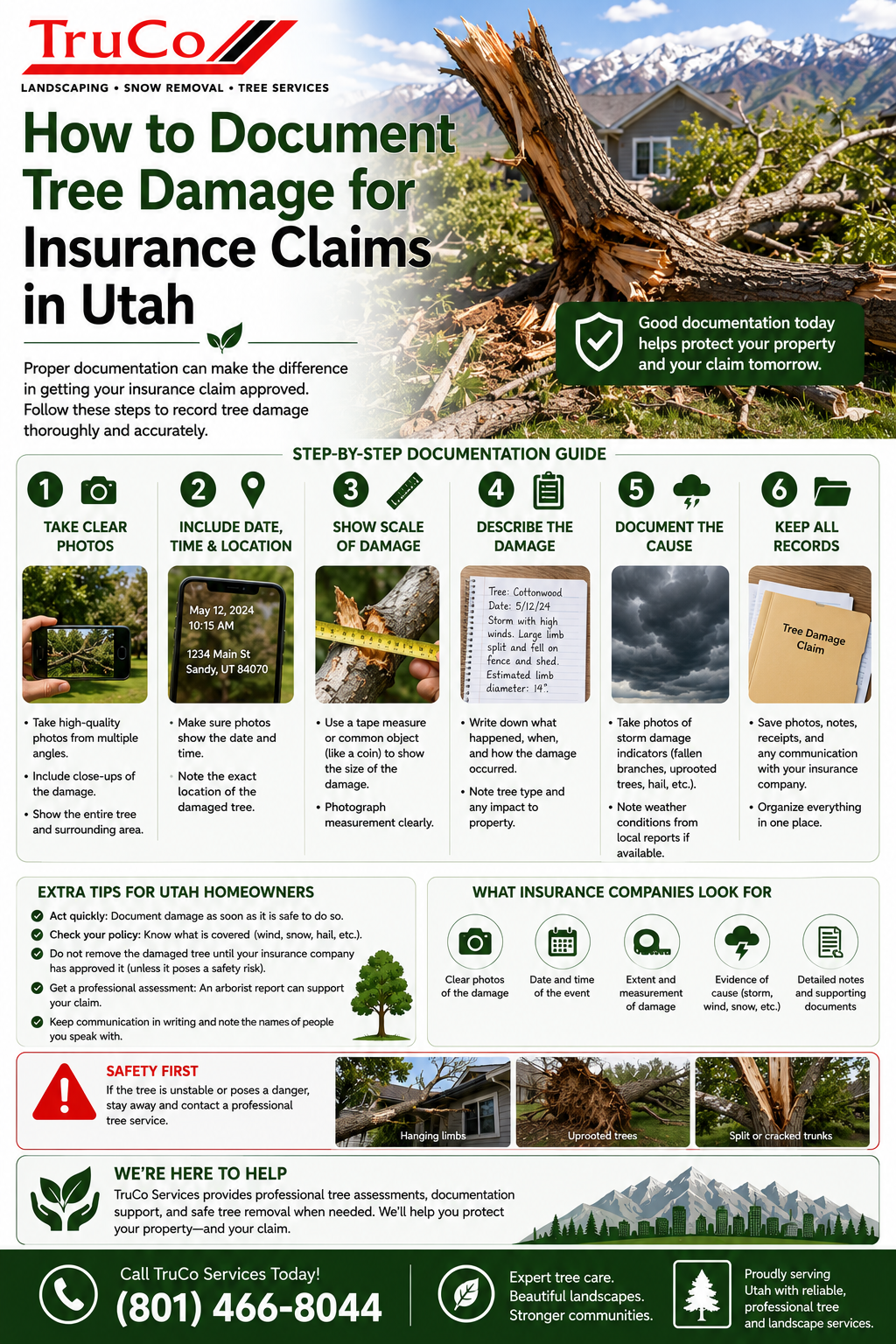
Why Proper Documentation Matters for Tree Damage Claims
When a tree falls on your home, vehicle, or property in Utah, your homeowner's or auto insurance policy may cover the damage — but only if you can properly document the incident. Insurance claims adjusters evaluate thousands of claims, and thorough documentation can mean the difference between full reimbursement and a denied or underpaid claim. Utah's severe weather — spring windstorms, heavy snow, and microbursts — causes millions in tree-related property damage annually. Many Utah homeowners miss out on legitimate claims because they fail to document damage properly. This guide walks you through every step of documenting tree damage for insurance claims in Utah, from immediate post-damage photos to working with adjusters and arborists. Understanding the process before you need it ensures you are prepared when tree damage strikes your property.
Immediate Steps After Tree Damage
The first few hours after tree damage are critical for documentation. First, ensure safety — if the tree has damaged your home or is near power lines, evacuate if necessary and call 911 for downed power lines. Do not approach damaged trees or structures that may be unstable. If it is safe, take photos before doing any cleanup or temporary repairs. Broad overview photos showing the entire scene — the tree, the damaged structure, and the surrounding area. Close-up photos of specific damage — cracks, breaks, root plate (the exposed root ball if the tree has uprooted), and impact points. Take photos from multiple angles. Document the tree itself — photos of the trunk, roots (if exposed), canopy, and any broken branches. Capture the species if identifiable. If it has been storming, take photos of weather conditions. If possible, take photos showing the tree before the damage — from your phone's camera roll, social media, or real estate photos. These are invaluable for showing the tree's condition before the incident. Do not begin cleanup, removal, or repairs until you have thorough documentation and have contacted your insurance company — unless the damage creates an immediate safety hazard.
What to Document: A Complete Checklist
Use this checklist to ensure complete documentation. Photos and video — overview shots of the entire scene; close-ups of damage from multiple angles; the tree's trunk, roots, and canopy; the damage to your property (house, vehicle, fence, etc.); any secondary damage (downed power lines, damaged landscaping); weather conditions at the time of damage; and pre-damage photos of the tree if available. Written documentation — date and time of the incident; weather conditions (wind speed, precipitation, temperature); description of how the damage occurred; condition of the tree before the incident (healthy, diseased, dead, etc.); any prior inspections or maintenance records; and contact information for witnesses. Professional documentation — certified arborist assessment of the tree and its condition before the incident; tree risk assessment if there were prior concerns about the tree; contractor estimates for tree removal and property repairs; and receipts for any temporary repairs or emergency services. Insurance documentation — your policy number and contact information; claim number after you file; adjuster's name and contact information; and copies of all correspondence with your insurance company. File everything together in a digital folder organized by category.
Working with Insurance Adjusters in Utah
Utah insurance adjusters will evaluate your claim based on your policy's coverage and the documentation you provide. When you contact your insurance company, have your policy number ready and describe the damage clearly. Ask what documentation they need and what their process is for tree damage claims. When the adjuster visits your property, be present if possible. Walk them through the damage and show them your documentation. Point out all areas of damage — even subtle damage like roof granule loss or cracked siding that may not be immediately obvious. Provide copies of all your documentation. If you disagree with the adjuster's assessment, you have options. Request a re-inspection — if you believe the adjuster missed damage or undervalued your claim. Hire a public adjuster — a licensed professional who advocates for you in insurance claims. Public adjusters charge a percentage of the claim (typically 10-20%) but often secure higher settlements. Get a second opinion from a contractor — independent contractor estimates can support your claim for repair costs. Contact the Utah Insurance Department (1-800-439-3805) if you believe your claim is being handled unfairly. The Department regulates insurance companies in Utah and can assist with disputes. Remember that insurance policies are contracts — your coverage depends on your specific policy language, not what you think should be covered. Read your policy carefully and ask your adjuster to explain any coverage questions.
Understanding Utah Homeowner's Insurance and Tree Damage
Utah homeowner's insurance policies typically cover tree damage in specific circumstances. Coverage for damage to structures — most policies cover damage to your home, garage, and other structures caused by a falling tree, minus your deductible. Coverage for tree removal — most policies cover $500-$1,000 for tree removal from the insured structure, but coverage varies widely. Some policies pay nothing for debris removal beyond the damaged structure. Coverage for the tree itself — most policies do not cover the value of the tree itself. The tree is considered landscaping, which typically has limited or no coverage. Coverage for landscaping — some policies have a sub-limit for landscaping damage (typically 5-10% of the home coverage amount, or $500-$2,000 per tree). Coverage for falling tree caused by neglect — if your tree falls because it was dead or diseased and you knew about it, your claim may be denied. This is why pre-damage documentation of tree health is important. Coverage for neighbor's tree damaging your property — your neighbor's liability insurance should cover damage if their tree falls on your property. However, if the tree was healthy and the fall was caused by an "act of God" (storm), your own insurance covers the damage. Coverage in Utah follows a "fault" standard — if your neighbor was negligent (knew the tree was hazardous and did nothing), their insurance pays. If the tree was healthy and fell due to a storm, your insurance pays. Deductibles — standard homeowner's deductibles in Utah range from $500-$2,500. Factor this into your claim decision — if damage is below your deductible, filing a claim may not make sense.
When to Hire a Certified Arborist for Insurance Claims
A certified arborist can provide crucial documentation for insurance claims involving tree damage. An arborist assessment can determine whether the tree was healthy or defective before failure — this is critical for establishing liability. The arborist examines the tree's root system, trunk, branch structure, and failure point to determine the cause of failure. Arborists identify pre-existing conditions — decay, cracks, root damage, pest infestations, or other defects that may have contributed to failure. An arborist report documenting these findings provides objective, professional evidence for your insurance claim. In Utah, arborist assessments are particularly important because our clay soil and weather patterns create specific failure modes — root plate failure in saturated clay soil, snow load breakage, and windthrow in shallow-rooted trees. An arborist familiar with Utah conditions can provide the most relevant assessment. Arborist reports typically cost $200-$600, depending on complexity. This is often a worthwhile investment for claims over $5,000. The cost may be recoverable as part of your claim. Provide the arborist report to your insurance adjuster along with your other documentation. If your claim goes to litigation, the arborist may serve as an expert witness.
Common Tree Damage Claim Scenarios in Utah
Several tree damage scenarios are common in Utah. Storm damage from wind — Utah's spring windstorms can uproot trees or snap trunks. Document the storm (weather reports, photos) and the damage. Insurance typically covers this as an "act of God." Heavy snow damage — wet snow accumulating on branches causes breakage. Document the snow event and the damaged branches. Note that gradual snow accumulation (over days) may be treated differently than a sudden storm — check your policy. Uprooting in saturated soil — Utah's clay soil becomes very slippery when wet, and trees can uproot during spring rains. Document soil conditions. Root failure may require an arborist to determine if roots were compromised before the storm. Tree falls on a vehicle — if your tree falls on your parked car, your auto insurance's comprehensive coverage pays (not your homeowner's). If your neighbor's tree falls on your car, their homeowner's liability or your auto comprehensive covers it. Neighbor's tree damages your fence — typically covered by your homeowner's policy for the fence, minus deductible. Pre-existing condition claim denial — if your insurance denies a claim because the tree was dead or diseased before the storm, documented arborist inspections and maintenance records are your best defense. Utah's statute of limitations for insurance claims varies — file promptly after damage occurs, as delays can jeopardize your claim.
Preventing Tree Damage Claims with Regular Maintenance
The best way to handle tree damage claims is to prevent them through regular maintenance. Annual inspections by a certified arborist identify hazardous trees before they fail. In Utah, annual inspections are recommended for all trees near structures, with more frequent inspections for high-risk species (cottonwoods, silver maples, large poplars). Address problems identified in inspections promptly — deadwood removal, cabling weak branches, removing hazardous trees, and treating pest infestations. Document all maintenance with dated receipts, inspection reports, and photos. This documentation serves two purposes: it reduces your risk of tree failure, and it demonstrates you were not negligent if a tree fails despite your efforts. Keep a tree care log for your property — note when trees were planted, pruned, inspected, treated, and removed. This log is invaluable for insurance purposes. In Utah, proactive tree maintenance is especially important given our challenging climate. Trees stressed by drought, alkaline soil, and extreme weather are more likely to fail. A healthy, well-maintained tree is your best insurance against tree damage claims. The cost of annual inspections ($150-$400) is far less than the cost of a single tree damage claim, which can easily exceed $10,000-$50,000 for major damage to your home.
Frequently Asked Questions
Does homeowner's insurance cover tree removal after a storm in Utah? Most policies cover removal of trees that have damaged insured structures (your home, garage). Coverage for trees that fall without damaging structures is typically limited or not covered. Check your policy — typical limits are $500-$1,000 per tree for removal from the structure.
What if my neighbor's tree falls on my house in Utah? If the tree was healthy and fell due to a storm, your homeowner's insurance covers the damage. If your neighbor was negligent (knew the tree was hazardous), their liability insurance covers it. An arborist assessment may be needed to determine the tree's pre-storm condition.
How long do I have to file an insurance claim for tree damage in Utah? File as soon as possible — ideally within 24-48 hours. Utah law requires insurers to acknowledge claims within 15 days, but filing promptly prevents disputes about when damage occurred. Most policies require prompt notice of loss. Delays can jeopardize your claim.
Will my insurance rates go up if I file a tree damage claim? Possibly. Single claims may not affect rates significantly, but multiple claims can. Consider the claim amount versus your deductible — if damage barely exceeds your deductible, paying out of pocket may be better than filing a claim. Ask your agent about rate impact before filing.
Do I need a separate policy for tree damage in Utah? Most standard homeowner's policies cover tree damage to structures. However, some Utah policies exclude certain types of tree damage (especially in wildfire-prone areas or for certain high-risk tree species). Review your policy with your agent to understand your specific coverage.
What if my tree falls on a public road in Utah? If your tree falls on a public road, contact your city or county public works department immediately. Your homeowner's liability may cover damage to public property. If the tree was healthy and fell due to a storm, the government agency typically handles removal. If the tree was hazardous and you knew it, you may be liable.